
Alabama has drawn a hard line against those who prey on the state's youngest residents.
On February 16, 2026, Governor Kay Ivey signed the Child Predator Death Penalty Act into law, making Alabama one of only a handful of states in the nation that authorizes capital punishment for certain sexual offenses committed against children.
The new legislation sends a stark message: adults who commit the most horrific sexual crimes against children under 12 years old in Alabama now face the possibility of a death sentence.
What the New Law Does
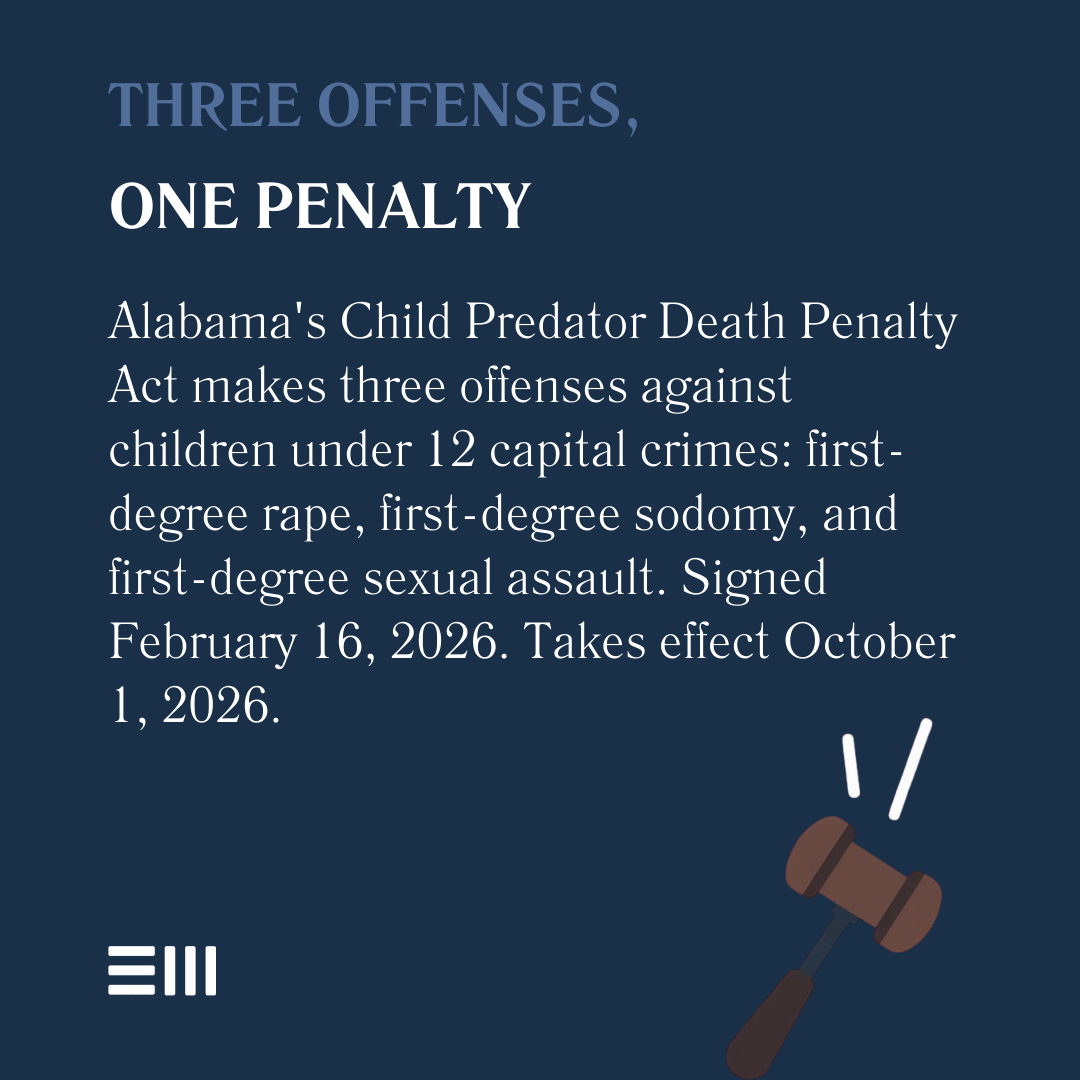
The Child Predator Death Penalty Act elevates three specific offenses to capital crime status when the victim is younger than 12 years old.
Under the legislation, the following crimes now carry the potential for a death sentence in Alabama:
- First-degree rape of a child under 12, which previously carried a maximum sentence of life imprisonment.
- First-degree sodomy of a child under 12, now reclassified as a capital offense under the new statute.
- First-degree sexual assault of a child under 12, completing the trio of charges that qualify for the ultimate penalty.
The law is set to take effect on October 1, 2026, giving prosecutors and courts time to prepare for its implementation.
The Case That Fueled the Push
While legislative efforts to strengthen penalties for crimes against children have surfaced in Alabama before, a 2025 case in Bibb County gave this particular bill undeniable momentum.
In that case, eight individuals were arrested and charged with rape, trafficking, and sexual torture involving at least 10 children — some as young as three years old.
The sheer brutality of the Bibb County case sent shockwaves through the state and intensified public demand for harsher consequences. Lawmakers pointed to that investigation as a driving force behind the legislation.
Governor Ivey addressed the signing directly, framing it as long-overdue protection for Alabama's most defenseless citizens.
"For too long, the most vulnerable of our society have lacked the most stringent legal protection from child predators," Ivey said in a statement.
"Through the Child Predator Death Penalty Act, Alabama now joins just a handful of states imposing the toughest penalty possible for child predators. Those who target the youngest among us for the vilest crimes will soon be met with the harshest punishment under the law."
Bipartisan Support in the Legislature
The bill was co-sponsored by State Representative Matt Simpson, R-Daphne, and State Senator April Weaver, R-Brierfield. Both legislators expressed strong conviction that the law reflects the gravity of the crimes it targets.
Simpson emphasized the significance of the governor's signature, calling it a decisive moment for the state.
"With the signing of the Child Predator Death Penalty Act into law, Alabama has taken decisive action to ensure that the most horrific offenses committed against minors face the maximum punishment our legal system permits," Simpson said.
"This law sends a clear message that we will not stand by while young lives are shattered."
Senator Weaver echoed those sentiments, framing the legislation as a zero-tolerance stance against child abuse.
"With the signing of the Child Predator Death Penalty Act, we are putting these sick individuals on notice that a cell on death row awaits them if they abuse the most innocent and defenseless among us," Weaver said. "Alabama now has zero tolerance for those who prey on our children."
Where Alabama Stands Nationally
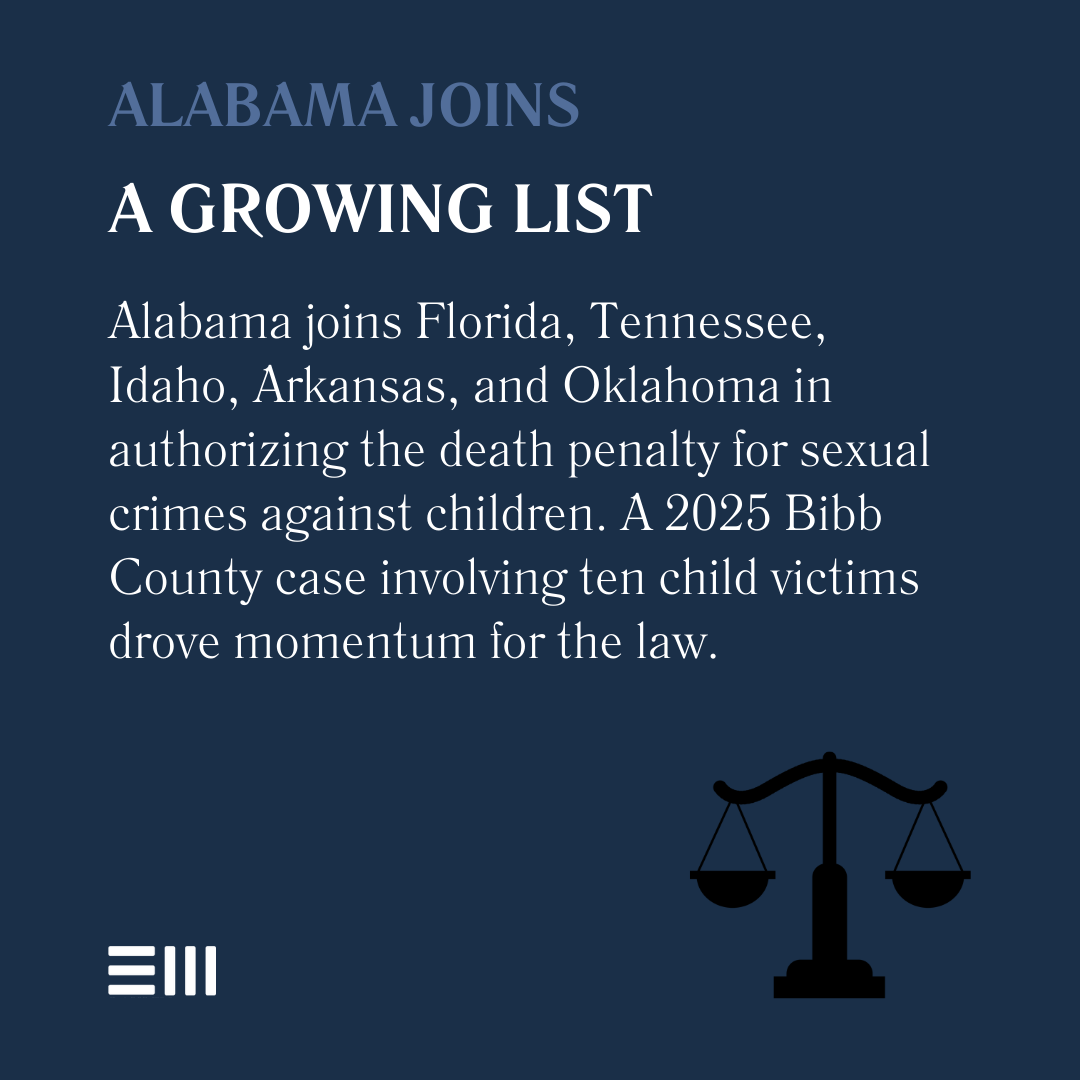
With the signing of this law, Alabama joins a small but growing group of states that have enacted similar measures. Florida, Tennessee, Idaho, Arkansas, and Oklahoma have all previously passed legislation authorizing capital punishment for certain sexual crimes committed against minors.
The legal landscape around these laws remains complex at the national level. The U.S. Supreme Court ruled in Kennedy v. Louisiana (2008) that the Eighth Amendment prohibits the death penalty for crimes against individuals that do not result in — and were not intended to result in — death.
However, several states have moved forward with these statutes in recent years, and legal challenges are widely expected as cases arise under the new laws.
For Alabama families, the immediate takeaway is clear: the state has signaled its intent to pursue the most aggressive penalties available against those who harm children.
How Alabama Law Protects Children and Families
Alabama's legal system offers multiple avenues of protection for children and families affected by abuse, neglect, or exploitation.
Beyond the criminal justice system, family courts play a critical role in ensuring that children are placed in safe environments through child custody and guardianship proceedings.
When a child's safety is at stake, the legal decisions that follow can shape the rest of that child's life. Custody determinations, protective orders, and adoption proceedings all carry enormous weight in these situations.
Having the right legal representation can make the difference between a child remaining in a dangerous environment and being placed somewhere safe and stable.
Our experienced family law attorneys here at Baxley Maniscalco have spent years advocating for families and children across Alabama. We understand the urgency these cases demand, and we are committed to fighting for outcomes that protect the people who matter most.
When Your Family Needs an Advocate
Whether you are navigating a custody dispute, seeking a protective order, or exploring adoption to provide a child with a safe and loving home, you deserve an attorney who treats your case with the seriousness it requires.
Contact Baxley Maniscalco today to schedule a consultation with our team.