Alabama's court system is sounding the alarm.
Without a significant increase in state funding for the upcoming fiscal year, the Unified Judicial System warns that courthouses across the state could face staff layoffs, mounting case backlogs, and serious delays in both criminal and civil proceedings.
The stakes are high for every Alabamian who depends on the courts — from families navigating divorce and custody disputes to individuals pursuing personal injury claims. A slower court system means longer waits for the resolutions that families and individuals urgently need.
The Funding Gap
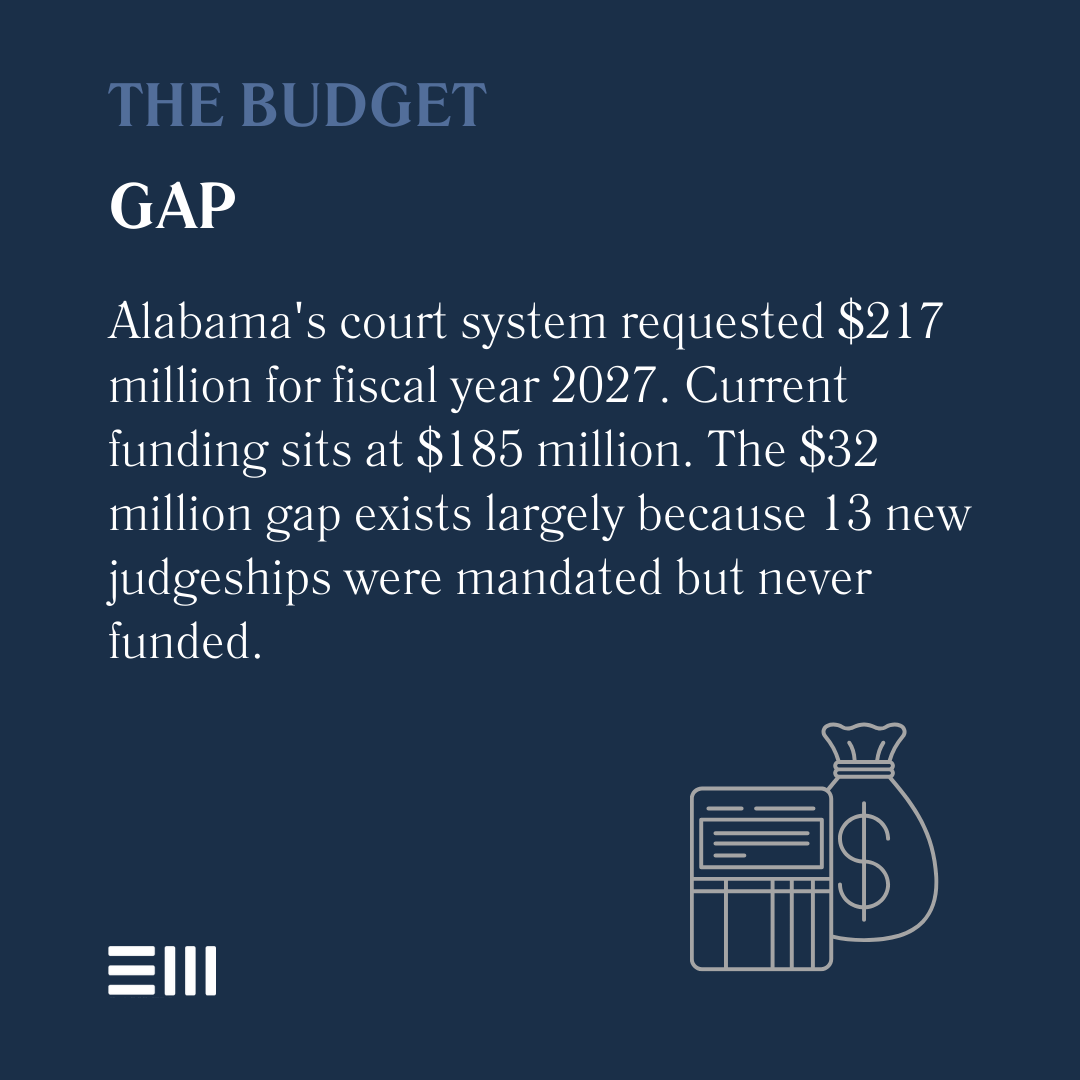
Alabama's Unified Judicial System has requested $217 million from the state General Fund for fiscal year 2027, which begins on October 1, 2026. That figure represents a 17 percent increase over the current year's appropriation of $185 million — a difference of roughly $32 million.
A major driver behind the request is a mandate the Legislature itself created.
Three years ago, lawmakers authorized 13 new judgeships based on the recommendations of the state's Judicial Resources Allocation Commission, a body the Legislature established to identify where growing caseloads demanded additional judicial resources.
Seven of those judgeships were filled in January 2025, and the remaining six will appear on the 2026 ballot, with those judges taking office in January 2027.
The problem is straightforward: the Legislature required the new positions but has not yet appropriated the money to fund them.
Governor Kay Ivey's budget recommendation for the courts calls for level funding — essentially the same dollar amount as this year — mirroring her approach across most of state government.
What Level Funding Would Mean
Alabama Supreme Court Chief Justice Sarah Stewart has been direct about the consequences if the court system does not receive additional appropriations.
"Without the requested increase, Alabama courts would face staff cuts, worsening case delays, and significant disruptions in day-to-day operations statewide," Stewart said.
Because the judgeships are created by statute, the court system is legally obligated to fund them regardless of whether new money arrives.
That means the Administrative Office of Courts would have to redirect existing funds — money currently used to pay other employees — to cover the new judges and their staff.
"This creates a shortfall that could result in the difficult decision to lay off non-statutory employees," Stewart said.
Personnel costs consume nearly the entire judicial budget, leaving almost no room to absorb the new expenses without cutting positions elsewhere. The chief justice warned that fewer support staff would trigger a cascade of operational problems throughout the system.
"Fewer staff would mean slower case processing, growing criminal and civil backlogs, delays in trials and sentencing, and other procedural delays," Stewart said.
"As courts prioritize criminal matters, wait times in civil cases like, divorces, custody disputes, and debt collection matters, would increase even further."
A Difficult Budget Year Across the Board
The court system's funding request arrives during a challenging fiscal environment for Alabama as a whole. State revenues have plateaued after several years of growth that were largely fueled by federal pandemic-era funds and the interest earned on that money.
Executive branch agencies collectively requested $3.7 billion from the General Fund for the coming year — 12 percent more than the current appropriation. The governor's recommendation came in at $3.2 billion, reflecting a 2 percent cut.
Lawmakers are also keeping one eye on the future. Starting in 2028, Alabama could face up to $200 million in additional annual costs for the Supplemental Nutrition Assistance Program (SNAP), which serves more than 700,000 residents, as a result of changes under President Trump's One Big Beautiful Bill Act.
Against that backdrop, finding $32 million for the courts is no small ask — but key legislators have expressed a willingness to try.
Senator Greg Albritton, R-Atmore, who chairs the Senate General Fund budget committee, acknowledged the challenge while signaling his intent to find a path forward.
"I'm trying my best to find a way to keep the judiciary whole," Albritton said.
Representative Rex Reynolds, R-Huntsville, chairman of the House Ways and Means General Fund committee, pointed to a potential silver lining. January revenue receipts came in above expectations, and additional reports due before the final budget vote this spring could improve the outlook.
"If the funding is there, I would like to make them whole," Reynolds said.
Why This Matters for Alabama Families
Court delays are not an abstract policy problem. They have real consequences for real people. A parent waiting months for a custody ruling lives in limbo.
A family unable to finalize an estate matter faces prolonged uncertainty during an already difficult time. An individual injured in a car accident who cannot get a trial date may struggle to cover medical bills and lost wages while their case sits in a growing queue.
When the court system slows down, the people who suffer most are the ones who depend on it for resolution and justice.
That reality makes effective legal representation more important than ever. Having an attorney who understands how to move cases forward efficiently — even in a strained system — can be the difference between a timely outcome and an indefinite wait.
Let Our Team Fight for You
Our experienced personal injury and family law attorneys here at Baxley Maniscalco know how to advocate for our clients even in challenging court environments.
If you are facing a legal matter that cannot afford to wait, contact us today for a consultation.