
A 2025 CDC survey found that roughly 1.63 million American middle and high school students reported current e-cigarette use. For Alabama lawmakers, that figure has landed squarely at the center of the state's latest public health decision.
On April 15, 2026, Governor Kay Ivey signed Senate Bill 9 into law, making Alabama one of a growing list of states that treat vaping the same way it treats cigarette smoking in enclosed public spaces. The new Alabama vaping law takes effect on October 1, 2026.
For residents, business owners, and anyone who has wondered whether someone's vape cloud in a restaurant was legal, the answer is about to get clearer.
What Senate Bill 9 Actually Changes
The new Alabama vaping law does not create an entirely new statute. It modifies an existing one in a targeted way, and the practical effect is significant.
- Expanded definition of smoking. The law adds electronic nicotine delivery systems to the existing definition of smoking under the Alabama Clean Indoor Air Act.
- Expanded list of restricted spaces. Vaping is now prohibited wherever cigarette smoking has been banned since 2003.
- Renamed statute. The Alabama Clean Indoor Air Act is now formally known as the Vivian Davis Figures and Barbara Drummond Clean Indoor Air Act.
Together, these changes close a gap that had existed in state law since vape products became widespread. The core structure of the statute remains the same.
Where Vaping Is Now Prohibited
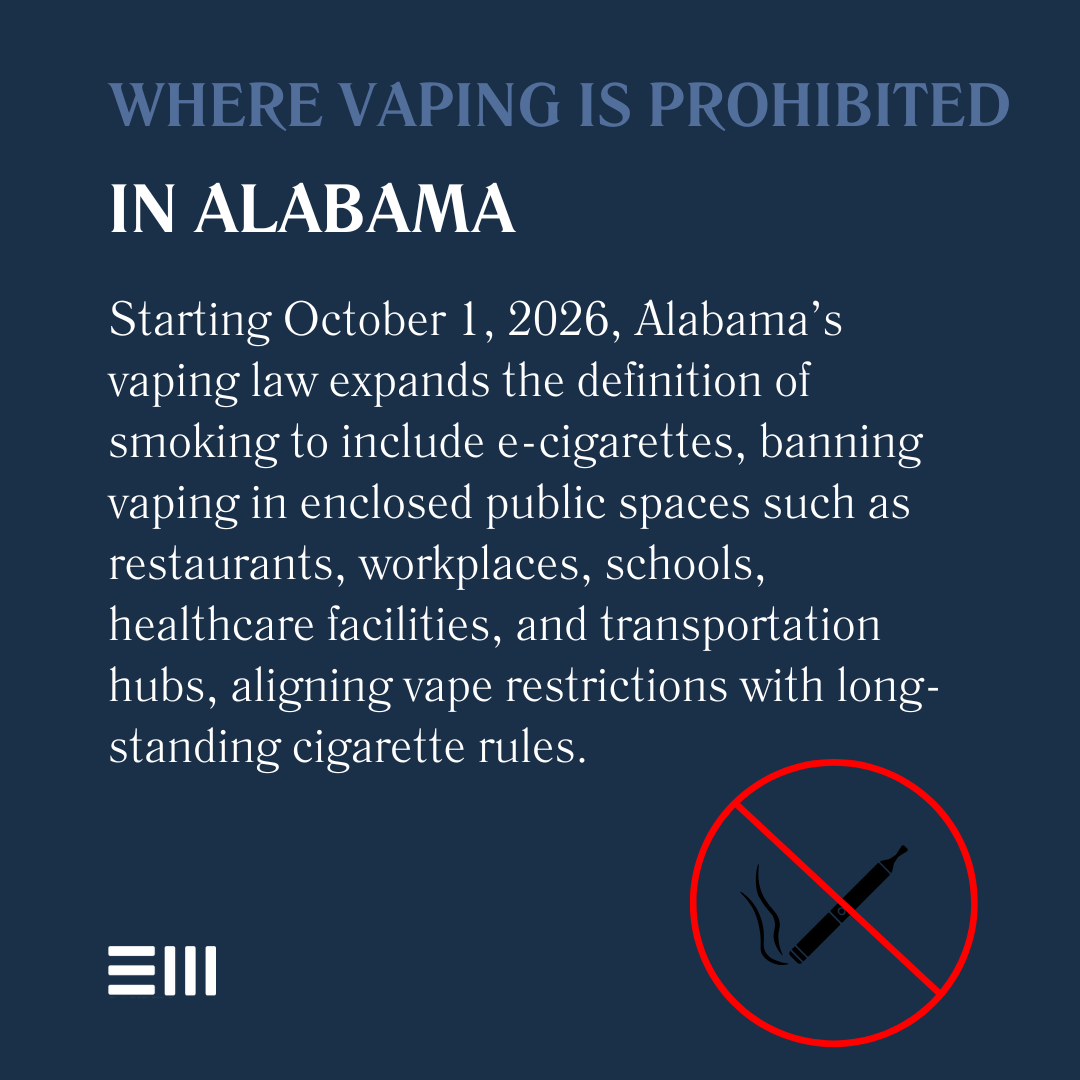
Understanding which locations fall under the new Alabama vaping law helps explain how daily life will shift after October 1. The law targets enclosed public spaces rather than outdoor or private areas.
- Restaurants and retail spaces. Most enclosed dining establishments and retail stores.
- Healthcare and government buildings. Hospitals, nursing homes, doctor's offices, and government facilities.
- Transportation hubs. Airports, bus stations, and elevators.
- Workplaces with five or more employees. Common work areas are included.
- Schools and school-sponsored events. Grades K through 12 fall under the act.
Private homes and most outdoor spaces remain outside the reach of the state law. Alabama cities with stricter ordinances may impose broader restrictions.
What Violators Face
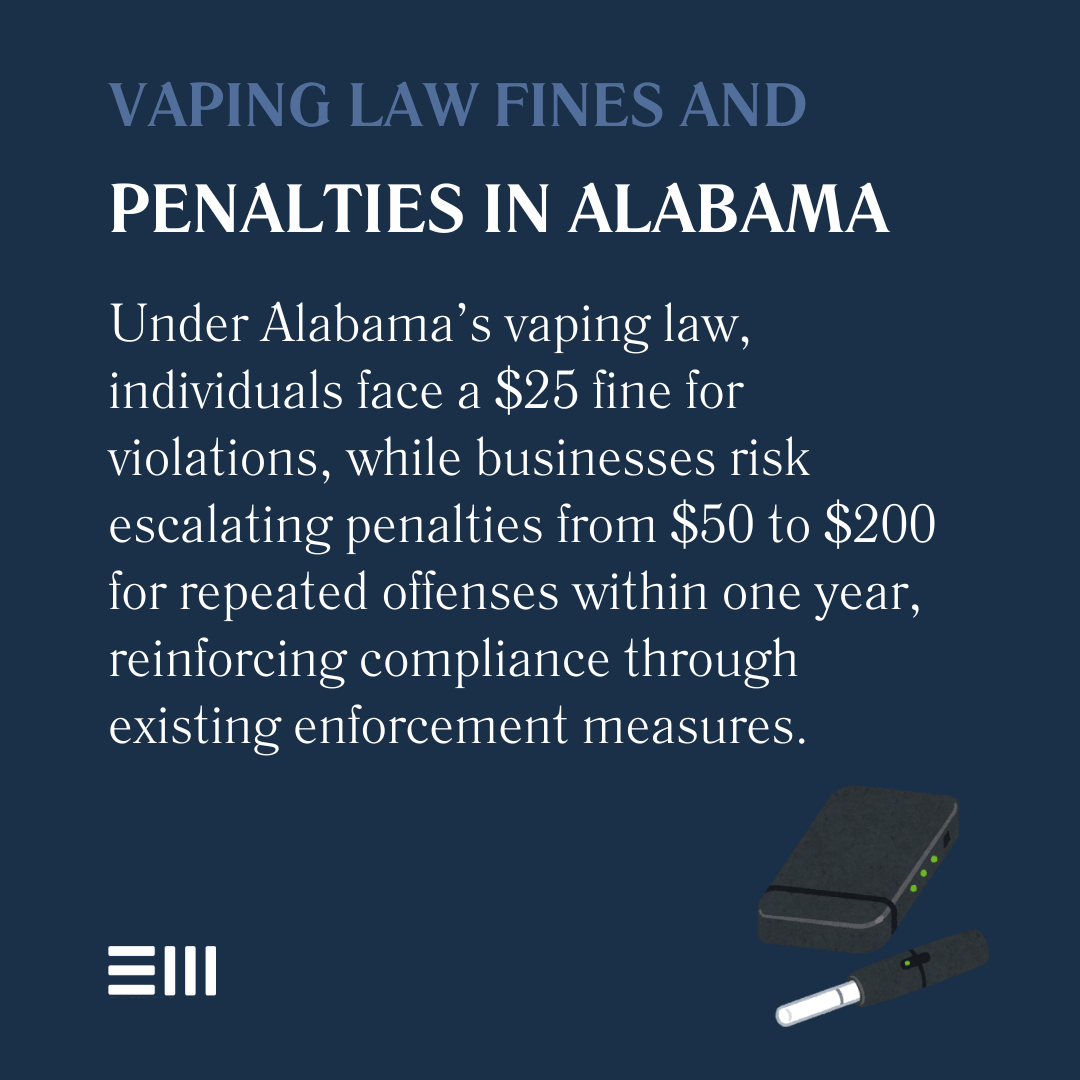
SB9 does not invent a new penalty structure. Instead, the existing civil fines that applied to cigarette smoking now apply equally to vaping. The framework is modest in dollars but real in effect.
- Individual violation. A person who vapes in a restricted space may receive a $25 civil fine from law enforcement.
- First business violation. A business that permits vaping in a restricted space may face a $50 fine for a first offense.
- Second business violation. A repeat offense within one year can carry a fine of up to $100.
- Third and subsequent business violations. Further offenses within a one-year window can bring fines of up to $200.
Municipalities may add their own penalties on top of the state fines. For business owners, the smart move is to update signage and staff training well before October 1.
Why the Law Was Renamed
SB9 honors two Alabama lawmakers who shaped the state's clean air policy. The renaming was added to the bill during the House floor debate and received bipartisan support.
Senator Vivian Davis Figures of Mobile spent nearly six years working to pass the original Clean Indoor Air Act in 2003.
Representative Barbara Drummond, also of Mobile, later sponsored a separate 2024 bill that tightened rules on vape product sales and banned fruit and candy flavored vapes at convenience stores.
The renaming recognizes their sustained advocacy across two decades of tobacco control efforts in the state.
What Business Owners Need to Do Before October 1
For Alabama businesses, the new vaping law brings a short but important to do list. Preparing ahead of the effective date helps avoid fines and complaints.
- Update your signage. Existing No Smoking signs should reflect that vaping is also prohibited.
- Revise written policies. Employee handbooks and customer notices should be updated.
- Train your staff. Employees should know how to politely inform customers that vaping is not permitted on the premises.
- Know the complaint process. The Alabama Department of Public Health issues notices of violation before fines are imposed, giving you time to come into compliance.
Getting these pieces in place well before October 1 reduces the risk of a violation. It also helps protect your business from complaints filed by employees or customers concerned about secondhand aerosol exposure.
Frequently Asked Questions About Alabama's Vaping Law
Many residents and business owners still have questions about how the new Alabama vaping law will work in practice. Here are some of the most common ones.
What Is the Effective Date of the New Law?
Senate Bill 9 takes effect on October 1, 2026. Enforcement begins that day.
Does This Apply to Outdoor Patios and Smoking Areas?
The Alabama Clean Indoor Air Act focuses on enclosed public spaces. Outdoor patios are generally not covered by the state law, but many cities have local ordinances that impose stricter rules.
Are Vape Shops Exempt?
Some retail establishments that primarily sell tobacco and vape products may be treated differently under local ordinances. Check with your municipality for specific rules.
What About Private Offices and Homes?
Private residences are not covered by the statute. Private offices are typically covered if they are part of a workplace with five or more employees.
Who Enforces the Law?
The Alabama Department of Public Health oversees enforcement. Local law enforcement officers may also issue citations for individual violations.
Can Businesses Face Larger Penalties Than the State Fine?
Yes. Some Alabama municipalities have local ordinances with additional penalties on top of the state fines.