

For an Alabama family dealing with the aftermath of a violent crime, the first twelve months can pass in a fog.
Between medical appointments, court dates, funerals, and the quiet work of trying to survive the emotional weight of what happened, the paperwork needed to apply for state financial assistance often gets lost in the shuffle.
By the time many victims learn that help is available, the window to apply has already closed.
That’s been the reality in Alabama for decades. Under current state law, crime victims and their families have exactly one year from the date of the incident to apply to the Alabama Crime Victims Compensation Commission for financial help. One missed deadline has meant one lost lifeline.
That reality is about to change.
On Tuesday, April 7, 2026, the Alabama Senate voted 33-0 to pass House Bill 255, legislation that doubles the application window from 1 year to 2 years. The bill had already cleared the House on a 101-0 vote back on February 3, 2026.
It now heads to Governor Kay Ivey for her signature, and for the victims’ advocates who have been pushing for this change for years, the unanimous votes sent exactly the message they had been hoping for.
What House Bill 255 Actually Does
HB 255 is a short bill with a specific purpose. Sponsored by Representative Russell Bedsole, R-Alabaster, the legislation extends the filing deadline for compensation claims submitted to the Alabama Crime Victims Compensation Commission, also known as the ACVCC.
Under existing Alabama law, victims of violent crimes and the families of those killed by violent crimes must apply to the ACVCC within one year of the date the crime occurred. Miss that window and the compensation is gone, regardless of the circumstances.
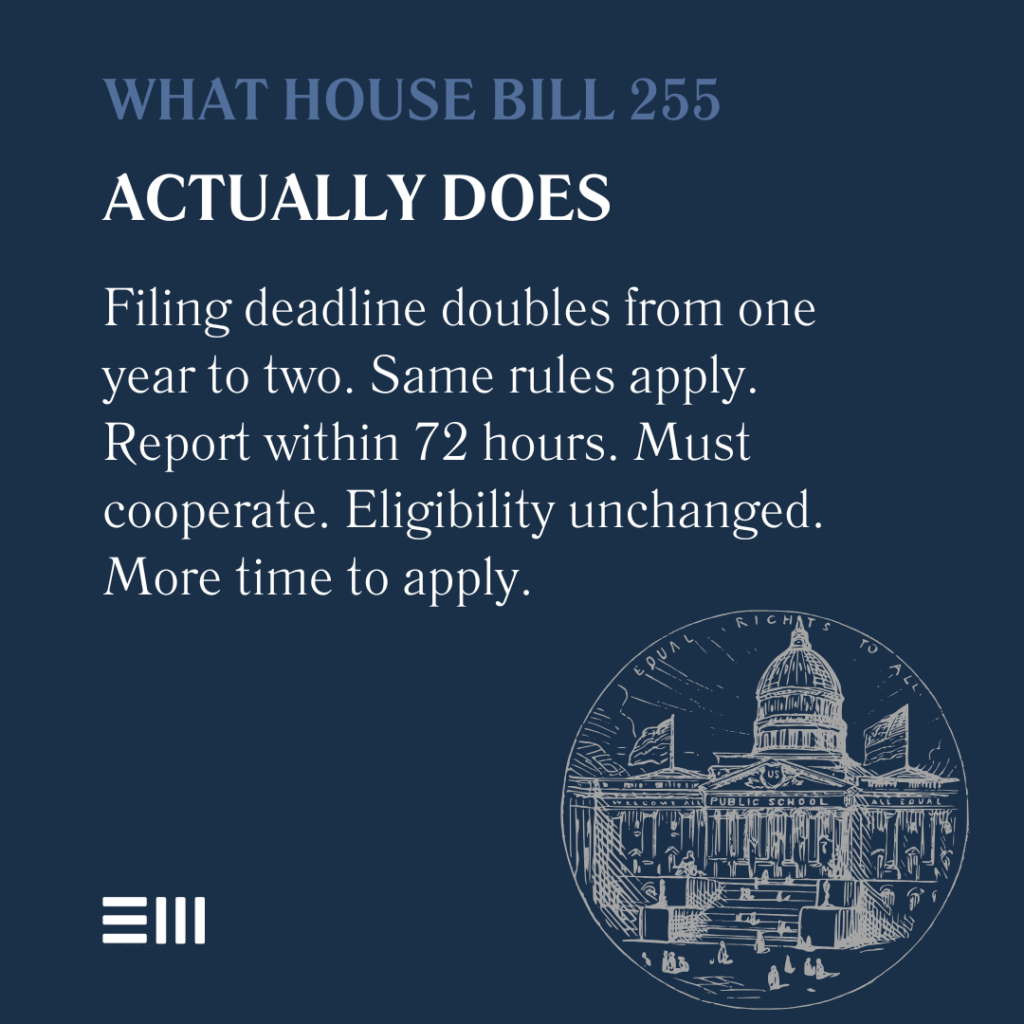
HB 255 changes that single number. One year becomes two years. Everything else about the program stays exactly as it was.
What the bill changes and what it leaves alone
Crime victim advocates have been careful to explain that HB 255 is a targeted amendment rather than a full rewrite of the ACVCC statute. The eligibility rules, reporting requirements, and program structure all remain intact.
- The filing deadline doubles. Victims now have 24 months rather than 12 to submit a completed application.
- The 72-hour reporting rule stays. Victims still must report the crime to law enforcement within 72 hours of the incident to remain eligible.
- Cooperation requirements are unchanged. Applicants must still comply with and cooperate in the criminal investigation.
- Ineligibility rules remain. Petitioners who were involved in the crime for which they are seeking compensation are still barred from receiving funds.
These existing guardrails are why advocates describe the extension as a minor fix with a major human impact. Nothing about who qualifies or what they have to do changes.
The only thing that changes is how much time they have to complete the process.
Why a Single Year Was Never Enough
To understand why this extension matters, you have to understand what that first year after a violent crime actually looks like for the people living through it.
Representative Bedsole put it plainly during a February 2026 rally at the Alabama State Capitol, where more than 200 crime survivors and family members gathered to urge lawmakers to pass the bill.
“I am carrying this bill because sorry isn’t a strategy and a deadline shouldn’t be a barrier to healing,” Bedsole said.
Victim advocates have spent years documenting what happens in the first twelve months after a violent crime. Trauma responses freeze people in place.
Families dealing with the loss of a child or spouse often don’t learn about the ACVCC until well into the grieving process. Some victims are still in the hospital or still navigating the criminal case against their attacker when the one-year clock runs out.
Shelly Linderman, director of the Wiregrass Angel House in Dothan, told WTVY in March 2025 that the current deadline has been a problem for a long time.
She said many crime victims spend the first year numb and unsure where to turn for help, and by the time they realize compensation is available, it is often too late to apply.
HB 255 was designed to meet victims where they actually are rather than where a rigid timeline expects them to be.
A Commission That Has Already Been Transformed
The timing of HB 255 matters in part because it lands at the end of a multi-year overhaul of the ACVCC itself.
The agency looked very different just three years ago. In 2023, crime victims and their families protested outside ACVCC offices over application backlogs that had kept some applicants waiting months or even years for compensation they had already been approved to receive.
The backlogs were driven by staffing shortages, which in turn were driven by declining revenues from the fines and fees that historically funded the agency.
In response, Alabama lawmakers began directly appropriating money from the state budget to the ACVCC in 2023. That change helped cut the backlog and stabilize the agency. For the coming fiscal year, lawmakers have approved another $1.6 million in direct funding for the commission.
Key numbers behind the ACVCC’s four-year transformation
The shift from a fee-based funding model to a legislatively appropriated one has changed what the agency can actually do for Alabama families. A few figures help illustrate the scale of the change.
- 2023 marked the turning point. Direct legislative appropriations replaced the commission’s previous reliance on declining fine and fee revenue.
- $1.6 million is the next installment. Lawmakers have committed this amount to the ACVCC for the upcoming year.
- One year became two. HB 255 extends the filing window, expanding who can realistically access the funds that are now available.
Taken together, these changes mean the ACVCC has both more money to distribute and more time for victims to claim it.
For a program that was struggling to meet demand as recently as 2023, that combination represents a significant shift in how Alabama supports the people affected by violent crime.
What ACVCC Compensation Covers and What It Doesn’t
For Alabama families unfamiliar with the commission, understanding what ACVCC compensation is actually for can help clarify why this deadline extension matters.
The ACVCC was established by the Alabama Legislature on June 1, 1984. It provides financial assistance to victims of violent crime for specific expenses related to the crime itself.
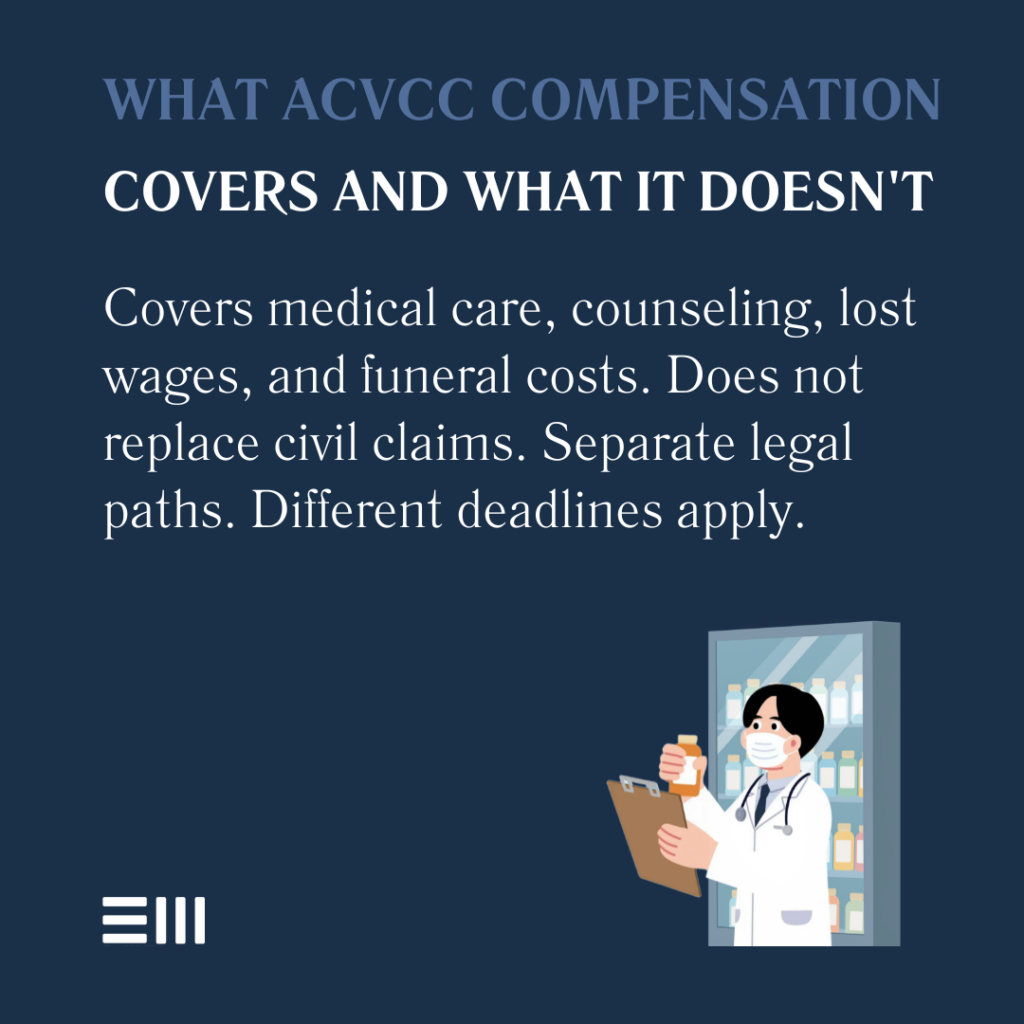
These include medical bills, counseling and mental health services, lost wages, loss of financial support for dependents, and funeral and burial costs for victims who did not survive.
What the ACVCC does not do is replace the civil legal claims that crime victims and their families may also have the right to pursue.
A victim of a violent crime may be eligible for ACVCC compensation while also pursuing a separate civil wrongful death claim against the perpetrator, or a personal injury claim against a third party whose negligence contributed to the crime, such as a property owner who failed to provide reasonable security.
These are parallel paths, not competing ones.
That distinction matters because the deadlines are different for each path. HB 255 changes the ACVCC deadline to two years.
Alabama’s separate civil wrongful death and personal injury deadlines are governed by different statutes of limitation and often have their own strict timelines.
Knowing which deadline applies to which claim is one of the first conversations a family should have with an attorney after a violent crime.
If a Violent Crime Has Turned Your Family’s Life Upside Down
The passage of HB 255 is good news for Alabama crime victims, but it does not replace the need for careful, individualized legal guidance after a violent crime has occurred.
Between ACVCC applications, potential civil claims, guardianship questions for surviving children, and estate matters for loved ones who did not survive, the legal landscape after violent crime is not something most families should try to navigate alone.
Our experienced personal injury attorneys here at Baxley Maniscalco have stood beside Alabama families through some of their most painful moments.
When the worst has already happened, our role is to carry the legal weight so your family can focus on healing.
Call (256) 770-7232 to speak with our team about your situation, or reach out through our contact form to schedule a consultation.
Can't find what you're looking for? Search our site below.