

The other driver’s insurer offers its entire policy limit. After weeks of appointments and missed work, the check sounds like progress.
But the release could affect your right to underinsured-motorist benefits. The order in which you notify, agree, and sign matters.
Alabama’s settlement process gives your insurer time to protect its rights. Skipping it can trigger a coverage dispute when you need additional compensation.
Our personal injury attorneys review the proposed release alongside potential UIM coverage. We help you distinguish a policy limit from what your car accident claim may be worth.
Before accepting an offer, ask whether it could compromise another source of recovery.
Have a settlement offer to review? Contact us for a free personal injury consultation or call (256) 770-7232.
A Policy-Limits Offer Is Not the Same as Full Compensation
A liability policy limit describes the insurer’s available contractual coverage, not necessarily the value of your injuries.
Surgery, future care, lost earnings, and lasting limitations may exceed the amount one policy can pay.
An offer of the full limit does not establish the value of the claim or prove that no other responsible party or policy exists.
Under Alabama Code § 32-7-23, the definition of an uninsured vehicle includes certain vehicles whose available bodily-injury liability limits fall below legally recoverable damages.
This is the basis for underinsured-motorist coverage, commonly called UIM.
Coverage is not automatic in every accident. The policy must cover the claimant and loss, and applicable limits and defenses still matter.
The first review should identify the available liability insurance and potential UIM coverage—not assume that the policy on your own vehicle is the only relevant contract.
Our guide to what an Alabama car accident case may be worth explains the broader damages analysis.
A policy-limits offer answers a narrower question: what that insurer is offering to pay in exchange for a release.
Why Your Own Insurer Has a Say in the Release
A release generally gives up claims described in the agreement against the people or entities it covers.
If you release the at-fault driver, your UIM insurer may lose an opportunity to pursue that driver for amounts the insurer later pays above the liability limits.
That interest is commonly called subrogation.
Consent-to-settle provisions are intended to protect that interest and guard against improper arrangements between claimants and liability insurers.
Alabama does not treat every such provision as meaningless simply because the other insurer has offered its limits.
In Lambert v. State Farm, the Alabama Supreme Court established guidelines for protecting the insured’s opportunity to settle and the UIM carrier’s rights.
The central lesson is straightforward: involve the UIM carrier before agreeing to a settlement that releases the driver, not after the paperwork is complete.
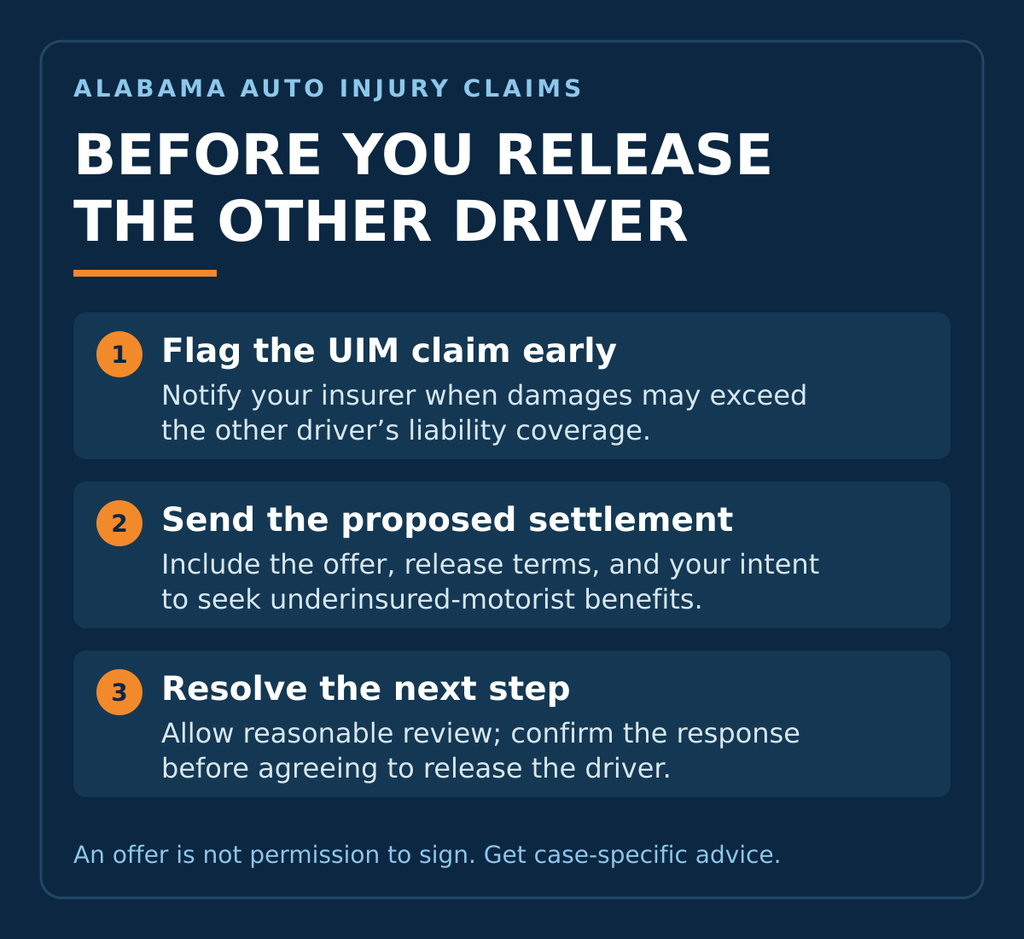
What to Send Before Agreeing to Settle
Lambert calls for notice of the UIM claim as soon as it appears that damages may exceed the other driver’s liability coverage.
Later, when a release-based settlement is proposed, the carrier needs notice of that proposal and its terms.
An earlier report that “I was in an accident” is not a substitute for telling the insurer that a specific release is now under consideration.
A useful submission will ordinarily bring together:
- The written offer: identify the amount, the offering insurer, and any stated response deadline.
- The proposed release: provide the actual terms, including everyone who would be released, rather than a summary of the check amount.
- Your UIM position: state whether you intend to seek underinsured-motorist benefits in addition to the proposed settlement.
- Supporting claim materials: organize available records addressing fault, injuries, treatment, lost earnings, and why damages may exceed liability coverage.
- Proof of delivery: preserve what was sent, when it was received, the claim number, and the carrier’s response.
The policy and case may require additional information.
A lawyer can coordinate notice to every potentially applicable UIM carrier and address gaps without treating an incomplete medical picture as a reason to delay all notice.
Consent, an Advance, and UIM Benefits Are Different
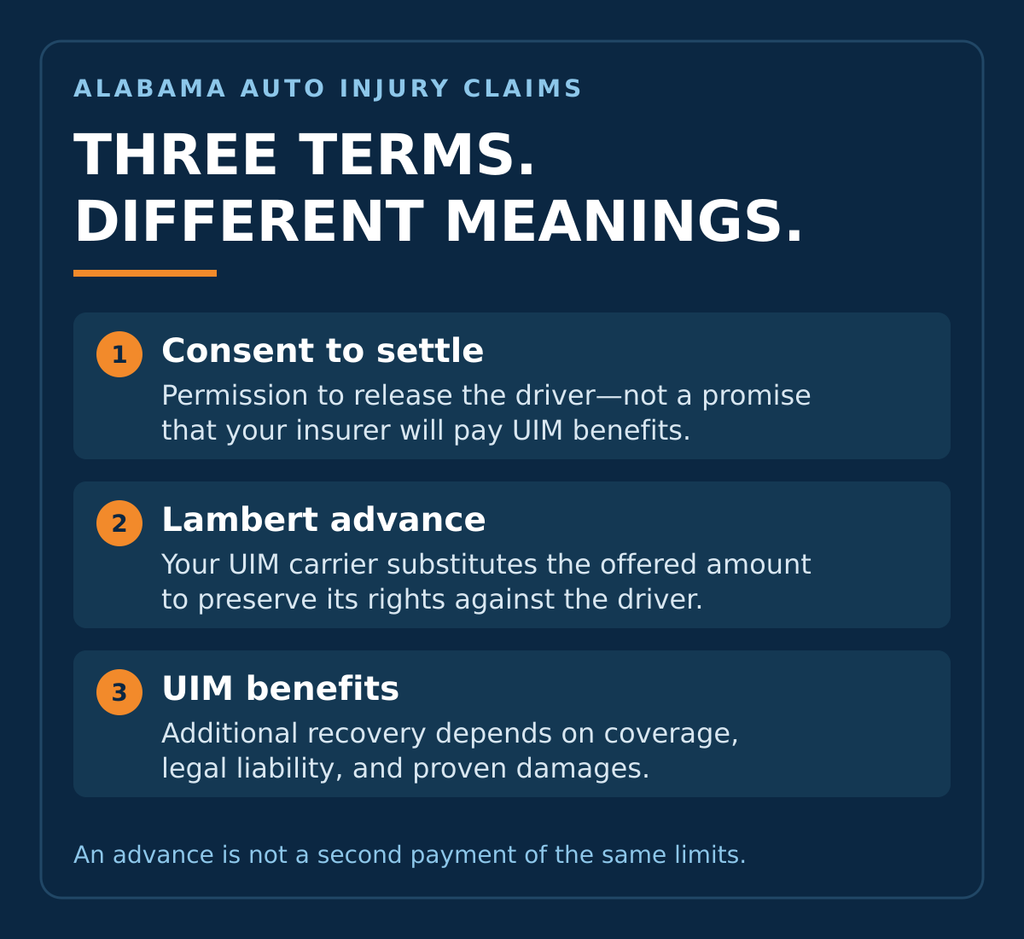
When the UIM insurer responds, read what it actually authorizes. Three terms often get blurred together even though they serve different purposes.
- Consent to settle allows the proposed settlement and release to proceed without that particular consent objection. It does not necessarily admit coverage, accept your valuation, or promise a UIM payment.
- A Lambert advance substitutes your UIM carrier’s money for the proposed settlement amount to preserve rights against the driver. It does not authorize the proposed release.
- UIM benefits compensate for a covered underinsured loss, subject to the policy, applicable law, and proof. The parties may still dispute fault, causation, damages, or the amount payable.
The Alabama Supreme Court explained a Lambert advance in Ex parte State Farm involving James Ross Pritchard Jr.: it substitutes for the liability limits.
Continued litigation can establish the driver’s liability and the injured person’s damages.
That distinction matters when a check arrives from your own company. Ask what the payment represents, which claims remain open, and whether any accompanying document releases the driver or the UIM claim.
The source of the check alone does not answer those questions.
An Example: One Offer, Two Possible Paths
Consider a hypothetical crash with a $25,000 liability-limits offer and evidence suggesting that recoverable damages may be substantially higher.
Assume the injured person has potentially applicable UIM coverage. These numbers illustrate the process, not a prediction of any claim’s value.
If the UIM carrier consents to the proposed settlement, counsel can review the final release and confirm that it matches what the carrier approved.
The $25,000 liability settlement may then proceed while the separate UIM claim remains to be evaluated.
If the UIM carrier instead makes a timely $25,000 Lambert advance, that money substitutes for the proposed liability payment.
The claim against the driver remains available for further proceedings consistent with the process. It is not a second $25,000 windfall on top of the same liability limits.
Neither path automatically produces a UIM policy-limits payment. The injured person still needs a covered claim and sufficient proof of legally recoverable damages.
Nor does either path resolve separate questions about medical reimbursement claims, fees, expenses, or the amount ultimately received.
Why “I Gave Them 30 Days” Is Not a Complete Answer
Lambert uses a reasonable-time standard for investigation and a protective advance; it does not create a universal 30-day safe harbor for every Alabama claim.
Reasonableness depends on the circumstances, including what the insurer knew, what it received, and what remained to investigate.
A deadline in the liability insurer’s offer should be communicated promptly. But that deadline does not by itself settle whether the UIM carrier had a reasonable opportunity to respond.
Likewise, an unanswered message or an adjuster’s acknowledgment of receipt should not be treated as written approval of the release.
If time is running short, counsel can seek clarification, request an extension, supplement the submission, or evaluate the appropriate legal response.
The safe approach is a documented resolution of the carrier’s position—not an assumption that silence means consent.
An Insurer Cannot Hold the Claim in Limbo Indefinitely
The process imposes responsibilities on the insurer too. Under Lambert, refusing consent or failing to investigate in good faith within a reasonable time can affect the carrier’s subrogation rights.
A carrier seeking to preserve those rights must make the required advance within a reasonable time and before the driver is released.
In Lambert itself, the court found the carrier’s refusal unreasonable and its later offer belated under the facts presented.
The injured parties’ settlement therefore did not defeat their UIM rights on the ground asserted.
That result is not a do-it-yourself exception to every consent requirement. Whether a carrier waived a right depends on the communications, timing, investigation, and governing law.
If the response is a denial, an objection, or continuing delay, have counsel evaluate it before taking an irreversible step.
The Settlement Process Does Not Replace Deadline Review
The release review and the filing-deadline review are separate jobs. Alabama Code § 6-2-38 generally supplies a two-year period for ordinary personal-injury claims against the at-fault party.
Exceptions and different claims can change the analysis, and the UIM claim requires its own deadline review.
Do not assume that negotiations, a consent request, or an insurer’s ongoing investigation pauses a filing deadline.
A lawyer should identify the necessary claims and parties early enough to protect them while the insurance discussions continue.
The same caution applies to records. Keep treatment documentation and income-loss evidence current while awaiting a response.
Preserving coverage does not eliminate the need to prove the underlying injury claim.
How Our Firm Helps Before a Release Is Signed
Our personal injury attorneys review the offer, proposed release, potentially applicable policies, and claim history together.
We identify whether UIM notice is needed, what the carrier has authorized, and what evidence or procedural steps remain.
Bring the declarations pages and full policies you have, the offer and release, carrier correspondence, crash information, and available medical and income records.
If you already agreed to something orally, electronically, or in writing, say so immediately. The sequence matters; a missing signature does not necessarily mean no agreement exists.
Frequently Asked Questions About Alabama UIM Settlements
Do I need to notify my insurer even if the other company offers its full limit?
If you may seek UIM benefits, a full-limits offer does not eliminate the notice and consent issue.
Notify the UIM carrier of the claim and, before agreeing to release the driver, the proposed settlement, release terms, and intent to pursue UIM benefits.
Can I cash the settlement check and deal with UIM coverage afterward?
Do not assume that is safe. The check, release, accompanying correspondence, and prior communications may affect whether a settlement has been accepted.
Have counsel review the entire transaction before depositing a settlement check or accepting payment electronically.
Does consent to settle mean my insurer agrees that it owes me money?
Not necessarily. Consent addresses the proposed settlement and release. Coverage, liability, injury causation, and damages may remain disputed.
Obtain the carrier’s position in writing and distinguish permission to settle from an agreement to pay a specific UIM amount.
Does a Lambert advance end the case against the driver?
No. It is designed to preserve rights that the proposed release could extinguish. Further proceedings may still determine liability and damages.
Counsel should explain who remains in the case and how the advance will be accounted for in any later recovery.
What if more than one UIM policy might apply?
Each potential policy needs review for insured status, coverage, limits, and notice obligations. Do not assume that one company’s consent binds another company.
Questions about combining available coverages are separate from obtaining the necessary settlement response.
What if I already signed the release without permission?
Get a prompt, case-specific review rather than assuming either that coverage is lost or that the problem can be undone.
Counsel will need the release, policy language, notice history, and insurer responses to assess the consequences and any available arguments.
Protect the Next Claim Before Closing This One
A policy-limits offer can be an important step toward recovery. Before accepting it, make sure the release, UIM notice, carrier response, and remaining claims fit together.
Resolving one insurance claim should not depend on guessing what happens to another.
If your losses may exceed the available liability coverage, contact us or call (256) 770-7232 for a free personal injury consultation.
We can review the proposed settlement and help you protect the next step before you sign.
Can't find what you're looking for? Search our site below.