
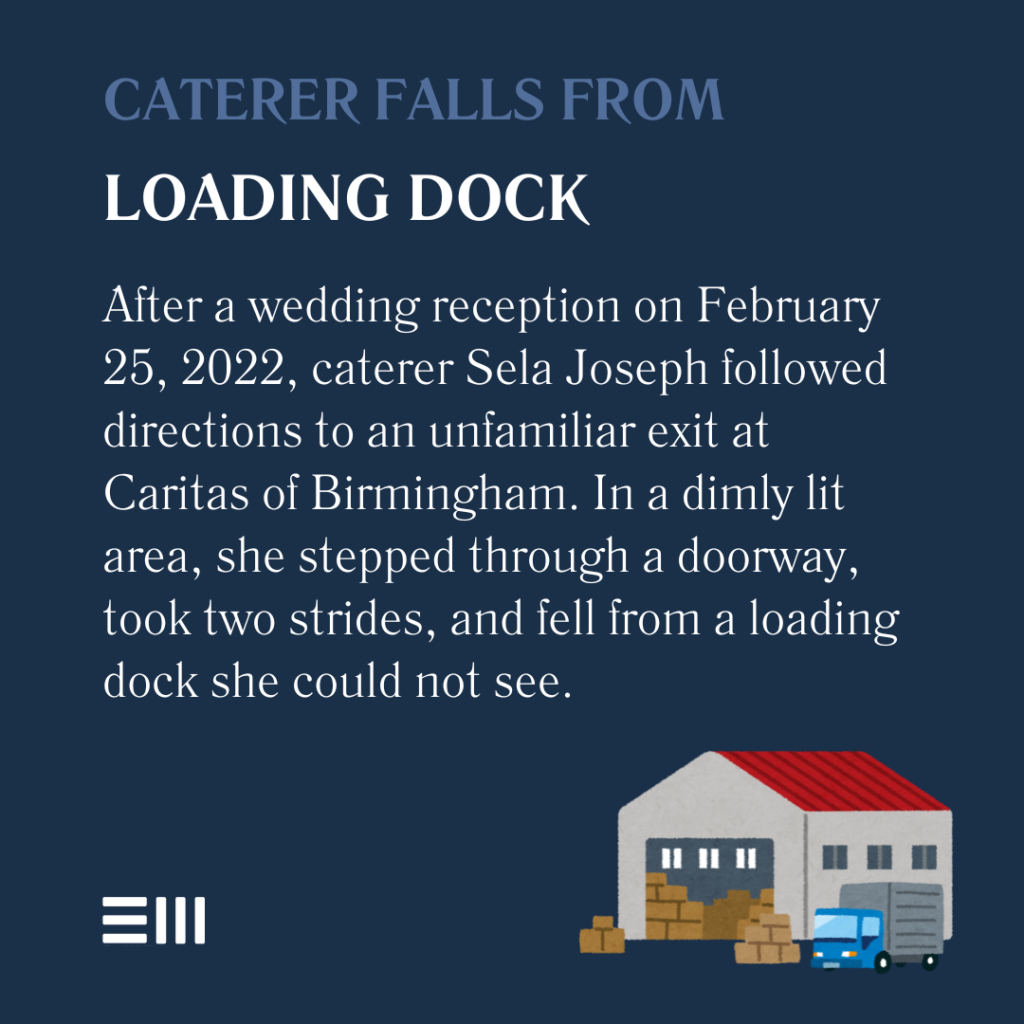
A caterer was led to an exit she had never used, walked through a doorway into the dark, and took two strides before falling off a loading dock she could not see. Almost four years later, on Friday, May 8, 2026, the Alabama Supreme Court decided her case was not over after all.
In Joseph v. Caritas of Birmingham, the high court reversed a summary judgment that had ended Sela Joseph’s negligence case in Shelby Circuit Court before a jury ever heard it.
The decision turned on two unsettled questions in Alabama premises liability law. Was she an invitee or a licensee on the property? And was the lighting that night “total darkness” that bars recovery as a matter of law, or “partial or poor light” that leaves the case in the hands of a jury?
Both answers cut in Joseph’s favor. The case now heads back to the trial court.
The Night of the Wedding Reception
On February 25, 2022, Caritas of Birmingham, a religious nonprofit in Shelby County, hosted a wedding reception for two of its missionaries.
The organization contracted with a catering company called Yellow Bicycle Catering, and when Yellow Bicycle came up short on staff, another caterer named Richard Wilton recruited Joseph to help. Joseph also hired additional workers, all paid by Wilton.
Joseph had been to the Caritas property before, but never inside the building where the reception took place.
She arrived in daylight and stayed until close to 7:00 p.m., the contract’s end time. When she got ready to leave, she asked a member of Caritas how to get out. She was told to follow a young woman with brown hair.
The woman led Joseph to an elevator, took her downstairs, and pointed her toward a standard door in a dimly lit hallway. The young woman did not exit with Joseph and did not warn her that a loading dock sat just outside that door.
Joseph took, in her own deposition words, “maybe two strides” and fell.
Invitee or Licensee, and Why the Difference Mattered
The first issue the Supreme Court resolved was Joseph’s legal status on the property. Caritas argued Joseph was a licensee, owed only the duty not to be willfully or wantonly injured, on the theory that the catering exchange ran between Joseph and Wilton, not between Joseph and Caritas.
Joseph argued she was a business invitee, owed the higher duty of reasonable care.
The court sided with Joseph. Under Alabama law, an invitee is someone who enters property to bestow a material or commercial benefit on the owner. Caritas had hired Yellow Bicycle, paid for the catering, and received the services Joseph provided as part of that contract.
That alone made her a business invitee. Citing Bush v. Alabama Power Co., the court treated her position as analogous to an employee of an independent contractor working on the premises owner’s behalf.
The Distinction the Supreme Court Drew on Lighting
The second issue was the heart of the case. Caritas argued the area where Joseph fell was so dark it triggered Alabama’s “total darkness” rule, under which a hazard concealed by total darkness is treated as open and obvious as a matter of law.
Joseph argued the lighting was poor but not total, leaving the openness of the danger as a question for a jury.
The Supreme Court walked through the line of cases that built the doctrine. Owens v. National Security of Alabama, Inc. and Ex parte Industrial Distribution Services Warehouse, Inc. both involved plaintiffs walking inside unlit commercial warehouses.
Ex parte Kraatz, by contrast, involved a customer falling over an unmarked speed bump in a dimly lit parking lot, where the court refused to call the condition open and obvious as a matter of law.
Joseph’s case looked closer to Kraatz than to Owens. The court pointed to several distinguishing features.
- Outdoor setting. Unlike the warehouse plaintiffs, Joseph was walking outside when she fell.
- Some ambient light. Joseph testified there was “a little bit of moonlight,” that she could see her hand in front of her, and that she could see directly in front of her feet.
- Caritas controlled the path. Joseph was using the exact exit Caritas personnel had directed her to use, in the lighting conditions Caritas provided.
Those features, the court held, created a genuine question of material fact about whether this was a “total darkness” case at all. That question belongs to a jury, not to a summary judgment ruling.
What the Dissent Argued
Justice Sellers wrote a dissent. In his view, Joseph’s own deposition placed the case squarely inside the total darkness line. She described the area as “very dark” and at one point agreed it was “pitch black.” She acknowledged she could not see the loading dock before she stepped off it.
The “little bit of moonlight” Joseph mentioned was, in Justice Sellers’s reading, part of her description of the darkness, not a distinguishing factor that pulled the case out of the Owens and Industrial Distribution line. Justice Shaw also dissented, without writing separately.
The majority’s reading prevailed.
Why the Ruling Matters Beyond One Loading Dock
Joseph v. Caritas of Birmingham clarifies how Alabama courts should treat the gap between “total darkness” and “partial or poor light” in premises liability cases.
That gap matters in slip and fall claims, parking lot falls, dimly lit stairwells, and many other settings where a hazard exists but is partially visible.
The decision keeps the openness and obviousness of a danger in the hands of a jury, wherever the lighting allowed a reasonably prudent person to think they could see.
It also reaffirms that an independent contractor’s worker performing services that benefit the premises owner is an invitee, not a licensee, regardless of who signs the paycheck.
Frequently Asked Questions about Joseph v. Caritas of Birmingham
Readers tracking the case have raised the same set of legal and practical questions. The most common ones are answered below.
What Did the Alabama Supreme Court Actually Decide?
On May 8, 2026, the court reversed a summary judgment that had been entered in favor of Caritas of Birmingham. The case now returns to the Shelby Circuit Court for further proceedings on Joseph’s negligence claim.
Why Was Joseph Considered a Business Invitee?
Caritas hired a catering company for the reception and paid for the services. Joseph provided catering work under that contract, which conferred a material benefit on Caritas. That made her a business invitee under Alabama law.
What Is the Difference between “Total Darkness” and “Partial or Poor Light”?
Total darkness, under Alabama law, is treated as an open and obvious danger as a matter of law, barring recovery for hazards it conceals.
Partial or poor light, by contrast, can mislead a reasonably prudent person into believing they can see and avoid hazards. Whether a case falls into one bucket or the other is generally a jury question.
Does This Ruling Change Premises Liability Law in Alabama?
The decision does not overrule prior cases. It reinforces the distinction the Supreme Court drew in Ex parte Kraatz and clarifies that outdoor settings with some ambient light typically belong in the “partial or poor light” category, where juries decide openness and obviousness.
Each answer points to the same takeaway. Premises liability outcomes in Alabama frequently turn on small factual details about lighting, signage, and direction, and a single line of testimony can move a case from summary judgment to trial.
When a Slip, Trip, or Fall Leaves You with Real Injuries
Premises liability cases in Alabama rarely come down to one obvious fact.
They depend on lighting conditions, property owner duties, the path you were directed to take, and the difference between hazards a reasonable person should have seen and those the property owner should have warned about.
Our experienced personal injury attorneys here at Baxley Maniscalco work from our office in Oxford, Alabama, to help Alabamians injured on someone else’s property build the kind of evidence record that holds up under exactly the analysis the Supreme Court applied in Joseph v. Caritas of Birmingham.
Contact Baxley Maniscalco today for a confidential consultation. If you or someone you love has been seriously injured in an Alabama slip, trip, or fall, we are here to listen and to help.
Can't find what you're looking for? Search our site below.