

After a serious accident, one of the first fears many parents face has nothing to do with their own recovery. It is the worry that an ex might point to a wheelchair, a healing injury, or a new limitation and say, “You can’t take care of them anymore.”
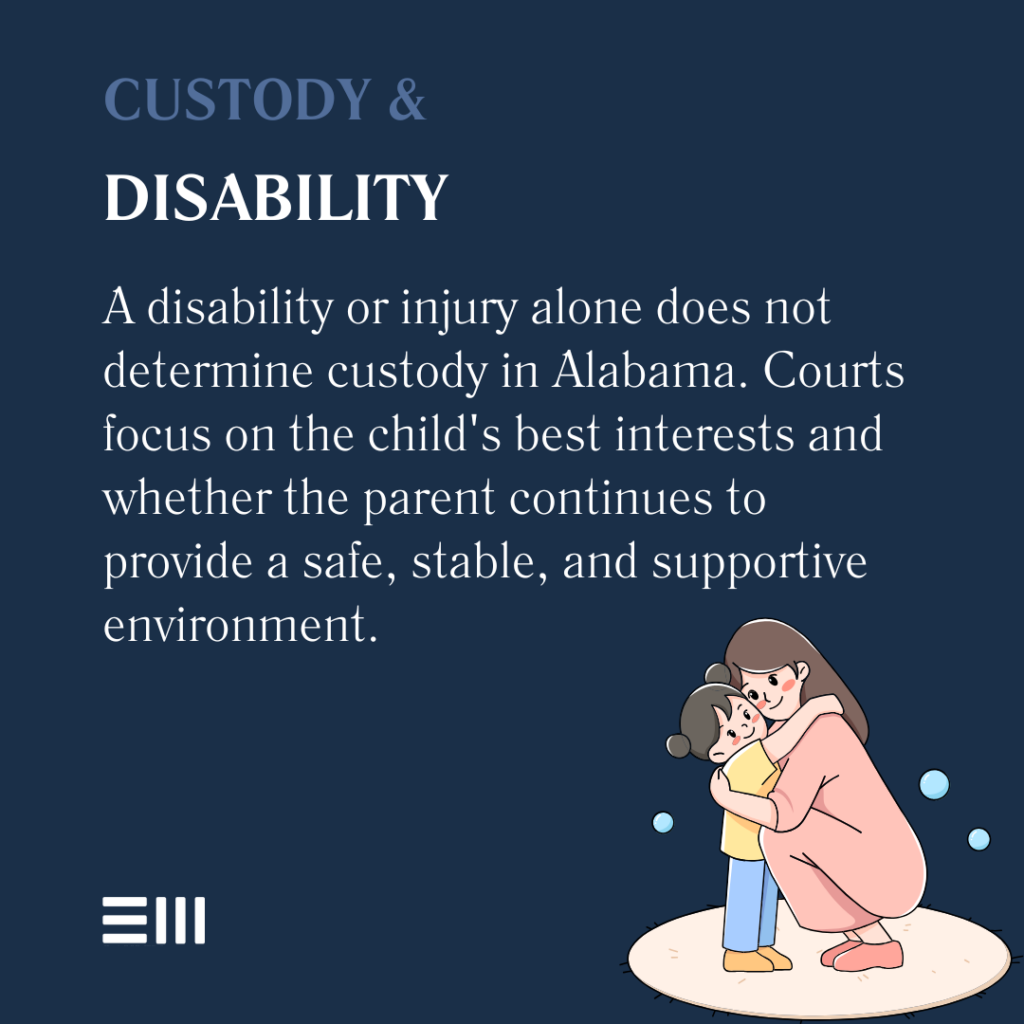
That fear is understandable, but Alabama law is far more balanced than many parents expect. A disability or injury, on its own, is not a reason to lose custody. What a court actually examines is narrower and fairer than the worst-case scenario running through a recovering parent’s mind.
Here is how Alabama courts approach injury and disability in child custody matters, and what the law does and does not allow.
The Standard Alabama Courts Actually Apply
Every custody decision in Alabama runs through a single lens: the best interests of the child. A parent’s injury or disability is never the question by itself. The question is whether, and how, a condition actually affects the child’s well-being.
Alabama judges weigh a range of factors when applying the best interests standard, and no single one controls the outcome.
- The parent-child relationship. The existing bond and each parent’s involvement in the child’s daily life carry significant weight.
- The child’s needs. Age, health, emotional well-being, and stability all factor into the analysis.
- Each parent’s ability to provide care. Courts look at actual caregiving capacity, not assumptions about a diagnosis.
- Stability and continuity. Alabama courts place a high value on keeping a child’s life stable.
Within this framework, a disability is just one piece of context, not a disqualifier. A judge cannot treat a condition as automatic proof that a parent is unfit.
Why a Disability Alone Does Not Cost You Custody
The distinction that protects parents is something courts call the nexus requirement. A court may only consider a disability to the extent there is a real connection, a nexus, between the condition and a genuine effect on the child.
In plain terms, a judge is not supposed to rely on what a parent “might” struggle with. Decisions are meant to rest on actual facts about how the child is cared for, not on fears, generalizations, or stereotypes about disability.
A parent who has adapted to a limitation, with the right tools, support, and routines, can absolutely continue to provide a loving and stable home. The focus stays on results for the child, not on the existence of a condition.
This principle matters because it shifts the conversation. Instead of “Can this parent walk, drive, or lift?” the real question becomes “Is this child safe, supported, and thriving?” Many parents with significant injuries and disabilities answer that question every day.
Federal Law Adds Another Layer of Protection
Beyond Alabama’s best interests framework, federal disability law offers parents an additional shield. Two statutes are particularly relevant in custody matters.
- The Americans with Disabilities Act. Title II of the ADA prohibits courts and public agencies, which receive federal funding, from discriminating against a parent based on disability.
- The Rehabilitation Act. Section 504 similarly bars disability-based discrimination by programs that receive federal funds.
These protections do not guarantee any particular custody outcome, and the best interests of the child always remain the priority.
What they do is reinforce that a custody decision cannot rest on disability alone. Federal guidance encourages decision-makers to base their assessments on facts specific to the individual parent rather than on assumptions about how a disability might play out.
When an Injury Could Genuinely Affect Custody
Honesty matters here, because pretending an injury can never affect custody would be misleading. There are situations where a real, demonstrated effect on the child’s care could become relevant in a divorce or custody dispute.
A court could consider an injury or condition where it produces a genuine, documented impact on the child’s safety or daily needs, where a parent has not put workable arrangements in place to handle caregiving responsibilities, or where a temporary limitation directly interferes with specific duties such as transportation to school or medical appointments.
Even then, the question is not whether the limitation exists but whether reasonable solutions, like a backup driver, a caregiver, or an adjusted schedule, can address it.
The takeaway is reassuring for most parents. A practical limitation is a problem to be solved, not a verdict on your fitness as a parent.
What This Means if You Already Have a Custody Order
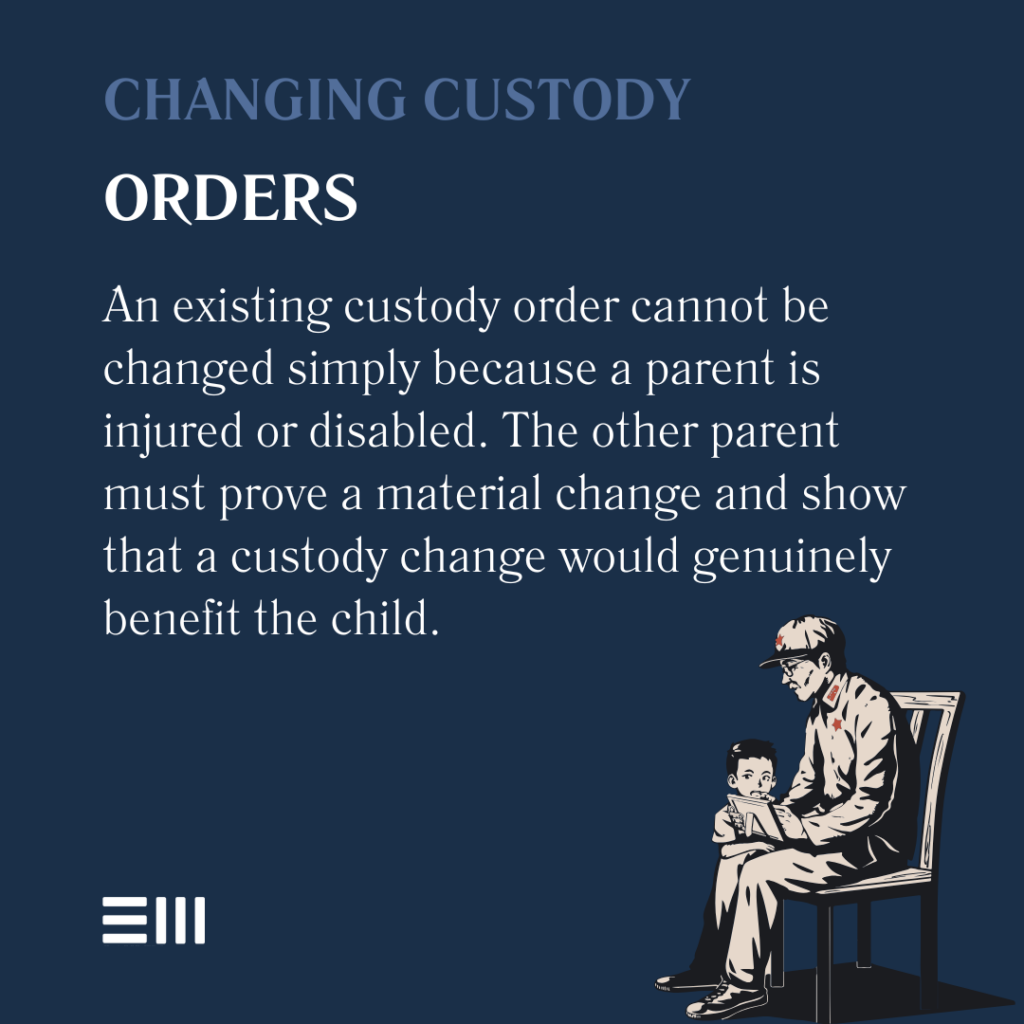
If a custody order is already in place and an ex wants to change it because of your injury or disability, the bar they must clear is high. Alabama follows the McLendon standard for modifying primary physical custody, established in the 1984 case Ex parte McLendon.
Under that standard, the parent seeking the change must prove three things: that a material change in circumstances has occurred since the last order, that changing custody would materially promote the child’s welfare, and that the benefits of the change would outweigh the disruption of uprooting the child.
A parent’s disability, without a real and demonstrated effect on the child, generally does not meet that demanding test. Alabama courts strongly favor stability, and that preference often works in favor of a recovering parent who already shares a stable home with their child.
How to Protect Yourself During Recovery
If you are healing from an injury or living with a disability and you are worried about custody, a few practical steps can strengthen your position.
These are the same steps our family law team often discusses with clients navigating recovery and co-parenting at the same time.
- Document your caregiving. Keep a record of the daily parenting tasks you continue to handle.
- Line up support. Identify family, friends, or services that help with anything you cannot do alone right now.
- Address logistics directly. If driving is a temporary issue, arrange reliable transportation and document it.
- Follow medical guidance. Demonstrating that you are managing your health responsibly reflects well on your stability.
Taking these steps does more than protect a case. It shows a court exactly what the best interests standard is looking for: a parent actively meeting their child’s needs.
Frequently Asked Questions
Below are answers to questions Alabama parents most often ask about injury, disability, and custody.
Can I Lose Custody Just Because I’m Disabled?
No. A disability by itself is not grounds to deny or remove custody in Alabama. A court must find a real connection between the condition and an actual effect on the child.
Can My Ex Use My Accident Against Me?
An ex can raise it, but raising it is not the same as winning. They would need to show a genuine, material impact on the child, not just point to the existence of an injury.
What if I Can’t Drive My Child Right Now?
A temporary limitation like not driving is usually a logistical issue to solve, not a reason to change custody. Arranging reliable transportation and documenting it helps address the concern.
Does Federal Law Really Protect Disabled Parents?
Yes. The ADA and the Rehabilitation Act prohibit courts and agencies from making decisions based on disability alone, though the child’s best interests still guide the final outcome.
Can My Custody Order Be Changed Because of My Disability?
Only if the other parent meets Alabama’s demanding McLendon standard, which requires a material change and proof that changing custody would genuinely benefit the child.
Your Rights and Next Steps With Baxley Maniscalco
An injury or disability does not erase your role as a parent, and Alabama law does not treat it that way. If someone is trying to use your recovery against you, you do not have to face that alone.
Our experienced family law and personal injury attorneys here at Baxley Maniscalco serve clients across the state of Alabama from our office in Oxford, reaching clients in Anniston, Gadsden, and surrounding communities.
We understand both sides of this situation, and we fight to protect the relationships that matter most.
Call (256) 770-7232 or reach out through our contact form to schedule a consultation.
Can't find what you're looking for? Search our site below.