

The IRS has measured something that every family court judge already suspects. Wage earners misreport about 1 percent of their income, because an employer reports it for them.
For sole proprietors, whose income carries little or no third-party reporting, that figure climbs to roughly 55 percent.
That gap explains why an Alabama judge rarely stops at a self-employed parent’s tax return. A return is built to lower a tax bill, and the number at the bottom often bears little resemblance to what a family actually lives on.
When child support is on the line, courts have both the authority and the tools to look further.
What Alabama Counts as Income for a Self-Employed Parent
Alabama child support runs on Rule 32 of the Alabama Rules of Judicial Administration, which sets its own definition of income for anyone who works for themselves. That definition is narrower than the one on a tax form.
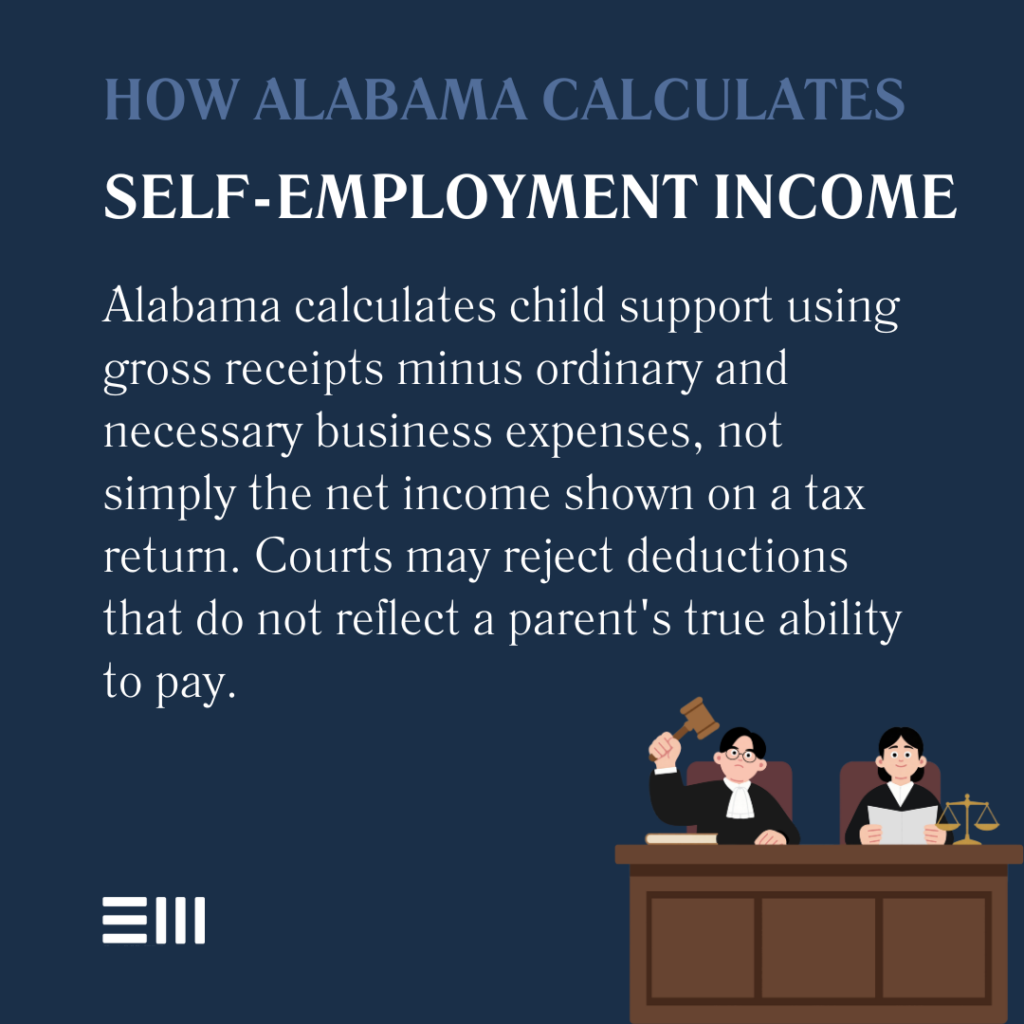
Under Rule 32, income from self-employment, rent, royalties, a proprietorship, or a share of a partnership or closely held corporation means gross receipts minus the ordinary and necessary expenses required to produce that income.
The phrase ordinary and necessary is doing heavy lifting there. An expense has to actually be needed to earn the money, not merely be deductible.
That single sentence is why two parents with identical tax returns can end up with very different support obligations.
The Deductions Courts Push Back On
Plenty of write-offs that a tax preparer welcomes get a much cooler reception when a self-employed parent’s support is calculated. Rule 32 expressly bars some, and gives judges room to reject others.
Deductions that commonly draw scrutiny include the following:
- Accelerated depreciation. Rule 32 excludes the accelerated component of depreciation, since a paper loss on equipment does not reduce the cash a parent has in hand.
- Investment tax credits. These are also excluded by the rule when calculating gross income for support.
- Personal costs run through the business. Vehicles, meals, travel, and phones that serve family life as much as the company invite a closer look.
- Any expense the court finds inappropriate. Rule 32 gives judges discretion to disallow other business expenses they conclude do not belong in a support calculation.
The through line is simple. If a deduction lowers taxable income without lowering what the parent can actually spend, a court may add it back.
Perks, Retained Earnings, and Money That Never Hits a Paycheck
Business owners can be paid in ways an employee never is, and Alabama law accounts for that. Value does not have to arrive as salary to count.
Rule 32 treats expense reimbursements and in-kind payments received through employment, self-employment, or running a business as income when they are significant and reduce personal living expenses.
A company truck, a covered phone, or housing paid by the business can all fall in that category.
Retained earnings raise a related question, because a parent who controls a company can choose to leave profits inside it rather than take a draw, and courts may examine whether that choice is genuine business planning or a way to look poorer than the parent is.
None of this means every business perk becomes income. It means the label on the payment matters far less than what it actually does for the parent’s life.
When Income Rises and Falls Every Month
Seasonal work, commissions, and lean quarters are a normal part of life for a self-employed parent, and courts know it. The goal is a number that reflects reality over time rather than a snapshot of a good month or a bad one.
Rule 32 requires income statements to be verified with documentation of both current and past earnings, and for a self-employed parent, suitable documentation includes business receipts and expenses.
That evidence is then supplemented with recent tax returns to show a longer view, or with whatever else the court directs. In practice, this usually means looking across enough time to smooth out the peaks and valleys.
Bring more history rather than less, since a fuller record protects a parent whose income genuinely swings.
What Happens When a Parent Appears to Underreport
Cash businesses and creative bookkeeping put courts in a familiar position, and Alabama gives judges real authority to respond.
The tools available include the following:
- Imputed income. If a court finds a parent voluntarily unemployed or underemployed, it estimates what that parent could earn and calculates support on that figure instead.
- A lifestyle comparison. Judges may weigh reported income against the home, vehicles, and spending a parent maintains.
- Full financial discovery. Bank records, merchant processing statements, ledgers, and invoices can reveal deposits that a tax return does not.
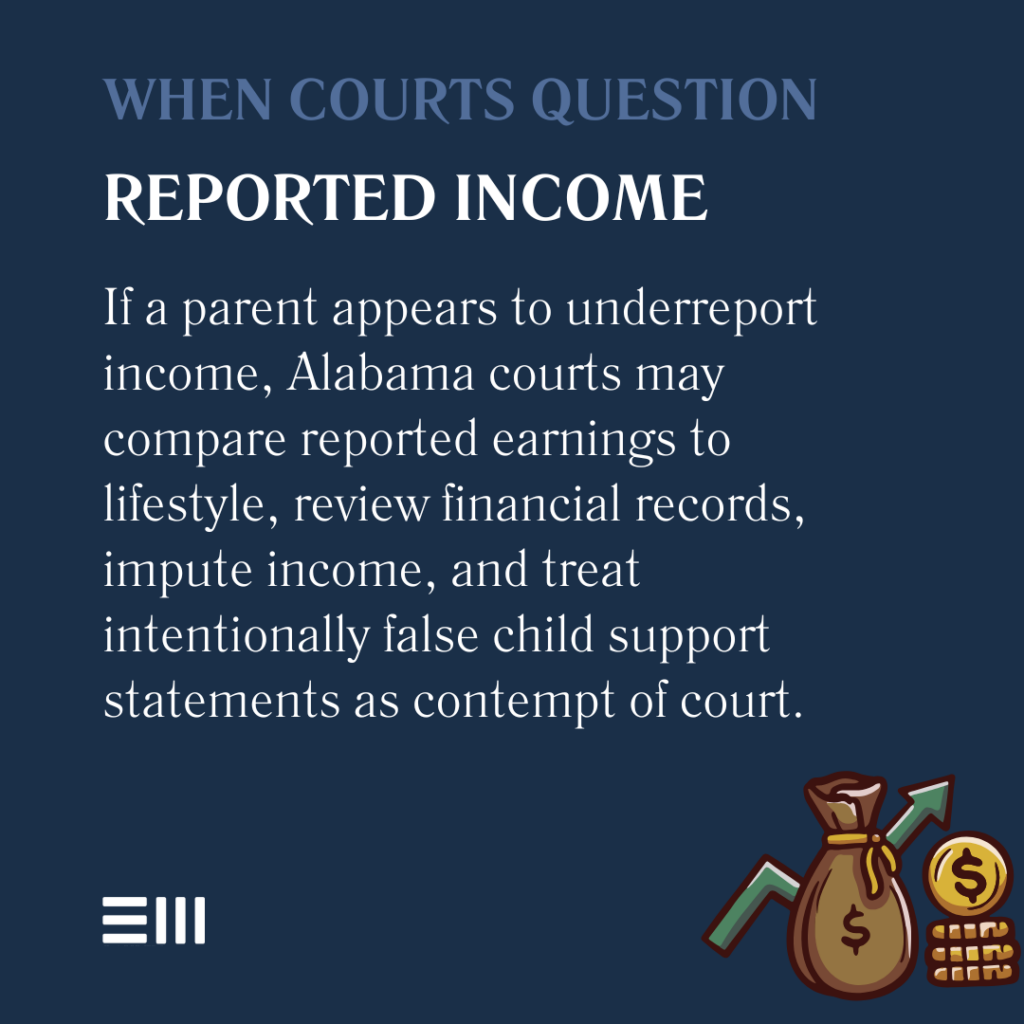
- A contempt finding. Rule 32 states that intentionally falsifying the child support income statement is contempt of court.
Underreporting is a risky strategy. Courts see it often, and the consequences reach past a higher support number.
How Our Firm Approaches Self-Employment Cases
Child support cases involving a self-employed parent are won on documentation and on knowing which questions to ask. That work looks different depending on which side of the table a parent sits.
Our experienced family law attorneys here at Baxley Maniscalco handle child support matters throughout Alabama, and our team brings a perspective few firms can match, since our attorneys have also served as deputy attorneys general enforcing child support.
We help business-owning parents document legitimate expenses so their support figure is fair, and we help receiving parents pursue the records that show what a business truly earns. If your case involves self-employment income, our office offers a confidential consultation to talk it through.
Questions Alabama Parents Are Asking Us
Self-employment raises questions that a standard child support calculator cannot answer. Here are the ones parents bring to us most often.
How Is Child Support Calculated for a Self-Employed Parent in Alabama?
The court starts with gross receipts and subtracts the ordinary and necessary expenses required to produce that income, then runs the result through Alabama’s income shares formula. The figure often differs from the net income shown on a tax return.
Can the Court Add Back My Business Deductions?
Yes. Rule 32 excludes accelerated depreciation and investment tax credits, and it lets a judge disallow other business expenses found inappropriate for calculating support.
Do Company Perks Count as Income? They can.
Expense reimbursements and in-kind payments count as income when they are significant and reduce personal living expenses, such as a business vehicle or a paid housing allowance.
What If My Income Changes Every Month?
Courts look at earnings over time rather than a single month, using receipts, expenses, and tax returns together. Keeping thorough records across several years helps show a true average.
What Happens If a Parent Hides Income?
A court can impute income based on earning ability, weigh lifestyle against reported earnings, and order discovery of financial records. Intentionally falsifying the income statement is treated as contempt of court.
Every business is different, so reach out if your situation is not covered here.
Your Business Is Complicated. Your Child Support Case Doesn’t Have to Be.
Whether you own the business or you are trying to understand what your child’s other parent really earns, the numbers deserve a careful look. A fair support order starts with an accurate picture of the income behind it.
Our experienced family law attorneys here at Baxley Maniscalco are ready to review your situation and explain your options.
Call us at (256) 770-7232 or reach out through our contact form to schedule a consultation today.
Can't find what you're looking for? Search our site below.