

Alabama requires just 30 days between the filing of a divorce complaint and the earliest date a judge can sign a final decree — one of the shortest mandatory waiting periods of any state in the country.
Yet the gap between that legal minimum and reality is often wide. Some couples walk away with a signed decree in six weeks, while others spend a year or more working through disputes over property, custody, and support.
Understanding how long a divorce takes in Alabama depends almost entirely on where your case falls between those two extremes and what steps you take before ever setting foot in a courtroom.
The 30-Day Waiting Period and What It Really Means
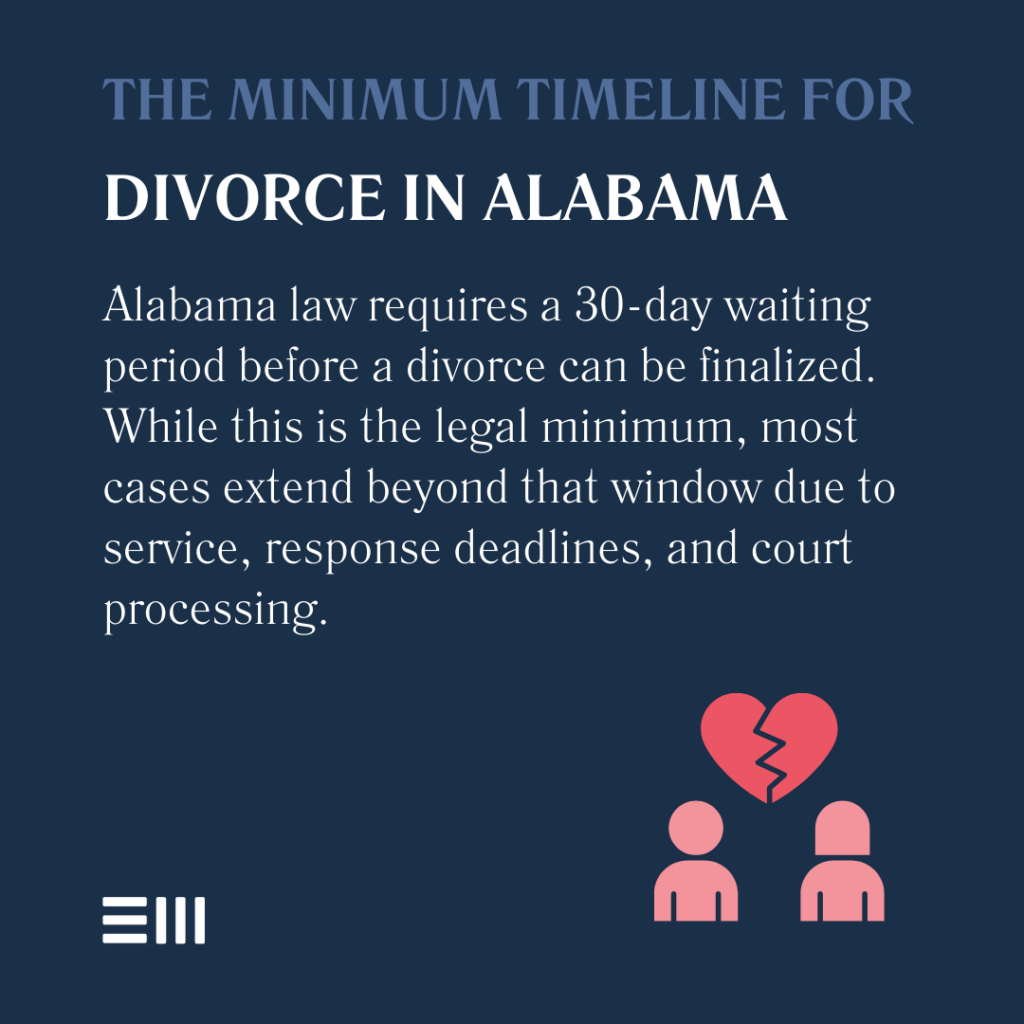
Every Alabama divorce, whether contested or uncontested, must observe a mandatory 30-day cooling-off period that begins on the date the divorce complaint is filed with the circuit court.
No judge can sign a final decree before those 30 days expire, regardless of how quickly both spouses reach an agreement.
The waiting period exists to give both parties time to reconsider the decision and potentially reconcile.
In practice, most cases are not resolved the moment the 30 days expire because the responding spouse also has a separate 30-day window to file an answer after being served with divorce papers.
Those two timelines can overlap, but if service takes longer than expected — because the other spouse is difficult to locate or lives out of state — the process extends before any substantive negotiation even begins.
Knowing that 30 days is a floor rather than a ceiling helps set realistic expectations about how long a divorce takes in Alabama from the very start.
Uncontested Divorce: The Fastest Path Forward
An uncontested divorce is the quickest and most cost-effective way to end a marriage in Alabama. It applies when both spouses agree on every major issue, including property division, debt allocation, spousal support, and child custody.
When full agreement is in place before or shortly after filing, the question of how long a divorce takes in Alabama often has a straightforward answer: roughly six to ten weeks from the date of filing.
Several conditions make this accelerated timeline possible:
- Both spouses sign a written settlement agreement that addresses all financial and custody-related matters before submission to the court.
- Service of process is completed quickly, either through personal delivery, certified mail, or waiver of formal service by the responding spouse.
- No hearing is required, as many Alabama judges will review uncontested cases on the paperwork alone without scheduling a court appearance.
- All documents are filed accurately, since incomplete or incorrect paperwork can force resubmissions that add weeks to the process.
When every piece falls into place, an uncontested divorce in Alabama can move from filing to final decree in as little as five to six weeks, making it the benchmark for how long a divorce takes in Alabama under ideal circumstances.
Contested Divorce: Why Some Cases Take a Year or Longer
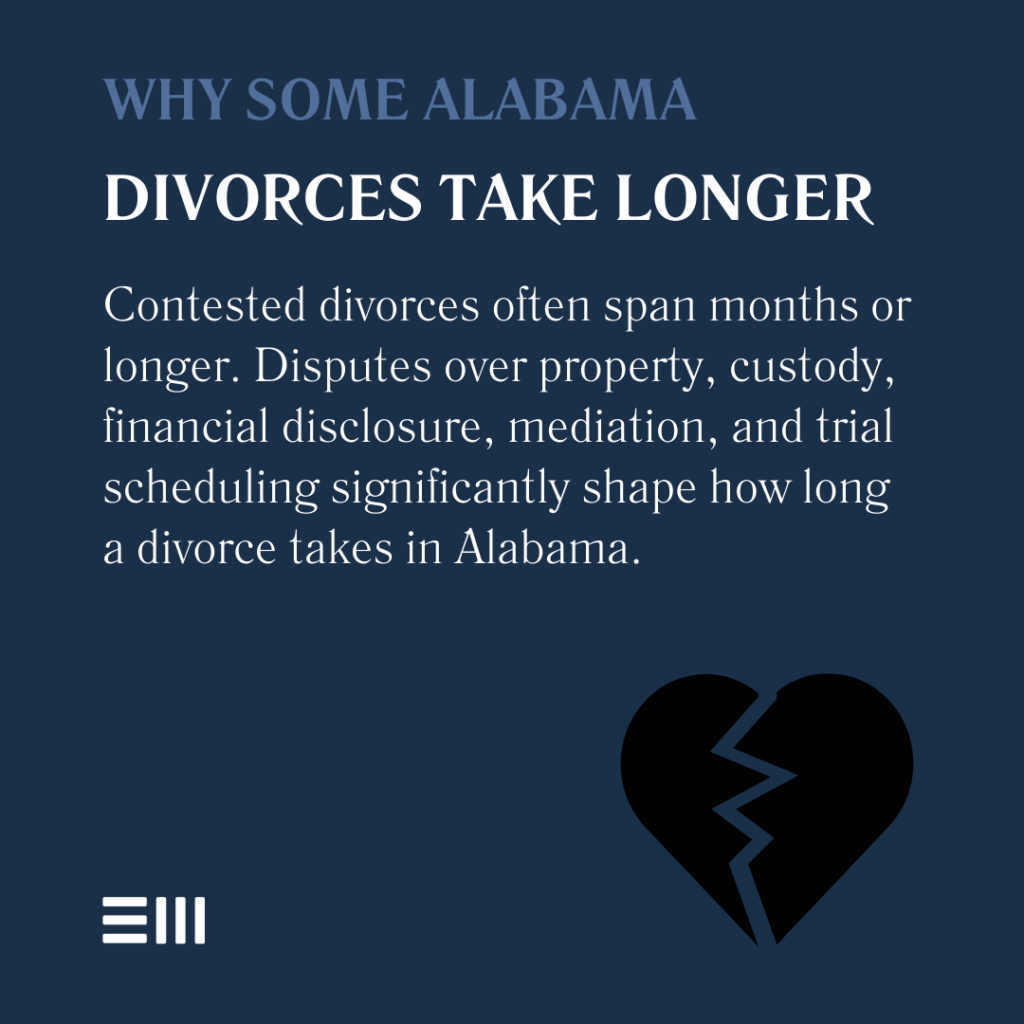
A contested divorce arises when spouses disagree on one or more significant issues. Disputes over property division, alimony, or child custody introduce additional legal steps that dramatically affect how long a divorce takes in Alabama.
Most contested cases resolve within six to eighteen months, though highly complex situations can stretch beyond that range.
The additional time stems from several procedural stages that uncontested cases skip entirely:
- Discovery and financial disclosure, where both parties exchange bank statements, tax returns, retirement account records, and business valuations under court supervision.
- Mediation or settlement conferences, which Alabama courts frequently require before scheduling a trial to encourage negotiated resolutions.
- Custody evaluations and expert testimony, which courts may order when parents cannot agree on living arrangements or parenting plans for minor children.
- Trial preparation and scheduling, which depends heavily on the court’s existing caseload and the availability of judges, attorneys, and witnesses.
Each contested issue adds its own layer of complexity, and cases involving high-value assets or contentious custody battles tend to sit at the longer end of the spectrum.
Understanding these stages helps explain why the length of a divorce in Alabama can vary so dramatically from one case to the next.
Factors That Speed Up or Slow Down Your Alabama Divorce
Beyond whether a divorce is contested or uncontested, several practical factors influence how long a divorce takes in Alabama. Addressing these variables early can shave weeks or even months off the total timeline.
- Residency requirements must be met before filing, meaning at least one spouse needs to have lived in Alabama for a minimum of six months.
- Cooperation between spouses plays a significant role, as delays in responding to paperwork, attending mediation, or providing financial records can stall progress at every stage.
- Court caseloads vary by county, and busier jurisdictions may take longer to schedule hearings, review filings, and issue final decrees.
- Children add complexity, since custody arrangements, child support calculations, and parenting plans require additional court review and potential evaluation.
- Fault-based filings tend to take longer than no-fault cases because proving grounds such as adultery, abandonment, or substance abuse requires gathering and presenting evidence at trial.
Addressing as many of these variables as possible before filing gives you the best chance of keeping your case on the shorter end of the timeline.
Frequently Asked Questions about Divorce Timelines in Alabama
Alabama residents preparing for divorce often have urgent questions about how the process will fit into their lives. The following answers address the timeline concerns that come up most frequently.
What Is the Absolute Fastest a Divorce Can Be Finalized in Alabama?
The fastest possible timeline is just over 30 days, which requires a fully uncontested case where both spouses have signed a complete settlement agreement and all paperwork is filed without error.
In practice, most uncontested divorces take closer to six to ten weeks due to service and processing times.
Can the 30-Day Waiting Period Be Waived?
Generally, no. The 30-day waiting period is mandatory under Alabama law and applies to every divorce case filed in the state. Judges do not have the discretion to waive it under normal circumstances.
How Long Does a Contested Divorce Take in Alabama if Children Are Involved?
Custody disputes are among the most time-consuming aspects of a contested divorce. When parents disagree on living arrangements, courts may order evaluations and require custody hearings that add months to the process.
Cases involving complex custody issues often take nine to eighteen months or longer to resolve.
Does Filing on Fault-Based Grounds Take Longer?
In most cases, yes. Fault-based divorces require the filing spouse to prove the alleged misconduct, which typically involves gathering evidence, deposing witnesses, and presenting a case at trial. No-fault filings based on incompatibility or irretrievable breakdown generally proceed more quickly.
Can I Remarry Immediately after My Divorce Is Finalized?
Not immediately. Alabama law imposes a 60-day waiting period after the final divorce decree before either former spouse can legally remarry someone other than each other.
These answers provide a clearer picture of what to expect so you can plan your next steps with confidence.
Stop Waiting and Start Moving Forward with Baxley Maniscalco
How long a divorce takes in Alabama depends on preparation, cooperation, and the quality of legal counsel guiding the process.
Our experienced family law attorneys here at Baxley Maniscalco work to streamline every phase of your case, from initial filing through final decree, so that unnecessary delays never stand between you and the fresh start you deserve.
Whether your divorce is straightforward or contested, we bring the preparation and courtroom skill needed to keep your case moving efficiently.
Contact Baxley Maniscalco today to schedule a consultation. Let our team evaluate your situation, outline a realistic timeline, and help you take the first step toward closing this chapter on your terms.
Can't find what you're looking for? Search our site below.