

You finally have a divorce date. Then a much less exciting question hits: what happens to the insurance card in your wallet?
If your coverage comes through your spouse’s job, don’t wait until the pharmacy rejects it to find out.
The divorce decree, the health plan, and your replacement coverage each do a different job. We help clients work through those moving parts in Alabama divorce cases and related family law matters.
Your goal is simple: know when the old coverage ends, when the new coverage starts, and what it will actually cost. Getting there takes more than adding “health insurance” to a settlement checklist.
Planning for life after divorce? Contact us to discuss your next steps or call (256) 770-7232.
Start With the Plan, Not an Assumption
A spouse’s employer plan may stop covering a former spouse when the divorce becomes final. Exactly when coverage ends depends on the plan’s terms and the circumstances.
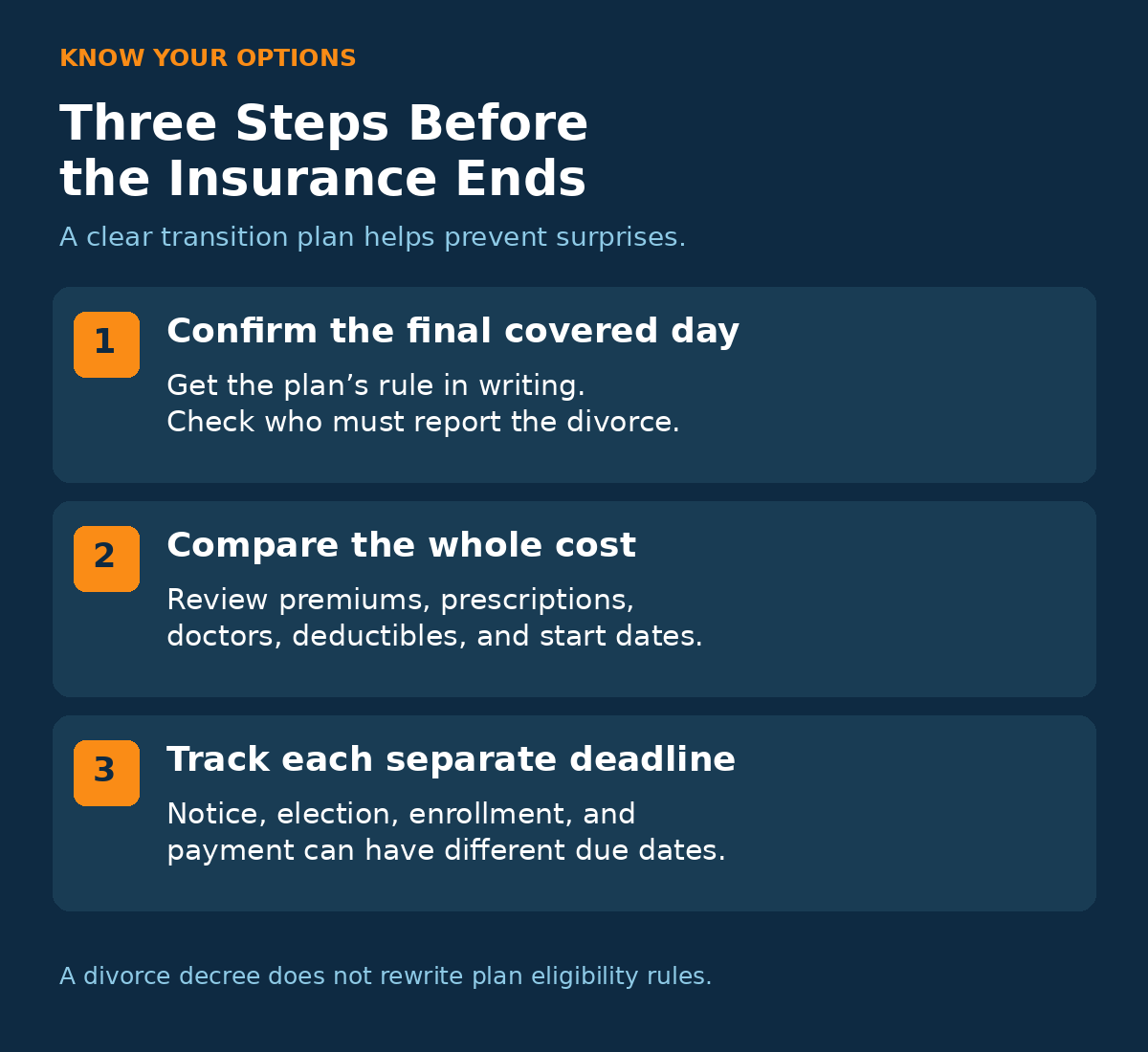
Don’t assume you have coverage through the end of the month, the end of the year, or until somebody removes your name. Ask the plan administrator for the applicable rule in writing.
A separation may be treated differently from a divorce. A pending case isn’t the same as a final decree, and an insurer’s administrative delay doesn’t necessarily extend eligibility.
Before the final hearing, request these details:
- The event that ends eligibility: Ask how divorce or legal separation affects your particular plan.
- The last covered day: Get a specific date or the rule used to calculate it.
- The required notice: Find out who must notify the plan, how, and by when.
- The continuation options: Request the documents, premiums, and enrollment instructions.
Keep a copy of what you send and proof of delivery. A note to your spouse isn’t necessarily notice to the plan administrator.
Can the Divorce Order Keep You on Your Ex’s Plan?
Be careful with that promise. A settlement can address who pays certain health insurance expenses, but it doesn’t automatically make an ineligible former spouse eligible under an employer plan.
“Keep me insured” and “pay toward replacement coverage” may lead to very different results. The wording should match a coverage option that is actually available.
For example, an agreement might address continuation premiums or a defined contribution toward an individual plan. The details should explain timing, payment, documentation, and what happens when coverage changes.
We want to identify a workable arrangement before the decree is signed. A clause that sounds reassuring but doesn’t fit the plan can leave a difficult gap.
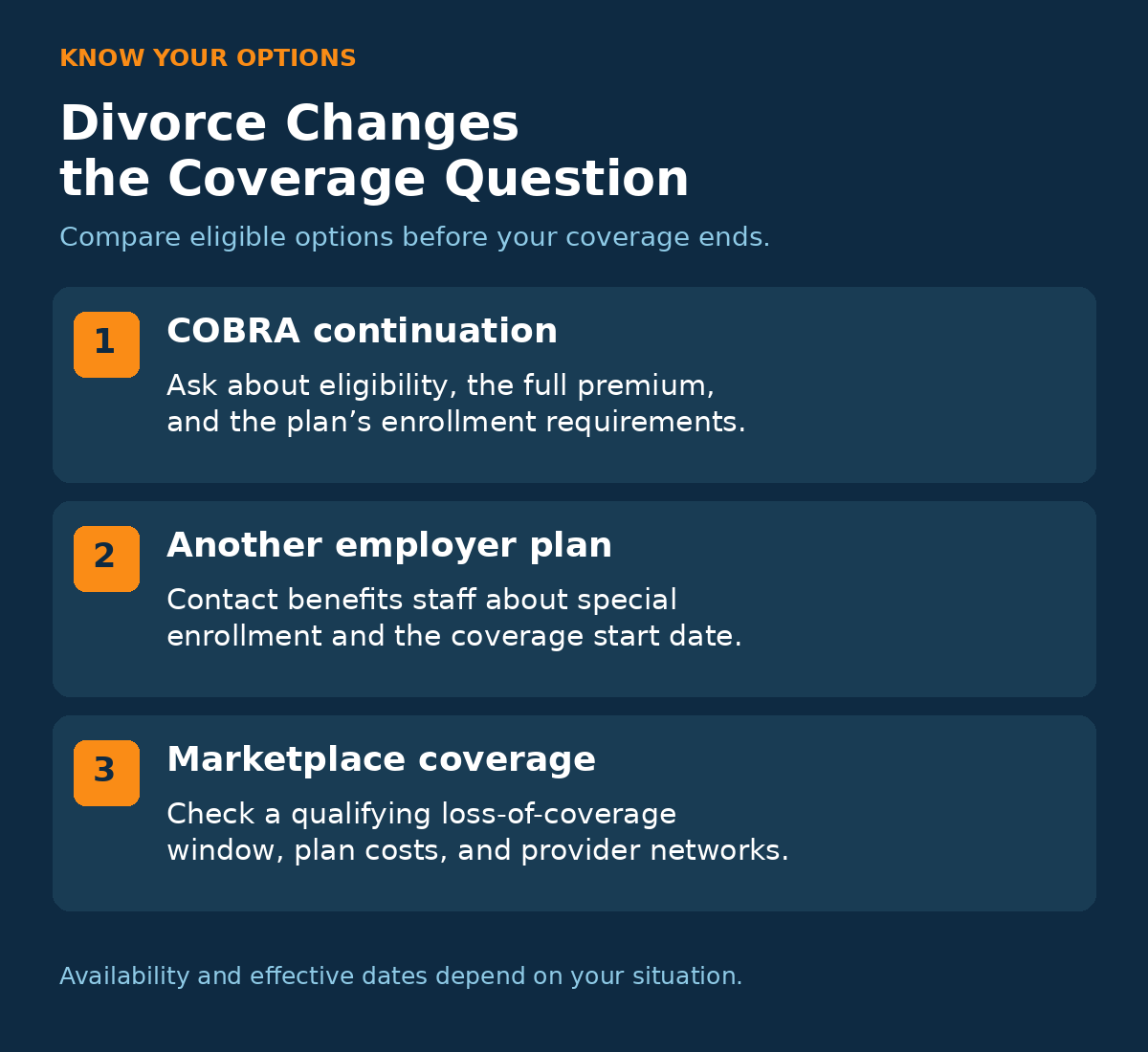
COBRA May Buy Time, but Check the Price
Federal COBRA generally applies to group health plans maintained by employers with at least 20 employees, subject to important exceptions. It isn’t available under every policy.
A covered spouse who loses coverage because of divorce may qualify for up to 36 months of continuation coverage. The plan can generally charge the full cost plus a 2% administrative charge.
The U.S. Department of Labor’s COBRA guidance explains these rules and the enrollment process. Your employer’s contribution may disappear, making the premium much higher than the old payroll deduction.
Continuing the same plan can be valuable when you’re mid-treatment or your doctors participate in its network. That convenience still needs to fit your budget.
Ask for the actual premium. Don’t build your post-divorce finances around what your spouse currently sees on a pay stub.
Your Own Job or the Marketplace May Offer Another Route
If you have access to another employer plan, losing eligibility under a spouse’s plan may create a special enrollment opportunity. That window can be much shorter than people expect.
The Department of Labor’s special enrollment guidance explains that a group plan generally must give eligible people at least 30 days to request enrollment after qualifying loss of other coverage.
Ask your benefits department about eligibility, the effective date, and the documents it needs. Don’t assume your annual open enrollment is the only chance to act.
An individual Marketplace plan is another possibility. HealthCare.gov’s special enrollment rules generally provide a window around a qualifying loss of coverage, including 60 days before or after the loss.
Divorce alone doesn’t create that Marketplace opportunity if you haven’t lost coverage. And choosing to drop COBRA early generally doesn’t create a new enrollment right by itself.
Compare your options while the original loss-of-coverage window is still open. Don’t elect one option on the assumption that switching later will be effortless.
There Isn’t Just One Deadline
This is where an otherwise organized transition can go sideways. Notifying a plan, electing COBRA, paying the first premium, and enrolling in another plan are different steps.
For COBRA, the election period is generally at least 60 days from the later of coverage loss or the election notice. The initial premium is generally due within 45 days after election.
The plan also has a separate procedure for receiving notice of divorce. Follow it promptly and read the notice provisions carefully; don’t treat the election window as permission to delay reporting the divorce.
The Department of Labor’s guide to health coverage during life changes is a useful starting point. Keep your plan’s actual notices beside your calendar.
If you’re already facing a coverage gap, tell us immediately. Backdating an assumption on a household calendar doesn’t fix a missed enrollment requirement.
Compare the Whole Cost, Not Just the Premium
A lower monthly payment can look appealing until you discover that your specialist is out of network or your deductible starts over. Think about the care you expect to use.
Before choosing, compare:
- Your providers: Verify your physicians, hospital, and planned treatment directly with the proposed plan.
- Your prescriptions: Check the drug list, dosage, pharmacy network, and any authorization requirements.
- Your out-of-pocket exposure: Compare deductibles, copayments, coinsurance, and the applicable maximum.
- Your start date: Confirm when coverage becomes effective and what must be paid first.
Also consider practical access. A plan may work well near your former marital home and poorly near the apartment you’re moving into.
Keep the estimates you relied on. If insurance expenses are part of settlement negotiations, current written numbers are more useful than a rough guess.
Your Children’s Coverage Needs a Separate Plan
Your loss of eligibility as a spouse doesn’t necessarily mean your children lose eligibility as dependents. Don’t remove everyone from the same policy simply because the marriage is ending.
Children’s coverage, premium allocation, and uncovered expenses should be addressed clearly. Your own replacement policy is a separate issue from the children’s needs.
The Department of Labor provides resources on medical child support orders. For covered employer plans, a qualifying medical child support order can affect a child’s enrollment rights.
Ask who will maintain insurance cards, submit claims, share explanations of benefits, and handle reimbursement requests. Those small administrative details can prevent a recurring argument.
Frequently Asked Questions
Do I Automatically Keep My Spouse’s Insurance Until Year-End?
No. Get the termination rule from the plan administrator. Don’t rely on the calendar year, a verbal promise, or the fact that an old insurance card still exists.
Can a Judge Force an Employer Plan to Cover a Former Spouse?
Don’t assume a divorce order changes the plan’s eligibility rules. We can address insurance expenses in negotiations, but the proposed arrangement must fit coverage that’s legally available.
Is COBRA Always the Cheapest Choice?
No. It can preserve continuity, but the full premium may be expensive. Compare it with any eligible employer or Marketplace option, including networks, deductibles, and effective dates.
Does Getting Divorced Automatically Let Me Buy a Marketplace Plan?
Not by itself. For the divorce-related loss-of-coverage enrollment opportunity, the divorce must result in losing qualifying coverage. Other enrollment routes may apply to your circumstances.
Can I Wait Until COBRA Feels Too Expensive and Then Switch?
Don’t count on it. Voluntarily ending COBRA early generally doesn’t create a new Marketplace special enrollment period. Review switching rights before your original enrollment window closes.
What Should I Bring to a Divorce Consultation About Insurance?
Bring plan documents, premium information, any termination or COBRA notices, and details about available alternatives. Include anticipated treatment costs and the children’s coverage information.
Make the Coverage Plan Before the Coverage Ends
You shouldn’t have to guess whether your next appointment will be covered while you’re adjusting to life after divorce. We can help you identify the insurance issues your agreement needs to address.
Contact our team or call (256) 770-7232 to discuss your divorce and the practical decisions that come with it.
Can't find what you're looking for? Search our site below.