

Alabama’s family courts process thousands of divorce cases each year, and a significant portion involve contested custody disputes where both parents believe they deserve primary placement.
Judges do not make these decisions based on gut feelings or personal preference. Instead, they follow a defined set of criteria rooted in the child’s best interests, and the parent who addresses those criteria most effectively often walks away with a favorable outcome.
Preparing to present your custody case using the Alabama custody factors gives you a structured roadmap for turning everyday parenting into courtroom-ready evidence that speaks directly to what the judge needs to hear.
Understanding the Alabama Custody Factors and Why They Matter
Before gathering a single document, it helps to understand exactly what a judge evaluates when deciding where a child will live.
Alabama does not follow a rigid formula. Instead, courts weigh a broad set of considerations collectively known as the best-interests factors.
These factors give judges wide discretion, which is precisely why preparing to present your custody case using the Alabama custody factors requires more than simply showing up and telling your side of the story.
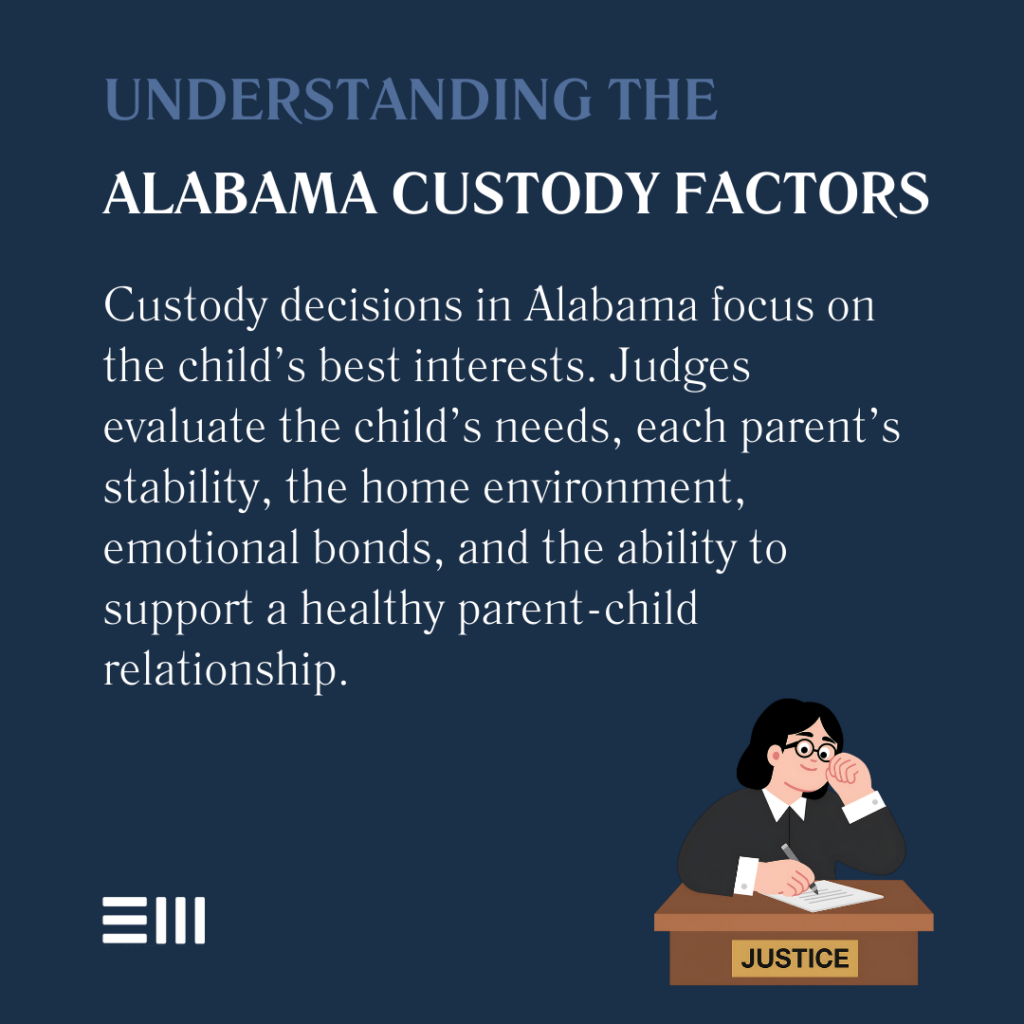
Courts generally examine the age and developmental needs of the child, the moral character and stability of each parent, each parent’s home environment, the emotional bond between parent and child, and each parent’s willingness to foster a healthy relationship with the other parent.
Additional considerations may include the child’s own preference depending on age and maturity, continuity of schooling, proximity to extended family, and any history of domestic violence or substance abuse.
A deeper look at Alabama child custody laws can help you identify which factors are most relevant to your specific situation.
Familiarizing yourself with every factor the court considers ensures that no area of your parenting record goes unaddressed when it matters most.
Gathering Evidence That Speaks to Each Factor
Preparing to present your custody case using the Alabama custody factors is largely an exercise in organized documentation.
Judges rely on tangible proof rather than verbal promises, so building a comprehensive evidence file should be your first priority.
The strongest cases pair everyday records with professional evaluations to create a complete picture of each parent’s role.
- School and medical records that show which parent schedules and attends appointments, teacher conferences, and extracurricular events.
- Communication logs between co-parents, including text messages and emails that demonstrate cooperation or document conflict.
- Financial records reflecting child-related expenses, such as daycare tuition, insurance premiums, clothing, and activity fees.
- A detailed parenting journal that tracks daily routines, overnight stays, homework help, meal preparation, and bedtime responsibilities.
- Character references from teachers, coaches, or counselors who can speak to your involvement in the child’s day-to-day life.
- Photographs or videos of your home environment that show a safe, stable, and child-friendly living space.
Each piece of evidence should connect directly to one or more of the Alabama custody factors.
When your documentation mirrors the court’s own evaluation criteria, the judge can follow a clear thread from your evidence to a favorable ruling.
Our custody hearing preparation guide outlines additional steps for organizing this material before trial.
Presenting Yourself Effectively in Court
Strong evidence means little if it is not delivered persuasively. Preparing to present your custody case using the Alabama custody factors extends beyond paperwork and into how you carry yourself during hearings, depositions, and mediation sessions.
Alabama custody proceedings do not involve a jury, so the judge alone evaluates your credibility, demeanor, and composure.
- Stay focused on the child’s needs rather than attacking the other parent, which judges view negatively.
- Answer questions directly and honestly, avoiding exaggeration or emotional outbursts that can undermine your credibility.
- Dress professionally and arrive early to demonstrate respect for the court and the seriousness of the proceedings.
- Prepare a proposed parenting plan that addresses schedules, holidays, decision-making authority, and transportation logistics in detail.
- Anticipate the other side’s arguments and have evidence ready to counter claims about your fitness or involvement.
Parents who present themselves as calm, child-focused, and cooperative consistently fare better in Alabama courtrooms than those who treat custody hearings as an opportunity to air grievances.
Understanding how Alabama courts determine custody helps you anticipate judicial priorities and frame your testimony accordingly.
Frequently Asked Questions about Presenting Your Custody Case in Alabama
Parents preparing to present their custody case using the Alabama custody factors often share similar concerns about the process.
The following questions address the topics that arise most frequently during the preparation stage.
What Are the Most Important Custody Factors in Alabama?
Alabama courts do not rank the custody factors in a formal hierarchy, but judges tend to pay close attention to the stability of each parent’s home, the strength of the parent-child bond, each parent’s willingness to support the other’s relationship with the child, and any evidence of abuse or neglect.
The weight given to each factor depends on the unique circumstances of the case.
Can My Child Choose Which Parent to Live With?
Alabama law allows judges to consider the preference of a child who is of sufficient age and maturity, typically around 12 to 14 years old. However, a child’s preference is only one of many factors and never serves as the sole basis for a custody decision.
Does Alabama Favor Mothers over Fathers in Custody Cases?
No. Alabama law explicitly prohibits gender-based preferences when awarding custody. Courts evaluate both parents using the same best-interests standard, and the presumption that mothers receive automatic preference was abandoned decades ago.
How Long Does a Custody Case Typically Take?
Uncontested cases where both parents agree on a parenting plan can conclude in as little as 30 to 60 days. Contested custody disputes that require hearings, evaluations, and witness testimony may take several months to a year or more depending on the complexity of the issues involved.
Can I Modify a Custody Order Later if Circumstances Change?
Yes. Alabama courts allow custody modifications when a parent can demonstrate a material change in circumstances that affects the child’s well-being. Examples include relocation, significant changes in income, or evidence that the current arrangement is no longer serving the child’s best interests.
Knowing the answers to these questions removes uncertainty and allows you to enter the process with a clear understanding of what the court expects.
Let Baxley Maniscalco Help You Build the Strongest Case Possible
Preparing to present your custody case using the Alabama custody factors is a high-stakes process where the quality of your preparation often determines the outcome.
Our experienced family law attorneys here at Baxley Maniscalco have spent years helping Alabama parents organize their evidence, refine their courtroom strategy, and present compelling cases that align with every factor judges evaluate.
We combine aggressive advocacy with compassionate guidance because we understand that your child’s future is on the line.
Contact Baxley Maniscalco today to schedule a consultation. Let our team help you build a case that puts your child’s best interests front and center and positions you for the result your family deserves.
Can't find what you're looking for? Search our site below.