

Here’s something that surprises most Alabama parents in the middle of a medical dispute. Once a child turns 14, state law lets that child consent to their own medical, dental, and mental health care, and no other person’s consent is required.
For younger children, though, the authority sits squarely with the parents, and a custody order decides how it is shared. When two parents read the same order and reach opposite conclusions about a prescription, a therapist, or a vaccine, the question of who actually decides becomes urgent.
What Legal Custody Actually Controls
Parents often focus on the parenting schedule and overlook the part of the order that governs health care. Physical custody sets where a child lives. Legal custody sets who decides.
Under Alabama Code Section 30-3-151, the two forms of legal custody work like this:
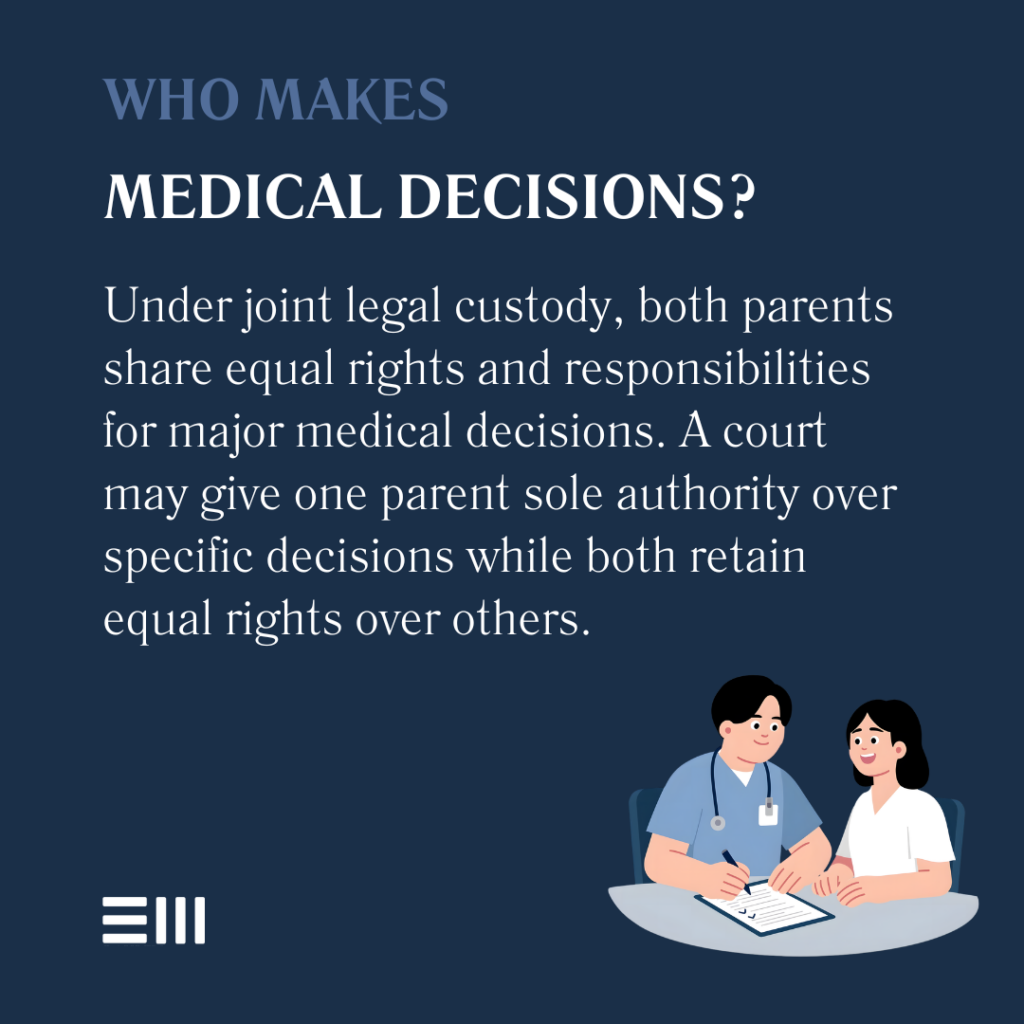
- Joint Legal Custody. Both parents hold equal rights and responsibilities for major decisions about the child, including education, health care, and religious training.
- Sole Legal Custody. One parent holds the sole right and responsibility to make those major decisions.
The statute adds a provision many parents miss. A court may designate one parent to have sole power over certain decisions while both parents keep equal rights over everything else, which is how many Alabama orders resolve medical conflict without stripping either parent of a voice.
Routine Care Versus Major Medical Decisions
Not every trip to the doctor requires a conference between parents. Legal custody governs major decisions, and daily caretaking generally belongs to whichever parent has the child at the time.
Routine matters, such as a sick visit for a fever, a strep test, or an over-the-counter fever reducer, are usually handled by the parent on duty.
Major decisions are a different category, covering things like elective surgery, starting a long-term medication, choosing a new pediatrician, or beginning ongoing therapy. Under joint legal custody, those calls belong to both parents together.
The dividing line is not always obvious, which is exactly why a well-drafted order spells out who handles what.
Emergencies Do Not Wait for Agreement
Parents worry about what happens when a child is hurt, and the other parent cannot be reached. Alabama law answers that directly, and the answer should ease some minds.
Under Alabama Code Section 22-8-3, medical, dental, health, and mental health services may be provided to a minor of any age without a parent’s consent when, in the physician’s judgment, trying to obtain consent would delay treatment in a way that increases the risk to the child’s life, health, or mental health.
In a true emergency, treatment proceeds.
That said, notifying the other parent promptly afterward is both good practice and, in many orders, a written requirement.
Therapy, Medication, and Vaccinations
Three areas generate more conflict than any others, and each carries its own wrinkle in Alabama.
Here’s how they typically play out:
- Therapy and counseling. Starting ongoing mental health treatment is usually a major decision requiring agreement under joint legal custody, though a child 14 or older may consent to mental health services independently.
- Medication. A short course of antibiotics rarely stirs a dispute, while long-term prescriptions, especially for behavioral or psychiatric conditions, generally call for joint agreement.
- Vaccinations. Alabama requires a Certificate of Immunization for school entry, and the Alabama Department of Public Health issues religious and medical exemptions through county health departments. Disagreement over an exemption is a major medical decision.
When parents cannot align on these, the order controls, and if the order is silent, the court may have to fill the gap.
When a Disagreement Needs a Judge
Most medical disputes should never reach a courtroom, and courts prefer that parents resolve them first. Mediation, a pediatrician’s recommendation, or a parenting coordinator often settles the question faster and far more cheaply.
Court involvement becomes appropriate in situations like these:
- A true deadlock on a real decision. Treatment is genuinely needed, the parents cannot agree, and delay would harm the child.
- One parent acting alone. A parent makes major medical decisions unilaterally in violation of the order.
- Care being withheld. A parent refuses treatment a physician recommends, or blocks the other parent from medical records and providers.
- A pattern rather than an incident. Repeated conflict may justify asking the court to modify the order and assign medical decision-making authority.
A court can enforce an existing order through contempt or modify it to give one parent final say on health care, which is often the more lasting fix.
How Our Firm Helps Parents Resolve Medical Disputes
Medical conflicts are rarely only about medicine. They are usually about trust, and about an order that was never specific enough to prevent the fight.
Our experienced family law attorneys here at Baxley Maniscalco help Alabama parents draft custody orders that address medical authority clearly from the start, and we step in when an existing order is being ignored.
One of our attorneys is a registered family law mediator with the state of Alabama, so we can often resolve these disputes without the cost and strain of litigation. If a medical disagreement is affecting your child’s care, our office offers a confidential consultation.
Questions Alabama Parents Are Asking
Medical decision-making raises questions that a parenting schedule does not answer. Here are the ones we hear most often.
Who Makes Medical Decisions Under Joint Legal Custody in Alabama?
Both parents share equal rights and responsibilities for major medical decisions. A court may also give one parent sole power over specific decisions while both retain equal rights over the rest.
Can I Take My Child to the Doctor Without Telling the Other Parent?
Routine care during your parenting time is generally fine, though many orders require notice. Major decisions, such as starting ongoing treatment, require agreement under joint legal custody.
What Happens in a Medical Emergency?
Alabama law allows a physician to treat a minor without parental consent when seeking consent would delay care and increase the risk to the child’s life, health, or mental health. Notify the other parent as soon as you can.
Can One Parent Refuse to Vaccinate Our Child?
Under joint legal custody, neither parent can decide alone. Alabama requires a Certificate of Immunization for school, with medical and religious exemptions issued through county health departments, so a dispute over an exemption may need court resolution.
Can My Teenager Consent to Their Own Treatment?
Yes. Alabama law allows a minor 14 or older, or one who has graduated high school, married, divorced, or is pregnant, to consent to their own medical, dental, and mental health care.
Every family and every order reads differently, so reach out if your circumstances are not covered here.
Your Child’s Care Should Not Be Stuck in a Standoff
When two parents disagree about medical care, the child is the one waiting. A clear order, or a firm hand enforcing the one you have, can end the standoff.
Our experienced family law attorneys here at Baxley Maniscalco are ready to review your custody order and explain your options.
Call us at (256) 770-7232 or reach out through our contact form to schedule a consultation today.
Can't find what you're looking for? Search our site below.