

The settlement offer finally arrives. You’ve already thought about the bills you’ll pay. Then someone mentions that Medicare may need to be reimbursed.
Wait. Didn’t Medicare cover those appointments because you were insured?
It may have paid them conditionally. In certain accident cases, those payments must be addressed when another source becomes responsible for the same medical expenses.
We consider repayment issues while handling Alabama personal injury claims, including car accident cases. The offer’s headline number isn’t the same as the amount you can safely take home.
This discussion focuses on Original Medicare’s recovery of accident-related payments. Other health plans can raise separate issues, so we need to know about all of your coverage.
Have questions about a settlement and Medicare? Contact us for a free personal injury consultation or call (256) 770-7232.
Why Medicare May Have Paid First
After a crash, you need treatment now. The liability claim may take months to resolve, and the insurance company hasn’t agreed to pay your medical expenses yet.
Under the Medicare Secondary Payer rules, liability or no-fault insurance may be responsible before Medicare for covered accident-related care.
Medicare can make a conditional payment when the responsible insurer hasn’t paid promptly. “Conditional” means Medicare may seek repayment when a settlement, judgment, award, or other payment becomes available.
This isn’t a conclusion that you did something wrong by using your benefits. It’s a coordination issue that needs to be handled as part of the claim.
Don’t stop necessary treatment because you’re worried about the terminology. Tell your providers and your legal team about the accident and your coverage so the records can be handled accurately.
Three Numbers You Shouldn’t Confuse
A provider’s billed charge, Medicare’s payment, and Medicare’s eventual recovery demand aren’t automatically the same figure. Nor is an early claim summary always the final amount owed.
A useful way to organize the paperwork is to separate:
- The treatment bill: What the provider charged and how the service was processed.
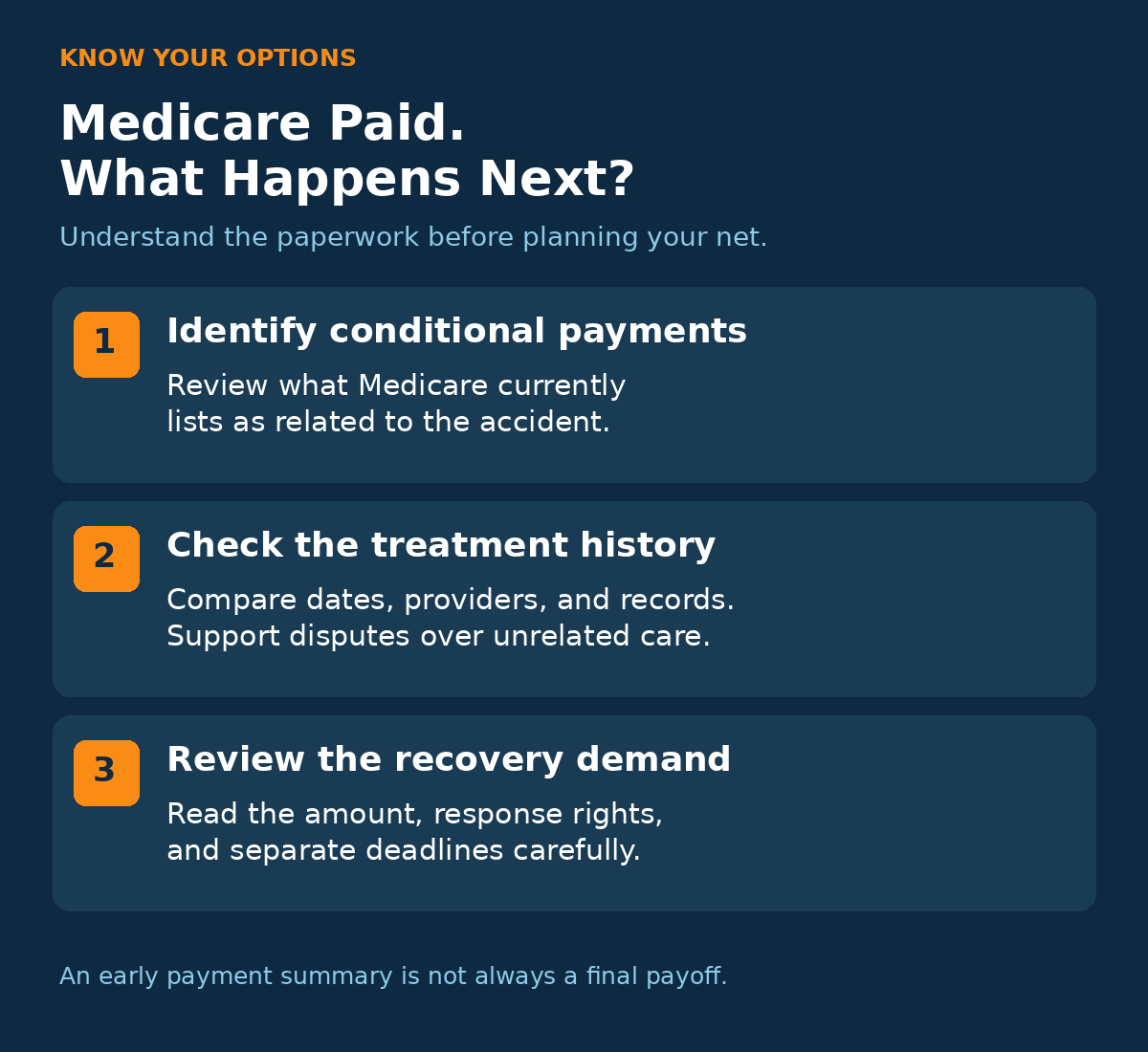
- The conditional payment information: What Medicare currently identifies as payments related to the accident.
- The recovery demand: The amount Medicare seeks after it has the relevant settlement information and applies its recovery rules.
You may also have balances or claims from other sources. One Medicare letter doesn’t establish that every financial issue attached to the settlement has been resolved.
We want an understandable accounting, with each amount identified. A stack of letters with different totals is a reason to reconcile the records, not pick the lowest number.
Check Which Treatment Is Actually Related
Medicare’s records may include services that need closer review. A payment appearing on a conditional payment summary doesn’t eliminate the need to examine its connection to the injury claim.
CMS explains the review process in its conditional payment information for attorneys. Unrelated claims can be disputed with an explanation and supporting documentation.
Imagine that you received treatment for a crash-related shoulder injury and also had an unrelated routine eye appointment. We would review the actual records before treating both payments as part of the injury claim.
The opposite can happen too. A service with an unfamiliar billing description may still be related to your accident. The label alone doesn’t settle the issue.
Help us build a clear treatment timeline. Dates, providers, diagnoses, and the reason for each visit can make a dispute more specific and easier to evaluate.
Don’t alter a medical record or ask a provider to erase accurate history. If something is wrong, use the provider’s legitimate correction process and preserve the original context.
An Early Letter Isn’t Permission to Spend the Money
A conditional payment letter provides information about payments identified at that stage. It isn’t necessarily a final payoff figure, especially if additional claims are still being processed.
The CMS recovery process involves reporting settlement information and obtaining a recovery demand. The demand explains the amount requested and available response rights.
Read every notice by its actual title. A conditional payment letter, conditional payment notice, and demand letter can require different responses.
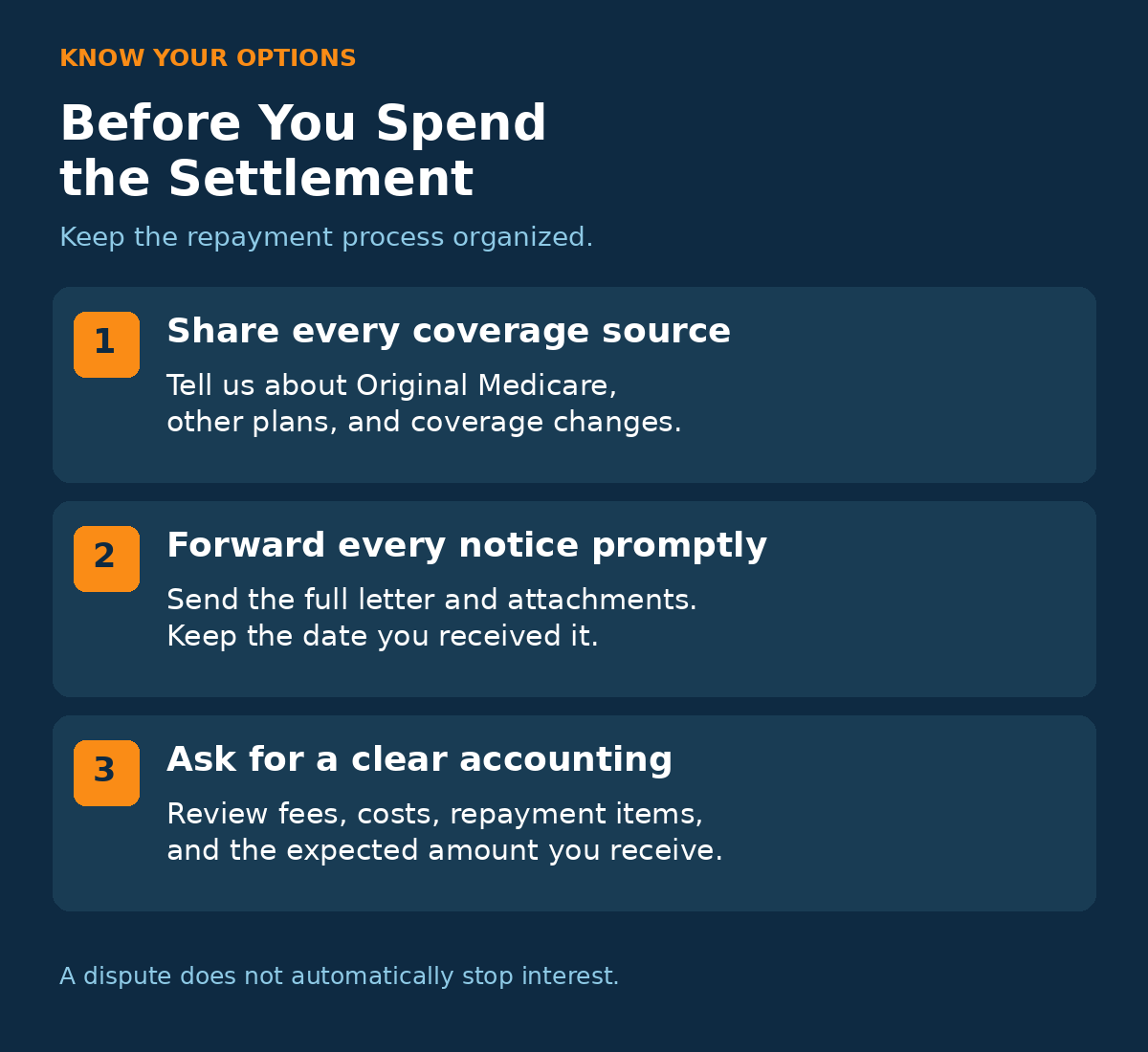
If you receive a letter directly, send the complete document to us, including attachments and the envelope or receipt date. Don’t assume we received an identical copy.
Keeping the settlement funds organized while repayment is resolved can prevent a painful problem later. We can explain which amounts are still uncertain before you make plans around the proceeds.
Can Attorney Fees Reduce Medicare’s Recovery?
They can affect the calculation. Federal regulations address how Medicare shares certain procurement costs, including qualifying attorney fees and litigation expenses incurred in obtaining the recovery.
The formula appears in 42 C.F.R. § 411.37. The calculation depends on the relevant payments, recovery, and costs; it isn’t an automatic promise to erase the debt.
That’s why accurate settlement and expense information matters. We don’t want Medicare calculating its demand from an incomplete account of how the recovery was obtained.
A friend may tell you that their repayment was reduced dramatically. Their result doesn’t establish what will happen in your claim, with your treatment and your settlement figures.
Ask for a breakdown that shows the gross settlement, fees, expenses, repayment obligations, and expected net proceeds. Each line should have an explanation.
Disputing an Amount and Requesting a Waiver Are Different
You might believe a payment wasn’t related to the accident. Or you might accept that a debt exists but believe a waiver should be considered. Those are different issues.
The notice and the applicable process determine how to present your request. Sending a general letter saying “this seems unfair” may fail to address the actual question Medicare needs to decide.
A beneficiary’s first-level appeal generally has a 120-day deadline from receipt of the initial determination, as described in CMS’s beneficiary recovery portal guide.
That appeal period isn’t an extension of every payment deadline. Don’t assume a pending dispute or waiver request automatically prevents interest from accruing.
Bring us the notice promptly so we can identify the appropriate response, supporting evidence, and separate dates. Waiting until the last day leaves less room to correct missing information.
Tell Us About Every Type of Coverage
Your Medicare card is only part of the picture. You may also have a Medicare Advantage plan, prescription coverage, Medicaid, supplemental insurance, or another health plan.
Tell us about all of them, even if you think one “didn’t pay much.” Different payers can involve different rules, records, and contacts.
Also flag any change in coverage during treatment. A switch between plans can explain why one portion of your medical history appears in a different system.
Finally, repayment of past medical expenses isn’t the same question as planning for future care. Don’t assume that resolving one automatically resolves the other.
Frequently Asked Questions
Do I Have to Deal With Medicare if the Insurer Denied Fault?
A liability dispute doesn’t automatically eliminate Medicare’s recovery issues when a settlement is reached. We review the payment history and the recovery rules that apply to the particular claim.
Is the Conditional Payment Letter the Final Amount I Owe?
Not necessarily. It reflects information at a particular stage. Additional payments, disputes, settlement information, and applicable adjustments can affect the final demand.
Can I Challenge Medical Payments That Weren’t Accident-Related?
Yes, the process allows disputes over unrelated payments. Supporting medical records and a clear explanation matter. Don’t assume that every disputed item will automatically be removed.
Does Medicare Always Take the Entire Settlement?
No. There isn’t a universal outcome like that. The recovery calculation depends on the circumstances, and applicable procurement-cost rules can affect the demand.
Can I Ignore a Letter While My Lawyer Handles the Case?
No. Send it to us promptly, even if you believe we already have it. A notice delivered to you may contain a response deadline or information we need to review.
Is This the Same as a Medicare Set-Aside?
No. Reimbursement of past conditional payments and planning for future medical expenses are different questions. Don’t assume a future-care arrangement is automatically required in every liability settlement.
Know the Net Number Before You Plan Around It
A settlement should come with a clear explanation of what happens next. We help clients examine repayment issues alongside liability, damages, and the proposed release.
If Medicare paid for treatment after your accident, contact us for a free personal injury consultation or call (256) 770-7232. We’ll help you understand the questions that need answers before the funds are distributed.
Can't find what you're looking for? Search our site below.