

The auto policy sitting in your glove box may contain a sentence Alabama courts threw out more than fifty years ago.
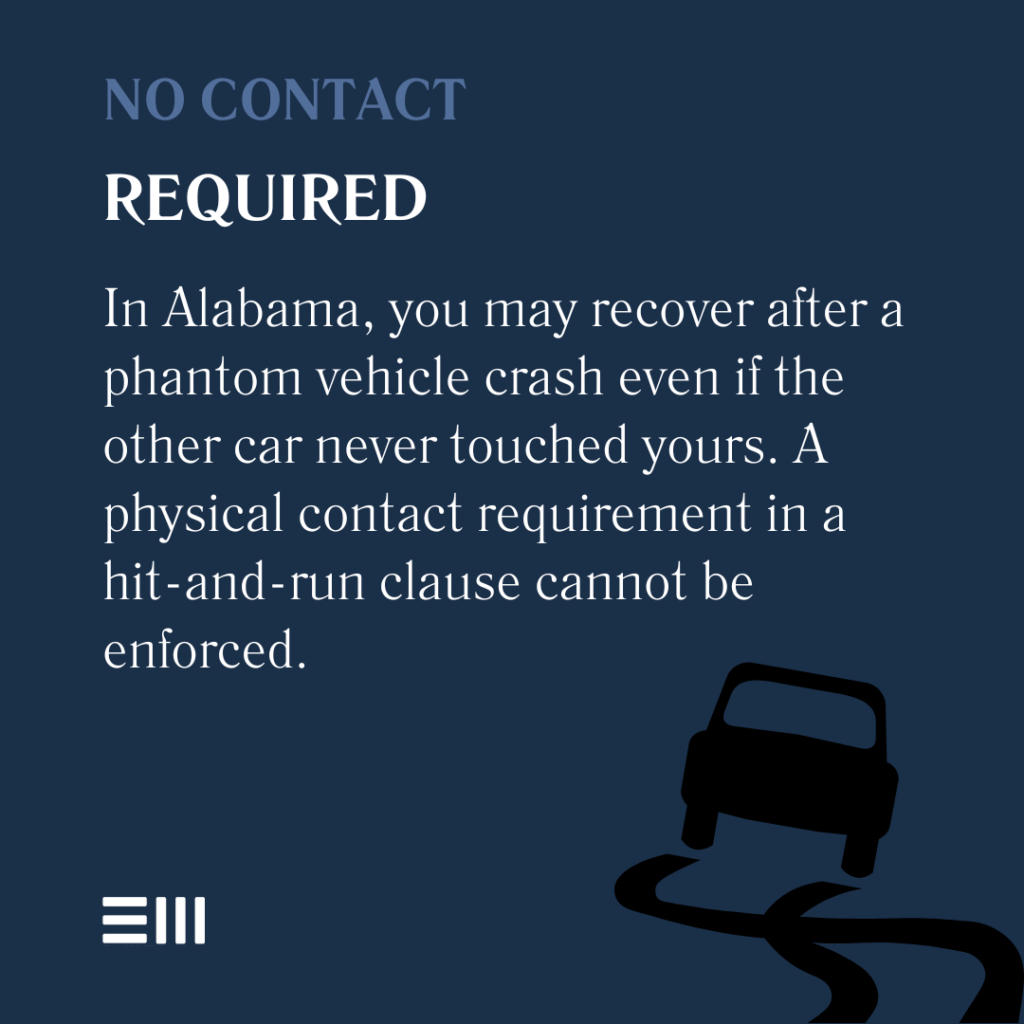
Many policies still say that a hit-and-run claim requires physical contact with the other vehicle. In Alabama, that clause is contrary to the state’s uninsured motorist statute and cannot be enforced.
That matters enormously if a driver ran you off the road and vanished without ever touching your car. Insurers sometimes deny these claims by pointing to language the law does not permit them to use, and drivers accept the denial because they do not know any better.
What Counts as a Phantom Vehicle Crash
A phantom vehicle case, sometimes called a miss and run, involves an unidentified driver who causes a crash without colliding with you. The wreck is real. The other driver is simply gone.
These situations tend to look like this:
- A driver drifts into your lane. You swerve to avoid a head on collision and strike a guardrail, a ditch, or a tree.
- A vehicle cuts you off. You brake hard or veer away, lose control, and leave the road.
- A wrong-way or crossing driver. You take evasive action that saves your life and wrecks your car.
- A driver who never stops. By the time you come to rest, the vehicle that caused it is out of sight.
In each case, the crash report may list a single vehicle, which is precisely why these claims need careful handling from the outset.
Where Your Recovery Comes From
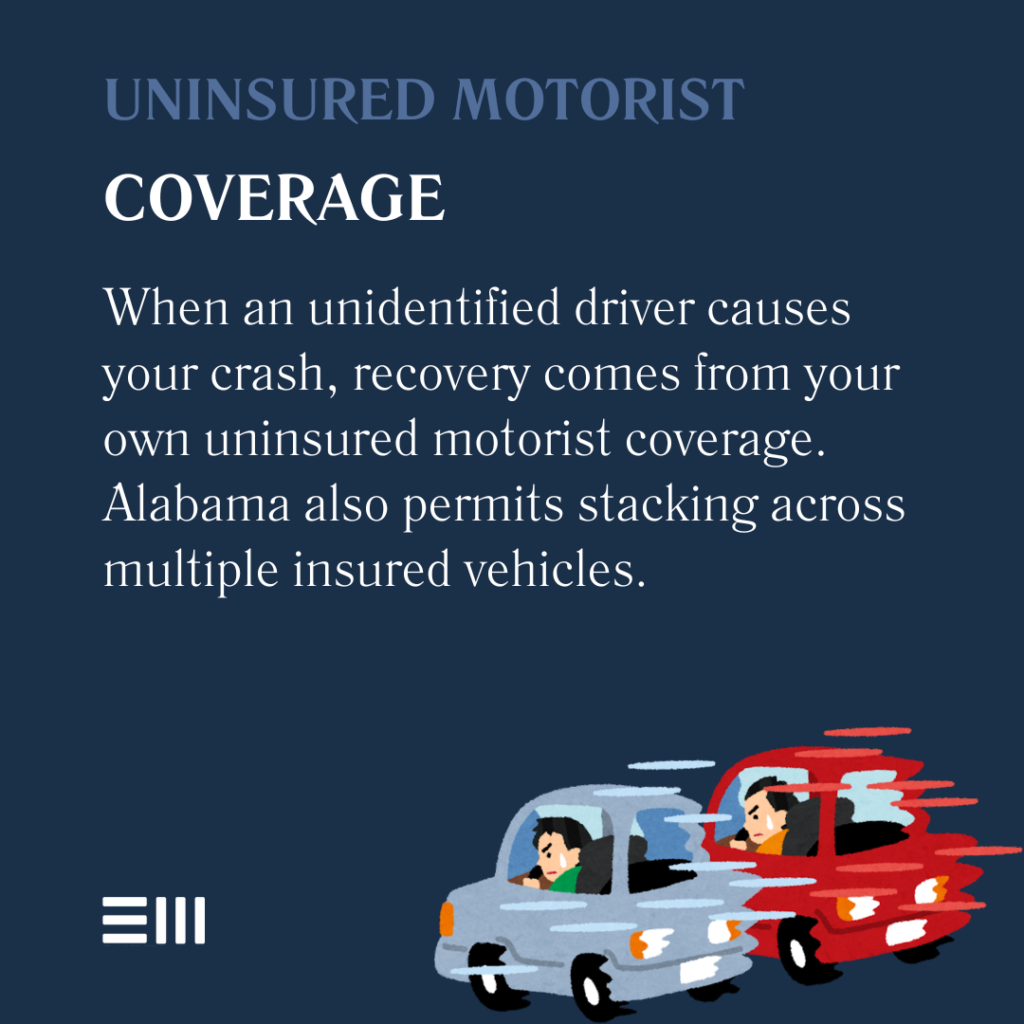
With no identified driver, there is no one to sue and no liability policy to pursue. Recovery instead comes from your own uninsured motorist coverage, which exists for exactly this scenario.
Under Alabama’s uninsured motorist statute, Section 32-7-23 of the Alabama Code, insurers must offer this coverage unless the insured rejects it in writing.
When an unidentified driver causes your crash, your own carrier effectively steps into that driver’s place, which means the company you pay premiums to becomes the party evaluating your claim.
Alabama also permits stacking, so a household insuring multiple vehicles on one policy may be able to combine limits and increase what is available.
Check every policy in the household, since coverage a family did not know it had is common in these cases.
The Rule Insurers Do Not Advertise
This is the point most drivers never learn, and it decides many of these claims. Alabama does not condition your recovery on the other vehicle having hit you.
The Alabama Supreme Court held that a physical contact requirement in a hit-and-run clause conflicts with the uninsured motorist statute and is void as against public policy, reasoning that the statute exists to protect people injured by motorists who cannot make them whole.
Alabama authority likewise treats a phantom vehicle as presumed uninsured, and the claimant’s own testimony can suffice to prove that the phantom vehicle existed.
Policy clauses demanding corroboration beyond your own testimony have been challenged as imposing a higher burden than the statute allows.
None of that means proof is optional. It means the law does not shut the door before you get a chance to offer it.
What You Still Have to Prove
Removing the contact requirement does not remove your burden. You must still show the phantom driver was at fault and that the crash caused your injuries.
Evidence that carries weight includes a prompt police report describing the other vehicle, dashcam footage from your car or a nearby vehicle, nearby business or traffic camera recordings, physical evidence at the scene such as skid marks and gouges, testimony from passengers or other motorists, and medical records created soon after the wreck.
Accident reconstruction can also demonstrate that your vehicle’s movement is consistent with an evasive maneuver rather than a simple loss of control.
The sooner this evidence is gathered, the stronger the claim, because camera footage in particular is often overwritten within days.
The Alabama Rule That Can Sink Your Claim
There is a hard edge to these cases that catches injured drivers by surprise. Alabama remains a contributory negligence state, meaning a person found even slightly at fault may recover nothing at all.
Your uninsured motorist carrier can raise the same defenses the phantom driver could have raised, and contributory negligence is the favorite.
Expect questions suggesting you overreacted, drove too fast for conditions, or could have avoided the crash without leaving the roadway. Because your own insurer is now the opposing party in substance, statements you give casually can be used against you later.
Treat the claim as adversarial from the first phone call, however friendly that call sounds.
Steps to Take After a Driver Disappears
What you do in the first hours shapes what is possible months later. A short checklist protects the claim.
- Call the police immediately. A contemporaneous report describing the other vehicle is powerful corroboration.
- Describe the phantom driver in detail. Color, make, direction of travel, and any partial tag belong in the report.
- Look for cameras and witnesses. Note nearby businesses, homes, and traffic cameras before footage is lost.
- Photograph the scene fully. Capture skid marks, debris, road position, and your vehicle from several angles.
- Get medical care right away. A same-day record links your injuries to the crash and closes an easy defense.
- Notify your insurer, then get advice. Report the crash as your policy requires, but speak with an attorney before giving a recorded statement.
Each of these steps builds the record that answers an insurer’s central argument, which is that no other vehicle was ever there.
How Our Firm Handles Phantom Vehicle Claims
These claims are unusual because the fight is with your own insurance company, and because the evidence that proves them tends to disappear quickly. Both realities reward moving fast.
Our experienced personal injury attorneys here at Baxley Maniscalco locate and preserve footage before it is erased, identify every uninsured motorist policy available to your household, and push back when a carrier relies on policy language Alabama law does not permit.
We handle serious injury and wrongful death claims across the state on a contingency basis, so there’s no fee unless we recover for you. If an unidentified driver ran you off the road, a free case review costs you nothing.
Questions Alabama Drivers Are Asking
Phantom vehicle claims raise questions that ordinary crash claims do not. Here are the ones we hear most often.
Can I Recover If the Other Car Never Hit Me?
Yes. Alabama courts have held that a physical contact requirement in a hit-and-run clause conflicts with the uninsured motorist statute and cannot be enforced, so a claim may proceed without contact.
What If I Have No Witnesses?
You may still have a claim. Alabama authority indicates a claimant’s own testimony can establish that the phantom vehicle existed, and policy terms demanding more than the statute requires have been challenged as unenforceable.
Will My Rates Go Up If I File a Claim?
Uninsured motorist coverage exists for this situation, and you are using a benefit you paid for. Concerns about a carrier’s response are worth raising with an attorney rather than allowing them to stop you from filing.
How Much Coverage Do I Have?
Check each policy in your household. Alabama permits stacking, so combining limits across multiple insured vehicles may increase what is available.
What If the Driver Is Later Identified?
If the driver is found and uninsured, the claim generally proceeds against your own coverage. If they carry insurance, your claim may shift to their liability policy, with underinsured coverage available if their limits fall short.
Every crash is different, so reach out if your situation is not covered here.
The Other Driver Vanished. Your Claim Should Not.
Being run off the road by someone who never stopped is infuriating, and being told there is nothing you can do is usually wrong. There may be coverage waiting, and finding out costs nothing.
Our experienced personal injury attorneys here at Baxley Maniscalco are ready to review your crash and explain your options.
Call us at (256) 770-7232 or reach out through our contact form to schedule a free consultation today.
Can't find what you're looking for? Search our site below.