

An adjuster’s favorite question after a crash is simple: Send me your pay stubs.
For millions of American workers, that request has no answer, because as of December 2025, roughly 16.6 million people in the United States were self-employed, and broader surveys that count freelancers and side gig earners put the number far higher.
Not one of them receives a pay stub. That doesn’t mean their income is unprovable, and it certainly doesn’t mean an insurer gets to treat their losses as zero. It means the proof looks different, and it has to be assembled deliberately.
Why Insurers Push Back on These Claims
Insurers prefer claims they can calculate in a spreadsheet. An hourly worker missing three weeks produces a clean number, while a contractor whose earnings swing month to month produces an argument.
Expect to hear that your income was unpredictable anyway, that a slow season explains the drop, that the business could have run without you, or that you chose not to work rather than being unable to. None of these arguments are proof.
They are positions, and they lose their force against organized records that show what you actually earned before the crash and what changed after it.
The burden does sit with you, which is why the documentation matters so much.
Lost Income and Lost Earning Capacity Are Not the Same
These two terms are often used interchangeably, but they are different claims with different proof. Understanding the distinction helps you know what to gather.
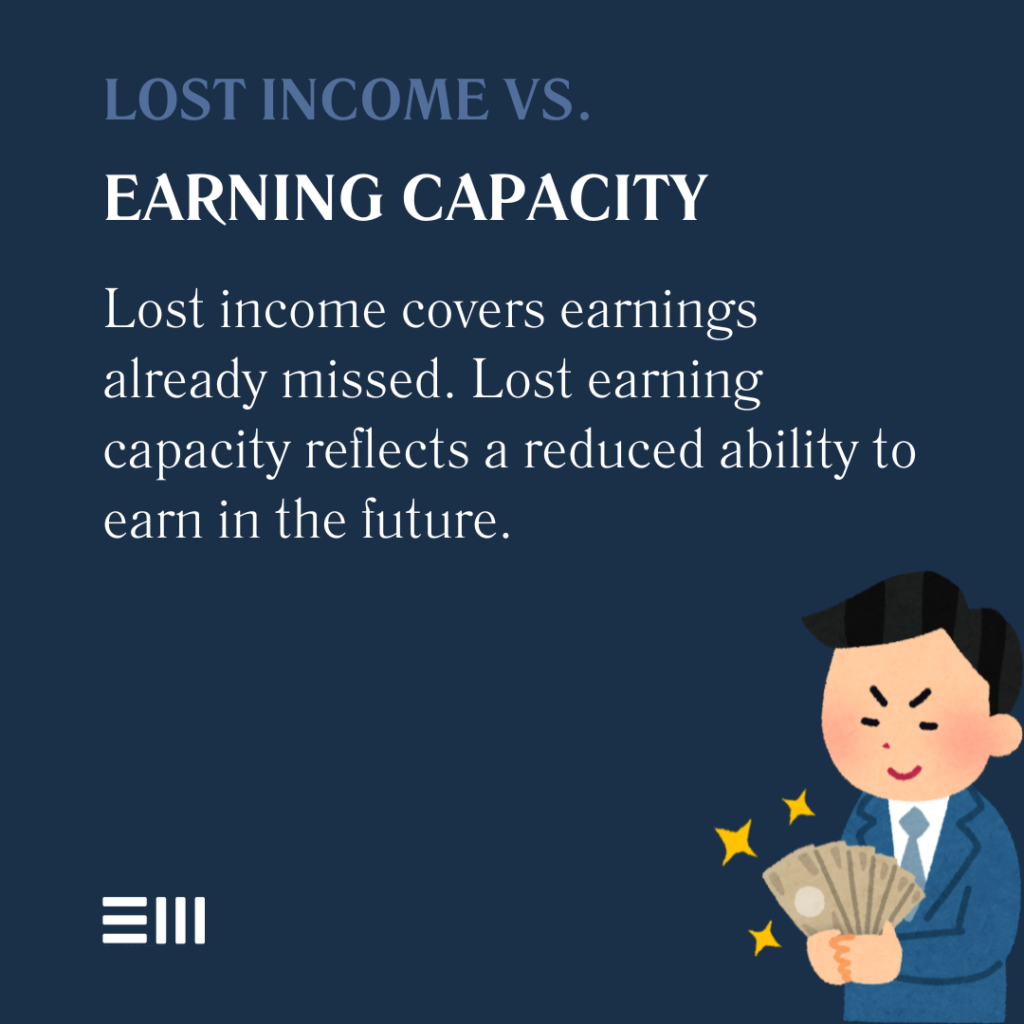
The difference works like this:
- Lost Income. The specific earnings you already missed between the injury and now, measured against what you would reasonably have earned.
- Lost Earning Capacity. The reduction in your ability to earn going forward, which can exist even if you return to work and even if your income eventually recovers.
A self-employed person can have both. A photographer who misses a wedding season has lost income, and a photographer who can no longer carry equipment has lost earning capacity on top of it.
The Records That Actually Prove Your Losses
No single document carries a self-employed worker’s claim. Strength comes from layering several sources that tell a consistent story.
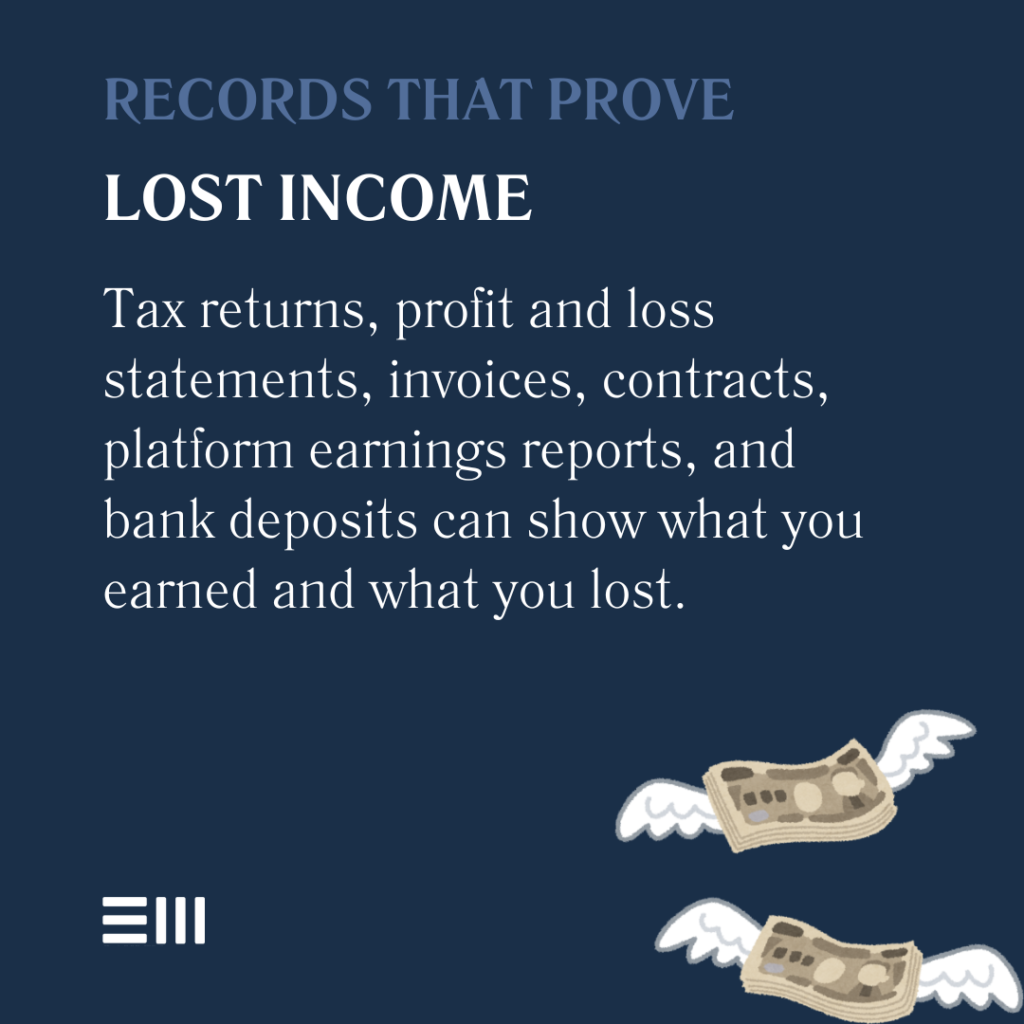
Records worth gathering include the following:
- Tax returns and schedules. Two or three prior years establish your earnings history and typical seasonal pattern.
- Profit and loss statements. These show revenue and expenses in a form an adjuster and a jury can follow.
- Invoices and contracts. Signed agreements and unpaid invoices demonstrate work that existed and did not happen.
- Platform earnings reports. Rideshare, delivery, and freelance marketplace apps generate downloadable weekly and annual summaries.
- Bank and merchant deposits. Deposit histories and payment processor records corroborate what the returns report.
- Client communications. Emails canceling or postponing work connect a specific lost job to your injury.
- Replacement labor costs. What you paid someone to cover your duties is a direct, documented loss.
Together, these convert a claim that sounds speculative into one built on numbers with sources behind them.
Proof by the Kind of Work You Do
Different types of self-employed work generate different evidence, and the strongest claims lean on whatever the job already produces.
Rideshare and delivery drivers have an advantage, since platforms record trips, hours, and earnings in exportable reports that show a clear before-and-after.
Commission-based workers can pull pipeline reports, prior commission statements, and sales records showing deals that were pending when the crash happened. Freelancers and contractors rely on signed contracts, project proposals, and client correspondence.
Small business owners face the most complex proof, because the analysis has to separate what the business lost from what the owner personally lost, and it usually turns on showing that the owner’s own labor drove the profits rather than employees or capital.
Whatever the category, the goal is the same: a documented gap between the expected and the actual.
Where Expert Testimony Earns Its Keep
Serious self-employment claims often need more than records. Alabama requires damages to be proven with reasonable certainty rather than left to speculation, and experts help meet that standard.
A forensic accountant can normalize fluctuating income, isolate the injury’s effect from ordinary market swings, and project losses in a defensible way.
A vocational expert can explain how a physical limitation restricts the kind of work you can still perform and reduces your earning capacity. An economist can reduce future losses to present value.
For a business owner, expert analysis is frequently what separates a claim an insurer dismisses as guesswork from one that survives scrutiny.
These professionals do not manufacture numbers. They organize real ones into a form the law recognizes.
Alabama Rules That Make Timing Matter
Two features of Alabama law give these claims urgency. Both catch self-employed people by surprise.
Alabama is a contributory negligence state, meaning an injured person found even slightly at fault may recover nothing at all, which raises the stakes on every part of the case. Alabama also generally allows two years from the date of injury to file a personal injury claim.
Meanwhile, the records that prove self-employment losses have their own clocks, since platform data may be purged, clients move on, and the memory of who canceled what fades quickly.
Start gathering records now, even if you have not decided whether to pursue a claim.
How Our Firm Handles Self-Employment Claims
Insurers count on self-employed people accepting a lower number because their losses are harder to package. We treat that difficulty as work to be done, not a reason to discount a claim.
Our experienced personal injury attorneys here at Baxley Maniscalco help Alabama freelancers, contractors, drivers, and business owners assemble the records that prove lost wages and income, and we bring in forensic accounting and vocational experts when a claim calls for it.
We handle these cases on a contingency basis, so there’s no fee unless we recover for you. If a crash interrupted work you do for yourself, a free case review is the place to start.
Questions Self-Employed Alabamians Are Asking
Proving income without a pay stub raises questions traditional employees never face. Here are the ones we hear most often.
Can I Claim Lost Income Without a Pay Stub?
Yes. Tax returns, profit and loss statements, invoices, contracts, platform earnings reports, and bank deposits can all establish what you earned and what you lost.
What If My Income Varies a Lot Month to Month?
Fluctuation is expected in self-employment. Several years of records establish your pattern, and a forensic accountant can separate injury-related losses from ordinary seasonal swings.
I Underreported Income on My Taxes. Can I Still Recover?
This is a serious complication worth raising privately with an attorney before filing anything. Tax returns are central evidence in these claims, and inconsistencies carry consequences beyond the case.
Can My Business Recover for Its Losses Too?
The analysis separates the owner’s personal earnings loss from the business entity’s losses. Which claims are available depends on how the business is structured and whose labor produced the profits.
What If I Went Back to Work Right Away?
You may still have a claim. Returning to work does not eliminate a loss of earning capacity if you are working in pain, taking fewer jobs, or unable to perform the same tasks.
Every business and every injury is different, so reach out if your situation is not covered here.
Your Work Is Real. So Is What the Crash Cost You.
Not having a pay stub does not make your losses smaller, only harder to show. With the right records and the right experts, those losses become as concrete as any paycheck.
Our experienced personal injury attorneys here at Baxley Maniscalco are ready to review your situation and explain your options.
Call us at (256) 770-7232 or reach out through our contact form to schedule a free personal injury consultation today.
Can't find what you're looking for? Search our site below.