
You’re still going to physical therapy from the first crash when another driver hits you. Now your neck hurts more, your appointments multiply, and two insurers start pointing at each other.
Which accident caused what? And does the second wreck ruin the first claim?
There isn’t a one-sentence answer. We need a reliable timeline, medical evidence, and a clear picture of both claims before assigning responsibility for overlapping injuries.
We handle Alabama car accident claims and help clients document worsened pre-existing conditions. Two crashes add another layer: your condition between the accidents can become especially important.
Injured again while your first claim is still open? Contact us for a free personal injury consultation or call (256) 770-7232.
Start With What Changed, Not a Percentage
An adjuster may ask how much of your pain belongs to each crash. You don’t have to invent a medical percentage to sound cooperative.
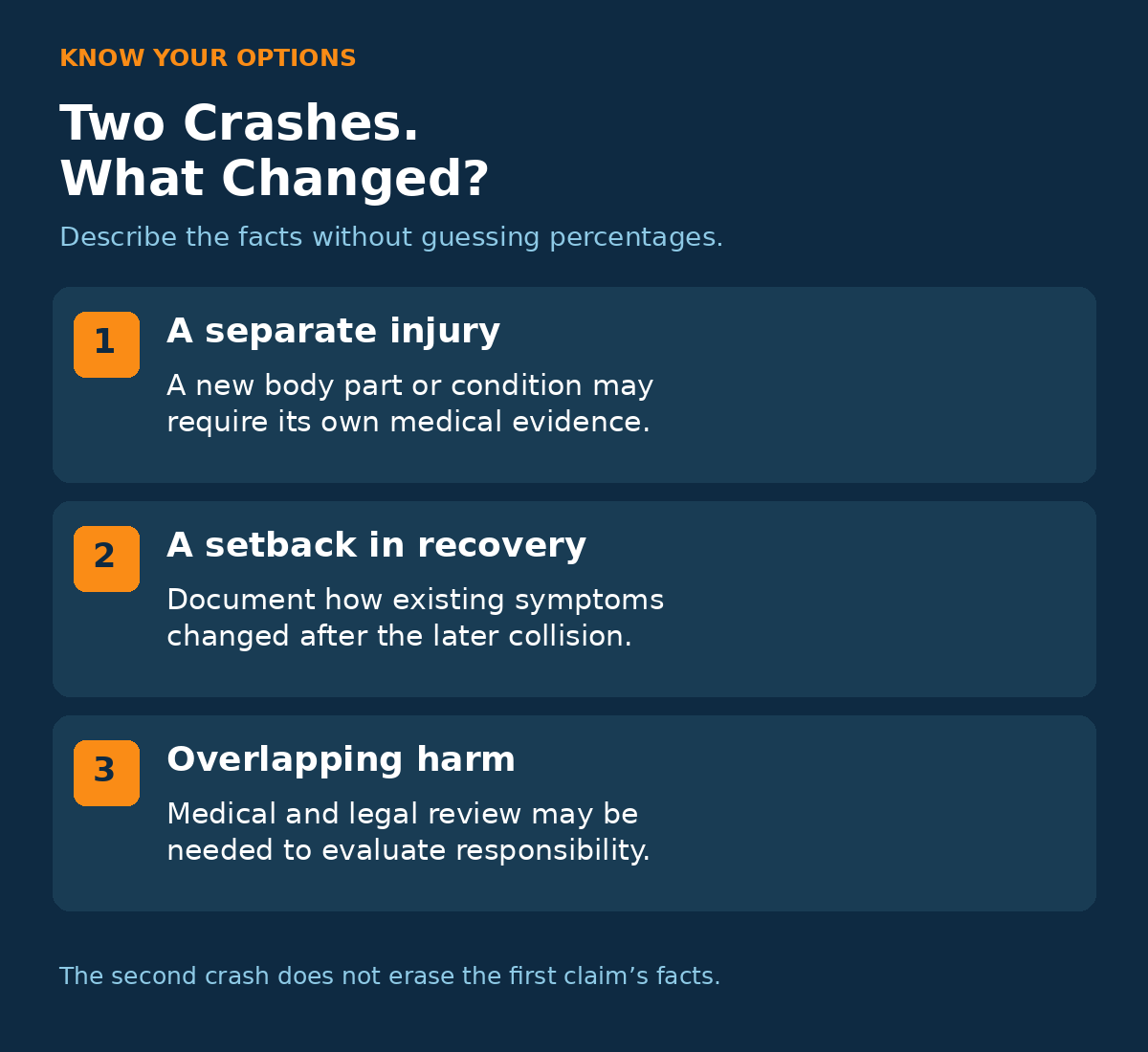
Tell the truth about what you experienced. Were you improving before the second collision? Did a new symptom appear afterward? Did an existing limitation become more severe?
Those observations are useful. A confident guess that the first crash caused “70%” of the problem can create confusion when the medical evidence tells a more complicated story.
We work from records and qualified medical opinions where needed. Your role is to describe your experience accurately, including uncertainty when you genuinely don’t know.
There Are Several Possible Injury Patterns
Sometimes the injuries are distinct. The first crash injured a wrist; the second caused a knee injury. Even then, time off work or overlapping appointments may need careful documentation.
Sometimes the second crash aggravates an existing injury. You may have been recovering from back pain, then experience a significant setback after the later impact.
In other situations, the resulting harm is difficult to separate. That can raise complicated causation and allocation questions. It doesn’t automatically mean both drivers owe every dollar.
The legal approach depends on the evidence and the claims involved. We shouldn’t assume the last driver is responsible for everything, or that the first driver’s responsibility ends simply because another crash occurred.
Your Medical History Needs the Whole Story
Tell each treating provider about both collisions and any relevant earlier symptoms. Give the dates and describe how your condition changed between them.
A doctor evaluating you after the second crash may not automatically have the records from the first. Don’t assume that every office uses the same electronic chart or can see everything you’ve reported elsewhere.
The Alabama Supreme Court’s decision in Whisenant v. Nationwide shows why the history matters. The case involved claims arising from two accidents and conflicting evidence about the source of the alleged injuries.
The court upheld the challenged defense verdict. Among the evidence it discussed were earlier symptoms and treatment that a physician hadn’t been told about when relating the problems to the accidents.
That doesn’t mean an earlier injury defeats every later claim. It shows the risk of asking medical opinions to carry a case while leaving out relevant history.
If you realize you gave an incomplete answer, tell us and your provider. A timely, truthful clarification is better than letting an inaccurate account become the foundation of the claim.
Build a Timeline With Three Chapters
A useful timeline doesn’t need to read like a diary. It should help someone understand what your health and daily life looked like at each stage.
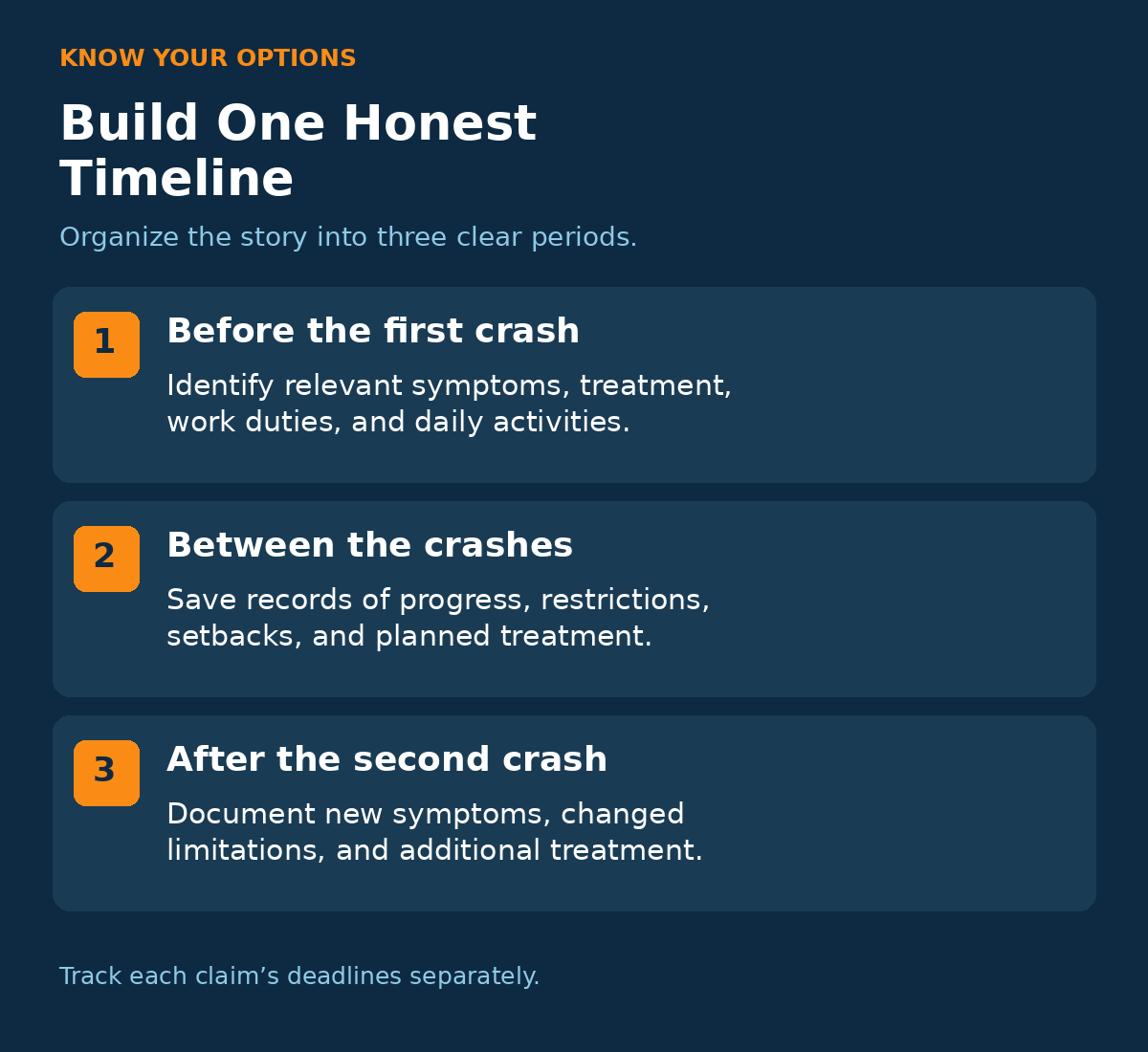
Organize it around three periods:
- Before the first crash: Identify relevant symptoms, treatment, work duties, and everyday activities.
- Between the crashes: Record diagnoses, therapy, restrictions, progress, setbacks, and any treatment plans already in place.
- After the second crash: Note new symptoms, changes in existing symptoms, additional treatment, and revised restrictions.
Use existing records wherever possible. Appointment notes, work restrictions, photographs, and contemporaneous messages can help establish what was happening at the time.
If you’re reconstructing events later, label the timeline honestly. Don’t present a memory written today as a note you made months ago.
Keep Two Claim Files and One Complete Medical Picture
Separate folders can help prevent mix-ups. Keep each crash report, claim number, adjuster’s contact information, vehicle photographs, and insurance correspondence with the correct accident.
At the same time, your legal team needs to see the whole picture. Handling the files as if the other accident never happened can create inconsistent statements and settlement problems.
Tell us if another lawyer represents you on either claim. Coordinating the relevant information is especially important when the injuries, providers, or insurers overlap.
Don’t forward one insurer a document simply because the other insurer requested it. Review requests in context, including authorizations and statements that could affect both claims.
Don’t Count the Same Loss Twice
If one week away from work overlaps both injuries, it still represents one week of lost earnings. How responsibility is allocated may be disputed, but duplicating the loss doesn’t solve that dispute.
The same care is needed with medical bills, transportation expenses, and household help. Keep each expense identifiable and note what it relates to without guessing beyond what you know.
For workers without traditional payroll records, our guide to proving lost income without a pay stub explains useful documentation.
A spreadsheet can help track dates and amounts. It can’t replace the underlying records or determine medical causation on its own.
We want the claim to account for your actual losses accurately. That requires both completeness and a method for spotting overlap.
Review a Settlement in the Context of Both Crashes
An offer on the first claim may arrive while treatment continues after the second crash. Before signing, we need to understand what the proposed release says and which claims it resolves.
Alabama Code § 12-21-109 provides that written releases are given effect according to their terms and the parties’ intentions.
That makes the actual language important. Don’t assume a document is harmless because the adjuster describes it as “just closing this file.”
The settlement accounting may also involve medical repayment obligations or insurance conditions. A release review should happen before you sign, not after the check has been deposited.
The Second Crash Doesn’t Restart the First Deadline
Alabama’s general two-year limitations provision for many personal injury claims is an important starting point, but different claims and exceptions can involve different rules.
Don’t treat the date of the second collision as a new filing date for the first one. Each claim needs its own deadline analysis.
Insurance notices and other required steps can also arise before a lawsuit deadline. Waiting for your doctors to sort out every medical question isn’t a safe reason to ignore those requirements.
Bring us both accident dates promptly. We can evaluate the deadlines while the evidence and medical investigation continue.
Frequently Asked Questions
Does a Second Accident Automatically Destroy My First Claim?
No. It creates additional causation and damages questions. We need to evaluate what each event caused and how the evidence supports the losses claimed in each case.
Should I Tell the Second Doctor About the First Crash?
Yes. Provide an accurate history, including relevant prior symptoms and treatment. A medical opinion based on incomplete information can be vulnerable when the records are reviewed.
What if I Can’t Tell Which Crash Caused the Pain?
Say so. Describe the timing and changes you noticed without inventing an answer. Medical evaluation and the surrounding evidence may help address questions you can’t resolve yourself.
Can Both Insurance Companies Blame the Other Crash?
They may dispute causation or allocation. That doesn’t settle the issue. A coherent timeline and supporting medical evidence are more useful than simply repeating one adjuster’s position.
Can I Settle One Claim While the Other Is Still Open?
Possibly, but the release, injury allocation, insurance conditions, and repayment issues need review first. Don’t assume a settlement affecting overlapping injuries has no consequences for the other matter.
Do I Have Two Years From the Most Recent Crash for Everything?
No. The later collision doesn’t automatically restart the earlier claim’s limitations period. Each accident and each applicable claim needs a separate deadline review.
Two Claims Need One Honest Timeline
Being injured twice is stressful enough without trying to referee two insurance companies. We can help organize the evidence and evaluate how the claims affect one another.
Contact us for a free personal injury consultation or call (256) 770-7232. Bring both crash reports, your treatment information, and any settlement paperwork you’ve received.
Can't find what you're looking for? Search our site below.