
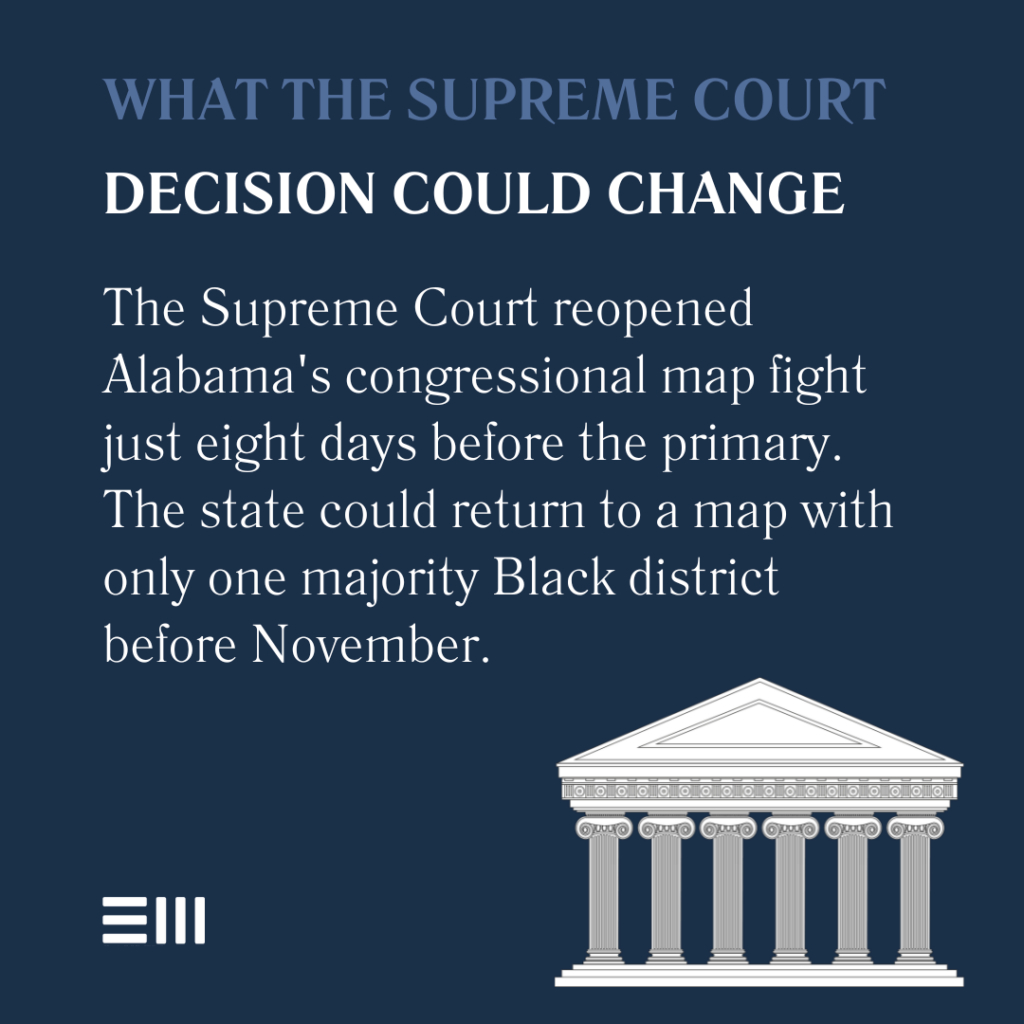
Eight days before Alabama voters head to the polls, the U.S. Supreme Court rewrote the map they will eventually vote under.
On May 11, 2026, the justices opened the door for the state to eliminate one of its two majority Black congressional districts before the November midterms, a move that could hand Republicans an additional U.S. House seat in a chamber where every vote counts toward control.
The ruling overturned a judicial order that had required Alabama to use a court-imposed map through the 2030 census. In its place, the high court directed a lower court to reconsider the case in light of the April 2026 decision that struck down a majority-Black district in Louisiana.
The chain reaction is now in motion, with the May 19, 2026, primary just days away and Alabama lawmakers already preparing for a redrawn ballot.
A Decision Eight Days before the Primary
The Supreme Court’s brief order arrived at a moment Alabama officials had been preparing for. The state had requested an expedited decision ahead of the May 19, 2026, primary, anticipating that the justices might use the Louisiana ruling as a pivot point to revisit its own congressional map.
That is exactly what happened.
The order sends the case back to a lower court for reconsideration. If that court allows it, Alabama can revert to the map approved in 2023 by the Republican led legislature, which contains only one district where Black residents comprise a majority.
Several moving pieces define what happens next.
- Lower court review. A federal court must now reevaluate the Alabama map in light of the Louisiana decision before any new boundaries can take effect.
- Primary contingency law. Alabama lawmakers recently enacted legislation allowing the state to void the May 19 primary results in four impacted districts and hold special primaries under revised boundaries.
- Governor’s authority. Special primary dates would be set by the governor’s office if the map changes.
The architecture for a redrawn election is in place. The only open question is how quickly it gets used.
The Louisiana Domino That Set This in Motion
The Supreme Court’s April 2026 ruling on Louisiana’s congressional map did more than reshape one state’s politics. It significantly weakened a provision of the federal Voting Rights Act that had long anchored majority Black districts across the South.
Alabama officials cited the Louisiana decision as the foundation for revisiting their own court-ordered map.
The argument carried weight with the high court, which, on May 11, 2026, overturned the Alabama order and signaled that the reasoning behind the Louisiana ruling now applies more broadly.
The shift means legal frameworks Black voters relied on for decades are being recalculated in real time, one state at a time.
Reactions Split Along Predictable Lines
Within hours of the ruling, voices from both sides of the redistricting fight made their positions known. The split was sharp and largely along party lines.
Alabama Attorney General Steve Marshall said in a video statement, “Today, the Supreme Court vindicated the state’s long-held position. Now, the power to draw Alabama’s maps goes back to the people’s elected representatives.
That’s our Legislature.” Marshall added that his job was “to put the legislature in the best possible legal position to draw a congressional map that favors Republicans seven-to-zero,” and closed with the line, “Stay tuned.”
Alabama House Speaker Nathaniel Ledbetter called the decision “a massive victory not just for Alabama, but for conservatives across the country.”
The other side responded with equal force. NAACP National President Derrick Johnson said, “We are witnessing a return to Jim Crow.
And anybody who is alarmed by these developments — as everybody should be — better be making a plan to vote in November to put an end to this madness while we still can.”
Deuel Ross, the NAACP Legal Defense Fund attorney who argued the Alabama case, said, “We will consider all of our options to fight to protect the rights of these voters and keep the court-ordered map in place.”
Plaintiff Shalela Dowdy said, “For me, I feel like this is a step backward towards the Jim Crow era for congressional representation. The state is not going to stop here.”
Rep. Shomari Figures, the Democrat elected in 2024 under the court-ordered map, called the ruling an “incredibly unfortunate decision” that “sets the stage for Alabama to go back to the 1950s and ’60s in terms of Black political representation in the state.”
Justice Sonia Sotomayor’s dissent struck a different note.
She wrote that the Louisiana case had reversed only one of the grounds upon which the Alabama case had been decided, leaving open the possibility that a lower court could still find Alabama intentionally discriminated against Black voters in violation of the 14th Amendment.
These responses set the stage for whatever legal arguments come next.
A National Redistricting Battle with Alabama at the Center
Alabama’s ruling fits inside a much larger national fight over who draws congressional lines and when. President Donald Trump urged Texas Republicans in 2025 to redraw their districts in a bid to hold the narrow House majority.
Democrats in California responded with their own redistricting. Republican led states have followed in waves.
The current tally suggests Republicans could pick up as many as 14 additional seats in November from new districts enacted in Texas, Missouri, North Carolina, Ohio, Florida, and Tennessee. Democrats could gain as many as six from new maps in California and Utah.
A recent Virginia Supreme Court ruling overturning a voter-approved redistricting amendment cost Democrats a potential four seats, marking a significant setback for the party.
Alabama’s May 11, 2026, decision now adds one more piece to that national board.
Frequently Asked Questions about the Alabama Congressional Map Ruling
Alabamians watching the news have raised the same set of practical questions about what comes next. The answers below address the ones most often asked.
Will the May 19, 2026, Primary Still Happen?
Yes. Alabama Secretary of State Wes Allen confirmed the May 19 primaries will proceed as scheduled. Allen called the Supreme Court action a “historic win for Alabama voters” and said his office will remain in close contact with the governor’s office “as this situation continues developing.”
Can Some Primary Results Be Voided?
Yes. Alabama lawmakers passed a contingency law allowing the state to void primary results in four impacted congressional districts and hold special primaries under revised boundaries if the map changes.
How Many Black Majority Districts Could Alabama Have Going Forward?
If the 2023 legislative map is reinstated, Alabama would return to a single majority Black district. The state’s Black residents make up more than one quarter of the population.
Can the Decision Still Be Challenged?
Yes. Justice Sotomayor noted in her dissent that the lower court could still find a 14th Amendment violation based on intentional discrimination. Civil rights groups have already signaled they intend to keep fighting.
Each answer points to a developing legal landscape. Alabama’s redistricting story is still being written, and the next chapter is likely to arrive within weeks rather than months.
Stay Informed as Alabama’s Legal Landscape Shifts
Major rulings like the May 11, 2026 Supreme Court decision change the legal environment Alabamians live and work in, often with little notice and even less explanation.
Our experienced attorneys here at Baxley Maniscalco follow these developments closely from our office in Oxford, Alabama, and we are committed to helping our community understand how state and federal rulings shape everything from voting rights to everyday civil matters.
Contact Baxley Maniscalco today to speak with a member of our team. Whether you have a current legal matter or want to understand how a recent decision affects your rights, we’re here to listen and to help.
Can't find what you're looking for? Search our site below.