
The tuition bill arrives after the divorce papers. One parent assumes the child will remain at the same private school. The other says the monthly child-support payment should cover it. The school needs a deposit now, but the court order says nothing clear about who must pay.
Private-school disputes often look like a single disagreement. Legally, they can involve several distinct questions: Who has authority to choose the school? Did the parents make an enforceable agreement?
Can a judge add tuition to ordinary child support? What happens when the cost increases or a parent’s finances change? In Alabama, a child’s enrollment does not by itself answer who’s responsible for the bill.
Private School Tuition Is Not Automatically Included in Basic Support
Alabama’s child-support guidelines begin with income, the number of children, and specified expenses such as work-related childcare and health-insurance costs. Private-school tuition is not simply folded into every guideline calculation. It is treated as an additional educational expense that requires its own legal basis.
That distinction matters. A parent who receives guideline child support cannot assume tuition is automatically included in that monthly figure. A parent who pays guideline support cannot assume the payment automatically eliminates every possible tuition obligation. The controlling judgment, any incorporated settlement agreement, and the evidence presented to the court all deserve a careful reading.
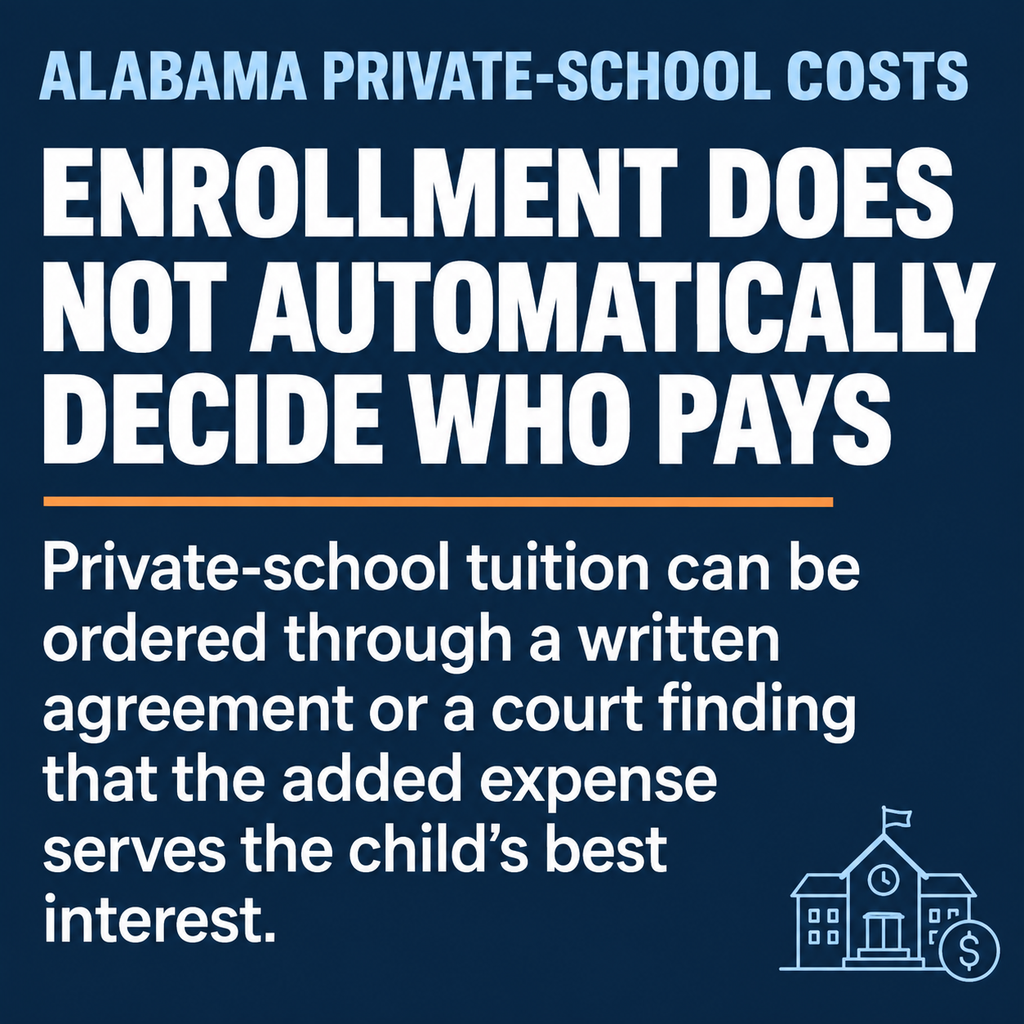
Under Rule 32 of the Alabama Rules of Judicial Administration, a court may award additional amounts for extraordinary educational expenses in two circumstances. The parents may agree to the expense in writing, or the court may determine from the evidence that the additional amount serves the child’s best interests and state its reasons for the award.
Alabama Rule 32 Gives the Court Two Paths
The first path is agreement. Parents can negotiate private-school costs as part of a divorce settlement or later modification. Once the agreement is incorporated into a judgment, its wording can be enforced like other provisions of the order.
The second path applies when there is no written agreement. The court can still order an additional educational amount, but it must review the evidence, find that the expense is in the child’s best interests, and state its reasons.
The result is not automatic merely because one parent prefers a private school, the child has already been accepted, or tuition was paid voluntarily for a short time.
Choosing the School and Paying for It Are Different Questions
Alabama custody orders commonly address legal custody: the authority to make major decisions about education, health care, religion, and other important parts of a child’s life.
The order may require joint consultation, give one parent final decision-making authority, or divide authority by subject. That allocation can determine whether one parent may select or change a school.
Payment is a separate issue. A parent may have authority to make an educational decision without having unlimited power to create a new financial obligation for the other parent.
Conversely, a parent may be ordered to contribute toward tuition even if the other parent handles most school communications. The custody provisions and financial provisions must be read together.
A Written Agreement Can Control the Outcome
A carefully written settlement can remove much of the uncertainty. In Grant v. Smith, the divorce judgment incorporated an agreement requiring the father to pay private-school expenses under described conditions.
The case illustrates a practical point: when parents make an education-cost promise part of their judgment, courts can enforce the promise according to its terms.
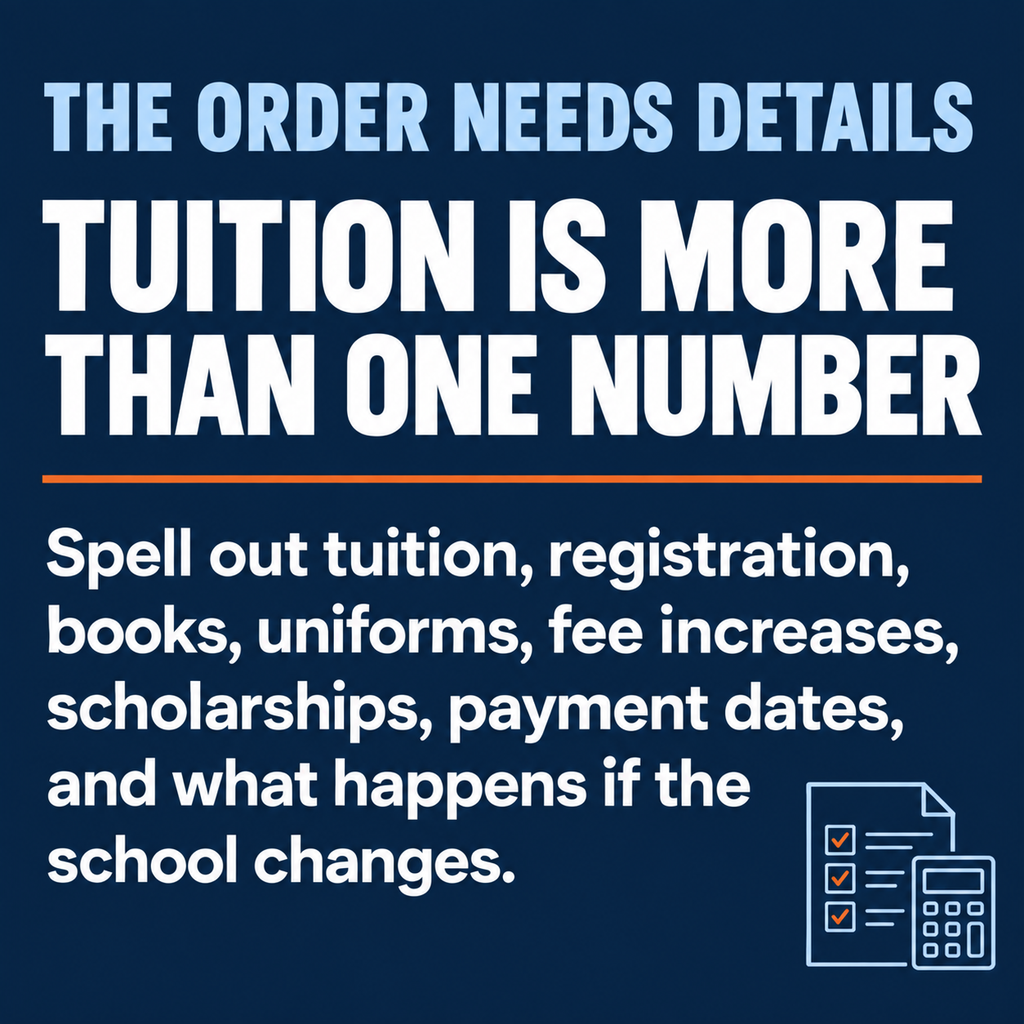
The phrase “split tuition” may sound clear during negotiation but become incomplete when the invoice arrives. A durable provision should address:
- Covered expenses: tuition, application and registration fees, books, technology, uniforms, transportation, meals, activities, and required fundraising.
- Percentages or caps: whether costs are divided equally, in proportion to income, or subject to a yearly maximum.
- Approval: whether both parents must agree to the school, whether consent must be written, and what happens if they cannot agree.
- Payment mechanics: who pays the school, when reimbursement is due, and what documentation must be provided.
- Cost changes: how annual tuition increases, sibling discounts, scholarships, grants, or education savings are applied.
- Duration: whether the obligation continues through a particular grade, graduation, a school change, or another defined event.
Specific language does more than allocate money. It reduces the chance that a child will be caught between parents while a deposit or registration deadline approaches.
Conduct Can Matter When the Order Uses the Word “Agree”
Sometimes an existing judgment says the parents will share private-school costs “if they agree” to private schooling, but it does not say how agreement must be shown. Later, one parent claims there was never an agreement while the other points to several years of payments and participation.
In Etheredge v. Etheredge, the judgment required the parties to divide tuition and related costs if they agreed on private school. The mother testified that they had agreed, and evidence showed the father had paid portions of the expenses in prior years.
The trial court found an agreement and ordered reimbursement; the appellate court upheld that result despite conflicting testimony.
Without an Agreement, the Court Must Explain Why
Myers v. Myers involved a private-school tuition award without a written agreement requiring the husband to pay. The Alabama Court of Civil Appeals treated tuition as an additional educational award under Rule 32(C)(4). Because the trial court had not found that the award served the child’s best interests and had not stated its reasons, the appellate court reversed that portion of the judgment.
Myers does not mean private-school tuition can never be ordered without consent. It means the court must do the work Rule 32 requires.
Depending on the case, relevant evidence may include the child’s educational needs, the family’s historical standard of living, continuity at the school, available alternatives, the parents’ resources, and the reasonableness of the total expense.
The best-interest analysis is child-specific. Prestige alone is not the same as necessity. At the same time, a private school may offer continuity, a program that addresses a particular learning need, an established support network, or another concrete benefit.
The strength of the request usually depends on connecting the school to this child’s circumstances and connecting the proposed payment to reliable financial evidence.
What Evidence Makes a Tuition Request Stronger?
Whether a parent seeks tuition, opposes it, or wants clearer terms, the court needs more than a preference. Useful evidence often includes:
- The existing order or settlement agreement: including every provision about legal custody, education, support, reimbursement, and dispute resolution.
- Enrollment history: report cards, attendance, time at the school, re-enrollment records, and evidence of both parents’ past involvement.
- Child-specific educational needs: learning plans, testing, counseling recommendations, specialized programs, class-size information, or services that bear on the requested placement.
- Alternatives and comparative costs: available public schools, other private programs, transportation, and the realistic cost of each option.
- The complete tuition picture: base tuition, deposits, fees, books, uniforms, activities, increases, refund rules, and binding enrollment contracts.
- Both parents’ finances: income, recurring expenses, debt, assets, and other support responsibilities shown through current records.
- Offsets and assistance: scholarships, grants, education savings, discounts, or education savings account funds that reduce the net cost.
- Communications and deadlines: emails, texts, school notices, payment confirmations, and proposals exchanged between the parents.
Do Not Change the Arrangement by Text Message
Informal messages can be useful evidence, but they are a fragile way to manage a recurring obligation. A text saying “I can help this year” may not define the amount, payment schedule, future increases, or duration. A message sent under time pressure may also be interpreted differently by each parent.
Unilateral action creates additional risk. One parent should not assume that enrolling the child automatically binds the other parent to pay.
A parent who is already ordered to pay should not simply stop because finances tightened, the school changed, or the parent now objects to the placement. Court orders remain enforceable until they are properly modified, and past-due installments can be difficult or impossible to undo retroactively.
When a Tuition Obligation May Be Modified
A tuition provision that made sense at divorce may become unworkable. A parent may lose a job, become disabled, or experience a substantial income change. Tuition may rise sharply. A scholarship may become available or end. The child may need a different program, or the parents may agree that another school is appropriate.
Under Rule 32, a child-support modification generally requires a material change in circumstances that is substantial and continuing. The exact standard and remedy depend on the order and the facts. A negotiated contractual provision may present different questions from a judicial tuition award, which is another reason to have the judgment reviewed before taking action.
Modification is usually prospective. Rule 32 states that only installments accruing after a modification petition is filed are subject to change. Waiting while unpaid tuition accumulates can therefore increase the problem.
A parent seeking relief should continue complying when possible, document the changed circumstances, and obtain legal advice promptly rather than treating private negotiations as a substitute for a court order.
How Our Firm Helps Parents Resolve School-Cost Disputes
Private-school cases require attention to both family dynamics and financial detail.
Our family law attorneys review the full custody and support judgment, separate educational decision-making from payment obligations, and identify whether the dispute turns on agreement, best interests, enforcement, or modification.
We help clients gather school contracts, cost schedules, payment records, communications, educational records, and current financial information. When an agreement is possible, we draft terms that address more than the next invoice. When litigation is necessary, we present the evidence the court needs to evaluate the child’s interests and each parent’s position.
Questions Alabama Parents Are Asking
Private school can be an important part of a child’s life, but the legal responsibility for it depends on the order, the parents’ agreements, and the evidence. These questions arise often.
Can One Parent Enroll the Child and Make the Other Parent Pay?
Not automatically. Enrollment may involve educational decision-making authority under the custody order, while payment requires a separate basis. A written agreement or a court award that satisfies Rule 32(C)(4) may create an obligation. Signing a school contract alone does not necessarily rewrite the other parent’s support duties.
Does Child Support Already Include Private School Tuition?
Usually not as a routine component of the basic guideline calculation. Alabama treats extraordinary educational expenses as additional amounts. Review the actual judgment because an incorporated settlement or specific support provision may separately address tuition and related costs.
What If Our Divorce Agreement Says We Split Tuition?
If the agreement was incorporated into the divorce judgment, the tuition provision may be enforceable according to its wording. Questions often arise about what “tuition” includes, whether both parents had to approve the school, and how scholarships or fee increases affect the calculation. The entire provision matters.
Can Past Payments Prove That We Agreed?
They can be relevant evidence, particularly when the order conditions payment on the parents’ agreement and does not require a specific form of consent. Payment history is not automatically conclusive. Courts may consider testimony, messages, enrollment conduct, and the language of the judgment together.
Can the Court Order Tuition Without an Agreement?
Yes, potentially. Rule 32(C)(4) permits an additional educational award when the court reviews the evidence, determines that the amount serves the child’s best interests, and states its reasons. The requesting parent should be prepared with child-specific evidence and complete financial information.
What If I Can No Longer Afford the Tuition?
Do not simply stop paying an amount required by a judgment. A substantial, continuing change in circumstances may support a modification request, but relief generally requires a court filing and applies prospectively. Prompt review can help limit arrears and identify whether the tuition provision is modifiable.
The School Deadline Is Real. So Is the Court Order.
Private-school tuition after divorce in Alabama is not resolved by the invoice alone. The answer may turn on custody authority, the words of a settlement, years of conduct, a child’s particular needs, or the findings required by Rule 32. Those pieces need to be evaluated together before a parent signs, refuses, pays, or stops paying.
Early advice is especially useful when a deposit is approaching or the current arrangement is becoming unaffordable. A clear plan can protect the child’s educational stability while preventing a rushed enrollment decision from becoming a long-term financial dispute.
Call or text Baxley Maniscalco at (256) 770-7232 or use our contact form to schedule a confidential consultation about your Alabama family-law matter.
Can't find what you're looking for? Search our site below.