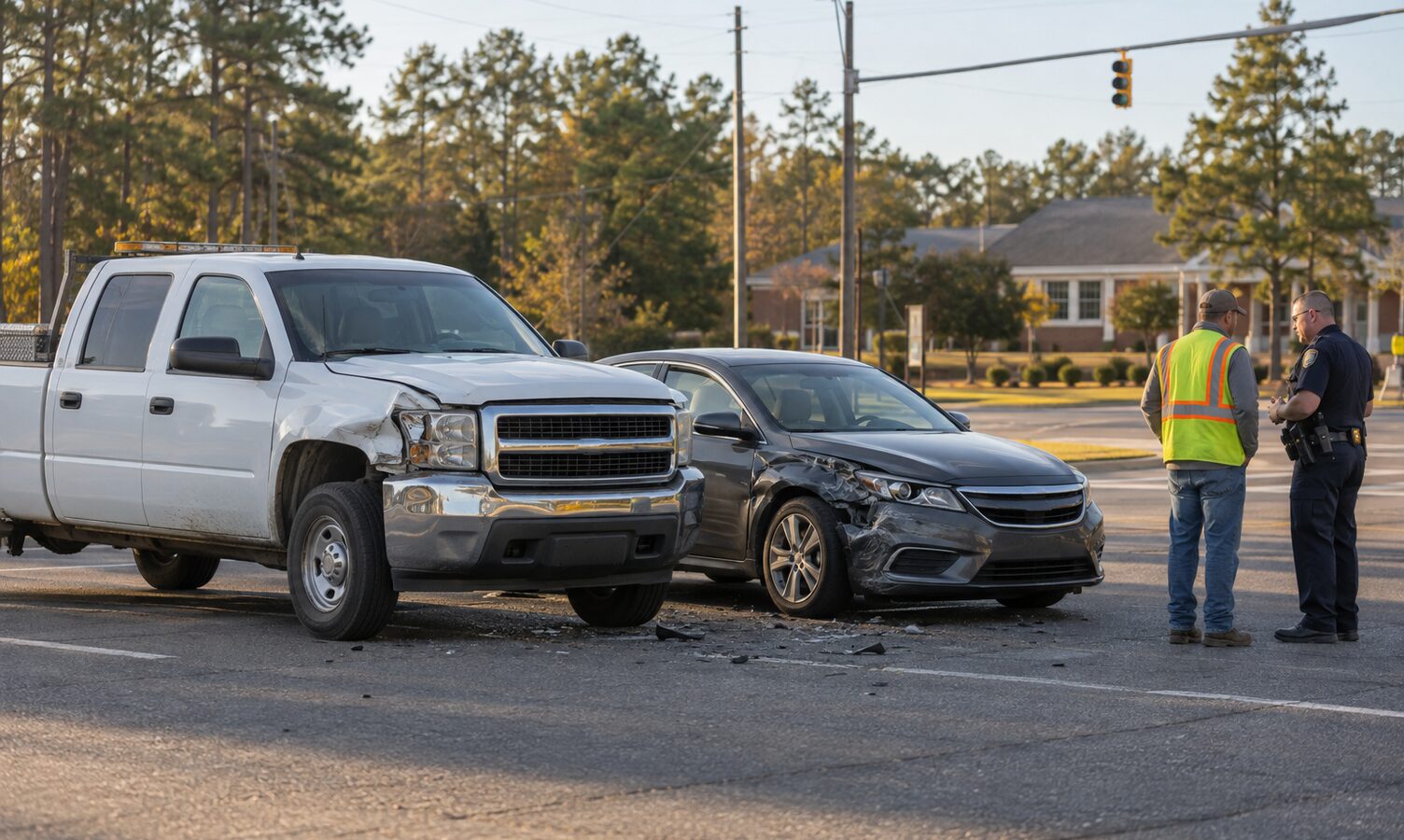
A city pickup runs a red light. A sanitation truck sideswipes a car. A public works vehicle backs into a pedestrian. The crash may look like an ordinary negligence case, but the logo on the door can change the deadline before the injured person even leaves treatment.
Alabama generally gives an injured person two years to file many personal injury lawsuits under Section 6-2-38 of the Alabama Code. A claim against a city or town carries an additional and much shorter requirement: under Section 11-47-23, a tort claim must be presented within six months after it accrues or it is barred.
Those are two different clocks. The six-month notice period can expire while the injured person is still in physical therapy, while a child is still being evaluated, or while an adjuster is still asking for medical records. Waiting for the ordinary two-year deadline can end a municipal injury claim before the lawsuit deadline ever becomes the problem.
A City-Vehicle Claim Starts With a Different Clock
The first question after a wreck is usually, “Who caused it?” When a government vehicle is involved, another question belongs beside it: “Who employed the driver?”
Alabama law permits municipal liability when an injury results from the neglect, carelessness, or unskillfulness of a city employee acting in the line of duty. That rule appears in Section 11-47-190. A city vehicle accident may therefore support a claim, but the right defendant and the right procedure must be identified early.
For a municipal injury claim, sending a routine insurance demand months later is not enough if the statutory notice period has already closed. The case needs a liability investigation and a deadline investigation at the same time.
A Crash Report Is Evidence. It Is Not Necessarily Notice.
Calling 911, giving a statement to an officer, completing a city incident report, or speaking with a claims adjuster can all help document the collision. None should be assumed to satisfy Alabama’s municipal notice statutes.
The Alabama Supreme Court has explained that a city’s actual knowledge of an accident is not automatically a substitute for notice filed with the authorized official.
In Large v. City of Birmingham, an accident report and the city’s awareness of the incident did not replace the required notice of an intent to make a claim.
That distinction is easy to miss. A police report and other crash evidence help prove what happened. Statutory notice protects the right to pursue the city. One document should not be treated as the other.
What the Notice Has to Say—and Where It Has to Go
Section 11-47-192 of the Alabama Code requires a sworn statement to be filed with the municipal clerk in a personal injury claim against a city or town. The statement must substantially identify the following:
- How the injury happened. The notice should describe the collision or other event clearly enough for the city to investigate it.
- When it happened. The statute calls for the day and time of the injury.
- Where it happened. The location should be specific, including the roadway, intersection, address, or other identifying details.
- What damages are claimed. The notice should identify the injuries and losses being asserted without pretending that early treatment has already revealed the final outcome.
The city clerk matters. Delivering papers to a police supervisor, a department office, a third-party administrator, or an insurer may create a record, but it may not be the statutory presentation the law requires. A municipal injury claim should include proof showing what was delivered, when it was delivered, and who received it.
Filing a Lawsuit Can Count, but It Is a Dangerous Backup Plan
In Diemert v. City of Mobile, the Alabama Supreme Court held that a lawsuit filed within the six-month period can be a sufficient presentation of the claim. That does not make delay a sound strategy.
A complaint must identify the correct parties, state viable claims, and be filed in the correct court. Rushing to do all of that near the six-month mark leaves little room to investigate ownership, employment, insurance, immunity defenses, or other responsible parties. A formal notice filed promptly gives counsel time to build the case instead of racing a deadline.
The Six-Month Deadline Does Not Pause for a Child
Many Alabama parents know that ordinary statutes of limitation may treat minors differently. That expectation can be dangerous when a city or town may be responsible for the injury.
In A.G.R. v. City of Irondale, decided in 2026, the Alabama Supreme Court reaffirmed that Section 11-47-23 contains no exception for minors. The Court treated the notice requirement as separate from a statute of limitations and declined to extend the six-month period because the claimants were children.
The practical rule is blunt: a parent or legal representative should not assume a child can wait until adulthood to pursue a municipal injury claim. The notice clock can run while the family is focused on treatment, school accommodations, and an uncertain diagnosis.
City, County, State, or Contractor? The Name on the Door Is Not Enough
A government-looking vehicle does not answer who legally controlled it. The driver may work for a city, a county, a state agency, a utility board, a private ambulance company, or a contractor operating under a public contract. Each can trigger a different route.
- City or town. A municipal tort claim is generally subject to the six-month presentment rule discussed above.
- County. Alabama uses a different presentment statute. Under Section 11-12-8, claims against counties generally must be presented within 12 months. Read the county-claim statute.
- State or state agency. Alabama’s constitutional immunity can prevent an ordinary damages suit against the State, and some matters may instead involve the State Board of Adjustment or claims against individual actors under narrow exceptions.
- Private contractor. A company may be responsible under ordinary negligence or employer-liability rules even when the work was performed for a public entity.
Vehicle registration, employment records, contracts, route assignments, and insurance documents can be as important as the crash report. Naming the wrong government entity—or assuming every public vehicle follows the same deadline—can waste the time a municipal injury claim cannot spare.
Emergency Lights Change the Analysis, Not the Need to Investigate
Police cars, fire apparatus, and ambulances may receive traffic-law privileges when responding to an emergency under Section 32-5A-7. Those privileges are conditional. The statute also says emergency drivers retain a duty to drive with due regard for others and are not protected from the consequences of reckless disregard for safety.
Whether lights and sirens were operating, whether the driver was responding to a qualifying call, what the intersection controls showed, and how nearby motorists reacted can all matter. Separate immunity rules may also apply to the employee. An emergency vehicle is not automatically liable, but it is not automatically beyond review either.
Even a Strong Claim May Face a Government Damages Cap
Alabama’s governmental damages cap generally limits a judgment against a governmental entity to $100,000 for bodily injury or death to one person in a single occurrence, with an aggregate limit of $300,000 when more than two people have bodily-injury or death claims arising from one occurrence. Property-damage recovery is also capped at $100,000 for a single occurrence.
A cap does not erase the need to document the full loss. Medical expenses, future care, lost income, disability, pain, and the effect on daily life still shape the claim and may reveal other responsible parties or coverage questions. It does mean the case must be evaluated with the public-entity limits in view from the beginning.
Evidence Can Disappear Before the Six Months Do
The municipal notice is only the procedural first step. A city vehicle accident still turns on proof, and some of the most useful records may be overwritten or routinely deleted long before a lawsuit is filed.
Evidence worth identifying and preserving may include:
- The vehicle itself. Photograph unit numbers, department markings, damage, cargo, warning lights, and any equipment mounted inside or outside the vehicle.
- Electronic records. Dash-camera video, body-camera video, traffic-camera footage, GPS data, telematics, event-data-recorder information, and mobile-device records may clarify speed, braking, routes, and timing.
- Dispatch and work records. 911 audio, computer-aided dispatch logs, shift assignments, work orders, route sheets, and supervisor communications can show why the driver was there and what the employee was doing.
- Human evidence. Obtain witness names and contact information before memories fade, and document the injured person’s symptoms, treatment, missed work, and daily limitations as they develop.
A preservation request does not prove negligence by itself. It helps prevent a municipal injury claim from being reduced to competing memories after the objective records are gone.
How Our Firm Handles Municipal Vehicle Claims
These cases require more than sending medical bills to an adjuster. The work begins by confirming the vehicle owner, the driver’s employer, the purpose of the trip, the correct public entity, and every deadline that applies.
Our experienced personal injury attorneys here at Baxley Maniscalco investigate public-vehicle collisions, preserve time-sensitive evidence, prepare municipal notices, evaluate immunity and damages-cap issues, and identify any additional defendant or insurance coverage that may affect recovery.
We handle Alabama personal injury matters on a contingency basis, so there is no attorney fee unless we recover for you. If a city or other public vehicle was involved, a free case review is the safest place to start before the short notice window closes.
Questions Alabama Families Are Asking
Government-vehicle crashes create deadline and liability questions that do not arise in an ordinary insurance claim. Here are the answers that matter first.
Do I Still Have Two Years to Sue After a City Vehicle Accident?
The ordinary lawsuit deadline may still be two years, but a separate Alabama law requires a tort claim against a city or town to be presented within six months. Missing that notice period can bar the municipal injury claim even if the lawsuit deadline has not expired.
Does the Police Report Count as Notice to the City?
Do not assume it does. A police report records the collision; statutory notice communicates the claim to the municipal clerk and must contain the information Alabama law requires. The city’s general knowledge of the event is not necessarily enough.
What If the Injured Person Is a Child?
The six-month municipal notice deadline still applies. In 2026, the Alabama Supreme Court confirmed that Section 11-47-23 has no exception that pauses the period because the claimant is a minor.
What If a County Vehicle Caused the Crash?
County claims follow a different presentment statute and generally carry a 12-month period. The proper recipient, contents, defendant, and immunity questions still need to be checked for the specific county and accident.
Can I Recover If the Police Car or Ambulance Was Responding to an Emergency?
Possibly, but emergency-response privileges and immunity defenses make the analysis fact-specific. Lights and sirens, the nature of the call, the driver’s conduct, and whether the vehicle was operating with due regard for public safety can all matter.
How Much Can Be Recovered From a City?
Alabama generally caps judgments against governmental entities at $100,000 for bodily injury or death to one person in one occurrence, with a $300,000 aggregate limit when more than two people have claims. Other parties and coverage should be investigated rather than assumed.
Every case is different, so reach out if your situation is not covered here.
Six Months Is Not Long When You Are Healing.
Treatment schedules, insurance calls, vehicle repairs, and missed work can consume half a year quickly. If a city vehicle or municipal employee may have caused the injury, the legal clock deserves attention immediately—not after recovery has stabilized.
Our experienced personal injury attorneys here at Baxley Maniscalco are ready to identify the right defendant, protect the notice deadline, and explain the next step clearly.
Call us at (256) 770-7232 or reach out through our contact form to schedule a free personal injury consultation today.
Can't find what you're looking for? Search our site below.