

The divorce decree is signed. The house, accounts, and parenting plan are settled. Years later, someone dies—and a beneficiary form completed during the marriage suddenly controls a large payment. The difficult question is not simply who the deceased person probably wanted to receive the money. It is who the insurer or plan administrator is legally required to pay.
For Alabama families, the answer can turn on several layers of law at once. Alabama has a statute that may revoke an ex-spouse’s designation automatically. A divorce judgment or settlement may preserve or require coverage. An employer plan may be governed by federal law and its own forms. A federal employee or service member may face still another set of rules.
That is why “the divorce took care of it” is a dangerous assumption. The decree, the beneficiary form, and the law governing the account must be read together.
Alabama Law May Revoke an Ex-Spouse Automatically
Under Alabama Code § 30-4-17, divorce or annulment generally revokes certain revocable transfers, appointments, and fiduciary nominations made to a former spouse in a governing instrument executed before the divorce. A life-insurance beneficiary designation can fall within that rule.
The Alabama Supreme Court applied the statute in Blalock v. Sutphin. A policyholder had named his wife and daughter as equal beneficiaries, later divorced, never changed the form, and died. The court held that the former wife’s designation was revoked and the daughter was entitled to the proceeds.
This is a default rule, not a universal substitute for paperwork. The statute tells a court how to treat qualifying pre-divorce instruments when no controlling exception changes the result. It does not mean every company will automatically identify the divorce, every account is governed by Alabama law, or every former spouse loses beneficiary status.
The Exceptions Matter as Much as the Default
Alabama’s statute expressly yields to the terms of a governing instrument, a court order, or a contract concerning division of the marital estate. It also contains an insurance-specific exception when the former spouse is the policy owner or continues paying premiums after the divorce.
Several facts can therefore change the analysis:
- The policy or account may contain controlling language about divorce.
- The settlement agreement or final judgment may require one former spouse to remain the beneficiary.
- The insured may have submitted a new designation after the divorce, confirming the ex-spouse intentionally.
- The former spouse may own the policy or pay its premiums after divorce.
- Another state’s law may govern the contract.
- Federal law may preempt Alabama’s revocation rule.
A legal separation that does not end the marriage is not treated as a divorce for this statute. Remarriage to the same former spouse can also revive provisions that the statute alone revoked. These details are why a lawyer should review the actual documents rather than rely on a general rule.

Private Policies and Employer Plans Can Follow Different Rules
A privately purchased life-insurance policy is often analyzed under the policy language, applicable state contract law, Alabama’s revocation statute, and any divorce order. An employer-sponsored life-insurance or retirement plan may be governed by the Employee Retirement Income Security Act, commonly called ERISA.
That distinction can control the first recipient of the money. In Egelhoff v. Egelhoff, the U.S. Supreme Court held that ERISA preempted a state revocation-on-divorce law as applied to ERISA plans. The Court emphasized nationally uniform administration and payment according to plan documents.
In Kennedy v. Plan Administrator for DuPont, a divorce decree said the former wife gave up her interest in an employer savings plan, but the participant never removed her from the plan’s beneficiary form. The Supreme Court held that the administrator properly paid her because ERISA required it to follow the plan documents.
The practical lesson is blunt: a divorce decree can create rights between former spouses without necessarily changing the instruction that binds an ERISA plan administrator. A qualified domestic relations order, or QDRO, may be needed for certain retirement-plan rights, and even a valid QDRO must satisfy federal requirements and reach the plan through the proper process.
Federal Employee and Military Benefits Need Their Own Review
Federal benefit programs may have statutory orders of precedence and filing rules that override state law. In Hillman v. Maretta, the U.S. Supreme Court held that federal law governing Federal Employees’ Group Life Insurance preempted a state-law effort to redirect proceeds away from the named former-spouse beneficiary after payment.
Military survivor and life-insurance benefits can also follow federal statutes and program-specific forms. A state divorce court may address the parties’ obligations, but it cannot always rewrite federal payment rules.
Anyone divorcing a federal employee, servicemember, or participant in a federally regulated plan should identify the exact program—not merely the employer—and obtain the current designation and plan documents. “Retirement account” and “life insurance” are categories, not answers.
A Divorce Decree Can Require Coverage Without Rewriting the Form
Life insurance is sometimes used to secure future child support, alimony, or a property-settlement obligation. A settlement may require a parent or former spouse to maintain coverage for a specific amount and period.
That provision should answer practical questions:
- Who owns the policy and who is the insured?
- Who must be named as beneficiary, and in what percentage?
- Is the beneficiary designation revocable or irrevocable?
- How much coverage is required, and when may it decrease?
- How long must coverage remain in force?
- Who receives proof of coverage and notices of lapse or cancellation?
- What happens if coverage becomes unavailable or unaffordable?
A vague direction to “maintain life insurance for the children” can create years of uncertainty. Minor children usually should not be named without considering who would manage the proceeds. Depending on the family’s needs, the decree may coordinate coverage with a trust, custodian, or other carefully selected arrangement.
People negotiating contested divorce matters should address these terms while evidence about income, existing coverage, health, and insurability is available. Trying to reconstruct the intended protection after a death is far more difficult.
The Beneficiary Form Is Not the Only Document That Matters
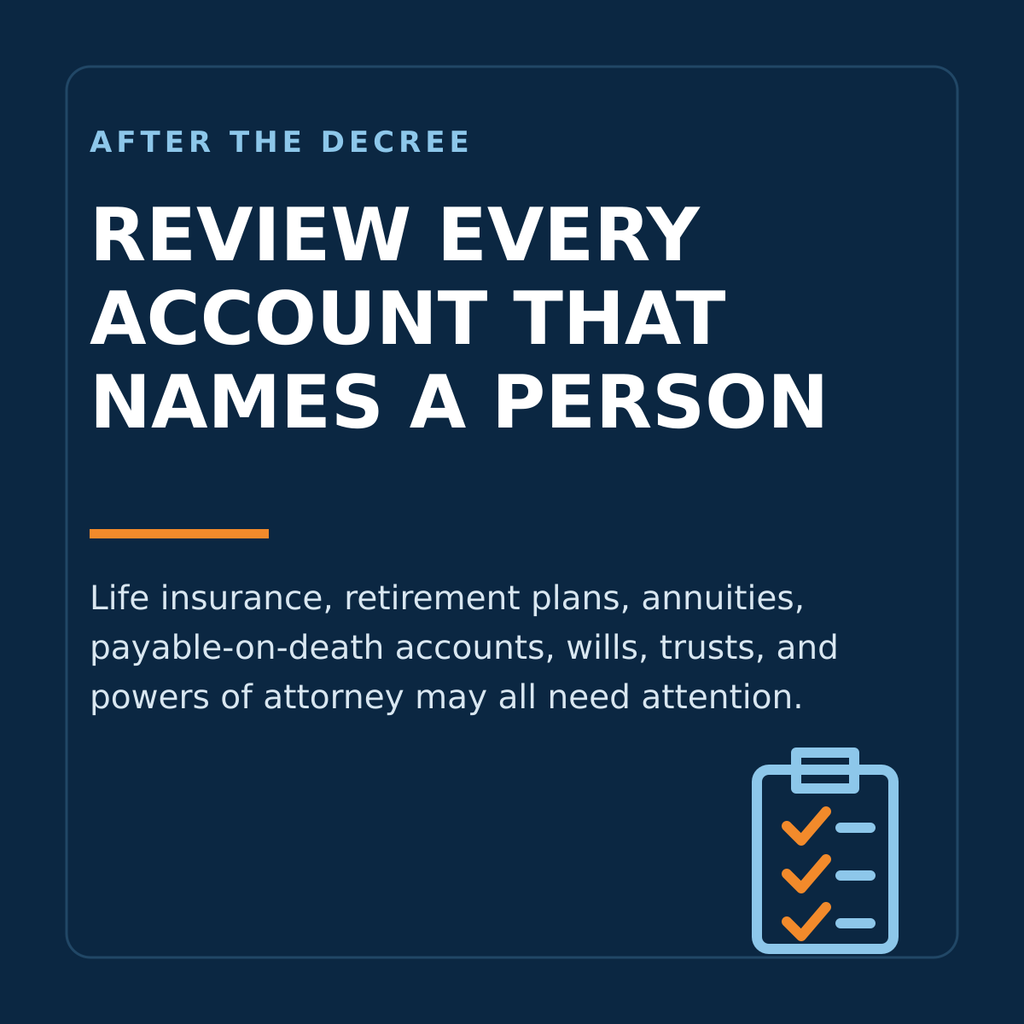
Divorce changes a family’s legal and financial structure, but most banks, insurers, employers, and estate-planning documents operate through separate records. A complete post-divorce review should include:
- Individual life-insurance policies: confirm the owner, insured, primary beneficiary, contingent beneficiary, coverage amount, and premium source.
- Employer life insurance: request the plan description and confirm whether the plan is governed by ERISA or another federal program.
- 401(k), pension, and other workplace plans: update permitted designations and determine whether a QDRO is required to divide or preserve benefits.
- IRAs and annuities: review the contract and beneficiary form; rules can differ from employer plans.
- Payable-on-death and transfer-on-death accounts: confirm the named recipient with the institution.
- Wills and trusts: revise fiduciaries, gifts, guardianship provisions, and trust terms as appropriate.
- Powers of attorney and advance directives: remove authority that should not continue and name reliable successors.
- Real property and jointly titled assets: confirm how title and survivorship rights were changed by the decree and recorded documents.
What to Do Before the Divorce Is Final
Beneficiary planning should begin during the case, not after it. First, make an inventory of every policy, plan, and account that pays on death. Obtain actual statements and beneficiary confirmations rather than relying on memory.
Before changing anything, ask whether temporary orders or plan rules restrict changes while the case is pending. An accepted form can still violate a court order, so coordinate changes with legal advice.
If continuing coverage will be part of the settlement, define the obligation precisely. If retirement benefits are being divided, prepare and submit the required order promptly. A divorce judgment alone does not guarantee that a plan will accept the intended division.
What to Do Immediately After the Divorce
Once the judgment is entered and any restrictions permit changes, complete a coordinated review:
- Read the final decree and settlement for every insurance, retirement, support, and estate-planning obligation.
- Submit each beneficiary change using the plan’s required form or online process.
- Name contingent beneficiaries so a later death does not leave the account without a valid recipient.
- Keep dated copies, confirmation numbers, and acceptance notices.
- Confirm that a QDRO or similar order was received and approved by the correct plan.
- Update estate-planning documents and property titles with the appropriate professionals.
- Calendar the end date of any court-ordered insurance obligation and any recurring proof requirement.
Do not assume an online screen means the update is complete. Some plans require a spouse’s consent, a witnessed signature, or additional review. The useful evidence is the plan’s written confirmation of the accepted designation.
When the Wrong Person Receives the Money
After a death, an insurer or plan administrator may file an interpleader action and ask a court to decide among competing claimants. In other cases, the administrator may pay the person identified by controlling plan documents and leave the family to litigate separately.
A post-payment claim against a former spouse may sometimes be possible under a decree, contract, or state law. But federal preemption, the wording of the judgment, the type of benefit, and the timing of notice can determine whether that remedy exists. Hillman demonstrates that even a state-law claim seeking the money after payment may be preempted for some federal benefits.
These disputes can involve short deadlines, probate, plan appeals, and competing claims. Collect the decree, policy, plan description, designation forms, premium records, correspondence, and death certificate promptly.
How Our Firm Helps
Beneficiary questions often sit at the intersection of family law, contracts, employee benefits, and estate planning. The family law attorneys at Baxley Maniscalco can help clients identify what the divorce case should require, draft clearer insurance provisions, coordinate retirement orders, and evaluate whether existing designations match the intended settlement.
Preventive work is best: define the obligation, document it, and complete the plan’s process. If a dispute exists, early analysis can identify the right court, claim process, or combination of forums.
Questions Alabama Families Are Asking
Does divorce automatically remove my ex-spouse from my life-insurance policy?
Alabama law may revoke a qualifying pre-divorce designation under § 30-4-17, but exceptions apply. The policy terms, ownership, premium payments, divorce order, governing law, and federal preemption can all change the answer. Updating the form remains the safest practice when legally permitted.
What if the beneficiary form still names my ex?
For a private policy governed by Alabama law, the statutory default may treat the former spouse as having predeceased the insured. For an ERISA or federal plan, the administrator may be required to follow the named beneficiary. The actual plan and divorce documents must be reviewed together.
Can a divorce decree require life insurance for child support or alimony?
Yes. A settlement or order may require coverage to secure future obligations. The provision should specify the policy, amount, beneficiary, duration, proof requirements, and consequences of a lapse.
Can I change beneficiaries while the divorce is pending?
Sometimes, but not always. Temporary restraining orders, standing orders, policy restrictions, or the circumstances of the marital estate may limit changes. Consult counsel before altering coverage during an active case.
Does a waiver in the divorce decree remove an ex-spouse from an employer retirement plan?
Not necessarily. Kennedy shows that an ERISA plan administrator generally follows the plan documents. A waiver may affect rights between the former spouses, but it may not replace the plan’s beneficiary-change procedure or a required QDRO.
Which documents should I update after divorce?
Review life insurance, retirement plans, annuities, payable-on-death accounts, wills, trusts, powers of attorney, advance directives, and property titles. Confirm each update with the institution or professional responsible for that document.
The Decree Ends the Marriage. It Does Not Update Every Account.
A divorce judgment cannot substitute for every insurer’s form, retirement plan procedure, or federal benefit rule. Align those systems while the terms are being written—or immediately after the decree.
If your Alabama divorce involves life insurance, retirement benefits, or a beneficiary dispute, contact Baxley Maniscalco or call (256) 770-7232. We can identify the governing rules and help you plan the next step.
Can't find what you're looking for? Search our site below.