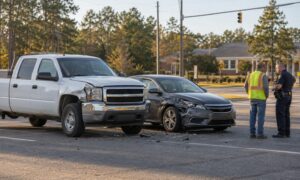
One moment, another vehicle is traveling normally. The next, it crosses the centerline without braking. Days later, the insurer offers an explanation instead of accepting fault: the driver had a heart attack, seizure, fainting episode, or blackout and could not control the car.
That explanation can matter under Alabama law. It is not a magic phrase. In a sudden medical emergency car accident in Alabama, the central question is usually whether the loss of consciousness was genuinely sudden and unforeseeable.
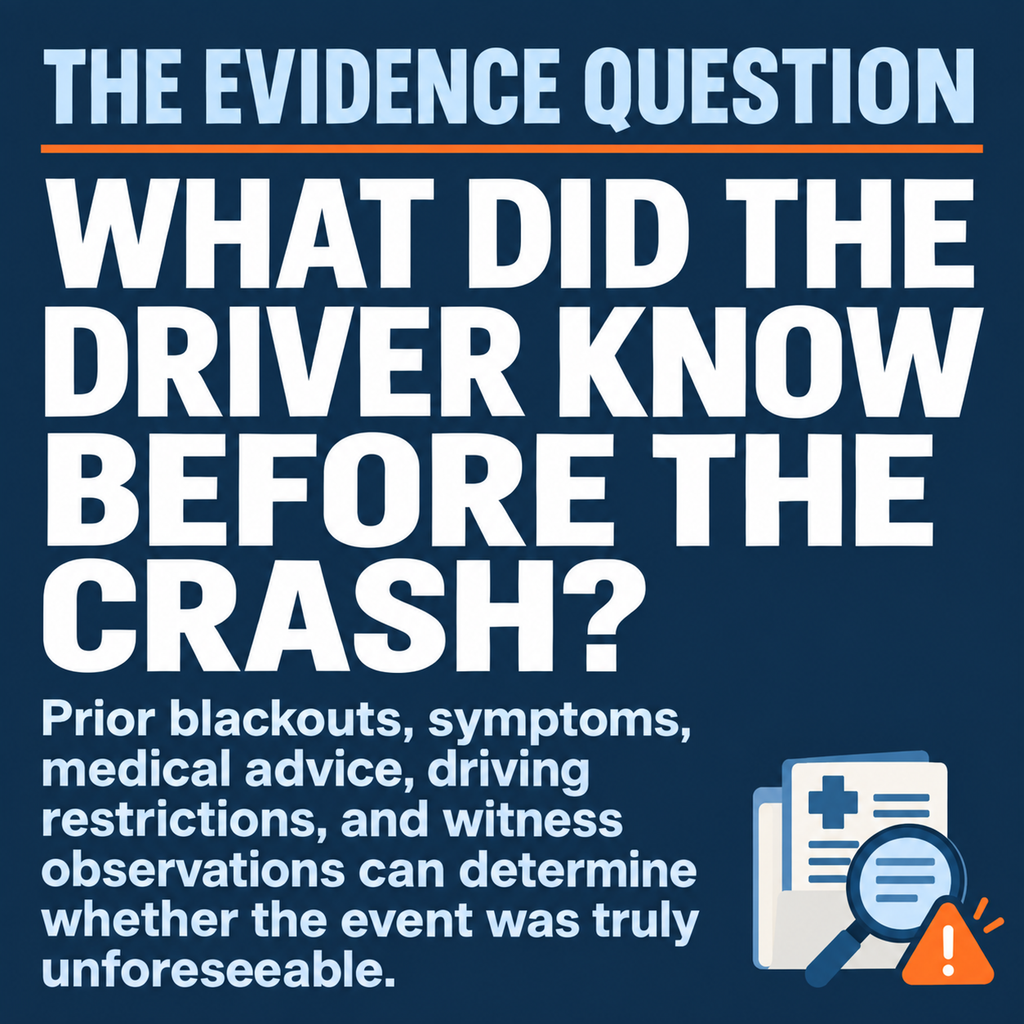
The investigation often shifts from what happened at impact to what the driver knew before starting the engine.
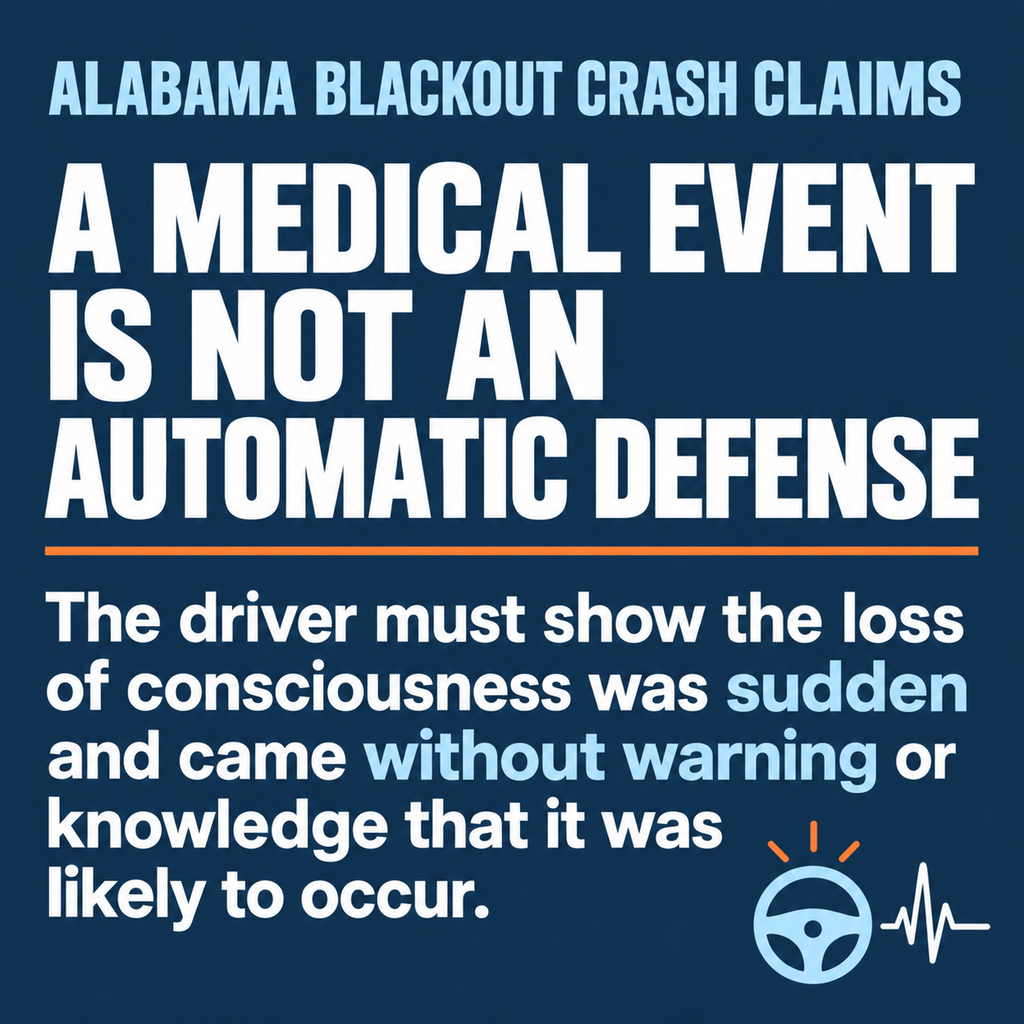
A Medical Event Is Not an Automatic Defense
Alabama recognizes that a person who becomes unconscious without warning may be unable to control a vehicle. In Walker v. Cardwell, the Alabama Supreme Court explained that a driver who loses consciousness before a crash, without warning symptoms or knowledge that the episode was likely to occur, cannot be held negligent or wanton for conduct that happens after the loss of consciousness.
The defense still needs a factual foundation. A diagnosis made after the collision does not prove the episode came without warning, and the word “blackout” does not answer when consciousness was lost or what the driver knew beforehand.
When evidence conflicts, the question may belong to a jury. Witnesses, vehicle movement, medical experts, and the driver’s history can support or undermine the claim that incapacitation came without warning.
Foreseeability Is the Line That Matters
The core issue is not simply whether a medical event occurred. It is whether the driver knew, or reasonably should have known, that sudden incapacitation was a meaningful risk.
The Alabama Supreme Court emphasized that distinction in Pearce v. The Estate of Daniel Lea Day. The Court treated the sudden-loss-of-consciousness defense as a foreseeability question. General awareness of imperfect health is not necessarily enough. The evidence must connect the driver’s prior knowledge to a condition that was likely to cause a sudden loss of consciousness.
That creates two very different cases. A first-time heart event in a person with no prior symptoms may support an unforeseeable-emergency defense.
A driver who recently fainted, ignored recurring dizziness, had been warned not to drive, or continued after unmistakable symptoms presents a much harder question. In either situation, conclusions should follow the records and testimony, not the insurer’s first description of the crash.
Imperfect Health Is Not the Same as a Known Blackout Risk
Many adults have high blood pressure, diabetes, heart disease, or another chronic condition. Treating every diagnosis as advance notice of a blackout would stretch Alabama’s rule too far. In Pearce, the Court rejected the idea that broad medical risk alone necessarily proves foreseeability.
The important connection is between what the driver knew and the specific danger of suddenly losing the ability to control a vehicle.
That nuance protects both sides. A person should not be labeled negligent merely because a later medical event can be traced to an existing condition. At the same time, a driver cannot avoid scrutiny by pointing to a medical event if prior episodes, symptoms, or restrictions made incapacitation foreseeable.
Medical evidence needs context. What a doctor told the patient may matter more than a diagnosis date. Prescriptions and prior hospitalizations matter only when they bear on the claimed loss of consciousness or the warning of that risk.
The Driver’s Choices Before the Blackout Still Matter
The defense addresses conduct after a driver has actually become unconscious. It does not automatically erase negligent choices made earlier.
Suppose a driver feels chest pressure, tunnel vision, severe dizziness, or the onset of a known seizure warning but continues down the highway. The eventual blackout may be involuntary, yet the decision to keep driving can still be examined. The same is true when a physician has imposed a driving restriction, when a license limitation applies, or when recent unexplained fainting episodes made another event reasonably predictable.
Timing is crucial. The investigation asks when symptoms began, how the driver responded, and whether there was a safe opportunity to pull over, while avoiding the assumption that a serious event was necessarily predictable.
The Most Important Evidence May Be Outside the Crash Report
A police report may record that the driver “had a medical emergency,” but that phrase often repeats what someone said at the scene. It rarely resolves foreseeability.
Building a sudden medical emergency car accident claim in Alabama may require evidence from several sources:
- Eyewitness accounts describing the driver’s appearance, speech, or behavior before impact.
- 911 recordings and dispatch notes showing what callers observed in real time.
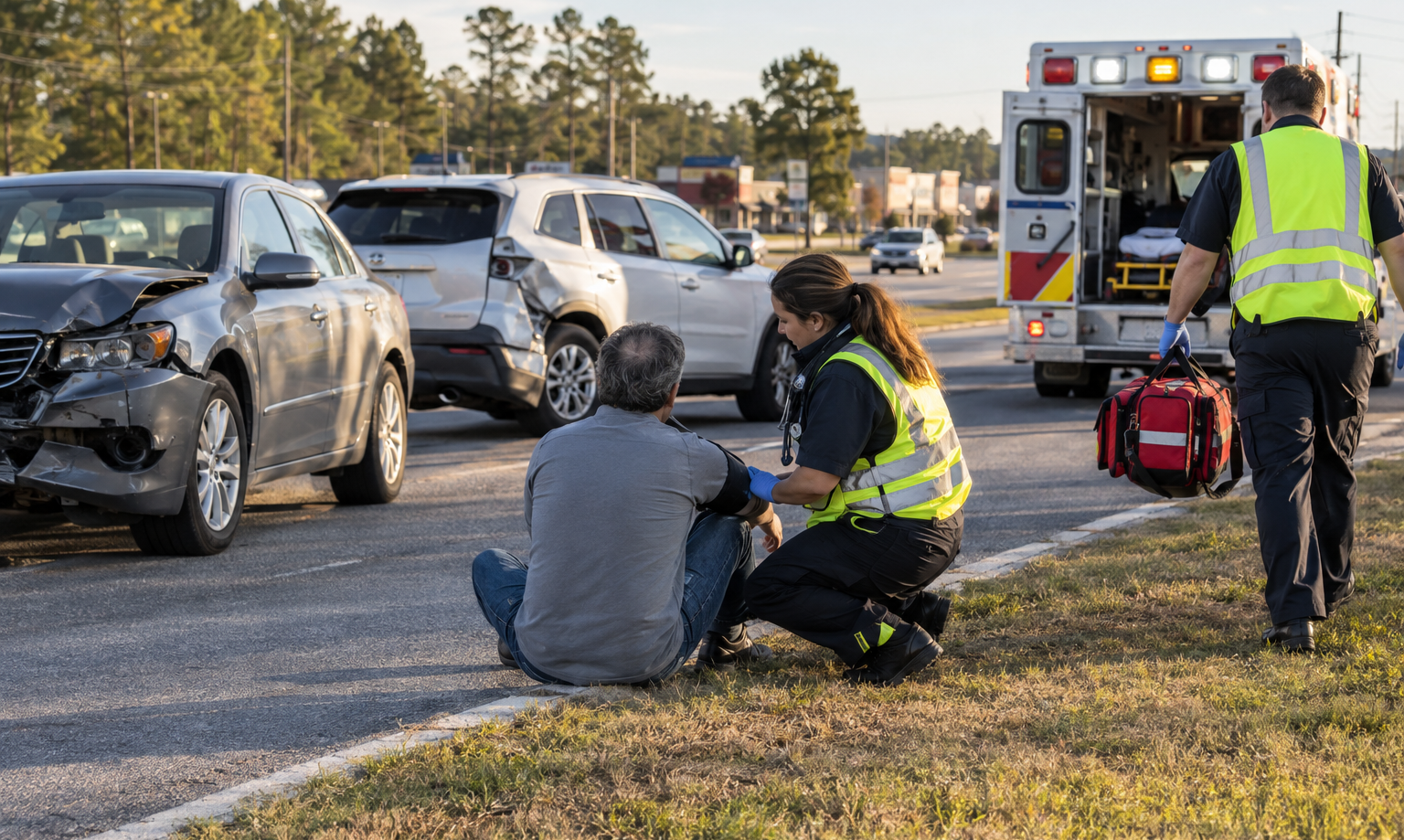
- Emergency medical services records documenting consciousness, vital signs, statements, and treatment at the scene.
- Medical records tied to the specific condition alleged to have caused the blackout.
- Evidence of earlier fainting, seizures, dizziness, cardiac symptoms, or unexplained crashes.
- Instructions from a physician, licensing authority, or employer concerning driving restrictions.
- Prescription and pharmacy records when medication effects or compliance are genuinely connected to the event.
- Dash camera footage, traffic video, vehicle data, and phone records that help establish the sequence before impact.
- Employment, training, or fitness-for-duty records when the driver was operating a vehicle for work.
- Autopsy and toxicology findings when the driver dies in or shortly after the collision.
Medical information is private, and a crash does not open the driver’s entire history. Lawyers use formal discovery and court procedures to seek records tied to the disputed condition while addressing privacy limits.
Alabama courts can exclude medical material when unfair prejudice or confusion outweighs its usefulness. The focused question is whether this driver had warning of sudden incapacitation, not what every diagnosis in the chart might suggest.
A Working Driver Can Add Another Layer of Liability
If the driver was making deliveries, visiting a customer, moving equipment, or otherwise acting within the scope of employment, the employer may be responsible under ordinary agency principles when the employee is liable. That can bring an employer’s insurance coverage and records into the case.
The employer’s own conduct may also matter. Prior episodes, medical restrictions, fitness requirements, and dispatch records can affect fact-specific claims involving hiring, retention, supervision, or entrustment.
Employer liability is not automatic. Control over the work, the trip’s purpose, vehicle ownership, company policies, and what the company knew all matter.
Our personal injury attorneys look beyond the driver’s personal policy when the evidence supports it.
When the Driver Dies, Two Legal Problems Collide
A fatal medical event can leave the injured person facing both a liability dispute and a probate deadline. The insurer may argue that the crash was unavoidable, while the person who could describe earlier symptoms is no longer available to testify.
The injury claim does not simply disappear. It may proceed against the driver’s estate, usually with the liability insurer defending the claim. But Alabama probate procedures can create deadlines and service issues that are different from an ordinary car accident claim. Evidence also becomes more fragile when family members, coworkers, doctors, and electronic systems hold separate pieces of the timeline.
Our guide to deceased-driver estate claims explains those procedural complications in more detail. When blackout and estate issues overlap, early coordination matters because the medical, insurance, and probate investigations need to support one another.
How Our Firm Investigates Blackout Crash Claims
These cases reward precision. A general statement that the driver was “sick” proves very little. So does a bare accusation that the driver should have stayed home. The useful questions are specific: What condition caused the episode? When did symptoms begin? What had happened before? What warnings were given? What did witnesses see? What does the vehicle data show?
Baxley Maniscalco approaches a sudden medical emergency car accident in Alabama by preserving time-sensitive evidence, identifying every potentially responsible party and policy, and working with qualified experts when medical causation is disputed. We examine both sides of foreseeability.
That means distinguishing ordinary health history from genuine warning signs while testing whether the defense fits the actual sequence of events.
We also document the injured person’s losses. Liability is only one part of a personal injury case. Medical expenses, lost income, future care, reduced earning ability, pain, physical limitations, and the effect on daily life must be supported with credible evidence. A strong investigation connects what caused the crash to what the crash changed.
Questions Alabama Crash Victims Are Asking
Blackout claims sit at the intersection of medicine, driving decisions, insurance, and evidence. These are some of the questions that often arise.
Does a Blackout Automatically Excuse the Driver?
No. The defense depends on proof that the driver became unconscious before the negligent driving at issue and that the loss of consciousness occurred without warning or knowledge that it was likely. Prior symptoms, episodes, medical advice, and the timing of the event can all matter.
What Counts as a Warning Sign?
There is no single list that decides every case. Recent fainting, recurring dizziness, seizure auras, severe chest symptoms, medication-related episodes, or a doctor’s driving restriction may be relevant. The key is whether the warning was connected closely enough to the risk of sudden incapacitation that a reasonable person should have changed the decision to drive or continue driving.
Can My Lawyer Get the Other Driver’s Medical Records?
Potentially, but a crash does not make an entire medical history fair game. The records sought should be tied to the condition, symptoms, treatment, restrictions, or prior episodes relevant to the asserted defense. Access may require an authorization, subpoena, protective order, or other formal discovery process.
What If the Driver Had No Formal Diagnosis Before the Crash?
A missing diagnosis does not automatically decide the issue. A truly first-time event with no symptoms may support the defense. On the other hand, repeated unexplained fainting or unmistakable symptoms can be important even if no doctor had yet assigned a label. What the driver actually knew and experienced may matter more than the date a condition was named.
Can the Driver’s Employer Be Liable?
Possibly. If the driver was acting within the scope of employment, the employer may share responsibility for the employee’s actionable negligence. Separate claims may also depend on whether the employer knew about a driving risk, controlled the work, entrusted the vehicle, or ignored restrictions. The result is highly fact-specific.
What If the Driver Died in the Crash?
Your injury claim may survive against the driver’s estate, and liability insurance may still respond. Probate deadlines and the appointment of a personal representative can complicate the process, so the estate issue should be investigated promptly alongside the medical-emergency defense.
The Crash Was Sudden. The Investigation Cannot Wait.
When an insurer calls a collision a medical emergency, injured people may assume there is no case to pursue. Alabama law is more careful than that. The answer turns on evidence about consciousness, warning, foreseeability, and the choices made before control was lost.
Video can be overwritten. Vehicle data can disappear. Witness memories fade, and medical or employment records may be spread across several organizations.
If a blackout, seizure, heart event, or other sudden condition may have caused your Alabama crash, early legal review can help preserve the evidence needed to separate a truly unforeseeable event from a preventable driving decision.
Call or text Baxley Maniscalco at (256) 770-7232 or use our contact form to schedule a free, confidential consultation today.
Can't find what you're looking for? Search our site below.