Motor vehicle crashes are the leading cause of work-related deaths in the United States. Between 2011 and 2022, more than 21,000 workers died in work-related crashes, which accounted for 35 percent of all workplace deaths in the country.
Those numbers describe the people behind the wheel. They say nothing about everyone else on the road who gets hit by a delivery van, a service truck, or a sales rep running late between appointments.
If that happened to you, the driver’s employer may share responsibility for your injuries, and that possibility can change everything about your claim.
Why the Employer Matters More Than the Driver
The instinct after a crash is to focus on the person who hit you. In a work-related collision, the more important question is often who that person was working for.
Employers typically carry commercial auto policies with limits far above a personal policy, which matters enormously when injuries are serious.
A driver with minimum coverage may be unable to compensate a catastrophic injury, while the company behind them can. Identifying an employer’s involvement early also preserves evidence that disappears quickly, such as dispatch records, route data, and vehicle telematics.
Overlooking the employer is one of the costliest mistakes an injured person can make.
How Alabama Holds an Employer Responsible
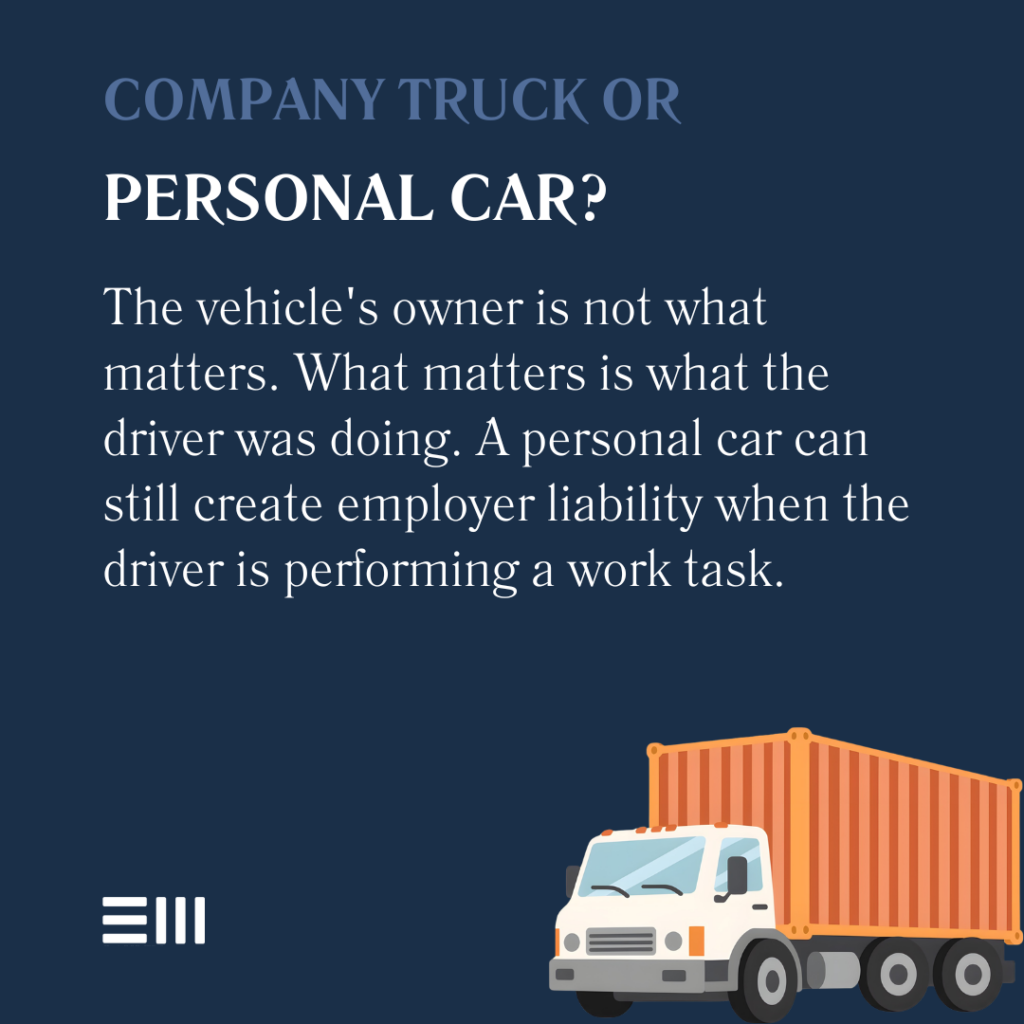
Alabama follows the doctrine of respondeat superior, which allows an employer to be held liable for an employee’s negligence committed within the line and scope of employment. It does not require proving the company itself did anything wrong.
Courts generally look at these elements:
- The right of selection. The employer hired or chose the person driving.
- The right of control. The employer retained authority to direct and supervise that person’s work.
- Line and scope of employment. The driver was performing a job task, or something reasonably connected to it, at the time of the crash.
When those pieces line up, the driver’s negligence is attributed to the company, and the company’s insurance is on the hook alongside the driver.
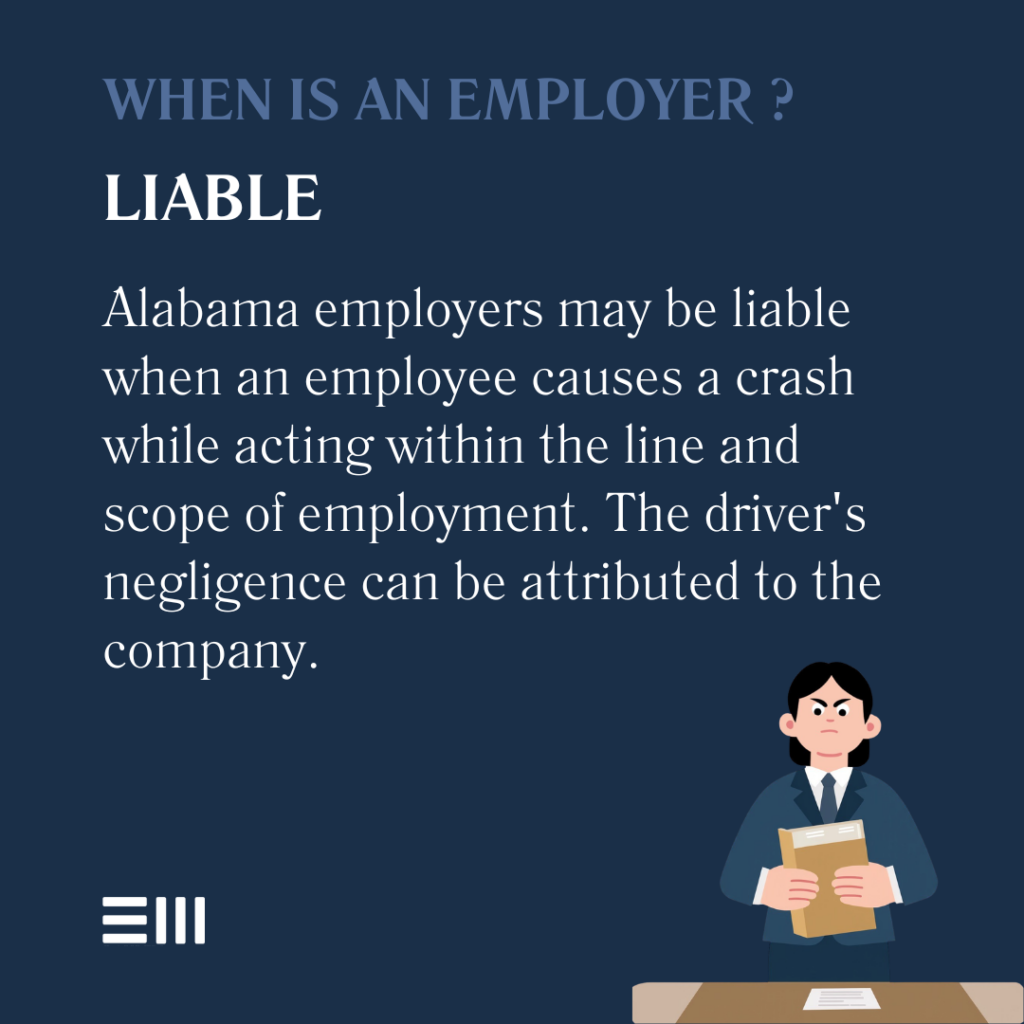
Company Truck or Personal Car, the Task Is What Counts
A common misunderstanding is that employer liability turns on who owns the vehicle. It does not. What matters is what the driver was doing.
A worker running deliveries in a company van and a salaried employee driving a personal sedan to a client meeting can both be acting within the scope of employment. Conversely, an employee behind the wheel of a company truck on a purely personal errand may fall outside it.
Alabama courts examine the purpose of the trip, whether the employer benefited from it, and whether the driver was doing what they were hired to do.
So the question to ask is not whose name is on the title. It is whose business was being served.
Commuting, Detours, and the Limits of Employer Liability
Employer liability does not extend to everything an employee does behind the wheel, and two doctrines mark the boundaries.
Under the coming and going rule, an ordinary commute between home and a fixed workplace generally falls outside the scope of employment, so a crash on the morning drive usually does not create employer liability.
Several situations can change that result, including a special errand undertaken at the employer’s request, travel that is itself part of the job for someone with no fixed workplace, and trips made in an employer-provided vehicle with work duties attached.
Courts also distinguish a minor detour, a slight deviation that stays within the scope, from a frolic, a substantial personal side trip that takes the driver outside it.
These lines are fact intensive, which is precisely why the details of a driver’s trip deserve close investigation.
Delivery Drivers, Rideshare, and the Contractor Question
Gig work has complicated this area considerably. Many companies classify drivers as independent contractors, and respondeat superior generally does not reach a true independent contractor.
That label is not the end of the analysis. Consider the following:
- The label can be wrong. Courts look at actual control over the work, not the title in a contract, so a misclassified worker may still trigger employer liability.
- Rideshare policies fill part of the gap. Uber and Lyft carry substantial liability coverage that can apply when a driver is matched with a rider, with lower contingent coverage while the app is on.
- Delivery arrangements vary widely. Some couriers are employees, some drive for staffing intermediaries, and some contract directly, and each structure carries different coverage.
- Direct claims may still exist. A company that negligently hired, trained, supervised, or entrusted a vehicle to a dangerous driver can be liable for its own conduct.
Sorting this out requires looking past the paperwork to how the work was actually controlled and insured.
Alabama Rules That Can End a Strong Case
Two features of Alabama law make early action especially important in these claims. Neither is intuitive, and both catch injured people by surprise.
Alabama remains a contributory negligence state, which means an injured person found even slightly at fault may recover nothing at all. Commercial defendants know this, and their insurers work quickly to build a record suggesting you share blame.
Alabama also generally allows two years from the date of injury to file a personal injury claim, and evidence unique to these cases, such as driver logs, dispatch records, maintenance files, and electronic vehicle data, can be lost long before that deadline arrives.
Moving early protects both the evidence and the claim itself.
How Our Firm Builds These Cases
A work-related crash is rarely a simple two-car claim. It is a case about a company, its policies, its records, and its insurance, and it needs to be built that way from the start.
Our experienced personal injury attorneys here at Baxley Maniscalco investigate whether the driver who hurt you was working, identify every policy that may apply, and move quickly to preserve company records before they disappear.
We handle serious injury and wrongful death claims across Alabama, and we work on a contingency basis, so there is no fee unless we recover for you. If a commercial driver caused your crash, a free case review is the place to start.
Questions Alabama Crash Victims Are Asking
Work-related crashes raise questions that a standard car accident claim does not. Here are the ones we hear most often.
How Do I Know If the Driver Was Working?
Signs include a company vehicle, a uniform or logo, delivery equipment, or a statement at the scene. Even without those, dispatch records, phone data, and employment records can establish it later.
Can the Employer Be Liable If the Driver Used a Personal Car?
Yes. Employer liability depends on whether the driver was performing a work task, not on who owns the vehicle.
What If the Driver Was Commuting to Work?
An ordinary commute usually falls outside the scope of employment. Exceptions exist for special errands, travel that is part of the job, and some trips in employer-provided vehicles.
Does It Matter If the Company Calls the Driver a Contractor?
It matters, but it is not decisive. Courts examine actual control over the work, and misclassification, rideshare coverage, or direct negligence claims against the company may still apply.
How Long Do I Have to File in Alabama?
Generally, two years from the date of injury. Because key evidence can vanish much sooner, waiting is risky even well inside that window.
Every crash is different, so reach out if your situation is not covered here.
The Company Behind the Wheel Should Answer for It
When a business puts a driver on the road and someone gets hurt, that business should be part of the conversation about making it right. Finding out whether it is responsible costs you nothing.
Our experienced personal injury attorneys here at Baxley Maniscalco are ready to review your crash and explain your options.
Call us at (256) 770-7232 or reach out through our contact form to schedule a free consultation today.
Can't find what you're looking for? Search our site below.