

A class action settlement notice lands in your inbox with a number large enough to command attention: $9 million. It is easy to read that headline as a promise. Then the claim form mentions product limits, proof of purchase, a pro rata adjustment, a release of claims, and three different deadlines.
The recent proposed Dr. Squatch settlement is a useful example of what these notices actually require. The biggest number describes the gross settlement fund—not what any one consumer will receive. The more important questions are whether you fit the class definition, what proof changes the claim, which rights you release, and what happens if you take no action.
A Settlement Headline Is the Beginning, Not the Answer
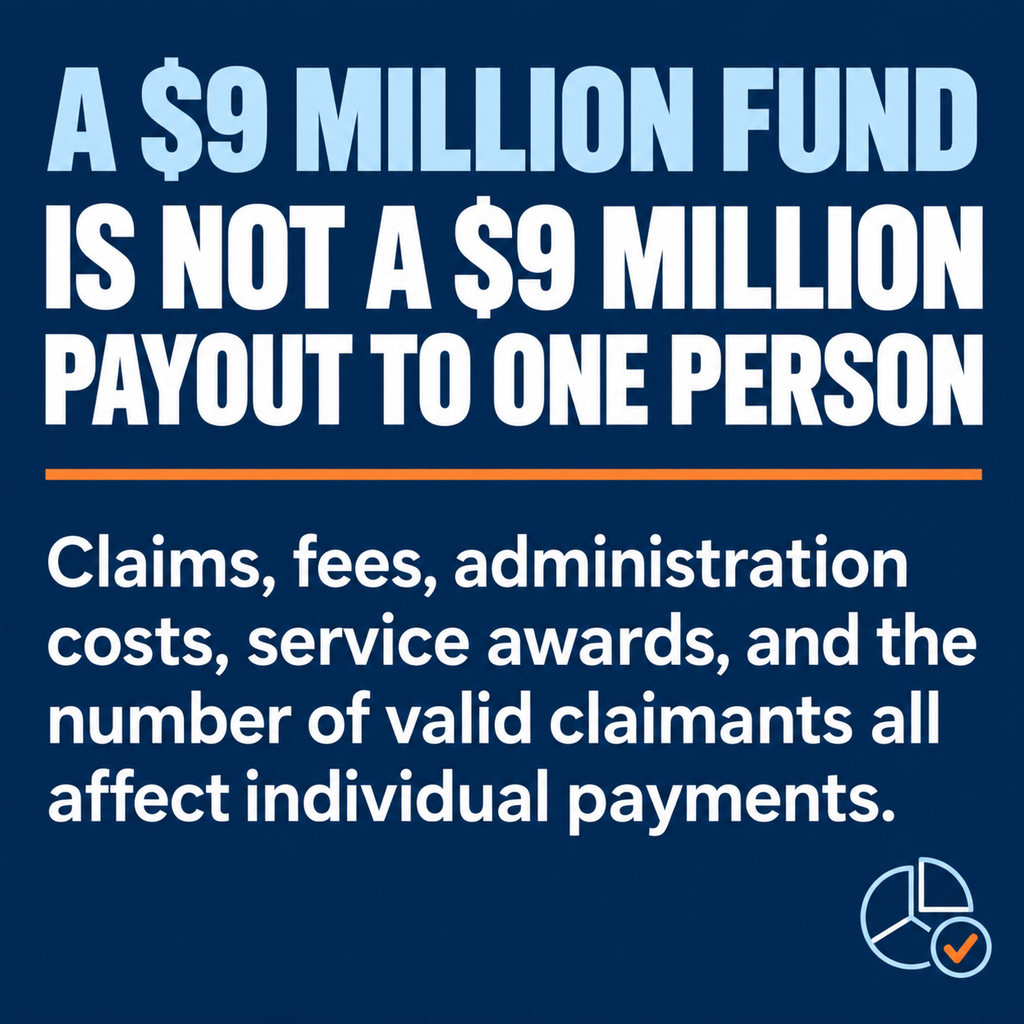
Class action settlements pool many similar claims into one resolution. The fund may need to cover payments to class members, court-approved attorneys’ fees, litigation expenses, notice and administration costs, and service awards for class representatives. The remaining amount may then be divided among valid claimants under a formula approved by the court.
That is why a class action settlement notice usually avoids guaranteeing a final check amount. The number of valid claims may not be known until the deadline passes. Some settlements increase or reduce individual payments on a pro rata basis, while others use payment tiers, documented-loss categories, product limits, or point systems.
The headline still matters. A substantial fund can create meaningful aggregate relief and resolve claims that would be impractical to pursue one purchase at a time. But the gross fund and the individual benefit answer different questions.
What the Dr. Squatch Settlement Actually Says
The proposed settlement in Guzman et al. v. Dr. Squatch, LLC involves allegations that certain products were marketed as natural even though plaintiffs alleged they contained synthetic ingredients. Dr. Squatch denies the allegations and any wrongdoing. The parties agreed to settle without a finding of liability.
According to the official court-authorized settlement website, the class generally includes people who purchased covered Dr. Squatch products in the United States from November 1, 2018, through August 29, 2026. Covered products include specified personal-care items whose labeling used the term “natural,” including certain soaps, shampoos, conditioners, deodorants, toothpastes, lotions, and related products.
The settlement establishes a $9 million fund. The official frequently asked questions state that the fund may also pay court-approved attorneys’ fees of up to one-third of the fund, up to $50,000 in litigation costs, up to $40,000 total in service awards, and estimated notice and administration expenses of $475,000.
Claims are due November 27, 2026. Requests for exclusion and objections are due October 13, 2026. A final approval hearing is scheduled for March 2, 2027. No payment is available yet, and distribution depends on final approval and the resolution of any appeals.
The Payment Formula Lives Below the Headline
The Dr. Squatch example shows how product limits and documentation can shape a claim. The reported settlement terms provide a base benefit of $0.50 per covered product. A claimant with proof of purchase may claim up to 20 products.
A claimant without proof may claim up to five. The categories can be cumulative, so someone claiming 20 documented products and five undocumented products could have a stated base benefit of $12.50 before any applicable adjustment.
That figure may look modest beside the $9 million headline, but it reflects the type of alleged economic harm at issue: consumers claim they paid for products marketed in a way they say was misleading. This is different from a case involving substantial medical bills, lost income, or an individualized physical injury.
The final payment can also depend on how many valid claims are submitted and how the settlement formula operates after court-approved deductions.
A class member should not multiply the fund by a hoped-for percentage or rely on an unofficial social-media estimate. The settlement agreement and court-authorized notice control.
A Claim Form Is Only One of Four Choices
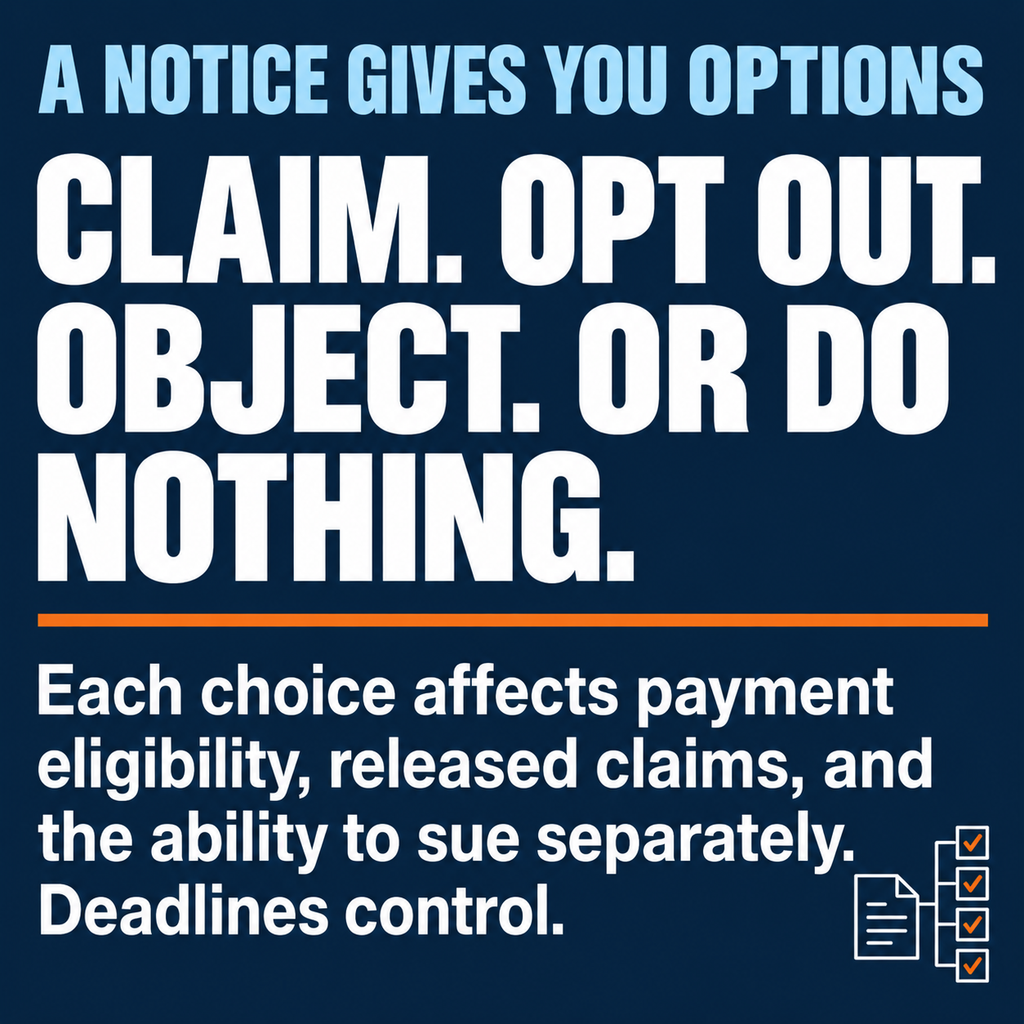
Most settlement notices present more than a yes-or-no decision. The Dr. Squatch class action settlement notice illustrates four separate paths:
- Submit a claim: A valid, timely claim preserves eligibility for a payment under the settlement formula. It does not guarantee that the court will approve the settlement or that a particular amount will be paid.
- Exclude yourself: Opting out removes you from the settlement class. You receive no settlement payment, but you preserve the ability to pursue the released claims separately, subject to applicable deadlines and other legal requirements.
- Object: An objection tells the court why you believe the proposed settlement should not be approved as written. You remain in the class. You may also submit a claim, but you will generally be bound if the court approves the settlement over the objection.
- Do nothing: Doing nothing is still a legal choice. You may receive no payment because you did not file a claim, while still becoming bound by the judgment and release if the settlement becomes final.
These options are not interchangeable. Opting out is not the same as objecting. Objecting does not remove you from the class. Filing a claim does not preserve a separate lawsuit over claims that the settlement releases.
The Release May Matter More Than the Check
Every class action settlement notice contains a release—the set of claims class members give up if they remain in the class and the settlement becomes final.
The release can be more consequential than the payment, especially for someone whose circumstances differ from the typical class member.
The Dr. Squatch notice says the released claims concern the use of the term “Natural” on covered products during the class period. It also states that the release does not include personal-injury or product-liability claims relating to the products.
That boundary is unusually important to read correctly. It does not prove that a separate injury claim exists, and it does not extend any filing deadline. It simply describes what this settlement says it releases and what it excludes.
Another settlement may use broader or narrower language. Never assume that joining one consumer settlement gives up all possible claims—or that it gives up none. Read the defined terms, the class period, the released parties, and the released claims together.
Proof of Purchase Can Change the Value of a Claim
Receipts disappear. Online order histories become inaccessible. Loyalty accounts change. Yet a settlement may assign a higher limit or different payment tier when a claimant can document purchases.
Before filing, look for:
- Retail receipts or email confirmations showing the item, seller, and purchase date;
- Online order histories from the manufacturer, marketplace, or retailer;
- Loyalty-account records that identify qualifying purchases;
- Bank or card statements when the claim form or administrator accepts them;
- Product photographs or packaging if permitted by the claim instructions; and
- The submission confirmation generated after the claim is filed.
Use only documentation the form requests or permits. Do not guess quantities, alter records, or submit a claim for products you did not purchase. Class action claim forms are legal submissions, and administrators can reject unsupported or inconsistent claims.
The Authorized Website Is the Safest Starting Point
Popular settlements attract search results, social posts, and websites that summarize eligibility. Some summaries are useful, but the court-authorized source should control your decision. For the Dr. Squatch matter, the official website expressly identifies itself as the only authorized site for the litigation.
Confirm the case name and number. Read the court-authorized long-form notice. Check the class definition, covered products, claim instructions, release, and deadlines.
Be cautious about a third party asking for payment to file a basic settlement claim or requesting sensitive information beyond what the official form requires.
Keep a copy of the completed claim, uploaded proof, confirmation number, and payment selection. Final approval can take months, and appeals can extend the timeline. A saved record is easier to use than trying to reconstruct the submission later.
Small Individual Payments Can Still Serve a Larger Purpose
A low-dollar consumer class action can address conduct that would rarely justify thousands of separate lawsuits. If an alleged overcharge or price premium is only a few dollars per person, the cost of individual litigation would overwhelm the possible recovery. Aggregation allows common issues to be tested and resolved together.
That does not mean every proposed settlement is automatically fair. Courts evaluate notice, class treatment, the proposed relief, fees, objections, and other factors before granting final approval.
Class members can review the proposal, object when appropriate, or exclude themselves when preserving an individual claim is more important than participating.
The meaningful comparison is not simply “$9 million versus $12.50.” It is the settlement’s likely individual benefit, the claims being released, the cost and risk of alternatives, and whether the proposed resolution fairly addresses the alleged group-wide harm.
When a Class Settlement May Not Fit Your Harm
Class actions work best when many people suffered a sufficiently similar injury from common conduct. They may be a poor fit when causation, physical injuries, medical expenses, lost income, or other damages vary significantly from person to person.
Baxley Maniscalco’s guide to how class actions work in Alabama explains the certification framework. Our comparison of mass torts and class action lawsuits addresses why serious individualized injuries may require a different structure.
If a notice overlaps with a significant financial loss, physical injury, existing lawsuit, or potential individual claim, obtain legal advice before the exclusion deadline. Waiting until after the deadline may leave fewer options, even when the claim-filing deadline is later.
How Our Firm Helps Consumers Evaluate Their Options
Baxley Maniscalco is not class counsel in the Dr. Squatch settlement and does not administer its claims. Consumers seeking to participate in that settlement should follow the court-authorized notice and official website.
More broadly, our attorneys help Alabama consumers distinguish a routine settlement claim from a potentially separate personal-injury, product-liability, consumer, or mass-tort matter. We can review the nature of the harm, the notice language, the release, relevant deadlines, and whether an individual claim may warrant separate evaluation.
The right question is not always “How do I join?” Sometimes it is “What would I give up?” or “Does this settlement address the harm I actually suffered?” Those questions should be answered before the earliest deadline passes.
Questions Class Members Are Asking
A class action settlement notice affects legal rights even when the expected payment is small. These are common questions consumers should resolve before choosing a path.
Am I Automatically Paid If I Received a Notice?
Usually not. A notice may mean records identified you as a potential class member, but many settlements require a valid claim form before payment. You must still satisfy the class definition and follow the instructions by the deadline.
How Much Will the Dr. Squatch Settlement Pay Me?
The reported base benefit is $0.50 per covered product, subject to product limits, proof rules, and the settlement formula. Up to 20 products may be claimed with proof and up to five without proof. The final payment can be affected by valid claim volume and court-approved settlement terms.
Do I Need a Receipt to File a Claim?
The settlement permits a limited claim without proof of purchase, while documentation allows a higher product limit. Read the official form carefully because acceptable proof and limits differ across settlements.
Is Objecting the Same as Opting Out?
No. An objector remains in the class and asks the court to reject or change the proposed settlement. A person who opts out receives no settlement payment but is not bound by the settlement’s release of claims. Each requires its own procedure and deadline.
What Happens If I Do Nothing?
Under the Dr. Squatch notice, doing nothing means you will not receive a payment because you did not submit a claim, but you may still be bound by the final judgment and release if the settlement is approved.
What If I Believe a Product Caused an Actual Injury?
Do not assume a low-dollar consumer settlement resolves an injury claim. The Dr. Squatch notice expressly excludes personal-injury and product-liability claims from its release, but whether a separate claim exists depends on evidence, causation, applicable law, and filing deadlines. Seek individualized advice promptly.
The Envelope Is Small. The Decision Is Not.
The most important line in a class action settlement notice may not be the fund amount. It may be the definition that decides whether you qualify, the proof rule that changes the claim, the release that limits future rights, or the deadline that arrives weeks before the claim form is due.
Read the official materials before clicking submit—or ignoring the notice. Save your records, distinguish opting out from objecting, and compare the settlement benefit with the rights being released. A few minutes of careful review can prevent a small claim from creating a much larger misunderstanding.
Call or text Baxley Maniscalco at (256) 770-7232 or use our contact form to schedule a confidential consultation about your legal options.
Can't find what you're looking for? Search our site below.