

Alabama family court judges do not flip a coin when deciding which parent receives custody.
Every ruling follows a structured evaluation rooted in a legal standard known as the “best interests of the child,” and the specific criteria that fall under that standard are collectively referred to as the Alabama custody factors.
Yet many parents enter the courtroom without a clear understanding of what those factors actually include or how heavily each one can influence the final outcome.
At a rate of roughly 3.2 divorces per 1,000 residents — well above the national average according to the CDC — Alabama courts weigh these factors thousands of times each year, and the parents who understand them hold a distinct advantage from the very first hearing.
What the Alabama Custody Factors Actually Evaluate
Alabama does not rely on a single checklist printed in a statute.
Instead, the Alabama custody factors emerge from decades of case law and judicial discretion, all anchored to one overarching question: what arrangement best serves the child’s physical, emotional, and developmental well-being?
Judges have broad latitude when applying these factors, which means no two cases are evaluated in exactly the same way.
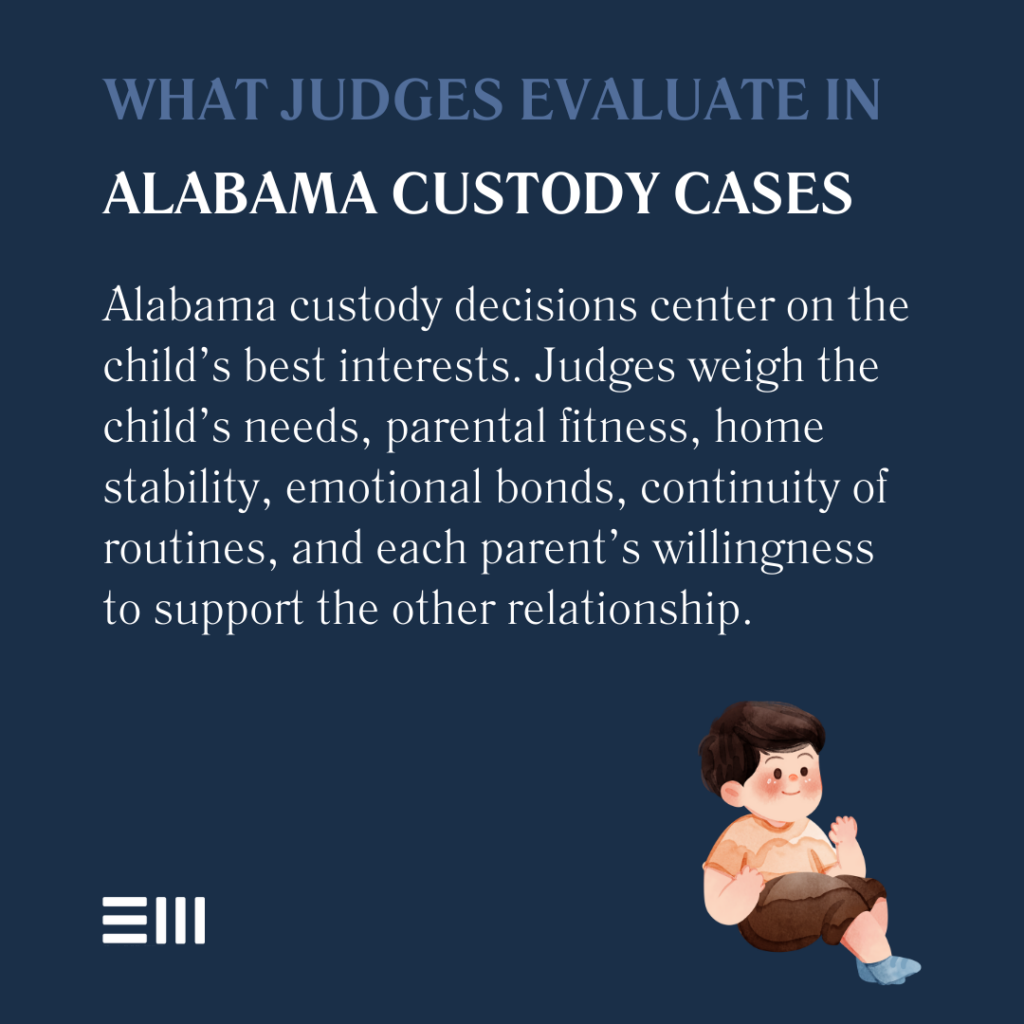
Courts generally examine the following considerations when making a custody determination:
- The age and developmental needs of the child, which influence whether overnight stays, extended visitation, or primary placement with one parent is most appropriate.
- Each parent’s moral character and fitness, including any history of substance abuse, criminal behavior, or domestic violence.
- The stability of each parent’s home environment, covering housing consistency, household members, and the overall safety of the residence.
- The emotional bond between the child and each parent, evaluated through the quality and frequency of daily interactions.
- Each parent’s willingness to support the child’s relationship with the other parent, a factor judges watch closely because uncooperative behavior can work against the offending party.
- The child’s ties to school, community, and extended family, which help the court assess how a change in placement might disrupt routines.
- The child’s own preference, when the child is of sufficient age and maturity to express a reasoned opinion.
These factors work together rather than in isolation, and no single factor automatically overrides the others.
For a more detailed breakdown of how judges apply these standards during hearings, our resource on how Alabama courts determine custody covers the process from start to finish.
How Judges Weigh the Alabama Custody Factors in Practice
Understanding what the Alabama custody factors are is only half the equation. Knowing how judges actually apply them during a contested case helps parents prepare evidence that aligns with the court’s priorities.
Alabama custody proceedings do not involve a jury — a single judge hears the evidence and issues a ruling — so the judge’s interpretation of each factor carries enormous weight.
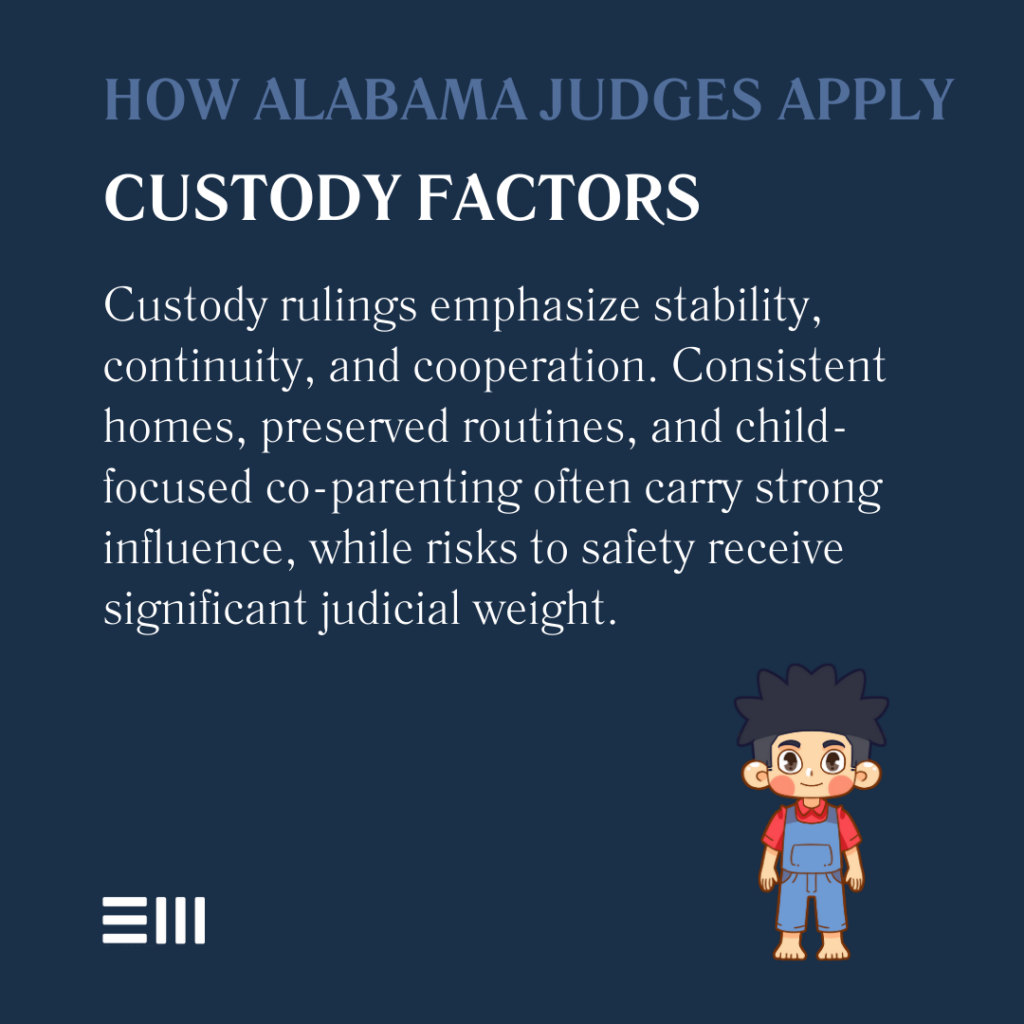
Courts tend to give significant attention to stability and continuity. A parent who has maintained a consistent home, kept the child enrolled in the same school, and provided reliable daily routines often earns favorable consideration under the Alabama custody factors.
Judges also look carefully at cooperation between parents. A mother or father who actively encourages the child’s relationship with the other parent and follows existing visitation schedules demonstrates the kind of co-parenting mindset courts want to reward.
Alabama law explicitly prohibits gender-based preferences in custody decisions. The outdated “Tender Years” doctrine, which once presumed mothers were automatically better suited for custody of young children, has not applied in Alabama for decades.
Both parents are evaluated under the same best-interests standard regardless of gender, and the Alabama custody factors apply equally to mothers and fathers.
When domestic violence, substance abuse, or neglect is part of the picture, those issues carry heavy weight. Courts may order supervised visitation, restrict overnight stays, or deny custody altogether when evidence shows that a parent poses a risk to the child’s safety or well-being.
The Role of the Child’s Preference in Alabama Child Custody Cases
One of the most frequently misunderstood Alabama custody factors is the child’s preference. Alabama law permits judges to consider what a child wants, but it does not give children the right to choose where they live.
Alabama courts typically begin giving meaningful weight to a child’s stated preference around age 12 to 14, though the child’s maturity level matters as much as chronological age.
Judges also evaluate the reasoning behind the preference. A child who wants to live with one parent because that household has fewer rules may not receive the same consideration as a child who articulates a preference based on school proximity, emotional closeness, or sibling relationships.
The child’s preference remains just one piece of the broader puzzle that the Alabama custody factors create, and it never serves as the sole deciding factor in a case.
Frequently Asked Questions About the Alabama Child Custody Factors
Parents navigating custody disputes for the first time often have pressing questions about how the Alabama custody factors will affect their case.
The answers below address the concerns that arise most often during the early stages of a custody matter.
Are the Alabama Custody Factors Listed in a Single Statute?
Not exactly. Unlike some states that enumerate custody factors in a single code section, Alabama’s best-interests standard draws from a combination of statutes and appellate case law.
This gives judges significant discretion, which is why having an attorney who understands local judicial tendencies is particularly valuable.
Does Income Determine Who Gets Custody?
Income alone does not decide custody under the Alabama custody factors. While financial stability is relevant, courts also consider which parent provides more hands-on care, emotional support, and household stability.
A parent with a lower income who is deeply involved in the child’s daily life can absolutely receive primary custody over a higher-earning parent who is less present.
Can the Alabama Custody Factors Change over Time?
The factors themselves remain consistent, but their application can shift as circumstances evolve. If a significant life change affects the child’s well-being — such as a parent’s relocation, remarriage, or change in employment — either parent may petition the court for a custody modification.
The court then reevaluates the Alabama custody factors in light of the new circumstances.
How Do I Prove I Meet the Alabama Custody Factors?
Documentation is everything. School records, medical appointment logs, communication records between co-parents, financial disclosures, and character references from teachers or counselors all help build a case that speaks directly to the factors judges evaluate.
Our guide on preparing for a child custody hearing in Alabama walks through the evidence-gathering process in detail.
Having clear answers to these questions allows you to approach your custody case with confidence and realistic expectations about the road ahead.
Protect What Matters Most with Baxley Maniscalco by Your Side
The Alabama custody factors shape every custody ruling in the state, and the way you present your case against those factors can define your child’s living situation for years to come.
Our experienced family law attorneys here at Baxley Maniscalco have spent years helping Alabama parents build organized, compelling cases that address every factor judges evaluate.
We combine thorough preparation with aggressive courtroom advocacy because we know your child’s future is at stake.
Contact Baxley Maniscalco today to schedule a consultation. Let our team help you understand the Alabama custody factors, build the strongest case possible, and fight for the outcome your family deserves.
Can't find what you're looking for? Search our site below.