

Alabama judges have complete discretion to decide where your children will live, who makes decisions about their education and healthcare, and how much time they spend with each parent.
When parents cannot agree, a judge who has never met your family will make choices that shape your children’s lives for years to come.
The court’s primary concern is always the child’s best interest—not what either parent wants.
Understanding how to win a custody battle means recognizing that “winning” isn’t about defeating the other parent; it’s about demonstrating to the court that you can provide the stability, nurturing environment, and co-parenting cooperation that serves your child’s needs.
Parents who approach custody disputes with this mindset position themselves far better than those who treat the process as a battle to be won at any cost.
What Alabama Courts Consider When Deciding Custody
Alabama judges evaluate numerous factors when determining custody arrangements, and knowing what the court examines helps parents focus their preparation on what actually matters.
The “best interests of the child” standard governs every custody decision in Alabama. This legal framework requires courts to consider the child’s needs rather than parental preferences, examining evidence about each parent’s ability to provide appropriate care.
Judges have significant discretion in weighing these factors, which means presenting strong, documented evidence becomes essential for parents seeking favorable outcomes.
Key factors Alabama courts evaluate include:
- Primary caregiver history. Courts examine who has provided daily care, managed school involvement, coordinated medical appointments, and handled day-to-day parenting responsibilities throughout the child’s life.
- Emotional bonds with each parent. The quality and depth of the relationship between parent and child matters more than simply counting hours spent together.
- Stability and continuity. Judges often prefer arrangements that minimize disruption to the child’s established home, school, community, and social connections.
- Co-parenting willingness. Courts favor parents who demonstrate commitment to encouraging healthy relationships between children and the other parent.
- Physical and mental fitness. Each parent’s capacity to provide safe, nurturing care receives careful scrutiny, including any history of substance abuse, domestic violence, or mental health concerns.
Understanding these factors reveals that how to win a custody battle often comes down to demonstrating genuine child-focused parenting rather than attacking the other parent.

Building Your Case: Documentation and Evidence
Strong custody cases rely on organized documentation that demonstrates your parenting involvement and ability to meet your child’s needs, and gathering this evidence should begin well before any court date.
Courts make decisions based on evidence, not accusations or emotions. Parents who arrive at custody hearings with documented proof of their involvement and capabilities position themselves significantly better than those who rely on verbal claims alone.
Keeping detailed records of interactions, contributions, and involvement creates the foundation for a compelling presentation.
Evidence that strengthens custody cases includes:
- School involvement records. Report cards, parent-teacher conference attendance, volunteer activities, and communications with teachers demonstrate educational engagement.
- Medical care documentation. Records showing which parent schedules appointments, attends visits, and manages healthcare decisions.
- Daily parenting logs. Notes documenting time spent with children, activities shared, homework help provided, and transportation to activities.
- Financial contribution records. Evidence of child-related expenses paid, including clothing, activities, school supplies, and extracurricular fees.
- Communication records. Text messages, emails, and other communications that demonstrate your co-parenting efforts and the other parent’s responses.
Organized documentation helps your attorney present a clear picture of your parenting and makes your case for how to win a custody battle significantly stronger.
Behaviors That Help and Hurt Your Case
Your conduct during custody proceedings directly impacts judicial perceptions, and understanding what impresses courts—and what damages credibility—guides better decision-making throughout the process.
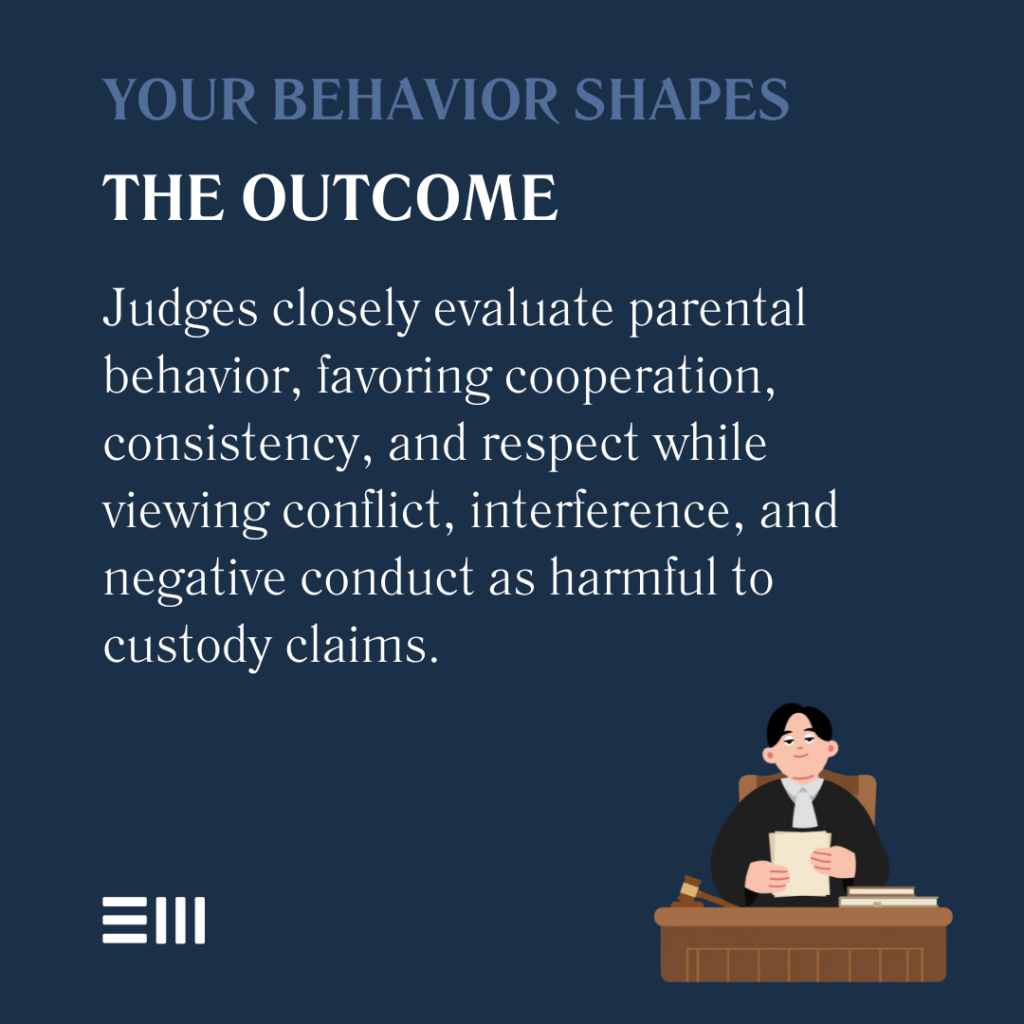
Judges observe parental behavior carefully, both in the courtroom and through evidence presented about conduct outside of it.
Parents who attempt to alienate children or interfere with the other parent’s relationship may be seen as acting against the child’s best interests, potentially damaging their own custody positions.
Courts want to see mature, child-focused adults capable of putting their children’s needs ahead of personal grievances.
Behaviors that strengthen your position include:
- Facilitating the other parent’s relationship. Encouraging your children to maintain bonds with their other parent demonstrates maturity and child-centered thinking.
- Maintaining stability. Keeping consistent routines, stable housing, and steady employment shows you can provide the environment children need.
- Communicating respectfully. Professional, businesslike communication with your co-parent—even when difficult—reflects well on your judgment.
- Following court orders. Strict compliance with temporary orders and visitation schedules demonstrates respect for the legal process.
Behaviors that damage your case include:
- Speaking negatively about the other parent. Disparaging comments to children or in court make you appear more focused on conflict than on your children’s wellbeing.
- Withholding visitation. Denying court-ordered parenting time without valid safety concerns creates serious problems for your case.
- Making unilateral decisions. Making major choices about children without consulting the other parent suggests an inability to co-parent effectively.
- Social media mistakes. Posts showing irresponsible behavior or criticizing your co-parent can become evidence against you.
Understanding how to win a custody battle means recognizing that your behavior is always being evaluated.
Frequently Asked Questions About Custody Disputes in Alabama
The following questions address concerns Alabama parents most commonly raise when navigating custody proceedings.
At What Age Can a Child Decide Which Parent to Live With in Alabama?
There is no specific age when children automatically choose their custodial parent. Courts may consider a child’s preference depending on their age and maturity level, but this is only one factor among many.
Judges evaluate whether the preference reflects sound reasoning and whether it has been influenced by parental manipulation. Older, more mature children’s wishes typically carry more weight.
Does Alabama Favor Mothers in Custody Cases?
No. Alabama does not have a presumption favoring either parent, and both mothers and fathers have equal opportunity to seek custody. Courts focus on which parent can best serve the child’s interests based on the specific evidence presented, not on gender assumptions.
What Is the Difference Between Legal and Physical Custody?
Legal custody refers to decision-making authority over major issues like education, healthcare, and religious upbringing.
Physical custody determines where the child primarily resides. Parents can share both types of custody jointly, or one parent may have sole legal custody, sole physical custody, or both.
Can Custody Orders Be Changed After They’re Finalized?
Yes, but modifications require demonstrating a material change in circumstances since the original order. Alabama courts set a high bar for modifications to protect children’s stability. Simply disagreeing with the existing arrangement isn’t sufficient grounds for modification.
Should I Try to Settle Custody Outside of Court?
Generally, yes. Negotiated agreements allow parents to craft arrangements tailored to their family’s specific needs rather than having a judge impose a one-size-fits-all solution. Mediation and collaborative approaches often produce better outcomes and preserve co-parenting relationships.
These answers provide general guidance, but every custody situation involves unique circumstances requiring individualized legal analysis.
Put Your Children First with Baxley Maniscalco
Custody disputes are among the most emotionally challenging legal matters any parent faces. Our experienced family law attorneys here at Baxley Maniscalco understand what Alabama courts look for and how to present your case effectively.
We help parents understand their rights, gather compelling evidence, and develop strategies focused on achieving the best possible outcomes for their children.
Contact us today for a confidential consultation, and let us help you navigate this difficult process with confidence.
Can't find what you're looking for? Search our site below.