

Every year, roughly one in 13 Americans changes residences, and for divorced or separated parents, a move across state lines can trigger a legal conflict that reshapes their entire custody arrangement overnight.
Alabama is one of several states with specific relocation statutes that restrict a custodial parent’s ability to simply leave with a child — and a noncustodial parent’s ability to block a legitimate move is equally limited.
If you or your co-parent is considering a move, understanding what happens if a parent wants to move out of state with a child in Alabama is the only way to avoid a costly misstep.
Alabama’s Parent-Child Relationship Protection Act: The Rules That Govern Relocation
Alabama’s relocation requirements are defined by the Parent-Child Relationship Protection Act, codified under Alabama Code § 30-3-160 through § 30-3-169.10.
The law applies whenever a parent with custody intends to move the child’s principal residence more than 60 miles from the current location — whether that move crosses state lines or stays within Alabama.
The statute exists to balance two competing interests: a parent’s freedom to pursue job opportunities, family support, or a fresh start against the child’s need for a stable, ongoing relationship with both parents.
Courts resolve that tension by evaluating each relocation request on its own facts, and the process starts well before anyone loads a moving truck.
The 45-Day Written Notice Requirement
The single most important procedural step in an Alabama relocation case is the written notice requirement.
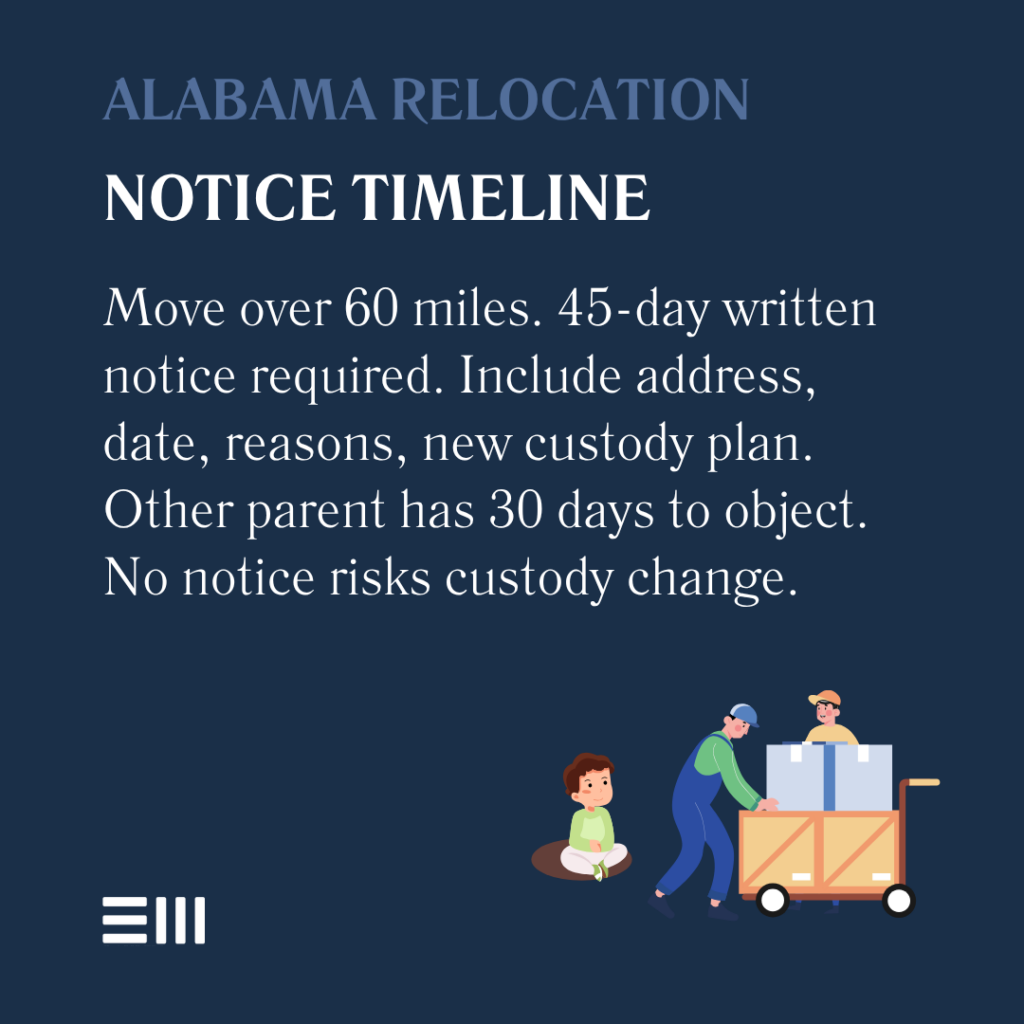
A parent who plans to move must provide formal written notice to every person with custody or visitation rights at least 45 days before the proposed move. This notice is not optional, and skipping it can carry serious consequences.
The notice must include several specific details required by statute.
- The intended new address and phone number. The relocating parent must disclose where they plan to live so the other parent and the court can evaluate the impact on existing custody arrangements.
- The date of the proposed move. A specific move date allows the other parent adequate time to evaluate their options and, if necessary, file an objection with the court.
- The reasons for the relocation. Whether the move is driven by a new job, a remarriage, proximity to extended family, or another factor, the relocating parent must state their rationale in writing.
- A proposed revised custody and visitation schedule. The relocating parent must suggest a new parenting plan that preserves the child’s relationship with the non-moving parent, including transportation arrangements and cost-sharing.
Failing to provide this notice — or moving without it — gives the non-relocating parent powerful legal ammunition. Alabama courts can treat an unauthorized move as grounds for modifying the existing custody order, potentially shifting primary custody to the parent who stayed behind.
What Happens When the Other Parent Objects
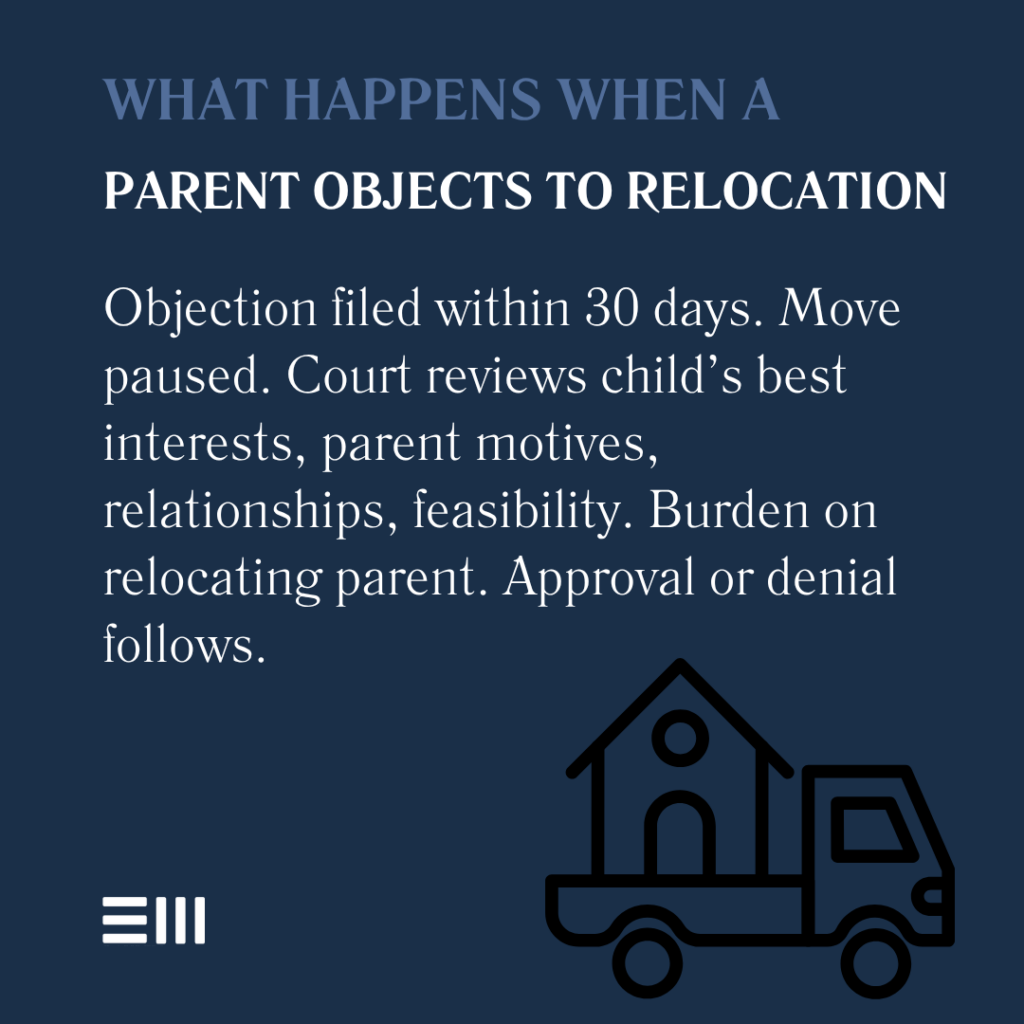
After receiving the 45-day notice, the non-relocating parent has 30 days to file a formal objection with the court. Once an objection is filed, the relocating parent cannot move with the child until a judge rules on the matter.
This is where understanding what happens if a parent wants to move out of state with a child in Alabama becomes most important — because the outcome hinges on a detailed judicial analysis.
Alabama courts weigh several factors when deciding whether to permit or deny a relocation, all centered on the best interests of the child.
- The quality of the child’s relationships with both parents. Courts examine the depth of the bond the child shares with each parent and how the move would affect day-to-day contact.
- The child’s age, developmental needs, and preferences. Older children with established school routines, friendships, and extracurricular activities may face more disruption than younger children.
- The feasibility of preserving the non-moving parent’s relationship. Judges assess whether the proposed revised visitation schedule — combined with technology, summer stays, and holiday arrangements — can realistically maintain meaningful contact.
- The relocating parent’s motives. Courts look at whether the move serves a legitimate purpose like career advancement or family support, or whether it is primarily intended to interfere with the other parent’s custody time.
- The non-relocating parent’s motives for objecting. A judge will also consider whether the objection is rooted in genuine concern for the child or in a desire to control or punish the other parent.
The burden of proof falls on the parent seeking to relocate. They must demonstrate that the move is made in good faith and that it serves the child’s best interests.
If the court is not persuaded, the relocation will be denied — and the parent who moved without permission may face contempt charges or a custody modification that works against them.
What Happens If No Objection Is Filed
If the 30-day objection window passes and the non-relocating parent does not file anything with the court, the relocating parent is generally free to proceed with the move.
However, the existing custody order remains in effect until formally modified, which means both parents should still petition the court for an updated parenting plan that reflects the new living arrangement.
Assuming the move is valid and proceeding without objection does not relieve either parent of their ongoing obligations.
Child support calculations, visitation schedules, and decision-making authority all may need to be adjusted to account for the increased distance between households.
Frequently Asked Questions About Relocating With a Child in Alabama
Relocation disputes generate some of the most pressing questions in Alabama family law. Below are answers to the concerns parents raise most frequently.
Can My Ex Move Away With My Child Without My Permission?
No — not legally. Alabama law requires the relocating parent to provide 45 days’ written notice before moving a child more than 60 miles from the current residence.
You then have 30 days to file an objection. If you object and the matter goes to court, a judge must approve the move before it can take place.
Do You Need Court Permission to Relocate With a Child?
You need court permission only if the other parent files a timely objection to your proposed move. If no objection is filed within 30 days of receiving your notice, you may proceed.
However, even without an objection, it is strongly advisable to petition the court for a modified custody order that reflects the new arrangement.
What Are Alabama’s Relocation Laws for Custody?
Alabama’s relocation framework is governed by the Parent-Child Relationship Protection Act. It requires written notice at least 45 days before the move, allows the non-moving parent 30 days to object, and directs courts to evaluate the move based on the child’s best interests.
Moves of more than 60 miles trigger the statute regardless of whether the destination is in-state or out-of-state.
What Happens if a Parent Moves Without Giving Notice?
Moving without proper notice is treated very seriously by Alabama courts. The non-relocating parent can file an emergency motion to have the child returned, and a judge may hold the relocating parent in contempt.
In some cases, an unauthorized move has led courts to transfer primary custody to the parent who remained.
Can a Relocation Be Reversed After It Is Approved?
Yes. If circumstances change significantly after a court-approved relocation — for example, the job that justified the move falls through, or the child’s wellbeing declines — either parent can petition for a custody modification under Alabama’s material change in circumstances standard.
If your relocation situation involves factors not covered here, speaking with a qualified attorney is the most reliable way to protect your rights and your child’s stability.
Navigate Your Move Without Losing Ground
Whether you are planning a relocation or fighting to keep your child close, the legal stakes are too high to leave anything to chance.
Our experienced family law attorneys here at Baxley Maniscalco have handled relocation disputes across Alabama — from drafting compliant 45-day notices to representing parents at contested hearings.
We understand the factors judges weigh, the documentation that matters, and how to position your case for the strongest possible outcome.
Contact us today for a confidential consultation and let us help you take the next step with confidence.
Can't find what you're looking for? Search our site below.