

Alabama is one of the only states in the country where families who lose a loved one to someone else’s negligence cannot recover compensation for medical bills, funeral costs, or lost income through a wrongful death claim.
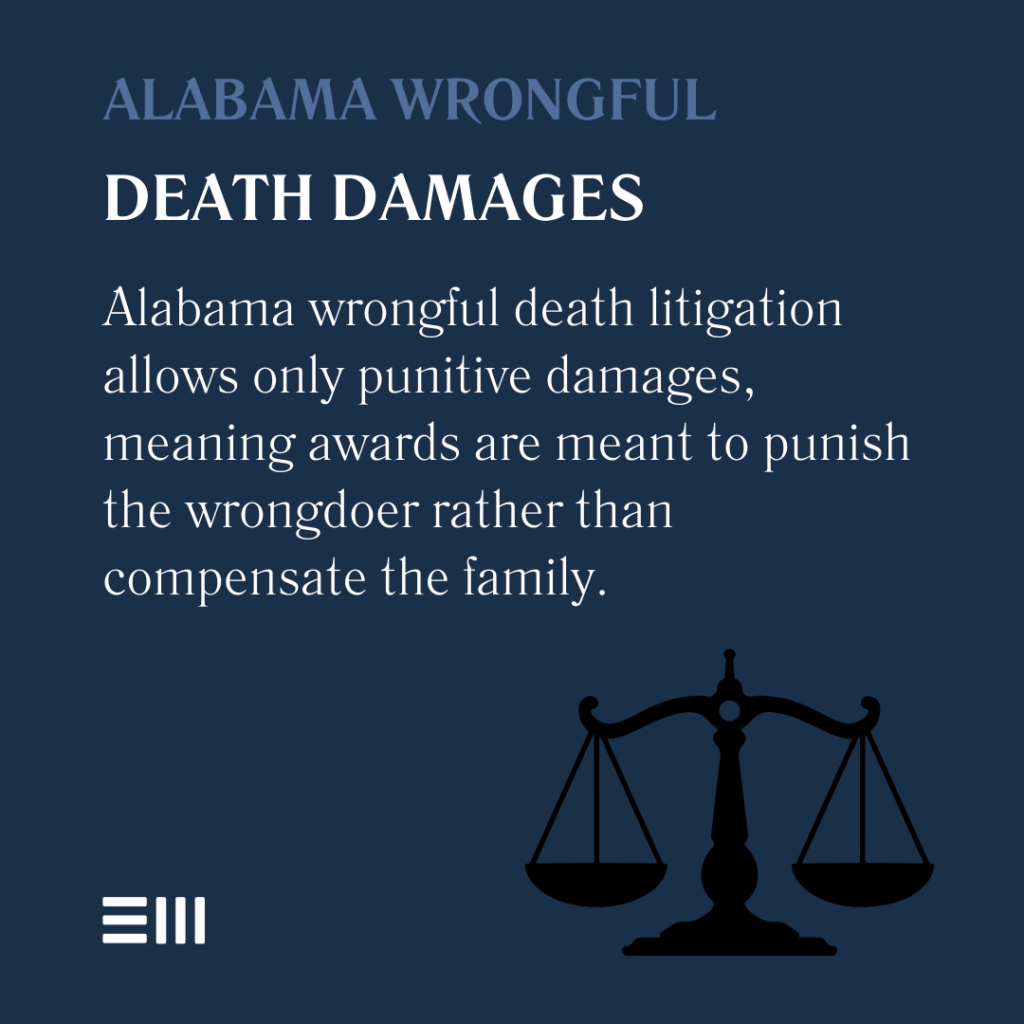
Instead, the state’s wrongful death statute — codified in Alabama Code §§ 6-5-391 and 6-5-410 — awards exclusively punitive damages, designed to punish the wrongdoer rather than reimburse the family.
It’s a legal framework that surprises most people and fundamentally changes how wrongful death litigation works here compared to almost everywhere else.
That distinction has enormous practical consequences. Because damages are punitive rather than compensatory, the focus in Alabama wrongful death litigation shifts from what the family lost to how egregious the defendant’s conduct was.
The more reckless, negligent, or intentional the behavior that caused the death, the larger the potential award — and unlike most civil cases in Alabama, there is no statutory cap on what a jury can award.
Understanding how this system works is the starting point for any family considering legal action.
How Alabama’s Wrongful Death Statute Differs from Other States
Most states allow families to recover for tangible losses — lost wages, medical expenses, funeral costs, loss of companionship. Alabama’s approach is fundamentally different, and that difference affects every aspect of how a wrongful death case is built, argued, and valued.
Here’s what sets Alabama apart:
- Only punitive damages are recoverable. Alabama wrongful death litigation does not permit compensation for the family’s financial losses. The award is based entirely on punishing the defendant and deterring similar conduct.
- There is no cap on damages. While Alabama limits punitive damages in most civil lawsuits, wrongful death claims are specifically exempt from those caps, giving juries wide discretion.
- The severity of the defendant’s conduct drives the award. Juries evaluate the degree of recklessness, the defendant’s financial resources, and the need to send a message — not the family’s economic hardship.
- Awards are generally tax-exempt. Under federal tax law, Alabama wrongful death awards are typically not subject to income tax because they are classified as punitive rather than compensatory.
This structure means that cases involving drunk driving, gross negligence, or deliberate misconduct tend to produce larger verdicts than those involving ordinary carelessness.
The focus on punishment rather than reimbursement makes the nature of the defendant’s behavior the central issue in every case.
Who Can File a Wrongful Death Claim in Alabama?
Alabama law restricts who has standing to initiate wrongful death litigation, and the rules are more narrow than many families expect. Filing authority doesn’t belong to a surviving spouse or child by default — it belongs to a specific legal role.
Here’s how it works:
- Only the personal representative of the deceased’s estate can file. This is the executor named in the will or an administrator appointed by the probate court. Family members cannot file on their own unless they hold this role.
- If no representative is named, the court appoints one. A surviving spouse, adult child, parent, or sibling is typically appointed, but the process requires a court proceeding before the lawsuit can move forward.
- Parents of a deceased minor child have direct standing. If a child under 19 dies, either parent may file the wrongful death claim. If neither parent acts within six months, the child’s personal representative may then file.
- Damages are distributed under intestacy law, not the deceased’s will. Regardless of what the will says, wrongful death proceeds are distributed according to Alabama’s statutory inheritance hierarchy — surviving spouse, children, parents, then siblings.
Establishing the correct personal representative early in the process avoids procedural delays that can jeopardize a claim. An attorney experienced in wrongful death litigation can handle the probate steps alongside the civil case.
The Statute of Limitations and Why It Matters
Alabama imposes strict deadlines for filing wrongful death litigation, and missing them can permanently eliminate your family’s right to pursue a claim. The standard timeline is straightforward, but exceptions and shorter deadlines for government entities add complexity.
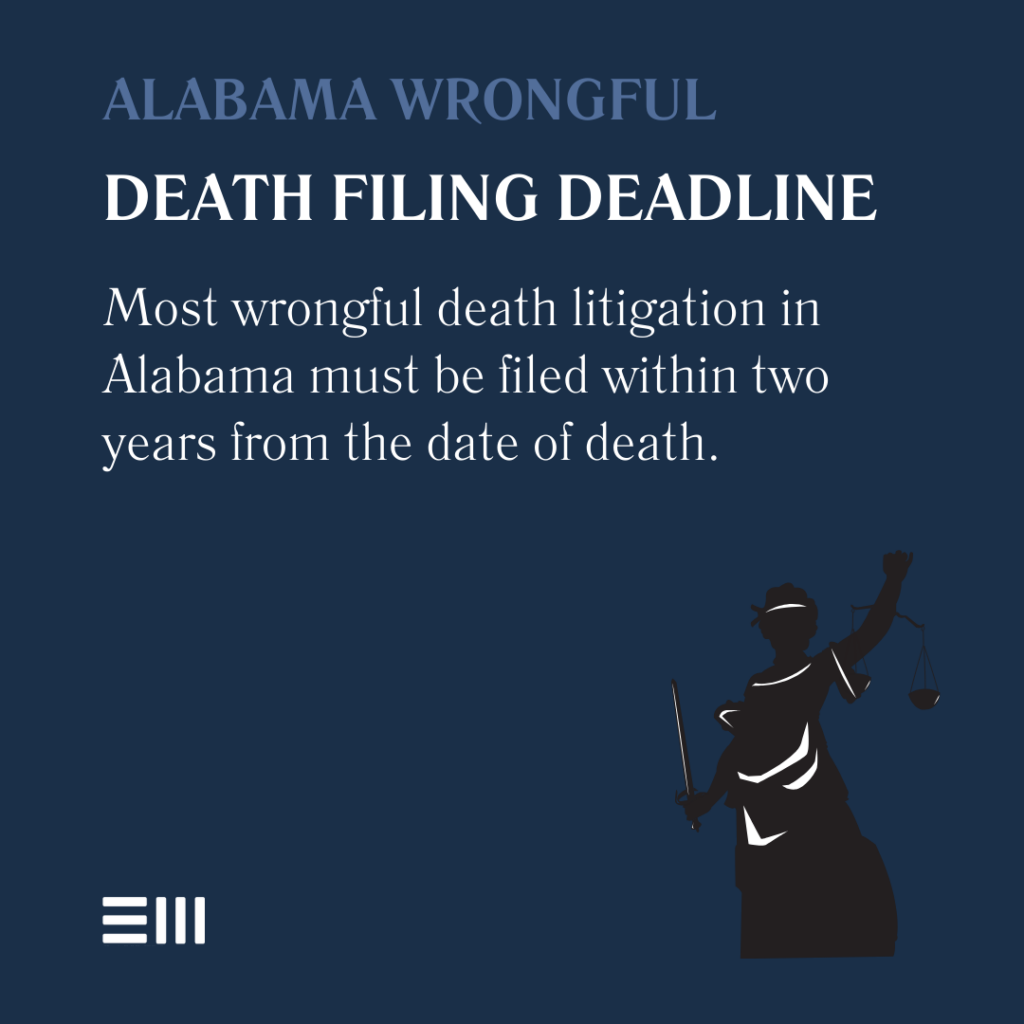
- Two years from the date of death. This is the general statute of limitations for wrongful death claims in Alabama under Code § 6-2-38.
- Six months for claims against municipalities. If a city or its employee caused the death, the filing window is dramatically shorter.
- Twelve months for claims against counties. County government entities have a one-year deadline.
- Limited tolling exceptions exist. In rare cases involving fraud, concealment, or the legal incapacity of the personal representative, a court may extend the deadline — but these exceptions are narrowly applied.
The two-year clock begins on the date of death, not the date of the incident that caused it. In cases where the victim survived for a period after the injury, this distinction can affect the filing timeline.
Acting quickly preserves your legal options and allows your attorney to secure evidence before it deteriorates.
Common Causes of Wrongful Death Claims in Alabama
Wrongful death litigation arises from a wide range of circumstances, but certain types of incidents appear more frequently than others in Alabama courts. The underlying requirement is always the same: someone died because another party was negligent, reckless, or acted intentionally.
- Car and truck accidents. Collisions involving speeding, distracted driving, drunk driving, or commercial truck negligence are among the most common triggers for wrongful death claims in Alabama.
- Medical malpractice. Surgical errors, misdiagnosis, delayed treatment, and medication mistakes that result in a patient’s death can give rise to wrongful death litigation against healthcare providers.
- Workplace accidents. Fatal injuries in construction, manufacturing, and industrial settings often involve safety violations or equipment failures that point to employer or third-party negligence.
- Defective products. When a consumer product, vehicle component, or piece of equipment fails and causes a fatal injury, the manufacturer may be held liable.
- Premises liability. Property owners who fail to maintain safe conditions — inadequate security, structural hazards, or dangerous conditions — can face wrongful death claims when someone dies on their property.
Each of these scenarios requires different evidence, different expert witnesses, and a different litigation strategy. The common thread is proving that the defendant’s conduct fell below the standard of care and directly caused the death.
Frequently Asked Questions About Wrongful Death Litigation
Families dealing with the loss of a loved one often face legal questions they never anticipated having to answer. Below are direct responses to the questions we hear most often about wrongful death litigation in Alabama.
Can I Recover Funeral Costs or Medical Bills through a Wrongful Death Claim?
Not through the wrongful death claim itself. Alabama’s statute limits recovery to punitive damages. However, families may pursue a separate survival action to recover the deceased’s pre-death medical expenses and pain and suffering, and property damage claims can also be filed independently.
These run alongside — not instead of — the wrongful death case.
What Factors Determine How Much a Jury Awards?
Because damages are punitive, juries look at the severity of the defendant’s misconduct, their financial resources, any prior similar behavior, and the need to deter future conduct.
The family’s financial losses are not part of the calculation, which is why the defendant’s behavior — not the victim’s circumstances — drives the award.
Can I File a Wrongful Death Lawsuit and a Survival Action at the Same Time?
Yes. Alabama allows both claims to proceed simultaneously. The survival action addresses what the deceased would have recovered had they lived — pain and suffering, lost wages, medical expenses — while the wrongful death claim focuses on punishing the defendant.
The two claims serve different purposes and provide separate forms of recovery.
What Happens if Multiple Family Members Disagree about Filing?
Only the personal representative has the legal authority to file. If family members disagree, disputes over who should serve as representative may need to be resolved in probate court before wrongful death litigation can begin.
An attorney can help navigate these family dynamics while protecting the claim’s timeline.
Understanding how Alabama’s wrongful death system works — and how it differs from what most people expect — is the first step toward protecting your family’s right to hold the responsible party accountable.
Your Family Deserves Answers — and Someone Who Knows How to Get Them
Losing someone to another person’s negligence is devastating. Navigating Alabama’s unique wrongful death laws while grieving makes it even harder.
The legal process won’t wait, though — filing deadlines are strict, evidence needs to be preserved, and the personal representative must be established before a claim can move forward.
Our experienced wrongful death attorneys here at Baxley Maniscalco have represented families across Alabama in cases involving fatal car accidents, medical malpractice, workplace tragedies, and defective products.
We understand how Alabama’s punitive-damages-only framework works, and we know how to build cases that hold defendants accountable for the worst outcomes of their conduct.
Your initial consultation is free, confidential, and carries no obligation. We’ll review the circumstances of your loss, explain your legal options, and give you an honest assessment of what comes next.
Call or text us today at (256) 770-7232 to schedule your consultation.
Can't find what you're looking for? Search our site below.