

The average American sends over 40 text messages a day and spends more than two hours on social media — and every one of those interactions creates a digital record that can surface in a courtroom.
In Alabama custody disputes, judges are increasingly relying on screenshots, message threads, and social media posts to evaluate a parent’s fitness, honesty, and willingness to co-parent.
If you are in the middle of a custody battle or anticipating one, the answer to whether text messages, social media, or emails can be used as evidence in an Alabama custody case is a definitive yes — but only when the evidence is collected, preserved, and presented correctly.
Turn Your Evidence Into a Stronger Case
Digital evidence can be the difference between winning and losing a custody dispute — but only if it is collected, preserved, and presented the right way.
Our experienced family law attorneys here at Baxley Maniscalco know how to evaluate digital communications, build compelling evidence packages, and present them effectively in Alabama courtrooms.
From organizing your text message records to challenging improperly obtained evidence from the other side, we handle the details that shape outcomes.
Contact us today for a confidential consultation and let us help you build the strongest possible case for your child’s future.
Why Alabama Courts Accept Digital Evidence in Custody Disputes
Alabama’s Rules of Evidence do not distinguish between paper documents and digital communications when it comes to admissibility.
Text messages, emails, direct messages, and social media posts are all treated as potential evidence under the same standards that apply to any other document or record. What matters to the court is whether the evidence is relevant, authentic, and obtained lawfully.
In custody proceedings, Alabama judges evaluate every decision through the lens of the child’s best interests.
Digital evidence has become one of the most effective tools for demonstrating — or undermining — a parent’s character, stability, and commitment to co-parenting. A single angry text thread or a reckless social media post can shift the trajectory of a case more than hours of verbal testimony.
Types of Digital Evidence That Carry Weight in Custody Cases
Not all digital evidence is created equal. Alabama family courts tend to give the most weight to communications and posts that directly reflect on parenting behavior, judgment, or honesty.
Understanding which types of evidence matter most helps you focus your efforts on what will actually influence the outcome.
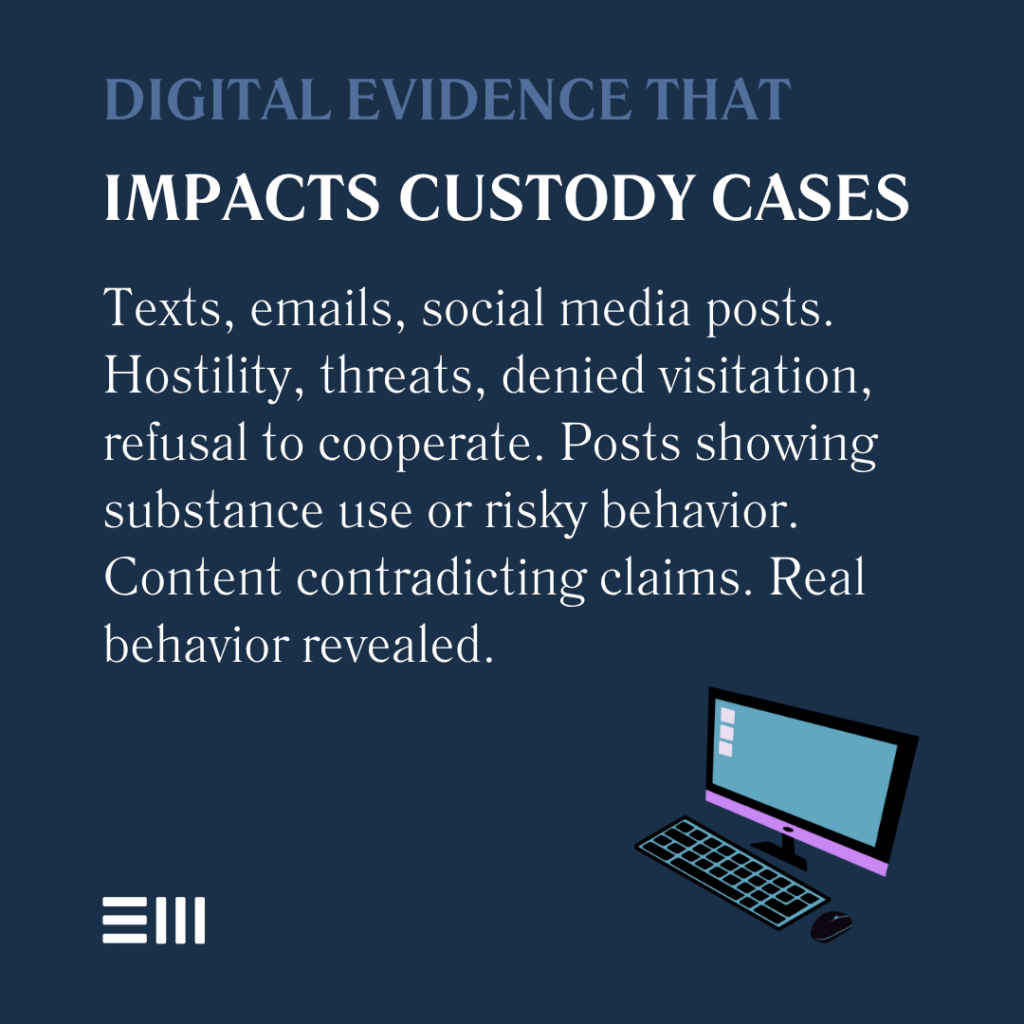
- Text messages showing hostility or threats. Messages where one parent threatens, insults, or attempts to manipulate the other parent demonstrate an inability to co-parent cooperatively — a factor judges weigh heavily.
- Social media posts contradicting court testimony. A parent who claims financial hardship but posts photos of expensive vacations or luxury purchases creates a credibility problem that is difficult to explain away.
- Emails documenting refusal to cooperate. Written exchanges where a parent ignores scheduling requests, blocks communication about the child’s needs, or unilaterally changes plans provide clear evidence of a custody order violation.
- Posts or messages showing substance abuse or risky behavior. Photos, check-ins, or conversations that depict excessive drinking, drug use, or reckless activities raise legitimate questions about a parent’s fitness.
- Evidence of parental alienation. Messages where one parent coaches the child against the other, disparages the co-parent, or actively undermines the child’s relationship with them can be devastating in court.
- Communications proving denied visitation. A text thread where one parent repeatedly cancels or refuses the other parent’s court-ordered parenting time provides documented proof of noncompliance.
When presented properly, these forms of digital evidence give judges an unfiltered window into how each parent actually behaves — not just how they present themselves during a hearing.
How to Preserve Digital Evidence So It Holds Up in Court
Knowing that text messages, social media, or emails can be used as evidence in an Alabama custody case is only useful if you preserve them in a way the court will accept.
Digital evidence is fragile — messages can be deleted, posts can disappear, and screenshots can be challenged as incomplete or altered. Taking the right steps early protects you from losing proof you may need later.
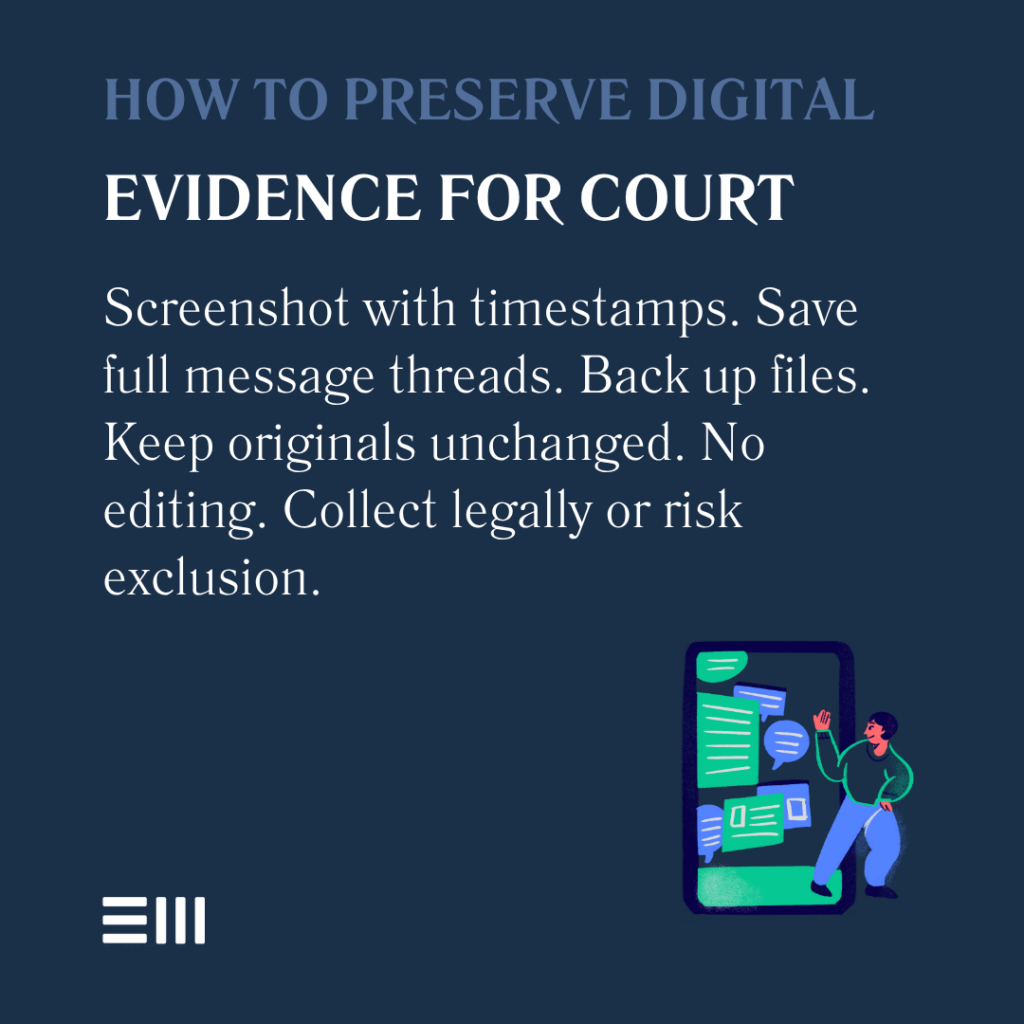
- Screenshot everything immediately. Capture the full conversation or post, including timestamps, sender information, and any visible metadata, as soon as you encounter relevant content.
- Save original files when possible. Export complete text threads or email chains rather than relying solely on screenshots, since exports preserve metadata that verifies authenticity.
- Back up evidence in multiple locations. Store copies on a separate device, a cloud service, and a USB drive so that a lost phone or deleted account does not destroy your proof.
- Do not alter or edit anything. Cropping out context, rearranging messages, or editing screenshots — even for formatting reasons — can get your evidence excluded and damage your credibility with the judge.
- Avoid obtaining evidence through illegal means. Accessing your co-parent’s phone, hacking into their accounts, or using spyware violates Alabama law and will likely result in the evidence being thrown out entirely.
A well-organized evidence file with clear, unaltered records makes your attorney’s job significantly easier and demonstrates to the court that you are thorough, honest, and prepared.
What Alabama Courts Will Not Allow
While digital evidence is broadly admissible, there are boundaries. Alabama judges will exclude evidence that was obtained illegally, lacks authentication, or is more prejudicial than probative. Understanding these limits is just as important as knowing what the court will accept.
Evidence gathered by hacking into a co-parent’s email account, installing tracking software without consent, or accessing password-protected social media profiles without authorization will almost certainly be excluded — and could expose you to criminal liability.
Similarly, evidence that is taken out of context or presented in a misleading way may be stricken by the court and could undermine your case rather than strengthen it.
If you are unsure whether a particular piece of evidence is admissible, your attorney can evaluate it before you attempt to introduce it in custody proceedings.
Frequently Asked Questions About Digital Evidence in Alabama Custody Cases
Parents involved in custody disputes frequently ask how digital communications factor into the court’s decision. Below are answers to the questions that come up most often.
Can Texts Be Used in Court for Custody in Alabama?
Yes. Text messages are admissible as evidence in Alabama custody proceedings as long as they are relevant to the case, properly authenticated, and obtained lawfully. Screenshots with visible timestamps and sender identification are the most common method of presenting text evidence.
Does Social Media Affect Custody Decisions?
It absolutely can. Alabama judges consider social media posts, photos, comments, and check-ins when they reflect on a parent’s judgment, lifestyle, or honesty.
Posts depicting substance use, reckless behavior, or hostility toward the co-parent have influenced custody outcomes in Alabama courts.
Adjusting your privacy settings does not guarantee protection — content shared with mutual contacts can still reach the courtroom.
What Evidence Helps Win a Custody Case?
The strongest custody evidence directly demonstrates your involvement as a parent and the other parent’s deficiencies.
Medical and school records, a detailed parenting journal, text and email exchanges showing cooperation or lack thereof, and witness testimony all carry weight. Digital evidence is most powerful when it corroborates other forms of proof rather than standing alone.
Can Deleted Messages Still Be Used as Evidence?
In some cases, yes. If you captured screenshots before the messages were deleted, those screenshots remain valid evidence.
Additionally, attorneys can sometimes subpoena phone records or request forensic recovery of deleted data during the discovery process. However, relying on recovery is risky — preserving evidence in real time is always the better approach.
Should I Stop Using Social Media During a Custody Case?
You do not necessarily need to deactivate your accounts, but you should assume that everything you post, comment on, or share could be presented in court. Avoid discussing the case, the other parent, or your children online. When in doubt, do not post.
If you have questions about specific evidence in your custody matter, consulting directly with a family law attorney is the best way to get guidance tailored to your circumstances.
Can't find what you're looking for? Search our site below.