

Alabama recorded over 140,000 traffic crashes in 2024, resulting in more than 36,000 injuries and 967 fatalities. That translates to roughly one accident reported every three and a half minutes across the state.
Watch one of our founding partners, Alyssa Baxley, walk you through an accident report.
After each of these collisions, law enforcement officers complete an official crash report documenting what happened—a document that becomes foundational to any insurance claim or legal action that follows.
Learning how to read an Alabama vehicle crash report empowers you to verify accuracy, identify potential problems, and protect your interests. The details recorded on this form can make or break your case, yet most people have never seen one until they’re involved in an accident themselves.
Understanding the Basic Layout
Every Alabama crash report follows a standardized format that organizes information into specific sections, and knowing where to look helps you quickly find the details that matter most.
When you first receive your crash report, the document may appear overwhelming with its codes, diagrams, and dense blocks of text.
However, the report follows a logical structure designed to capture everything relevant about the collision. Understanding how to read an Alabama vehicle crash report starts with recognizing how the document is organized from top to bottom.
Key sections at the top of the report include:
- Date, time, and day of week. These basic facts establish when the accident occurred and can be relevant for factors like traffic patterns or lighting conditions.
- County and city. The location determines which court has jurisdiction and may affect which laws apply.
- Investigating officer information. This identifies who responded to the scene and can be contacted if clarification is needed.
- Road and location details. Specific street names, mile markers, or landmarks pinpoint exactly where the collision occurred.
The header section provides the foundational facts that frame everything else in the report.
The Unit Designations: Who’s at Fault
One of the most critical aspects of understanding how to read an Alabama vehicle crash report involves recognizing how officers designate the involved vehicles and assign fault.
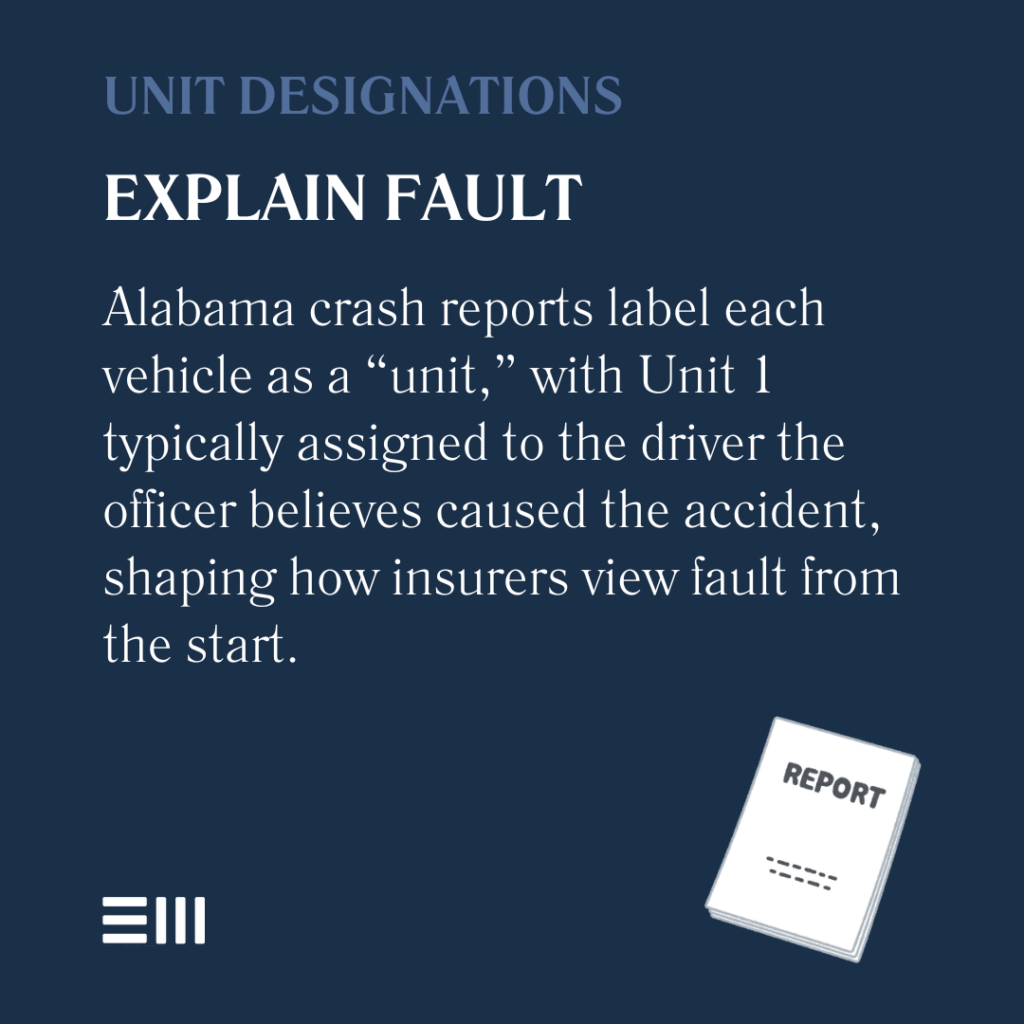
The term “unit” refers to each vehicle involved in the collision. This designation carries significant weight because officers are trained to list the driver they deem at fault as Unit 1.
If you’re pursuing an injury claim, knowing which unit designation you received tells you how the investigating officer viewed the accident.
How unit designations work:
- Unit 1 is the at-fault driver. Officers place the person they determine caused the accident in this position, along with their vehicle information, insurance details, and identifying data.
- Unit 2 is typically not at fault. If you’re listed here, the officer’s initial assessment favors your version of events.
- Additional units appear as needed. Multi-vehicle collisions involving three or more cars will include Unit 3, Unit 4, and so on down the report.
- Insurance information appears with each unit. Your own policy details and the other driver’s coverage are recorded in their respective unit sections.
Understanding your unit designation helps you anticipate how insurance companies and attorneys will initially view your case.
Reading the Damage Diagrams
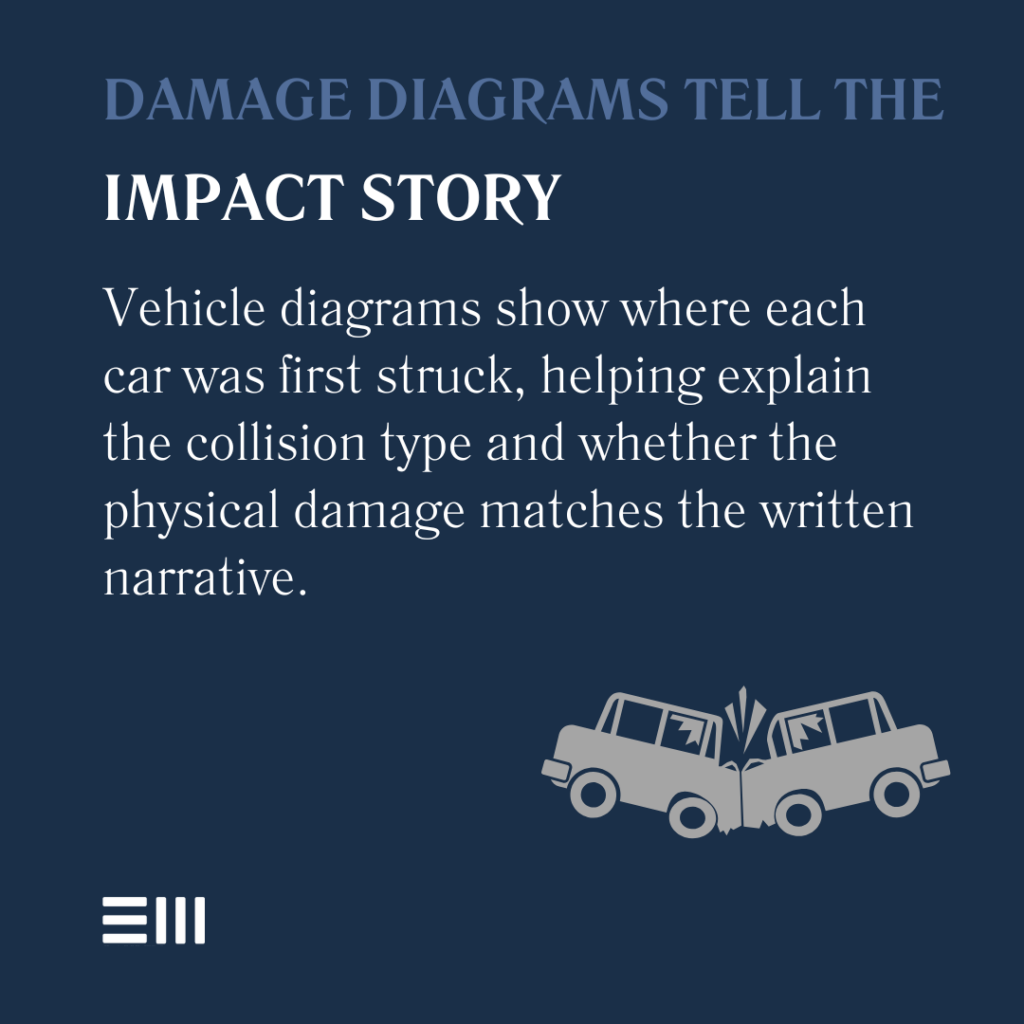
The vehicle diagrams on an Alabama crash report visually represent where each car was struck, providing valuable information about collision dynamics.
Each unit section includes a small diagram showing a vehicle from above, divided into numbered sections around its perimeter.
The investigating officer highlights the number corresponding to where that vehicle sustained initial impact. Learning how to read an Alabama vehicle crash report includes understanding these visual representations, which often tell the story of the collision at a glance.
What the diagrams reveal:
- Point of initial impact (POI). The highlighted number shows where the vehicle was first struck—12 indicates a front impact, 6 indicates a rear impact.
- Consistency with the narrative. The diagram should match the officer’s written description of how the accident occurred.
- Collision type indicators. Side impacts, rear-ends, and head-on collisions show distinctly different patterns in these diagrams.
- Secondary impact locations. Some reports note additional damage areas if the vehicle was struck multiple times.
If the diagram doesn’t match your recollection of the accident, that discrepancy becomes important information for your accident attorney to investigate.
The Narrative Section
The officer’s written narrative represents the most detailed account of what happened and deserves careful attention when reviewing your crash report.
While codes and diagrams provide quick reference points, the narrative section contains the officer’s actual description of the collision based on their investigation.
This includes statements from drivers, witnesses, and the officer’s own observations at the scene. Knowing how to read an Alabama vehicle crash report means understanding that this narrative often carries significant weight with insurance adjusters and attorneys.
Elements commonly found in the narrative:
- Driver statements. What each driver told the officer about how the accident happened, sometimes quoted directly.
- Witness accounts. Any third-party observations the officer collected at the scene.
- Physical evidence observations. Skid marks, vehicle positions, debris patterns, and other scene details.
- Officer conclusions. The officer’s determination of what likely caused the collision based on available evidence.
Reading this section carefully and comparing it to your own memory of events helps identify any inaccuracies that need correction.
Additional Codes and Details
Beyond the main sections, Alabama crash reports contain numerous codes and supplementary information that provide additional context about the accident circumstances.
The lower portions of the report include details that may seem minor but can significantly impact your case. Speed estimates, citation information, weather conditions, and road characteristics all appear in designated sections.
Understanding how to read an Alabama vehicle crash report completely means reviewing these supplementary details.
Additional information recorded includes:
- Estimated speeds. What the officer believes each vehicle was traveling at the time of collision.
- Citations issued. Whether any driver received a ticket and for what violation.
- Speed limit. The posted limit for the road where the accident occurred.
- Injury information. Anyone who reported injuries at the scene and where they were transported.
- Alcohol or drug test results. Whether either driver was tested and the results.
- Weather and road conditions. Factors like rain, fog, darkness, or road surface issues.
- Towing information. Which companies removed vehicles from the scene.
A legend at the end of the report explains all the codes used throughout the document.
Frequently Asked Questions About Car Crash Reports
The following questions address concerns Alabama residents most commonly raise when reviewing their accident documentation.
What if the Report Contains Errors?
Crash reports can contain mistakes—officers piece together information quickly at chaotic scenes. Document any discrepancies you notice, as your attorney can work with this information.
Minor factual errors may be correctable, while disputed fault determinations typically must be challenged through the claims or legal process.
How Do I Get a Copy of My Crash Report?
You can request your report through the Alabama Law Enforcement Agency (ALEA) or the local police department that responded to your accident. There’s typically a small fee, and reports may take several days to become available after the collision.
Does the Officer’s Fault Determination Bind Insurance Companies?
No. While insurers consider the officer’s assessment, they conduct their own investigations and can reach different conclusions about fault. The crash report provides important evidence but isn’t the final word on liability.
Should I Give a Statement at the Scene?
You should provide basic facts to the investigating officer, but avoid speculating about fault or admitting responsibility. Statements you make at the scene may appear in the narrative section and can affect your claim later.
What if I Wasn’t Listed as Injured but Got Hurt Later?
Many injuries don’t manifest immediately after accidents. The fact that you’re not listed in the injury section doesn’t prevent you from pursuing compensation for injuries discovered later through medical evaluation.
These answers provide general guidance, but individual circumstances may require professional legal analysis.
Let Justice Roll
Understanding how to read an Alabama vehicle crash report is just the first step—knowing what to do with that information requires legal experience.
Our experienced car accident attorneys here at Baxley Maniscalco review crash reports daily, identifying issues others miss and building strong cases for our clients.
If you’ve been in an accident, contact us for a free, confidential consultation and let us review your crash report.
Can't find what you're looking for? Search our site below.