
For more than three decades, the people living and working at one of the nation's largest Marine bases were drinking water laced with industrial chemicals, in some areas at levels reaching hundreds of times the safety limit.
By the government's own account, close to a million Marines, family members, and civilian workers may have been exposed at Camp Lejeune between 1953 and 1987.
That harm eventually grew into one of the largest mass injury efforts in American history.
Where those claims stand in 2026, and what still matters for the families who filed, has shifted in ways worth understanding.
What Happened at Camp Lejeune
The Camp Lejeune water contamination traces back to water systems on the North Carolina base that were fed toxic chemicals for years. The contamination came from several sources, and its reach was enormous.
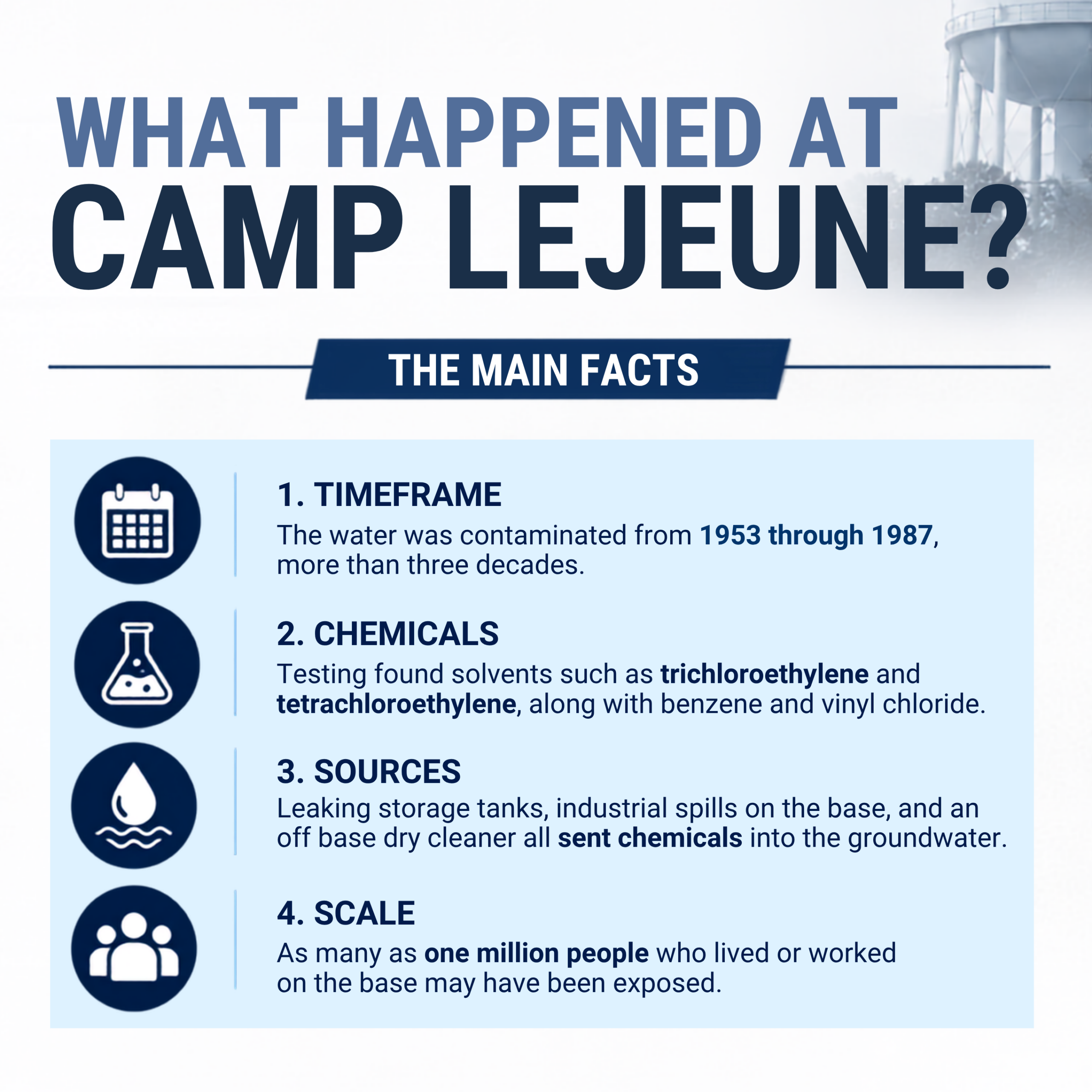
The main facts are these:
- The timeframe. The water was contaminated from 1953 through 1987, more than three decades.
- The chemicals. Testing found solvents such as trichloroethylene and tetrachloroethylene, along with benzene and vinyl chloride.
- The sources. Leaking storage tanks, industrial spills on the base, and an off base dry cleaner all sent chemicals into the groundwater.
- The scale. As many as one million people who lived or worked on the base may have been exposed.
Years later, that exposure was tied to serious illnesses, including several cancers, Parkinson's disease, and other conditions that surfaced long after families had moved on.
The Law That Opened the Door, and the Deadline That Closed It
For decades, the people harmed had no real way to hold the government accountable. That changed in 2022, then narrowed again in 2024.
The Camp Lejeune Justice Act, signed in August 2022 as part of the Honoring Our PACT Act, let people who spent at least 30 days on the base during the contamination years file claims against the federal government. It gave them a two-year window to act.
That window has now closed. The filing deadline passed on August 10, 2024, and the Department of the Navy is no longer accepting new claims.
One narrow exception remains. A person who filed on time but had the claim denied generally has 180 days from that denial to take the case to federal court.
Where the Camp Lejeune Claims Stand in 2026
Even with the filing window closed, the Camp Lejeune water contamination litigation is very much alive for the hundreds of thousands who filed in time.
Here is the current landscape:
- The volume. More than 400,000 administrative claims were filed with the Navy, and over 3,600 lawsuits are now pending in federal court in North Carolina.
- The settlements. Through a program called the Elective Option, the government has paid or offered hundreds of millions of dollars, with individual awards ranging from about $100,000 to $550,000.
- The trials. A group of test cases, known as bellwether trials, is expected to move forward and will help shape how the remaining claims are valued.
For families still waiting, these steps signal that answers, and in many cases compensation, are working their way through the system.
How Our Firm Helps Camp Lejeune Families
A filed claim is not the finish line. Choosing whether to accept a settlement or push a denied claim into court can shape the entire outcome, and those decisions are hard to make alone.
Our experienced mass tort attorneys here at Baxley Maniscalco help Alabama families understand where their Camp Lejeune claim fits in the process, weigh any Elective Option offer against what a case may truly be worth, and connect with the national mass tort teams driving this litigation.
You Filed a Claim. Now Make Sure It Counts.
If your family filed a Camp Lejeune claim, you deserve guidance you can trust as it moves forward. We'd be happy to review with you where things stand and explain your options.
Call our office at (256) 770-7232 or reach us through our contact form to schedule your consultation.