
Chick-fil-A built its brand on a day of rest. The chain has closed every Sunday since its founding so employees can spend the day with family and worship if they choose. That makes the latest headline an unusual one.
A Chick-fil-A franchise operator is now the target of a federal religious discrimination lawsuit, accused of firing a manager because she could not work on her own Sabbath.
The case was brought by the Equal Employment Opportunity Commission, the federal agency that enforces workplace civil rights law.
For Alabama workers, the lawsuit is a useful window into what the law actually requires when faith and a work schedule collide.
What the Lawsuit Alleges
The religious discrimination lawsuit names Hatch Trick Inc., a company that operates several Chick-fil-A restaurants in the Austin, Texas area.
It does not name the Chick-fil-A corporation itself. The case centers on a former employee named Laurel Torode, a member of the United Church of God, a faith that observes the Sabbath from sunset Friday to sunset Saturday.
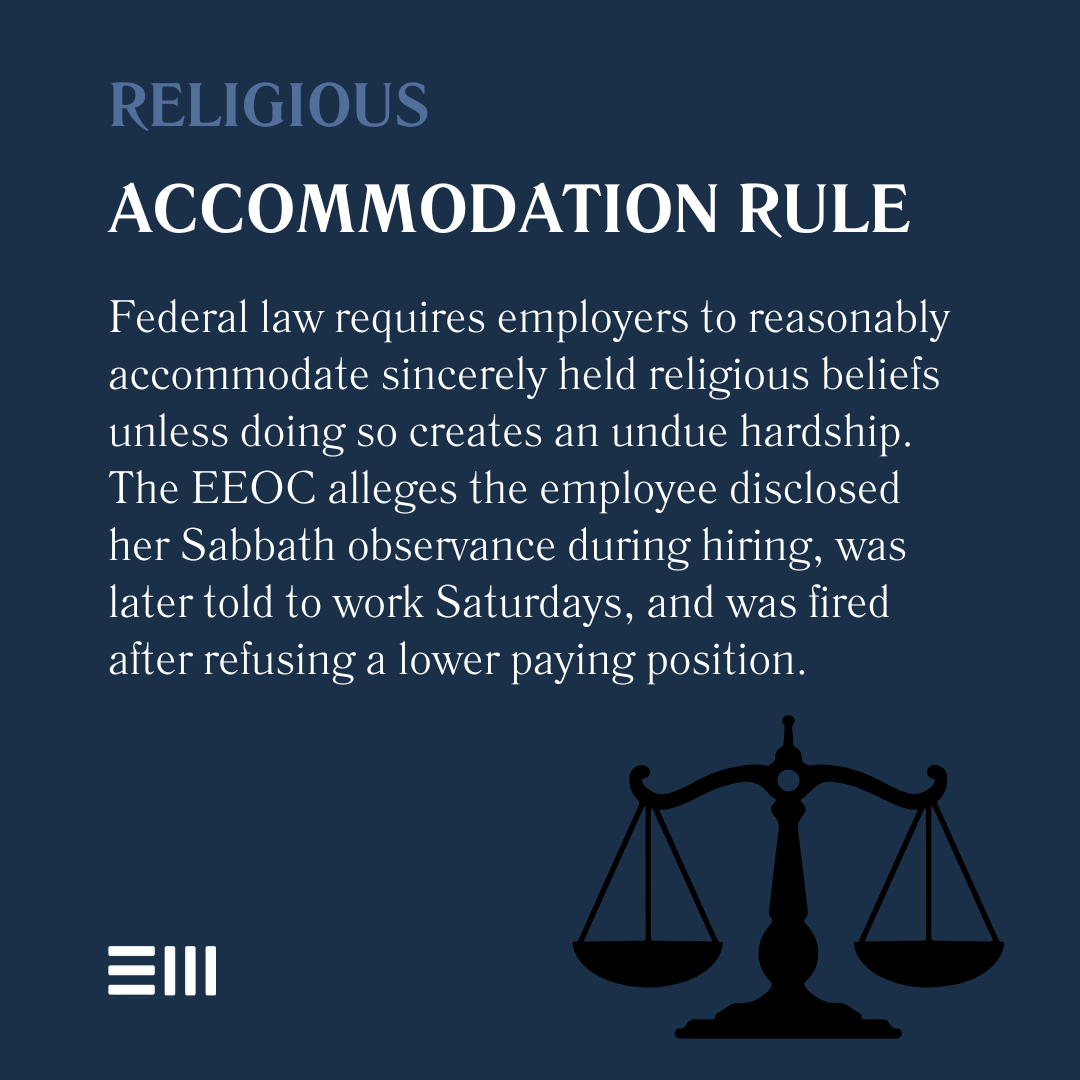
According to the EEOC, Torode disclosed her Sabbath observance during her 2023 job interview for a management role overseeing delivery drivers. The company honored that arrangement at first.
In early February 2024, the EEOC says, the operator told Torode she would have to start working Saturdays, including during her Sabbath.
The agency alleges that when Torode would not accept a demotion to a lower paying driver position, the company fired her. Hatch Trick has not been found liable, and the allegations will be tested through the litigation process.
The Federal Law at the Center of the Case
The religious discrimination lawsuit rests on Title VII of the Civil Rights Act of 1964, the federal statute that prohibits workplace discrimination based on religion. Title VII does more than bar outright bias. It affirmatively requires employers to work with employees of faith.
- Reasonable accommodation. Employers must reasonably accommodate an employee's sincerely held religious beliefs or practices.
- The undue hardship limit. That duty applies unless the accommodation would cause an undue hardship on the business.
- A higher bar for employers. Recent U.S. Supreme Court guidance raised what an employer must show to prove undue hardship.
- Protection from retaliation. Employees cannot be punished for requesting a religious accommodation in good faith.
In plain terms, an employer cannot treat a request to observe the Sabbath as an automatic problem. The law expects a genuine effort to find a workable arrangement before any adverse action is taken.
Why the EEOC Got Involved
The Equal Employment Opportunity Commission does not file suit over every workplace complaint.
Before this religious discrimination lawsuit reached federal court, the agency first attempted to resolve the dispute through its conciliation process, which is a negotiation step designed to settle claims without litigation.
When that effort did not produce a resolution, the EEOC filed suit in the U.S. District Court for the Western District of Texas.
The agency stated that the duty to accommodate religion reflects a broad social respect for the role faith plays in workers' lives. The EEOC typically seeks remedies that can include back pay, compensatory damages, and court orders requiring an employer to change its practices going forward.
What This Means for Alabama Workers
Although this religious discrimination lawsuit arose in Texas, Title VII is a federal law that protects employees in Alabama in exactly the same way. The case offers a few practical lessons for any Alabama worker whose faith affects their schedule.
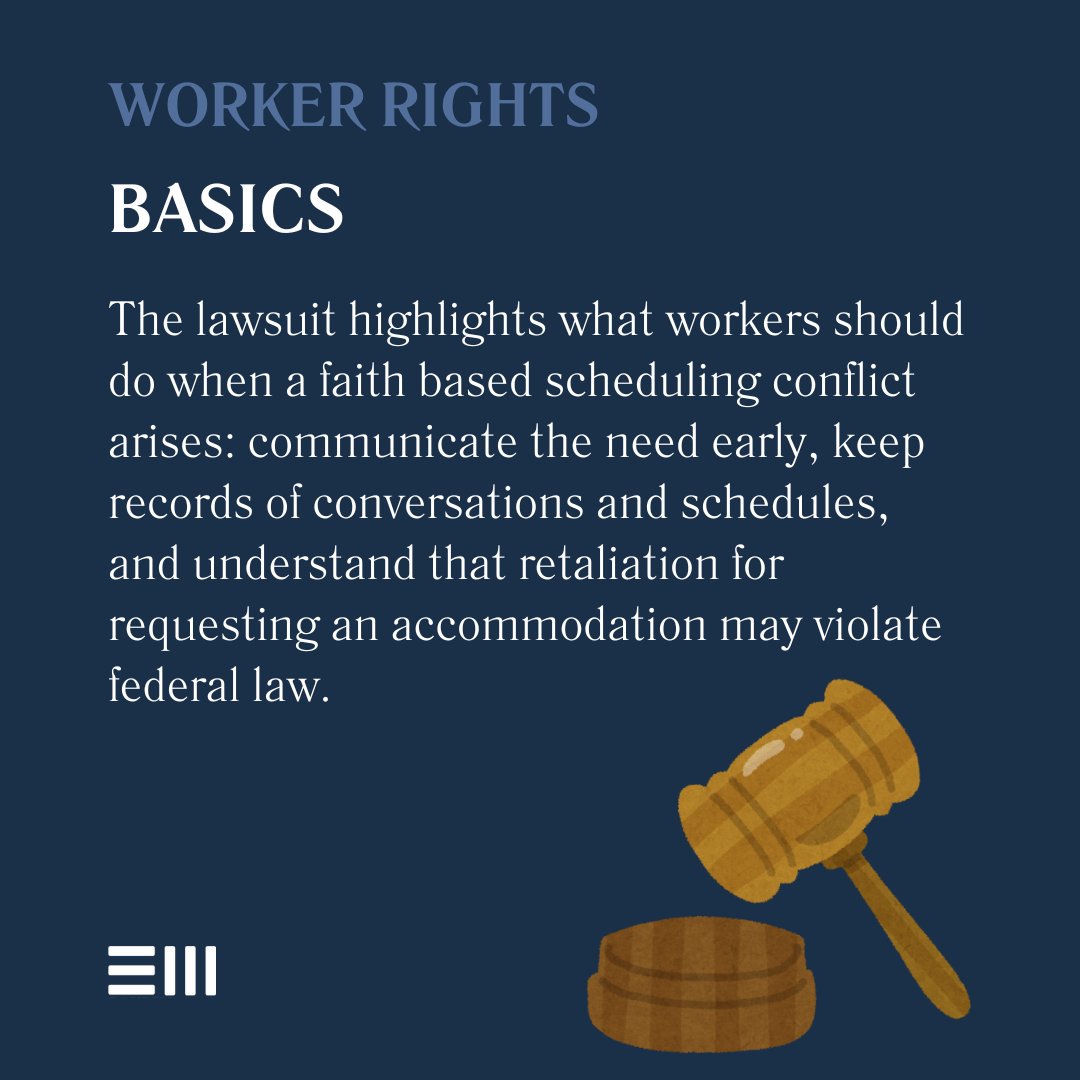
- Speak up early. Tell your employer about a religious scheduling need clearly, ideally in writing, so there is a record of the request.
- Propose solutions. Offering workable alternatives, such as shift swaps, strengthens your position and shows good faith.
- Keep documentation. Save emails, schedules, and notes about conversations regarding your accommodation request.
- Know retaliation is illegal. Being demoted or fired for requesting an accommodation may itself violate federal law.
These steps will not guarantee an outcome, but they create the kind of clear record that matters if a dispute ever escalates.
Frequently Asked Questions About Religious Discrimination at Work
Many Alabama workers have questions about how religious accommodation law applies to them. Here are answers to some of the most common ones.
Does Title VII Apply to Small Employers?
Title VII generally applies to employers with 15 or more employees. Some smaller employers may be covered by other state or local laws.
What Counts as a Reasonable Accommodation?
Common examples include schedule adjustments, voluntary shift swaps, and flexible break times. The accommodation must address the religious need without causing the employer undue hardship.
Can My Employer Just Deny Any Request?
No. An employer must show that granting the accommodation would create a genuine undue hardship. A request cannot be denied simply because it is inconvenient.
Is a Demotion a Form of Discrimination?
It can be. If an employee is pushed into a lower-paying role solely because of a religious accommodation request, that action may support a discrimination claim.
What Should I Do if I Believe I Was Discriminated Against?
Document everything, preserve relevant communications, and consider speaking with an attorney or contacting the EEOC, which enforces these protections.
Your Rights and Next Steps With Baxley Maniscalco
A workplace should never force a person to choose between a paycheck and their faith. Federal law recognizes that, and cases like this one are a reminder that those protections have real teeth.
Our experienced attorneys here at Baxley Maniscalco serve clients across the state of Alabama from our office in Oxford, reaching clients in Anniston, Gadsden, and surrounding communities.
If you have questions about a workplace matter, a personal injury issue, or another legal concern, we're happy to listen and help you understand your options.
Call (256) 770-7232 or reach out through our contact form to schedule a consultation.