
A crash that starts with a tire coming apart rarely feels like anyone's fault. One moment the drive is ordinary, and the next the wheel is fighting back. Most people assume the tire simply wore out and that the loss is theirs to carry alone.
That assumption is often wrong.
A tire that fails at speed can be the product of a design choice or a building error made long before it was ever mounted, and when that is what happened, the law may place responsibility on the company that made or sold it rather than on you.
When a Tire Fails, the Driver Is Not Always to Blame
The first move a tire maker tends to make after a failure is to question the driver. The story usually involves skipped maintenance or a few pounds of missing air pressure, offered up long before anyone examines the tire itself.
Sometimes upkeep really is part of the picture. Often, though, the true cause sits hidden inside the tire, in a weak bond or a flawed component that no owner could have seen during a routine check.
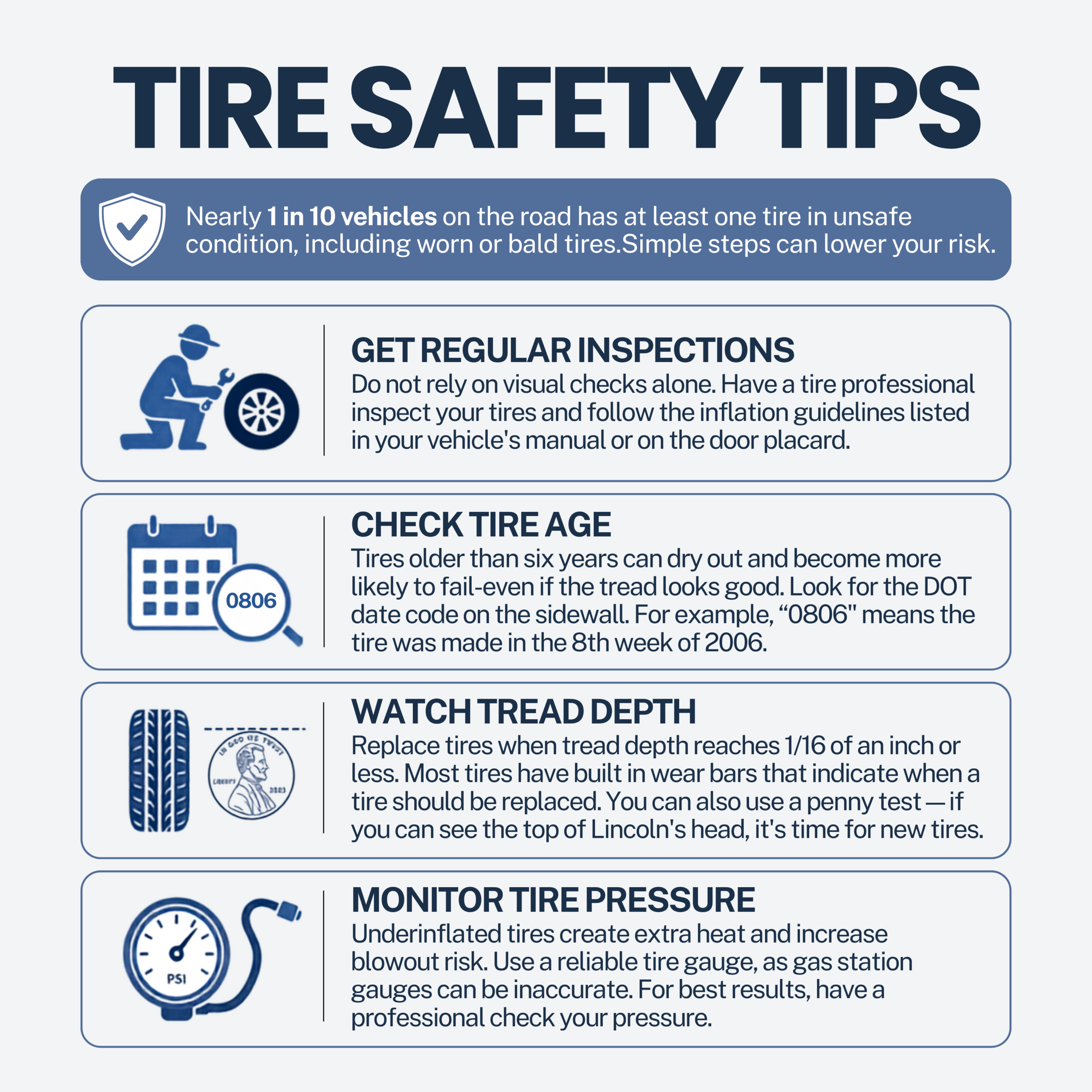
What Makes a Tire Defective
A tire can be unsafe for more than one reason, and the difference matters for who is held accountable. Claims generally fall into two groups.
- Design defects. The tire was unsafe by its very blueprint, so every tire built to that plan carries the same hidden risk.
- Manufacturing defects. The design was sound, but something went wrong on the line, leaving that particular tire weaker than it should have been.
These flaws tend to reveal themselves in two violent ways, a blowout that drains the air in an instant, or a tread separation where the outer layer tears free from the belts underneath. Either one can arrive with no warning at all.
How Alabama's Fault Rule Affects Your Case
Alabama follows one of the strictest fault rules in the country, known as contributory negligence. Under this rule, a driver found even slightly responsible for a crash can be barred from recovering anything.
This is why a tire maker works so hard to pin part of the blame on the driver, and why the way your case is built from the start carries so much weight. The tire itself is usually the best proof you have, yet once a vehicle is towed it can be discarded or repaired over and lost for good. Preserving it, and reading its history with the help of engineers, often decides the outcome.
What to Do After a Crash Involving a Tire Failure
The choices made in the first days after a tire failure often shape what is possible later. A few steps give your claim its best footing.
- Hold on to the tire and the vehicle. Ask that nothing be discarded or repaired until it can be examined.
- Photograph everything. Capture the tire, the wheel, and the scene before anything is moved or towed.
- Get medical care and keep the records. This protects your health and links the crash to your injuries.
- Be careful with insurers. Decline recorded statements or releases about the tire until you have spoken with a lawyer.
None of this asks you to understand the engineering behind the failure. It simply preserves the evidence so that someone else can.
Talk With an Alabama Defective Tire Lawyer
If a tire came apart and left you or someone you love injured, you may have the right to seek compensation from the company that designed, built, or sold it. Our team handles product liability and personal injury matters with the attention they deserve.
You do not have to decide on your own whether a tire was to blame. Let us take a careful look first.
Call our office at (256) 770-7232 or reach us through our contact form to find out whether you have a claim.