
A domestic violence conviction in Alabama results in the permanent loss of Second Amendment rights, even for misdemeanor charges—a consequence that surprises many defendants who assume only felonies carry such severe restrictions.
Third-degree charges represent the most common domestic violence offense filed in Alabama, yet many people underestimate the far-reaching impact these "lesser" charges can have on employment, housing, and family relationships.
(b) The minimum term of imprisonment imposed under subsection (a) shall be 30 days without consideration of reduction in time if a defendant willfully violates a protection order issued by a court of competent jurisdiction and in the process of violating the order commits domestic violence in the third degree.
(c) A second conviction under subsection (a) is a Class A misdemeanor, except the defendant shall serve a minimum term of imprisonment of 10 days in a city or county jail or detention facility without consideration for any reduction in time.
(d) A third or subsequent conviction under subsection (a) is a Class C felony.
(e) For purposes of determining second, third, or subsequent number of convictions, convictions in municipal court shall be included.
(Act 2000-266, p. 411, §3; Act 2011-581, p. 1273, §1.)
Understanding Domestic Violence 3rd Degree in Alabama
Domestic violence 3rd degree in Alabama encompasses a broad range of offenses committed against family members, household members, or intimate partners.
Unlike more serious degrees of domestic violence, third-degree charges typically involve less severe physical acts but still carry significant legal consequences under Alabama law.
The key distinguishing factor in domestic violence cases is not the severity of the underlying crime, but rather the relationship between the defendant and the alleged victim.
Alabama Code Section 13A-6-132 specifically defines which relationships qualify for domestic violence charges and which underlying crimes can be elevated to domestic violence offenses. Understanding these definitions becomes crucial for anyone facing these charges or their loved ones.
Legal Definition and Qualifying Relationships
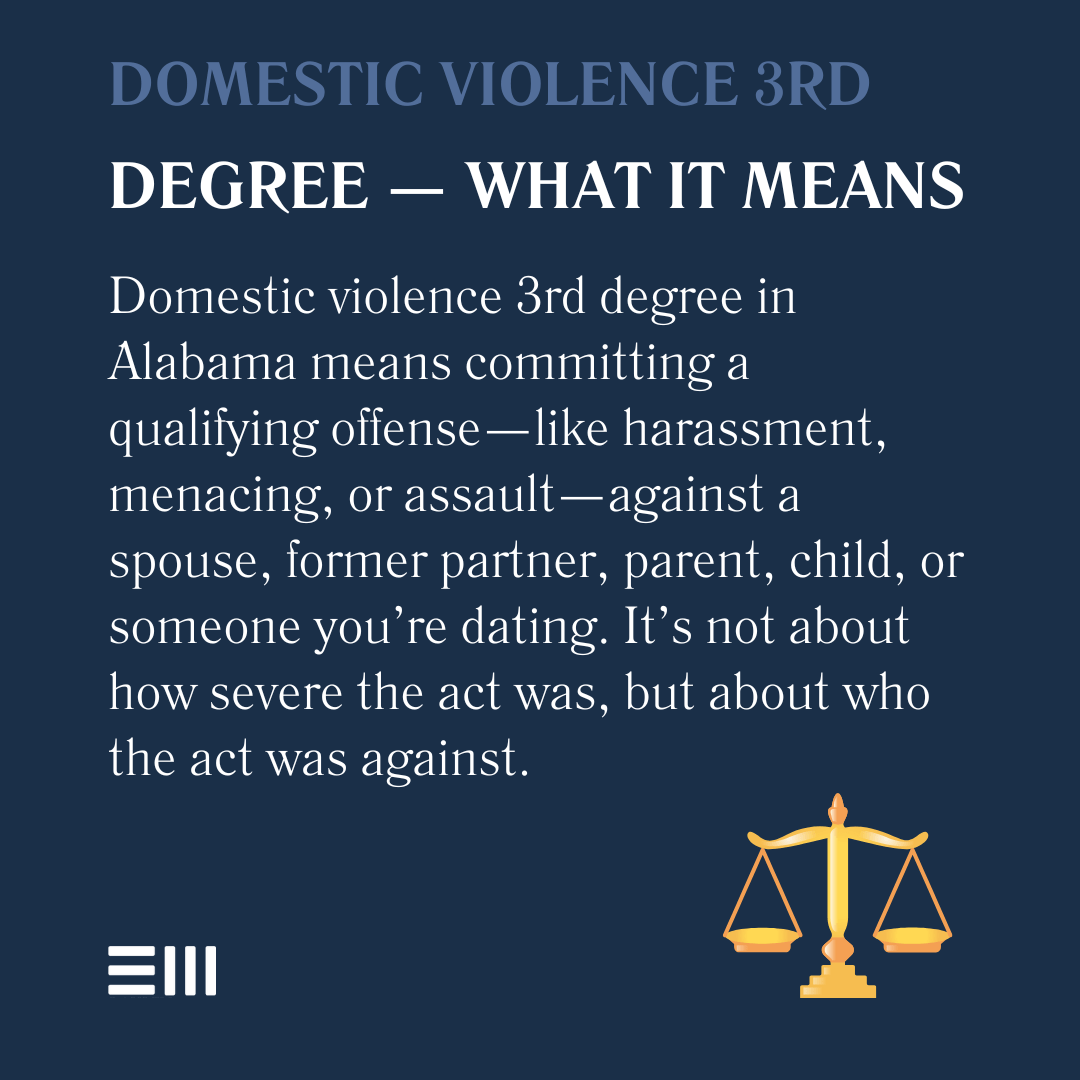
Alabama law requires two essential elements for domestic violence 3rd degree charges: commission of a qualifying underlying offense and the existence of a specific domestic relationship between the parties involved.
Qualifying relationships under Alabama law include current or former spouses, parents and children, individuals who share a child in common, present or former household members, and persons who have or had a dating or engagement relationship.
The law does not require cohabitation for dating relationships, but courts examine the nature and duration of the relationship.
The underlying offenses that can constitute domestic violence 3rd degree include assault in the third degree, menacing, reckless endangerment, criminal coercion, harassment, criminal surveillance, harassing communications, criminal trespass in the third degree, criminal mischief in the second or third degree, and arson in the third degree.
Each of these offenses has specific elements that prosecutors must prove beyond a reasonable doubt.
Criminal Penalties and Classification
Domestic violence 3rd degree is classified as a Class A misdemeanor in Alabama, carrying significant penalties that increase with subsequent convictions and specific circumstances.
- First Offense: Up to one year in jail and fines up to $6,000, with no mandatory minimum jail time for basic first offenses.
- Protection Order Violation: Minimum 30 days imprisonment without consideration for reduction when committed in violation of a protection order.
- Second Conviction: Mandatory minimum 10 days in jail without consideration for reduction in time, still classified as a Class A misdemeanor.
- Third or Subsequent Conviction: Elevated to Class C felony with potential prison sentences.
- Municipal Court Limitations: Maximum 180 days jail time and $500 fine when prosecuted in municipal court versus state court.
These escalating penalties reflect Alabama's approach to addressing repeat domestic violence offenses with increasing severity, making early intervention and effective legal representation particularly important for first-time offenders.
Long-Term Consequences Beyond Criminal Penalties
The impact of a domestic violence 3rd degree conviction extends far beyond immediate criminal penalties, affecting numerous aspects of a person's life for years or even permanently.
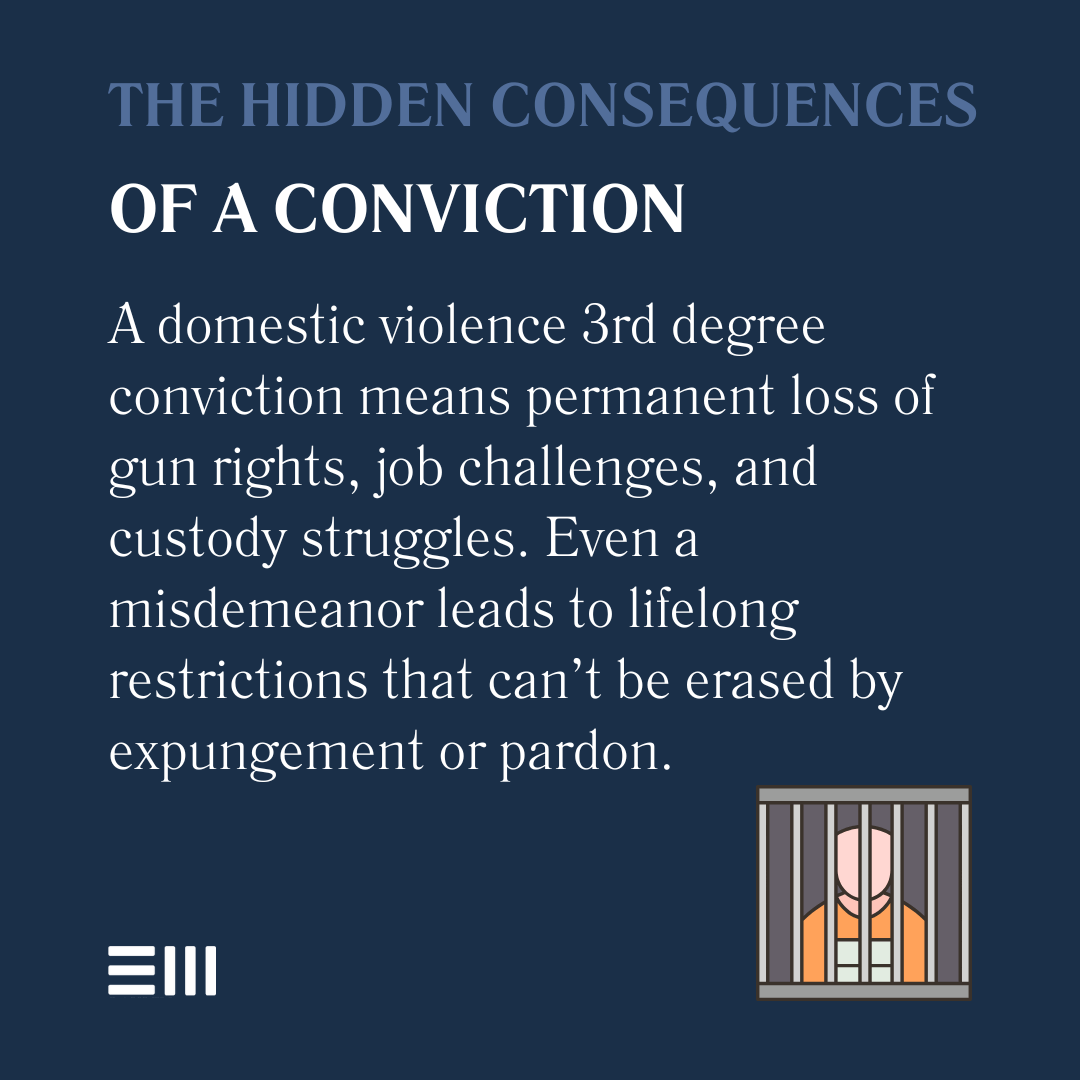
Firearm rights are permanently lost upon any domestic violence conviction in Alabama, including misdemeanor charges, which differs from most other criminal convictions.
This federal prohibition applies regardless of whether the conviction is later expunged or pardoned. Employment consequences can be severe, particularly for jobs requiring background checks, professional licenses, or security clearances.
Child custody and visitation rights often face restrictions following domestic violence convictions, with family courts considering such convictions as factors against the best interests of children. Immigration consequences can include deportation, denial of naturalization, or ineligibility for visa renewals for non-citizens.
Professional licensing boards may impose sanctions, suspensions, or revocations for various licensed professions.
Protection Orders and Enhanced Penalties
Alabama law provides for enhanced penalties when domestic violence 3rd degree occurs in violation of existing protection orders, reflecting the serious nature of continued harassment or threats despite court intervention.
Protection order violations that involve commission of domestic violence 3rd degree carry a mandatory minimum sentence of 30 days imprisonment without possibility of reduction. This enhancement applies regardless of whether it's a first-time domestic violence conviction, making protection order compliance critically important.
Violations can occur through direct contact, indirect contact through third parties, social media interactions, or presence in prohibited locations.
Understanding the specific terms and geographic limitations of any protection order becomes essential for compliance and avoiding additional charges that carry mandatory jail sentences.
Arrest Procedures and Bail Considerations
Alabama law grants police officers broad authority to make warrantless arrests in domestic violence cases, often leading to immediate incarceration even when allegations seem minor or disputed.
Officers can arrest without a warrant when they have reasonable cause to believe a domestic violence offense has occurred or when someone has violated a protection order. This authority allows arrests based on reasonable cause rather than the higher probable cause standard required for many other offenses.
Bail review must occur within 24 hours of arrest, but pretrial release conditions typically include no-contact orders with alleged victims, restrictions on returning to shared residences, and sometimes electronic monitoring.
These conditions can create immediate housing and family disruption even before any court determinations of guilt. Violation of pretrial release conditions can result in additional charges and revocation of bond.
Building Effective Defense Strategies
Successful defense of domestic violence 3rd degree charges requires a thorough investigation of the underlying facts, careful analysis of the relationship requirements, and strategic consideration of the specific elements of the charged offense.
Common defense strategies include challenging the existence or nature of the required domestic relationship, particularly in dating relationships where the timeframe or seriousness of the relationship may be disputed. Self-defense claims can be viable when the defendant acted to protect themselves or others from imminent harm.
Evidence gathering becomes crucial, as false allegations unfortunately occur in domestic disputes, particularly during divorce or custody proceedings.
Insufficient evidence challenges focus on the prosecution's burden to prove all elements beyond a reasonable doubt, including the specific intent requirements for the underlying offense.
Family law attorneys in Alabama often coordinate with criminal defense counsel when domestic violence charges arise during divorce proceedings, as the outcomes can significantly impact both cases.
Frequently Asked Questions About Domestic Violence 3rd Degree in Alabama
Understanding domestic violence 3rd degree charges often requires addressing specific concerns about the legal process, potential defenses, and long-term consequences.
Is Domestic Violence 3rd Degree Always a Misdemeanor in Alabama?
While domestic violence 3rd degree starts as a Class A misdemeanor, it becomes a Class C felony for third or subsequent convictions. Additionally, if someone has prior convictions for first or second-degree domestic violence, a subsequent third-degree charge may be enhanced to felony level. The classification depends on the defendant's criminal history and the specific circumstances of the case.
Can Domestic Violence Charges Be Dropped in Alabama?
While alleged victims cannot unilaterally drop domestic violence charges in Alabama, their cooperation or lack thereof can significantly impact prosecution decisions. Prosecutors make the final decision about whether to proceed with charges, based on the available evidence, the victim's cooperation, public safety concerns, and the strength of the case.
However, once charges are filed, they become a matter between the state and the defendant, not a private dispute.
What Happens if I'm Arrested for Domestic Violence 3rd Degree?
Following an arrest for domestic violence 3rd degree, you'll typically be held in jail until a bail hearing within 24 hours. The court will likely impose pretrial conditions, including no contact with the alleged victim and potentially removal from shared residences.
You should exercise your right to remain silent and request an attorney immediately. Any statements made to police can be used against you in court, making legal representation crucial from the earliest stages.
How Does Domestic Violence 3rd Degree Affect Gun Rights?
Any domestic violence conviction in Alabama, including misdemeanor charges, results in permanent loss of firearm rights under both federal and state law. This prohibition applies to the ownership, possession, and purchase of firearms and ammunition.
The restriction cannot be lifted through expungement, pardon, or restoration of civil rights, making it one of the most lasting consequences of a domestic violence conviction.
Can I Lose Custody of My Children Due to Domestic Violence 3rd Degree?
Domestic violence convictions significantly impact child custody and visitation decisions in Alabama family courts. While not automatically disqualifying, judges consider domestic violence convictions as evidence against the best interests of children.
The court may order supervised visitation, require completion of anger management or parenting classes, or impose other restrictions. The severity of impact often depends on the specific facts of the case and any evidence of threat to the children.
What's the Difference Between Municipal and State Court for These Charges?
Municipal courts can only impose maximum sentences of 180 days jail time and $500 fines for domestic violence 3rd degree, while state courts can impose the full Class A misdemeanor penalties of up to one year jail time and $6,000 fines.
However, defendants in municipal court have the right to appeal for a new trial in circuit court if they're unsatisfied with the outcome. The choice of court often depends on local prosecution practices and the specific circumstances of the case.
Protecting Your Rights: Expert Criminal Defense Representation
Facing domestic violence 3rd degree charges in Alabama requires immediate action to protect your rights, freedom, and future. The consequences extend far beyond potential jail time, affecting your ability to own firearms, maintain employment, and preserve relationships with your children.
The experienced criminal defense attorneys at Baxley Maniscalco understand the complexities of Alabama's domestic violence laws and the serious impact these charges can have on your life.
We provide aggressive representation from the initial arrest through trial, working to minimize consequences and protect your constitutional rights throughout the process.
Don't face these serious charges alone.
Contact us immediately for a confidential consultation and let our experienced team fight to protect your future.