
Parents struggling with child support payments in Alabama face more than wage garnishment and suspended licenses—they risk criminal prosecution.
While most child support enforcement remains civil, Alabama law transforms unpaid support into a felony under specific circumstances.
Understanding when back child support crosses from civil debt to criminal offense helps parents navigate this serious legal territory and protect their rights.
Understanding Alabama's Criminal Child Support Laws
Alabama takes child support obligations seriously, implementing both civil and criminal enforcement mechanisms to ensure children receive financial support.
The state's criminal laws targeting non-payment reflect a legislative determination that willful failure to support one's children constitutes a form of abandonment.
The primary criminal statute addressing unpaid child support is Alabama Code Section 13A-13-4, which defines abandonment of a child.
This law makes it a Class C felony when a parent:
- Willfully fails to provide support required by law or court order;
- Abandons a child under circumstances endangering the child's health or welfare;
- Leaves the state to avoid support obligations; and
- Demonstrates intentional refusal to meet parental responsibilities.
Criminal prosecution differs fundamentally from civil enforcement. While civil actions focus on collecting money, criminal charges punish the conduct of non-payment itself. This distinction means parents can face imprisonment even if they later pay the overdue support.
When Child Support Becomes a Felony
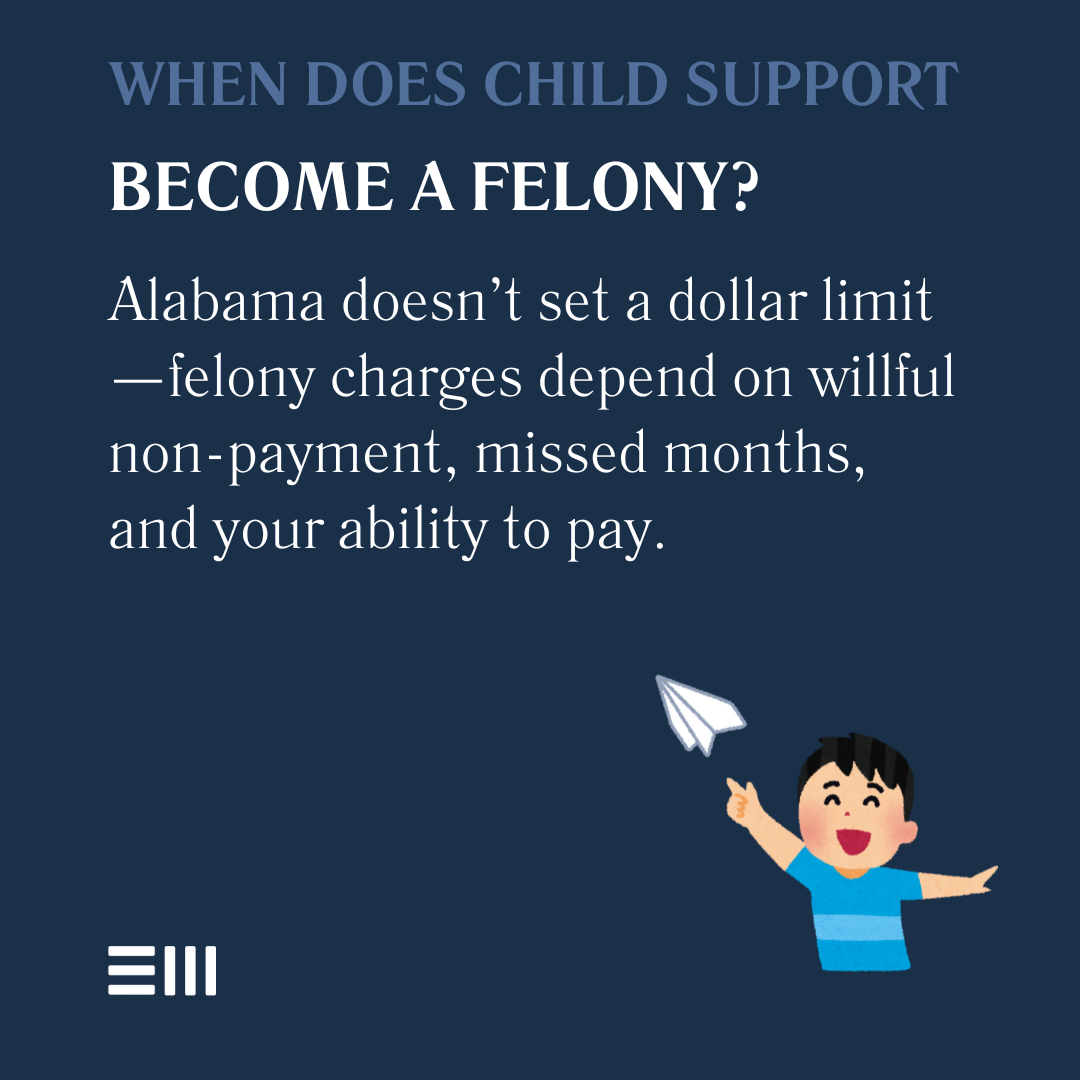
Alabama law doesn't specify an exact dollar amount that triggers felony charges for unpaid child support. Instead, prosecutors evaluate several factors when deciding whether to pursue criminal charges for non-payment.
Key factors prosecutors consider include:
- Duration of non-payment: Extended periods without any payment demonstrate willfulness.
- Amount owed: Larger arrearages suggest more serious abandonment.
- Payment history: Sporadic payments versus complete non-payment.
- Ability to pay: Evidence the parent could have paid but chose not to.
- Efforts to avoid obligation: Hiding assets or income, fleeing the state.
- Impact on the child: Whether non-payment created genuine hardship.
Felony charges typically arise when parents demonstrate a pattern of willful refusal to pay despite having the ability to do so.
Prosecutors must prove beyond a reasonable doubt that the failure to pay was intentional, not merely the result of financial hardship. This burden of proof provides important protection for parents facing genuine economic difficulties.
Penalties for Felony Child Support Violations
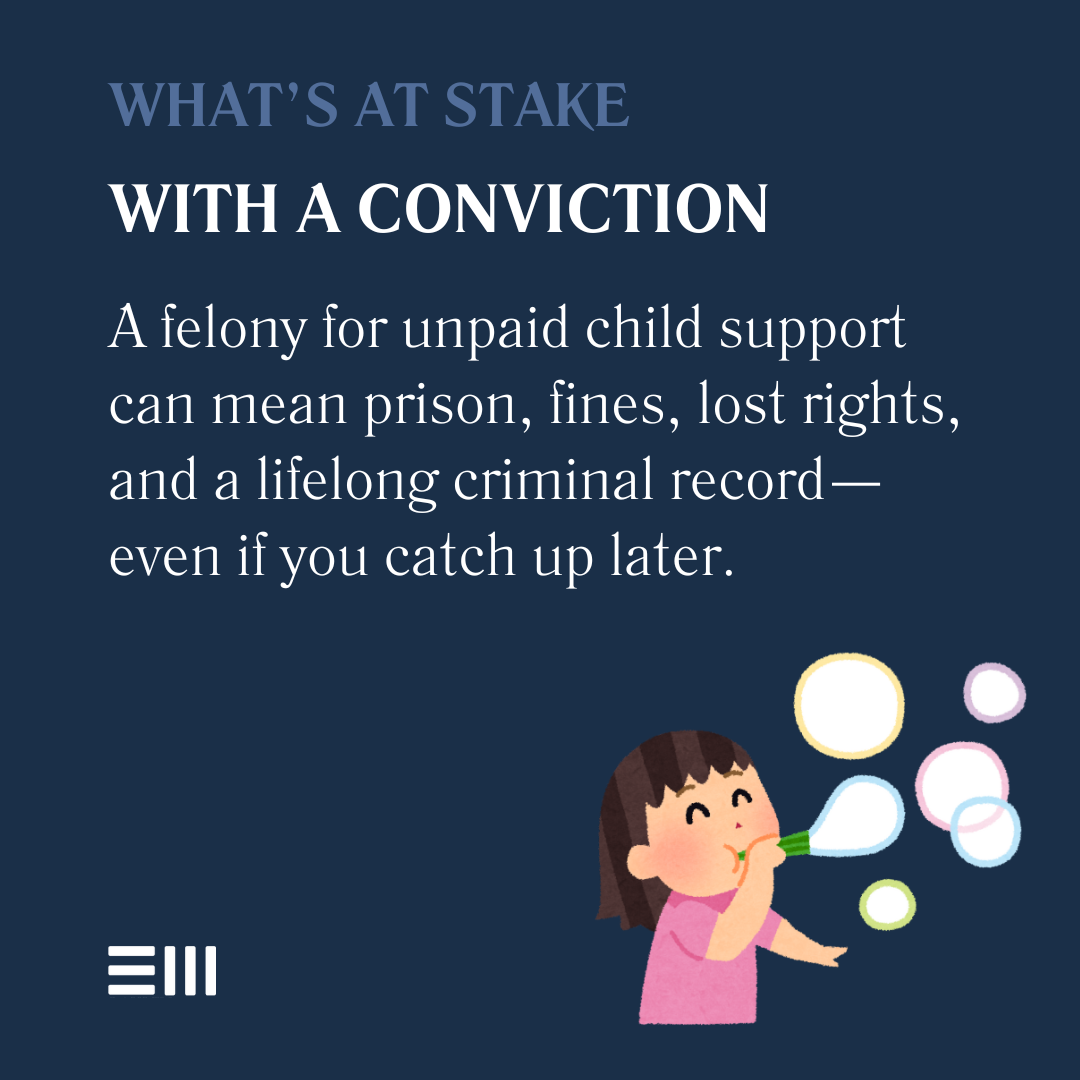
A felony conviction for unpaid child support in Alabama carries serious consequences that extend far beyond the immediate criminal penalties. Understanding these potential outcomes emphasizes the importance of addressing support obligations before criminal charges arise.
Criminal penalties for child support felonies include:
- Prison time: Class C felony convictions can result in 1-10 years in state prison.
- Fines: Monetary penalties up to $15,000.
- Probation: Extended supervision with strict conditions.
- Restitution: Court-ordered payment of all back support.
- Criminal record: Permanent felony conviction affecting employment and rights.
Beyond direct criminal penalties, a felony conviction creates collateral consequences affecting many aspects of life.
Convicted individuals lose voting rights, face employment barriers, cannot possess firearms, and may struggle with housing applications. Professional licenses may be revoked, and immigration status can be jeopardized.
These lasting impacts make avoiding criminal charges critical for parents struggling with support payments.
Defenses Against Criminal Child Support Charges
Parents facing criminal prosecution for unpaid child support have several potential defenses, though success depends on specific circumstances and evidence.
Understanding these defenses helps accused parents work effectively with their attorneys to protect their rights.
Common defenses include:
- Inability to pay: Demonstrating genuine financial hardship through unemployment, disability, or other circumstances.
- Lack of willfulness: Showing good faith efforts to pay despite falling behind.
- Incorrect calculations: Challenging the amount claimed as owed.
- Modification attempts: Evidence of trying to modify support through proper channels.
- Payment disputes: Proof of payments not properly credited.
- Procedural issues: Constitutional or statutory violations in the prosecution.
The most effective defense often involves demonstrating inability to pay rather than unwillingness.
Courts recognize that imprisonment for genuine poverty violates constitutional principles. However, parents must provide substantial documentation of their financial circumstances and efforts to meet obligations despite hardship.
Avoiding Criminal Prosecution
Preventing criminal charges requires proactive steps when facing mounting child support debt. Parents experiencing financial difficulties should take immediate action rather than waiting for enforcement escalation.
Strategies to avoid criminal prosecution include:
- Communicate with the custodial parent and child support enforcement;
- Request modification when circumstances change;
- Make partial payments to demonstrate good faith;
- Document all financial hardships and job search efforts;
- Seek legal counsel before arrears become substantial;
- Explore payment plans or settlements; and
- Never ignore court orders or hearings.
Taking these steps demonstrates responsibility and good faith, making criminal prosecution less likely. Courts and prosecutors generally prefer parents who acknowledge obligations and work toward solutions, even when full payment isn't immediately possible.
Early intervention prevents small problems from becoming felony charges.
Frequently Asked Questions About Felony Child Support in Alabama
Understanding the criminal aspects of child support enforcement raises important questions for parents navigating Alabama's legal system.
Is There a Specific Dollar Amount That Makes Child Support a Felony?
Alabama law doesn't establish a specific threshold amount for felony charges. Prosecutors consider the totality of circumstances, including the amount owed, duration of non-payment, and evidence of willfulness. Even relatively small amounts can lead to charges if non-payment appears intentional.
Can I Go to Prison If I Can't Afford Child Support?
The U.S. Constitution prohibits imprisonment for debt alone. However, courts can imprison parents who have the ability to pay but refuse. The key distinction lies in proving inability versus unwillingness to pay. Parents must present evidence of their financial circumstances.
What If I Lost My Job and Fell Behind?
Job loss alone doesn't excuse child support obligations, but it provides a strong defense against criminal charges. Parents should immediately seek support modification upon job loss and document all efforts to find new employment. Maintaining communication with enforcement authorities demonstrates good faith.
Can Criminal Charges Be Filed Years Later?
Alabama's statute of limitations for felony prosecution is generally three years, but the clock may restart with each missed payment. Additionally, some interpretations suggest no limitation period applies to ongoing support obligations. Parents shouldn't assume old debts are beyond prosecution.
Will Paying Back Support Dismiss Criminal Charges?
Payment of arrears after criminal charges are filed doesn't automatically result in dismissal. Prosecutors may proceed with cases to punish past willful non-payment. However, full payment often leads to more favorable plea negotiations or sentencing outcomes.
These questions highlight the complex intersection of civil support obligations and criminal law enforcement.
Protect Your Rights in Child Support Criminal Cases
Facing potential felony charges for unpaid child support demands immediate legal action to protect your freedom and future.
The stakes couldn't be higher—a conviction means prison time, a permanent criminal record, and lifelong consequences affecting employment, housing, and basic civil rights.
Whether you're struggling with mounting arrears or already facing criminal charges, experienced legal representation can mean the difference between resolution and incarceration.
Our attorneys here at Baxley Maniscalco understand both the criminal and family law aspects of child support cases in Alabama. We'll evaluate your situation, develop a comprehensive defense strategy, and work to protect you from criminal prosecution while addressing underlying support issues.
Contact us immediately if you're facing criminal charges or an investigation for unpaid child support. Time is critical in these cases, and early intervention provides the best opportunity for a favorable outcome.