Lawsuits against the makers of Similac and Enfamil are continuing to move forward nationwide on behalf of families whose premature babies developed necrotizing enterocolitis, a serious and often fatal intestinal disease commonly referred to as NEC.
These cases allege that formula manufacturers Abbott Laboratories, which makes Similac, and Mead Johnson, which makes Enfamil, failed to adequately warn doctors and parents that cow's milk based formulas can dramatically increase the risk of NEC in premature infants.
For families in Alabama who have walked through the nightmare of an NEC diagnosis, understanding where this litigation stands today is the first step toward knowing whether you may still qualify to file a claim.
What Is Necrotizing Enterocolitis?
Necrotizing enterocolitis is a severe intestinal disease that primarily strikes premature and low birthweight babies. It causes inflammation and damage to the intestines and can progress rapidly to infection, bowel perforation, emergency surgery, or death.
Each year in the United States, about 480,000 babies are born prematurely. Of those, an estimated 9,000 develop NEC.
The disease is most dangerous in the smallest infants, where studies show up to 10 to 12 percent of babies weighing under 3.3 pounds may be affected. About 30 percent of babies diagnosed with NEC require surgery, and between 20 and 30 percent of cases are fatal.
Survivors may face long-term complications, including feeding difficulties, short bowel syndrome, and developmental delays.
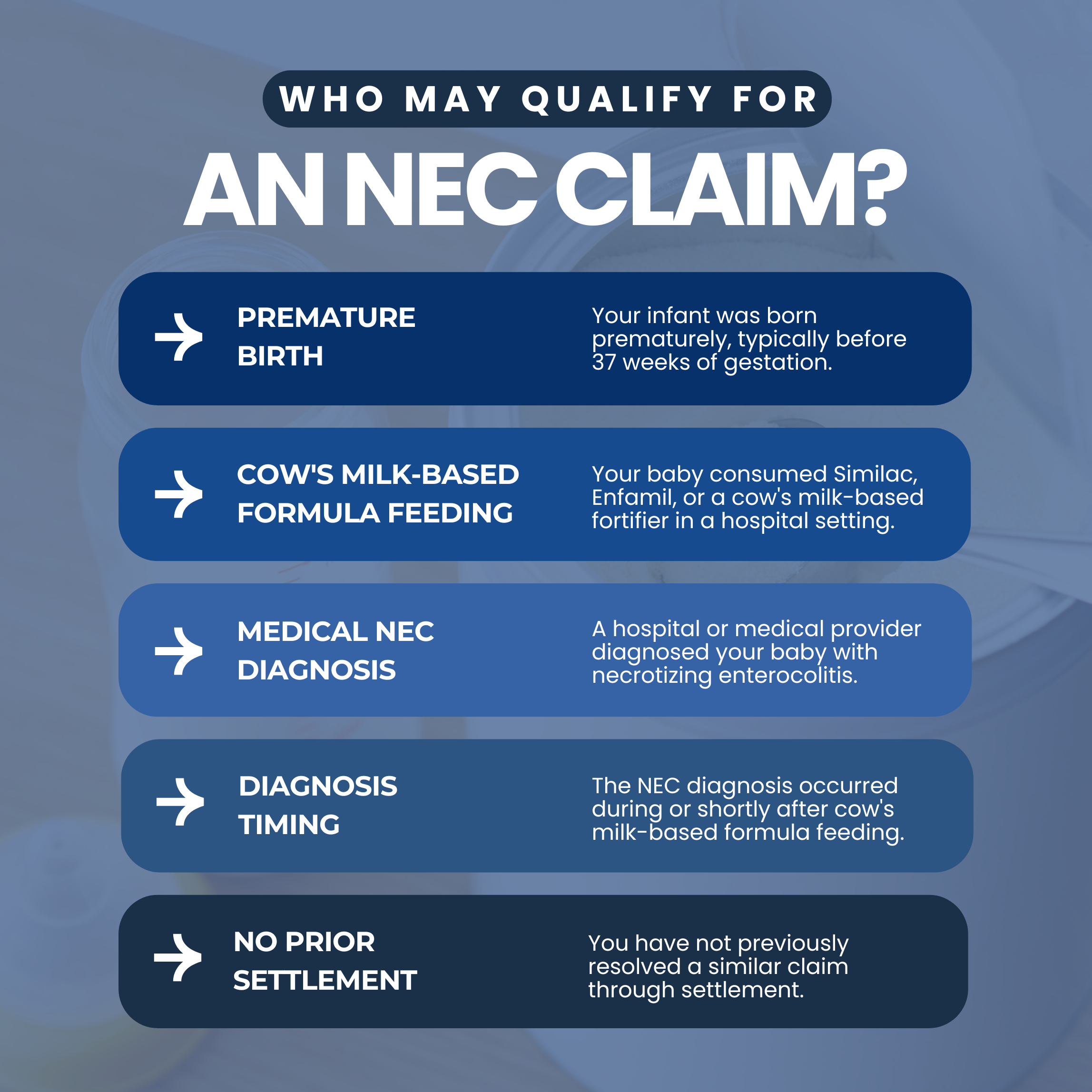
Who May Qualify for an NEC Claim?
Not every case of NEC qualifies for a formula-related lawsuit. The cases currently moving forward in the federal litigation and in state courts generally involve specific circumstances that must be documented and verified.
- Premature birth. Your infant was born prematurely, typically before 37 weeks of gestation.
- Cow's milk-based formula feeding. Your baby consumed Similac, Enfamil, or a cow's milk-based fortifier in a hospital setting.
- Medical NEC diagnosis. A hospital or medical provider diagnosed your baby with necrotizing enterocolitis.
- Diagnosis timing. The NEC diagnosis occurred during or shortly after cow's milk-based formula feeding.
- No prior settlement. You have not previously resolved a similar claim through settlement.
If your family meets most or all of these criteria, your case may be worth reviewing. Each claim is evaluated individually based on medical records and circumstances.
The Connection Between Formula and NEC
For more than three decades, medical research has pointed to a significant connection between cow's milk-based infant formulas and an elevated risk of NEC in premature babies.
- Multiple studies. Research reviews have shown a more than three times higher risk of NEC in formula-fed preemies compared to those fed human milk.
- Donor milk protection. Hospital studies demonstrate that donor breast milk significantly reduces NEC risk in extremely premature infants.
- Public health guidance. Major health organizations have long recognized human milk as protective against NEC.
Despite this body of research, neither Similac nor Enfamil cow's milk-based products carry NEC warnings specifically for premature infants. That absence of warning is at the heart of the current litigation.
Types and Symptoms of NEC
NEC can appear in different forms, and its symptoms can develop rapidly, often in babies who had previously seemed to be doing well.
- Classic NEC. Usually develops three to six weeks after birth.
- Transfusion-associated NEC. Occurs in the days following a blood transfusion.
- Atypical NEC. May appear before a baby has started regular feeding.
- Term infant NEC. Affects full-term babies with other underlying health conditions.
Common warning signs include a swollen or tender abdomen, feeding difficulties, vomiting, unusual lethargy, unstable heart rate or blood pressure, and poor weight gain. Symptoms can appear suddenly and progress quickly, making early recognition important.
Where the Litigation Stands in 2026
The NEC baby formula litigation is active and advancing on multiple fronts. Understanding the current status helps families know what to expect if they decide to pursue a claim.
The federal cases are consolidated as Multidistrict Litigation number 3026 in the U.S. District Court for the Northern District of Illinois, presided over by U.S. District Judge Rebecca Pallmeyer. As of March 2026, approximately 779 active cases remain pending in this MDL.
- Upcoming bellwether trials. The next federal bellwether trials are scheduled for August 2026, November 2026, and February 2027.
- Major state court verdicts. A Missouri jury awarded $495 million in a Similac case in July 2024, and an Illinois jury returned a $60 million Enfamil verdict in March 2024.
- New filings continue. Families across the country are continuing to file new cases, and the deadline to do so varies by state and by circumstance.
These bellwether trials and state court verdicts will likely influence the direction of the litigation as a whole, including any potential future settlement negotiations.
Exploring Your Legal Options
If your family experienced the trauma of an NEC diagnosis after your premature baby was fed Similac or Enfamil, you may still have time to pursue a claim.
Each case depends on medical records, feeding history, state law, and timing.
Our experienced attorneys here at Baxley Maniscalco serve clients across the state of Alabama from our office in Oxford. We handle complex product liability and mass tort cases with the care and attention they deserve.
Contact us for a careful case review to determine whether you qualify. Call (256) 770-7232 or reach out through our contact form.