
Tuskegee University men's basketball head coach Benjy Taylor has filed a federal civil lawsuit seeking more than $1 million in damages from Morehouse College and two of its campus police officers after he was handcuffed and escorted off the court following a January rivalry game in Atlanta.
The incident, captured on video by spectators and later broadcast nationally, has drawn widespread attention and raised serious questions about the use of force by campus law enforcement.
What Happened on January 31, 2026
The confrontation took place after a Southern Intercollegiate Athletic Conference (SIAC) matchup between Tuskegee and Morehouse at Forbes Arena. Tuskegee lost the game 77-69, but it was the events during the postgame handshake that turned the evening into a legal matter.
According to the lawsuit, members of the Morehouse football team positioned themselves near the baseline during the game and directed profanity at Tuskegee players, coaches, and staff throughout the contest.
Their presence along the playing surface violated SIAC crowd-control and security protocols, which require unauthorized individuals to remain off the court.
Taylor brought the issue to the attention of the game officials during play, and the head referee, Marcus Bryams, confirmed in his official game report that he asked Morehouse campus officer R. Clark to address the situation.
When the game ended and teams lined up for the customary postgame handshake, Taylor alleges the football players rushed onto the court and inserted themselves into the line.
Taylor again approached Officer Clark and asked him to remove the unauthorized individuals to prevent a physical altercation.
The lawsuit states that Clark had previously "laughed and turned his back" when asked to intervene during the game. Instead of addressing the security concern, Clark pulled out his handcuffs and restrained Taylor's hands behind his back.
Video from the arena shows Clark leading Taylor off the floor and into a back hallway, followed by a second Morehouse officer identified as M. Roberson.
Taylor did not resist at any point during the detention, according to the complaint. He was never charged with a crime, was released shortly afterward, and traveled home with his team that evening.
The Lawsuit and What It Seeks
Taylor filed the federal civil lawsuit on March 20, 2026, in the U.S. District Court for the Northern District of Georgia, Atlanta Division.
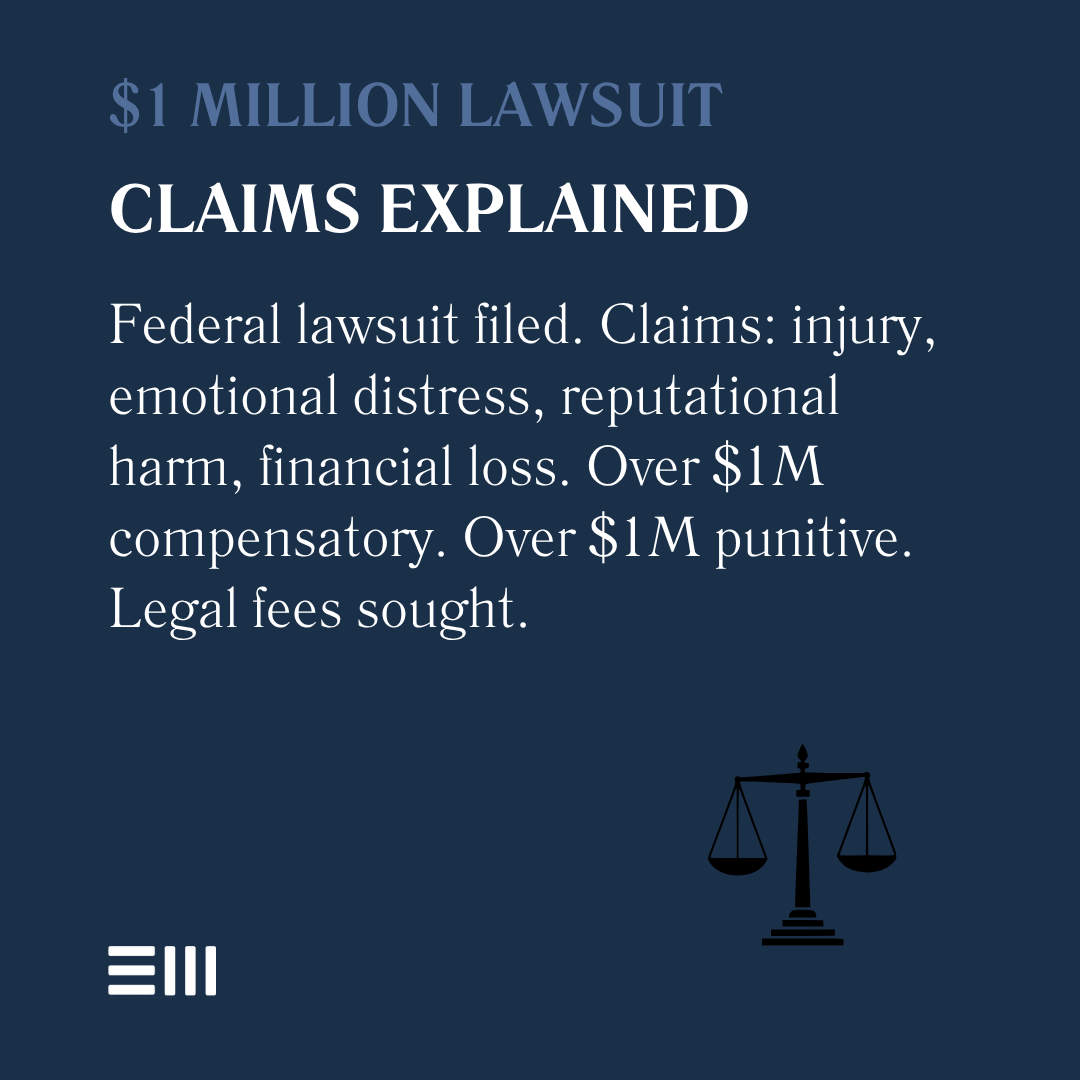
The complaint names Morehouse College and both campus officers as defendants and outlines several categories of harm. Taylor alleges the incident caused him physical injury, emotional distress, lasting reputational damage, and financial losses that have followed him in the months since.
The suit seeks significant monetary relief across multiple categories.
- More than $1 million in compensatory and consequential damages. Taylor alleges the public handcuffing undermined his professional standing, caused lasting emotional harm, and led to financial consequences that extend well beyond the night of the incident.
- More than $1 million in punitive damages. The complaint argues that the officers' conduct was reckless, unjustified, and warrants additional penalties designed to deter similar behavior in the future.
- Attorney fees and other relief. Taylor's legal team is also pursuing reimbursement for the costs of bringing the case to court.
These claims reflect the severity of the alleged violation and the very public nature of the incident, which was broadcast on the arena's Jumbotron and viewed by millions online.
The Legal Team and Public Response
Taylor has assembled a team of nationally recognized civil rights attorneys to represent him, including Harry Daniels, John Burris, Gerald Griggs, and Gregory Reynald Williams.
Griggs is the former president of the Georgia NAACP. At a March 20 press conference at the Westin Atlanta Airport, Daniels stated that "Coach Taylor is a good man who did the right thing to protect his team and de-escalate a dangerous situation, and this officer put him in chains for his troubles."
Following the January incident, the SIAC fined Morehouse College for failing to meet the conference's required security standards.
Tuskegee University president Mark Brown and athletic director Reginald Ruffin released a public statement supporting Taylor, noting that he "acted solely out of his fundamental responsibility to protect his student-athletes and staff — particularly in an environment where agreed-upon and customary game-management and security protocols were not properly carried out."
Despite being named the 2025-2026 SIAC Coach of the Year — a recognition of his 35-year coaching career — Taylor has said publicly that the honor has been overshadowed by the viral video and the stigma it created.
At the press conference, an emotional Taylor expressed concern that his legacy would be defined by the handcuffing rather than the decades of service he has devoted to his players and programs.
The two teams met again on March 7 in the SIAC Tournament Championship, with Morehouse winning 66-56.
Why Cases Like This Matter
When law enforcement officers act outside the scope of their authority, the consequences for the affected individual can extend far beyond the moment of the encounter.
Reputational harm, emotional distress, and professional setbacks can compound over months and years, particularly when the incident is recorded and distributed widely.
Understanding the elements of a negligence claim and how causation is established in civil rights and personal injury cases is an important first step for anyone who has experienced something similar.
Civil rights lawsuits serve as one of the primary legal mechanisms for holding institutions and their officers accountable for conduct that violates an individual's constitutional protections.
These cases send a message that authority must be exercised responsibly, regardless of the setting. Alabama residents can learn more about pursuing personal injury claims when another party's actions cause harm.