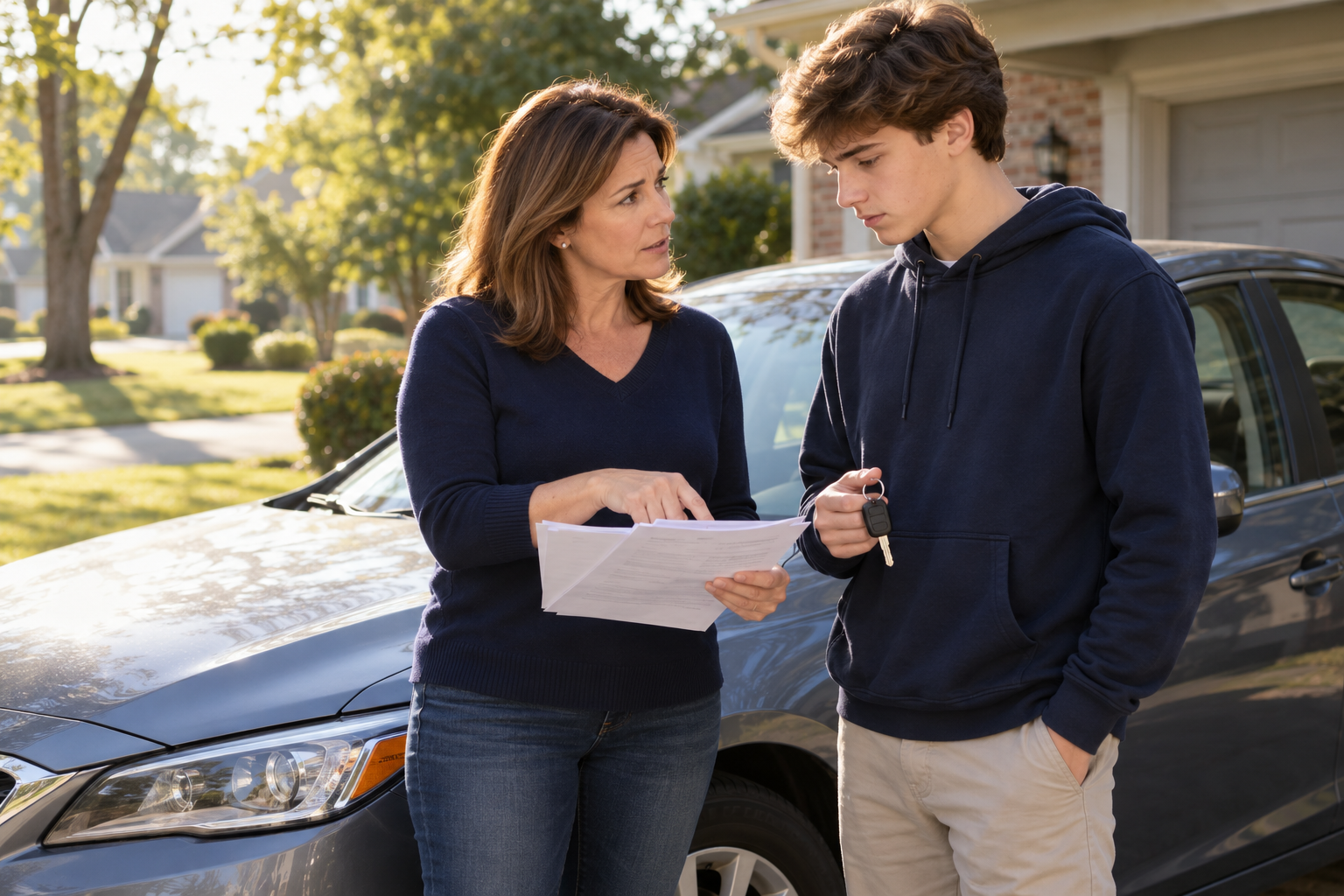
The driver looks barely old enough to have a license. The car belongs to a parent. Surely that means the parent is responsible for your injuries, right?
In Alabama, it takes more than a family relationship and a set of keys.
The driver’s conduct, the owner’s decisions, and the insurance policy raise separate questions. Mixing them together can lead you to overlook a claim or expect coverage that hasn’t been confirmed.
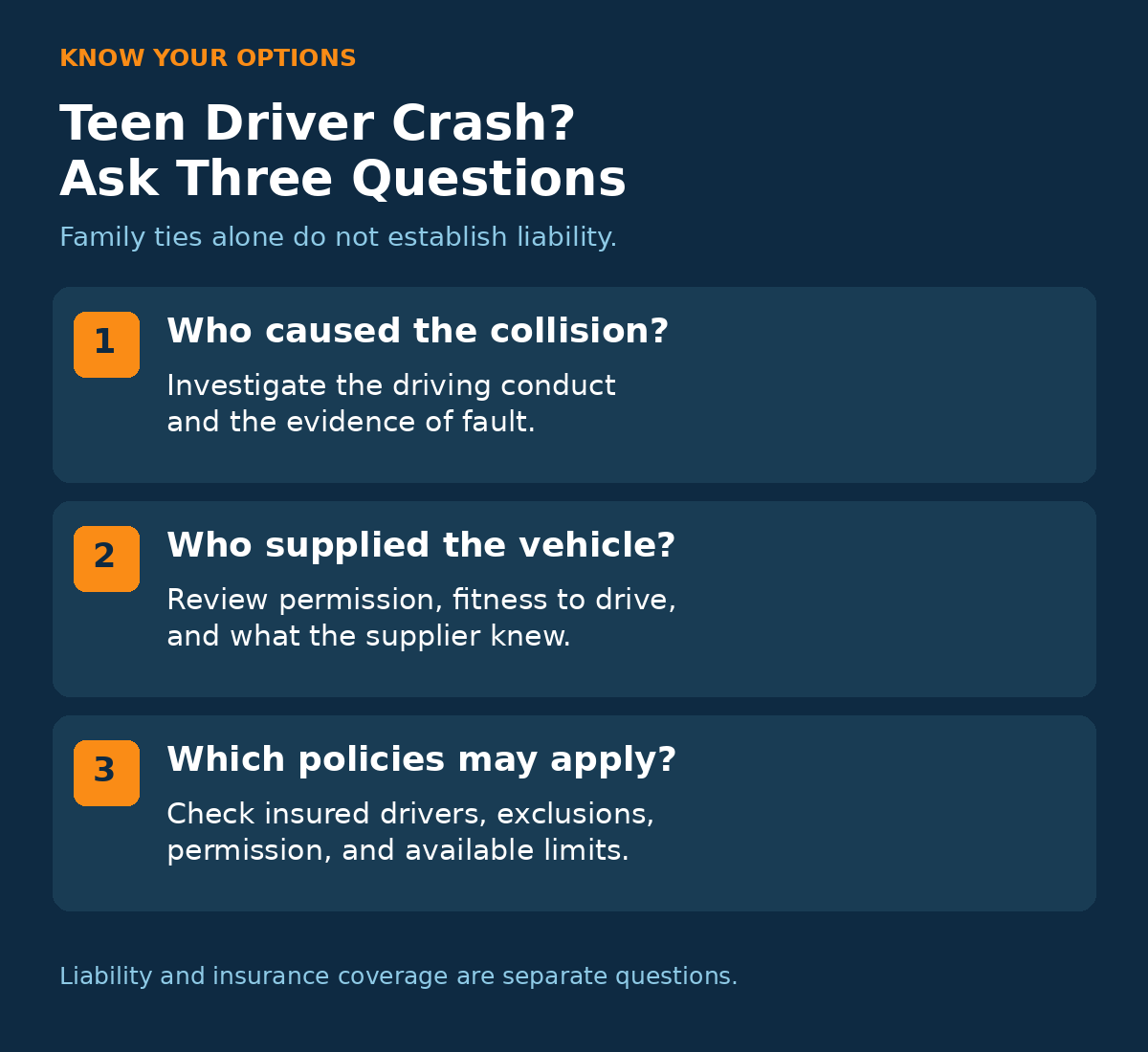
We investigate these issues in Alabama car accident cases and help injured people understand their personal injury options. The useful question is who may be legally responsible, and why.
Hurt in a crash involving a young driver? Contact us for a free personal injury consultation or call (256) 770-7232.
Being the Parent Doesn’t Automatically Create Liability
Alabama doesn’t follow the family-purpose doctrine that can impose liability on a family vehicle’s owner in some other states. Permission to drive and a family relationship aren’t enough by themselves.
That distinction appears in Bates v. Kurtts, where the court rejected family relationship and permitted use as a sufficient basis for liability.
So “the parents own the car” is a useful fact, but it isn’t a complete legal argument. We still need to identify the conduct or relationship that supports a claim against them.
The teenager’s own driving remains part of the investigation. A driver’s age doesn’t make the crash disappear, and it doesn’t remove the need to prove fault and damages.
For an injured person, this can feel like unnecessary complexity. But getting the parties right matters, especially when serious injuries may exceed one source of coverage.
The Decision to Hand Over the Car Can Matter
One possible claim is negligent entrustment. In plain language, it examines whether someone supplied a vehicle to a driver they knew, or had reason to know, was unfit to use it safely.
In Edwards v. Valentine, the Alabama Supreme Court identified the required elements: entrustment, driver incompetence, the supplier’s knowledge, causation, and damages.
This is a claim about the supplier’s own decision. It isn’t a rule that parents must pay whenever their child makes a mistake behind the wheel.
Suppose an owner knew about repeated dangerous driving and nevertheless continued providing access to the same car. Those facts could warrant investigation. They still need evidence and a connection to the injury.
Compare that with a licensed teenager who had no known history suggesting unsafe driving and caused a first collision. We can’t treat those situations as legally identical simply because both drivers are young.
Nor is “incompetent” an insult or a character judgment here. It’s a legal issue about the person’s ability or likely behavior when operating the vehicle.
A Missing License Isn’t the Whole Case
An expired or suspended license may sound like decisive evidence. The reason for the licensing problem matters.
In Halford v. Alamo Rent-A-Car, the court held that a suspension connected with an unpaid nonmoving citation didn’t, by itself, establish driving incompetence.
That doesn’t make licensing records irrelevant. It means we need to understand what they show rather than turning one fact into an automatic conclusion.
A teenager’s training, experience, driving history, and restrictions may be relevant in a particular case. Evidence that a restriction existed is different from evidence that violating it caused the collision.
Keep the distinction in mind when someone says, “They shouldn’t have been driving.” We want to know the factual and legal reasons behind that statement.
“They Took the Car Without Permission” Deserves a Closer Look
Sometimes an owner says the driver wasn’t allowed to use the vehicle that day. That statement matters, but the investigation doesn’t necessarily stop there.
Edwards recognized that entrustment can involve direct permission, continuing consent, or leaving a vehicle available under circumstances supporting the claim.
For unauthorized use, the court discussed whether the supplier knew or had reason to know that the particular unfit driver was likely to take the vehicle and failed to take reasonable precautions.
That is a fact-specific inquiry, not a rule making every accessible key an act of negligence. We look at the actual pattern of use and what the owner knew before this crash.
Imagine one family member saying the car was off-limits while earlier messages routinely allowed the teenager to borrow it. Those records could help explain whether the claimed restriction matched everyday practice.
We gather that evidence through appropriate channels. Don’t contact a teenager to pressure them into a statement or attempt to access someone else’s private accounts.
Liability and Insurance Coverage Are Different Questions
Even if a parent isn’t personally liable, a policy covering the vehicle or driver may still be relevant. Conversely, proving a claim against someone doesn’t establish that every policy will cover it.
We review the policy language, the people insured, permission issues, exclusions, and available limits. An insurance card gives us a starting point; it doesn’t supply every coverage answer.
Ask for the claim number and the adjuster’s contact information. Save written coverage explanations, especially any denial or reservation of rights.
Don’t assume an owner’s policy and a driver’s policy can simply be added together. Which coverage applies, and in what order, requires a policy-specific review.
Your own uninsured- or underinsured-motorist coverage may also deserve attention. Before accepting another insurer’s offer, review our guide to protecting an Alabama UIM claim.
What Evidence Helps Connect the Dots?
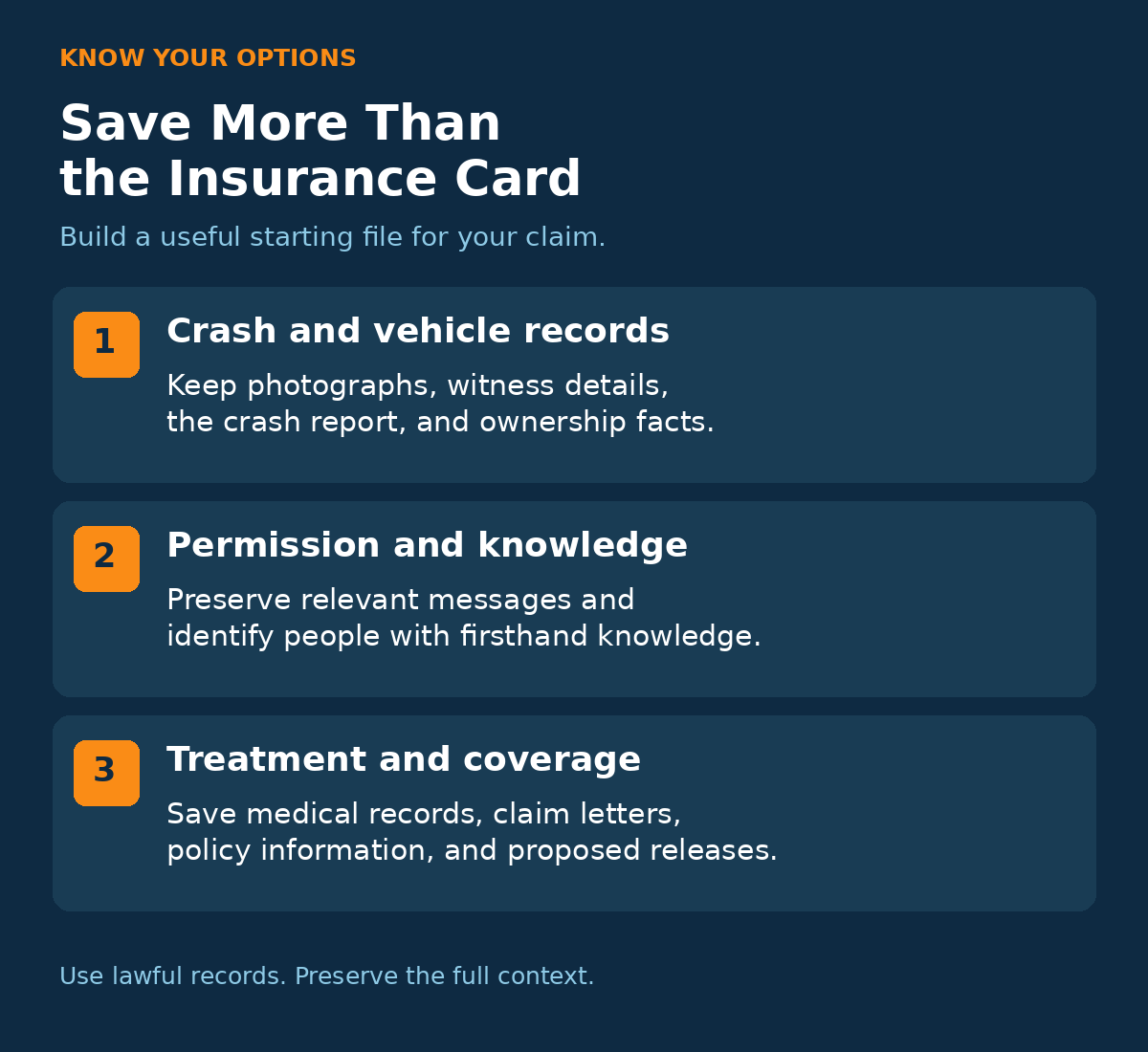
A useful file answers more than “whose name is on the title?” We want a clear picture of the crash, the vehicle arrangement, and the resulting harm.
- The collision: Photographs, witness names, available video, and the crash report help establish what happened on the road.
- The vehicle: Ownership records and insurance information identify people and policies that need review.
- The driving arrangement: Relevant messages and witnesses may explain permission, recurring access, or restrictions.
- Prior knowledge: Lawfully obtained records may show what the person supplying the vehicle knew about the driver’s ability or conduct.
- Your losses: Treatment records, bills, missed-work information, and a factual recovery timeline document the consequences of the crash.
You don’t need to collect everything before calling us. Some evidence requires formal requests, and some information may not be available to you directly.
Frequently Asked Questions
Can I bring a claim against a teenage driver?
Potentially. Age doesn’t automatically excuse negligent driving. A minor’s involvement can affect court procedures, so identifying the proper parties and representation is important.
Does the parent’s name on the title mean the parent must pay?
No. Ownership is relevant, but personal liability requires a legal basis. A negligent-entrustment claim requires evidence beyond ownership and family relationship.
What if the teenager had permission to use the car?
Permission can matter to both the legal claim and insurance review. It doesn’t automatically prove negligent entrustment, and its significance under a policy depends on the policy’s terms.
Is one previous traffic ticket enough?
There’s no reliable shortcut based only on counting tickets. The nature of the conduct, its timing, the owner’s knowledge, and the evidence connecting it to unsafe driving all matter.
What if the driver was doing a job when the crash happened?
That can raise a different responsibility question. We may need to examine an employment relationship and the trip’s purpose, as explained in our article on drivers working at the time of a crash.
Should I accept a private payment from the parents?
Get advice before signing anything or treating a payment as a full settlement. A friendly offer may come with a release that reaches further than you expect, especially while treatment is ongoing.
Start With the Facts, Not an Assumption About the Family
You may be dealing with an upset teenager, apologetic parents, and an insurer offering different explanations. You don’t have to decide which explanation is legally correct on the spot.
We can investigate who caused the crash, who supplied the vehicle, and which coverage may apply. That gives you a clearer basis for the next decision.
Let’s review what happened. Contact us for a free personal injury consultation or call (256) 770-7232.
Can't find what you're looking for? Search our site below.