

You find out your child spent the evening with a sitter while your ex went out. You were home, available, and would have loved the extra time.
Shouldn’t you have gotten the first call?
Maybe. In an Alabama custody case, that answer depends on the actual order and the circumstances. Being available doesn’t, by itself, establish a right to take over the other parent’s time.
We help parents work through these questions in Alabama custody matters and visitation arrangements. The useful starting point is the childcare provision, not a debate about who deserves more time.
Unsure what your order requires? Contact us to discuss your custody arrangement or call (256) 770-7232.
First, Check Whether You Have a Right of First Refusal
A right of first refusal generally requires a parent who needs certain childcare to offer that time to the other parent before using someone else. The order defines when the offer is required.
Don’t assume every Alabama parenting plan includes this provision. Don’t assume that joint legal custody creates a standing invitation to collect your child whenever the other parent is busy.
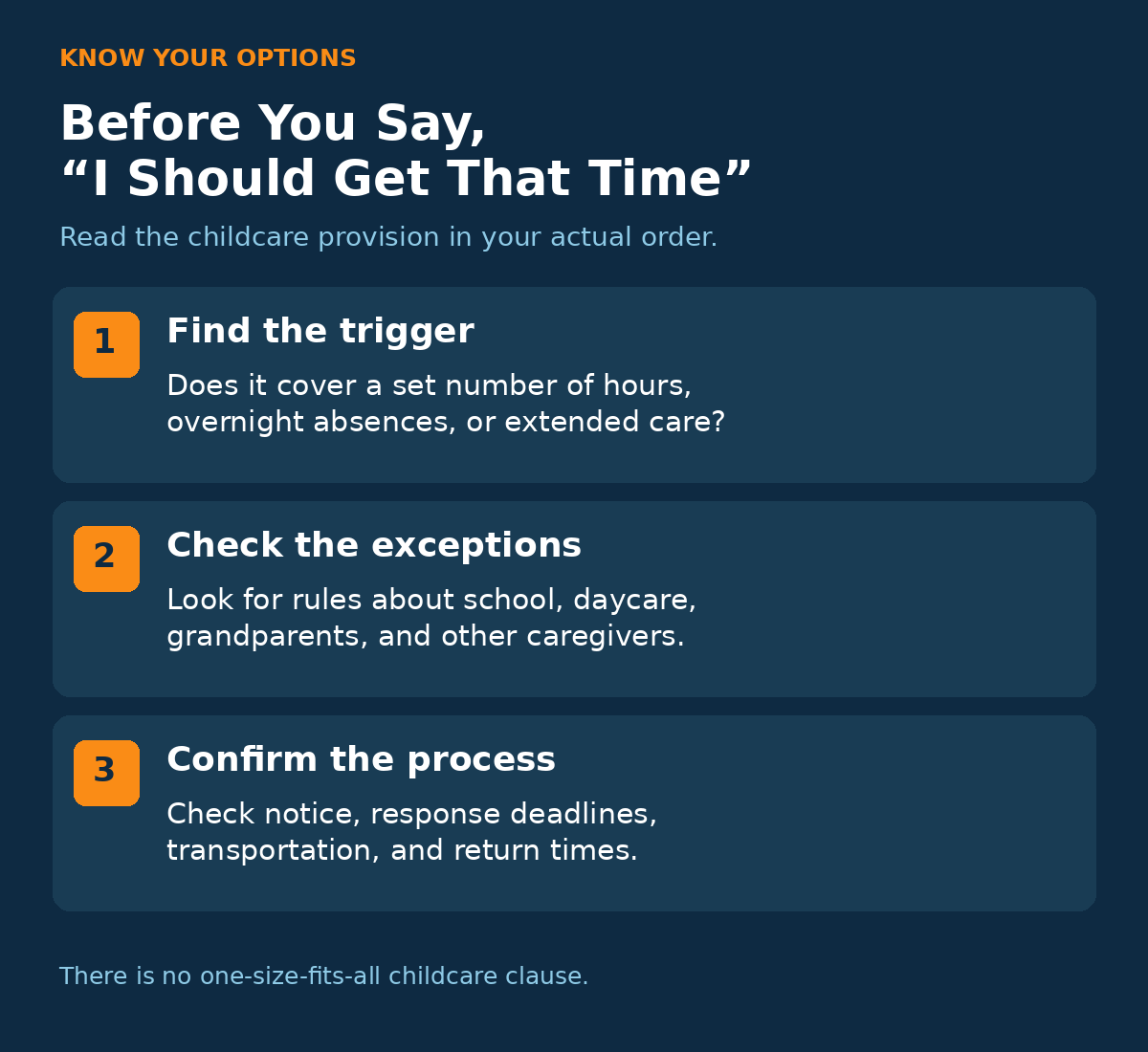
Start with the signed order, including later modifications. Search for language about childcare, a parent’s absence, overnight stays, and the other parent’s opportunity to care for the child.
Then read the whole paragraph. An exception near the end may change what the opening sentence appears to promise.
If your order says nothing about this issue, you can ask for extra time. Whether an enforceable provision should be added is a separate question for agreement or court review.
The Exact Wording Can Change the Answer
In Hopkins v. Hopkins, the order required an offer when a parent needed an overnight out-of-town stay or extended childcare.
The appellate court explained that the provision offered the other parent the opportunity to personally care for the child before a third party did so.
That doesn’t create a statewide rule requiring an offer for every errand or evening out. It shows why the trigger written into a particular order matters.
Consider two hypothetical clauses. One applies after four hours away. Another applies only to overnight absences. A six-hour dinner and concert could raise different obligations under those two versions.
Those thresholds are examples, not recommended language for every family. Travel distance, work schedules, school nights, and the child’s routine should shape the discussion.
What About Grandparents, Stepparents, and Sleepovers?
This is where a seemingly simple provision can become a recurring argument. Does a visit with Grandma count as childcare? What if a stepparent is home? What about a birthday sleepover?
The answer shouldn’t be guessed from the adult’s relationship to the child. Check whether the order includes or excludes that situation.
In White v. White, the order applied to care exceeding four hours but specifically excluded time with grandparents from “babysitting.”
The appellate court treated that exception as clear. The father’s preference to care for the children before their grandparents didn’t override the wording.
That was the order in that case. It isn’t a universal grandparent exception for every Alabama family.
When we help draft a provision, we want these predictable situations addressed upfront. Otherwise, one parent may see a normal family visit while the other sees a missed parenting opportunity.
An Offer Isn’t the Same as Permission to Rearrange Everything
Picture this: Your ex needs care from 5 p.m. to 10 p.m. You accept, then announce that the child will stay with you until Monday because another exchange seems inconvenient.
That may go beyond what was offered or ordered. A childcare opportunity doesn’t automatically replace the surrounding custody schedule.
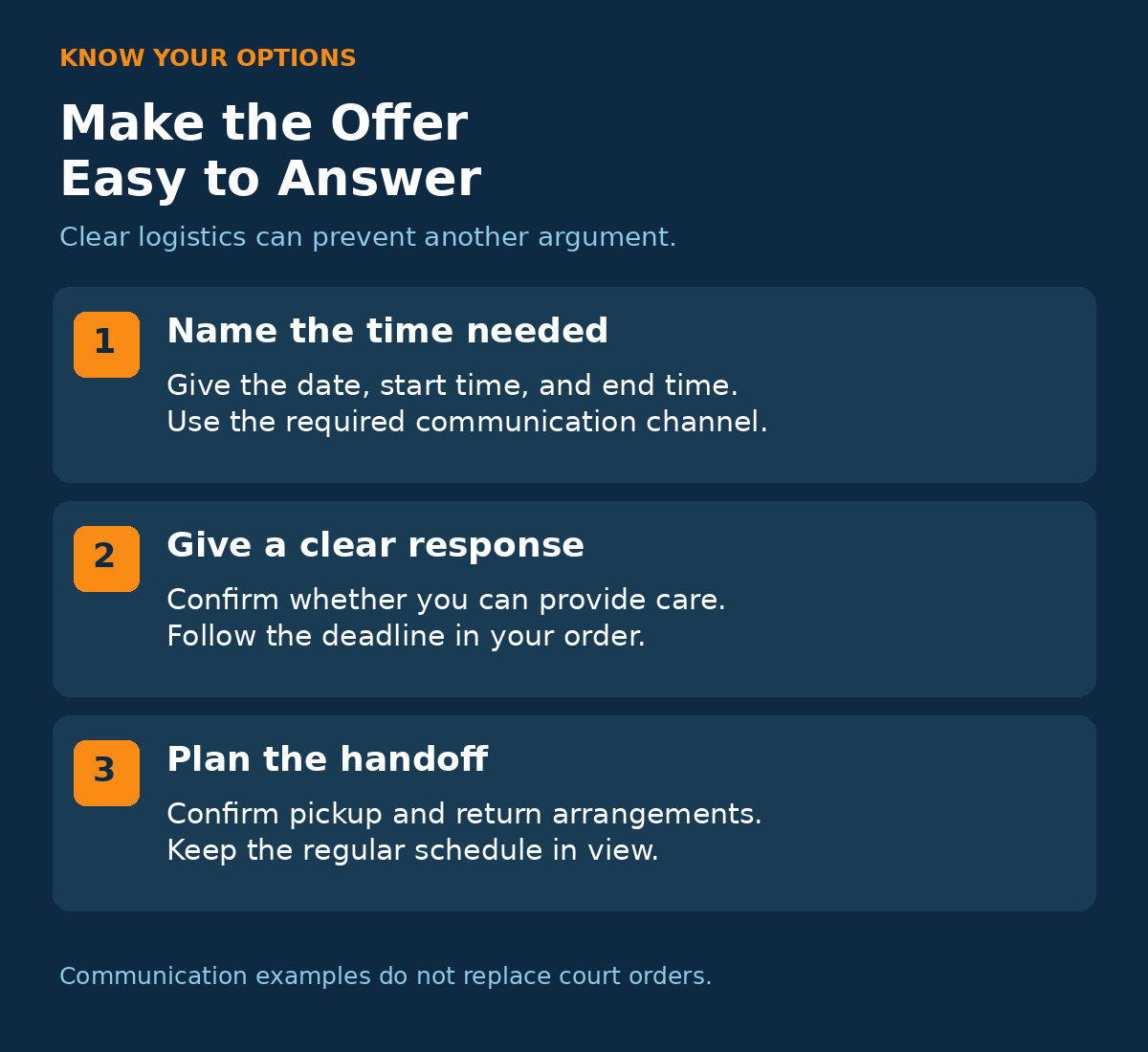
Confirm the start time, end time, pickup location, and return plan. If you want to extend the visit, ask and document any agreement through the permitted communication channel.
Also be honest about your availability. If you accept and immediately arrange a sitter of your own, the parties may end up fighting about whether you could personally provide the care contemplated by the order.
The aim is a workable plan for the child. A successful exchange shouldn’t require everyone to renegotiate the entire weekend at the curb.
Six Details That Make a Childcare Clause Easier to Use
Alabama’s joint-custody planning statute requires provisions addressing the child’s care and other important matters. When parents can’t agree on the required plan, the court sets it.
That statute doesn’t supply a universal first-refusal clause. These are practical drafting questions we can help parents evaluate for their particular arrangement:
- The trigger: How long must the parent be unavailable? Does the rule cover overnight work, routine shifts, or only occasional absences?
- The exceptions: How are school, daycare, activities, grandparents, stepparents, and social sleepovers treated?
- The notice: Where should the offer be sent, what details should it include, and how soon should foreseeable plans be shared?
- The response: How long does the other parent have to accept? What happens if there is no response before care must be arranged?
- The transportation: Who picks up, who returns the child, and how will distance or a school-night bedtime affect the exchange?
- The unexpected change: What happens when a shift runs late, a sitter cancels, or the accepting parent becomes unavailable?
We also look at whether the provision will create useful parenting time or constant disruption. A two-hour opportunity can look very different when the parents live five minutes apart instead of an hour apart.
More detailed language isn’t always better. The goal is language the parents can follow on an ordinary Tuesday, including when they’re tired and don’t agree.
A Message That Solves the Logistics
When an offer is required, keep it specific. A useful message might look like this, with the response time adjusted to your actual order:
“I’ll need childcare Friday from 5 to 10 p.m. Are you available to care for Sam during that time? Please reply by the deadline in our order. Let’s confirm pickup and return arrangements.”
That message identifies the care needed without inviting an argument about the parent’s plans. It also creates a clearer record than “Do you want Sam sometime this weekend?”
If you’re accepting, answer the practical question: “Yes, I can cover that entire period.” Then confirm transportation. If you can cover only part of it, say so rather than implying a full acceptance.
These are communication examples, not replacement terms for an order. Use any court-required parenting app and respect restrictions on contact.
What If Your Ex Keeps Skipping the Offer?
Keep the focus on the provision and the facts. Save the complete message thread, the dates and times involved, your availability, and the explanation you were given.
Don’t ask your child to report on the other parent’s whereabouts. Don’t secretly access accounts or use tracking as a substitute for legitimate evidence.
An enforcement request needs more than frustration. In Hopkins, the appellate court upheld the refusal to find contempt on the record presented; the existence of a clause didn’t prove a willful violation.
We can compare the incidents with the wording and evaluate whether clarification, enforcement, or a proposed change is appropriate. A disagreement about a vague term may need a different approach from repeated disregard of a clear obligation.
Don’t retaliate by withholding the next scheduled visit. If there is an immediate safety concern, seek urgent legal guidance; an ordinary childcare disagreement shouldn’t become a self-directed custody change.
Frequently Asked Questions
Does Alabama automatically give me first refusal before a babysitter?
Don’t assume so. Review your custody order for an express childcare provision. Your availability, by itself, doesn’t establish that the other parent violated an enforceable duty to offer the time.
Does the rule apply while my ex is at work?
It depends on the wording. Routine employment, daycare, and occasional overtime may need different treatment. A clause that never addresses work schedules can leave an important source of disagreement unresolved.
Can my ex choose a grandparent instead of me?
Possibly. Some orders expressly exempt grandparents, as the order in White did. Others may use different language. There is no substitute for reading the provision that governs your family.
Do I have to say yes every time?
A first-refusal opportunity generally lets you accept or decline the offered care. Read your order for the response process and consequences of silence. Don’t accept time you know you can’t cover.
Does extra childcare automatically reduce child support?
Don’t reduce a payment on your own. Keep records of the actual arrangement and get advice if parenting time has changed substantially. Occasional extra care doesn’t itself rewrite the support order.
Can we add this provision after the divorce?
You can discuss an agreed change or ask whether court relief is appropriate. The required showing depends on the existing order and the change requested; adding language isn’t automatic just because one parent wants it.
More Time With Your Child Shouldn’t Require Guesswork
A good childcare provision answers real questions before they become arguments. When should an offer happen? How should you respond? When does the regular schedule resume?
We can help you understand the order you already have or address those details in a proposed parenting plan. Bring the signed order and a few complete examples of the issue you’re trying to solve.
Let’s make the next step clearer. Contact us about your custody matter or call (256) 770-7232.
Can't find what you're looking for? Search our site below.