

Your child asks whether you saw the comment on the report card. You didn’t. Your ex got the email, the school portal won’t recognize your address, and now your child is the one explaining what happened at school. There’s a better place to start than asking a fourth grader to play messenger.
In Alabama, both parents generally have access to their child’s school records unless a court order or statute says otherwise. Having less parenting time doesn’t, by itself, take that access away. Being entitled to inspect a record, however, isn’t the same as having a particular app login or the authority to change schools.
If the school and your co-parent are reading the order differently, bring the question to our family law team or call (256) 770-7232. We can help you figure out what to ask for.
What does Alabama say about a noncustodial parent’s school records access?
Alabama Code § 30-3-154 covers records and information about the child, including scholastic and extracurricular information. The rule applies across custody arrangements. Its exception matters: A court order or statute can prohibit access that would otherwise be available.
So start by locating the signed order and any later modifications. The relevant language might not appear under “school.” Look for restrictions on contact, disclosure of identifying information or the way a parent may communicate with school personnel. A parenting schedule by itself may say very little about records.
Federal law supplies another piece. For schools covered by the Family Educational Rights and Privacy Act, the U.S. Department of Education’s guidance on divorced parents says both parents generally have education-record rights unless a legally binding restriction specifically provides otherwise. A school can ask you to establish that you’re the parent. Verification is different from a decision that you have no rights.
Do you need a record, a notification or a decision?
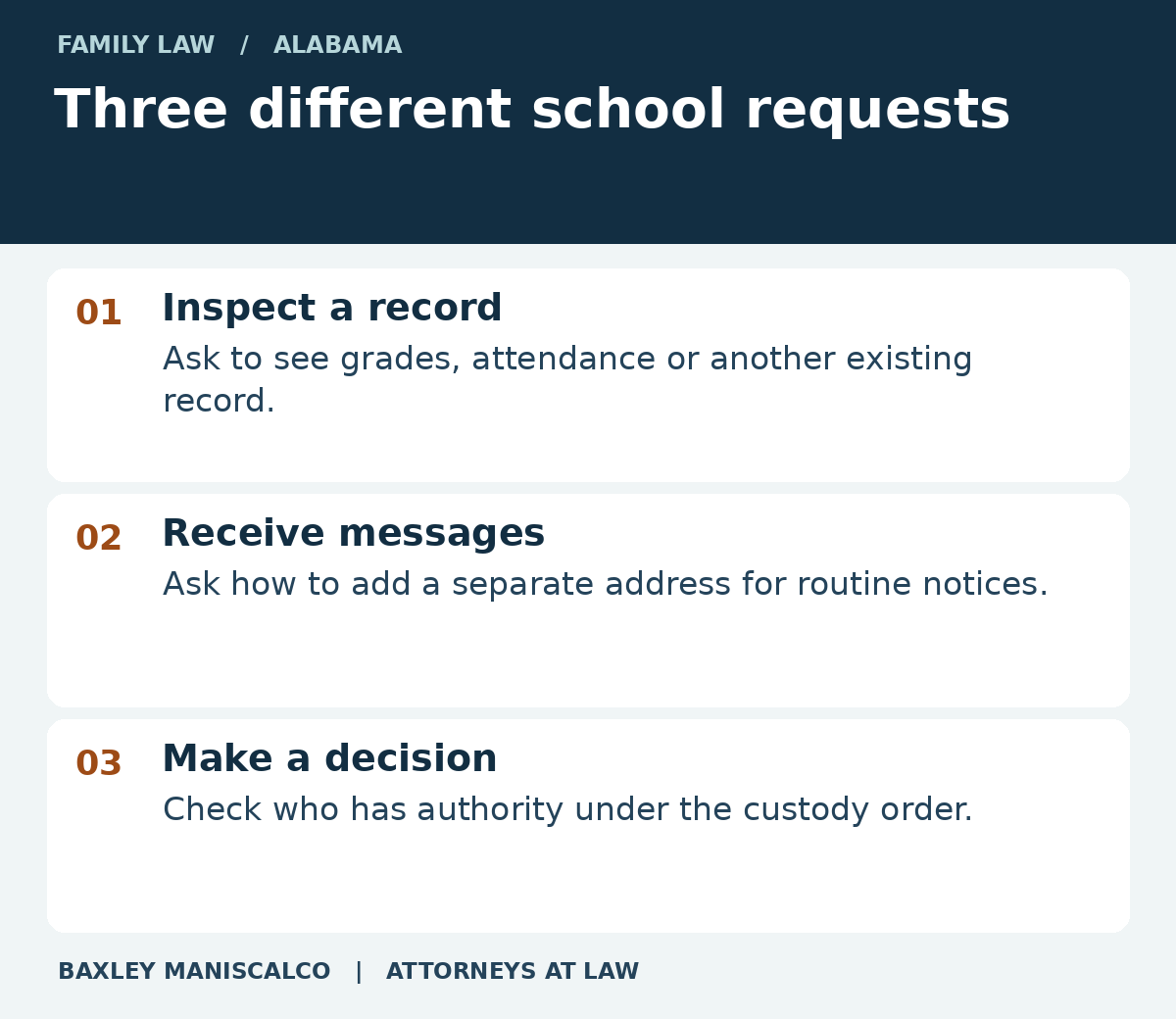
Imagine your daughter misses three assignments. You want to see the grade entries, get the weekly classroom email, and move her to a different math section. Those are three requests. Sending them all as “I have custody rights” makes it harder for the school to give you a useful answer.
- For an existing record, identify what you want to inspect: the current report card, attendance history for this semester or a particular progress report. Ask the records office what process it uses.
- For routine communications, ask the office how it adds a second verified email address or sets up a separate parent account. The school might have a straightforward administrative fix.
- For an educational decision, check the legal-custody provisions. A right to see grades doesn’t authorize either parent to change enrollment, services or placement alone.
Alabama’s definitions of legal and physical custody help explain why the distinctions matter. Parents may share some decisions while one has final authority over a particular subject. What happens on Tuesday at pickup won’t necessarily tell the registrar who can approve a change in instruction.
A request the registrar can actually answer
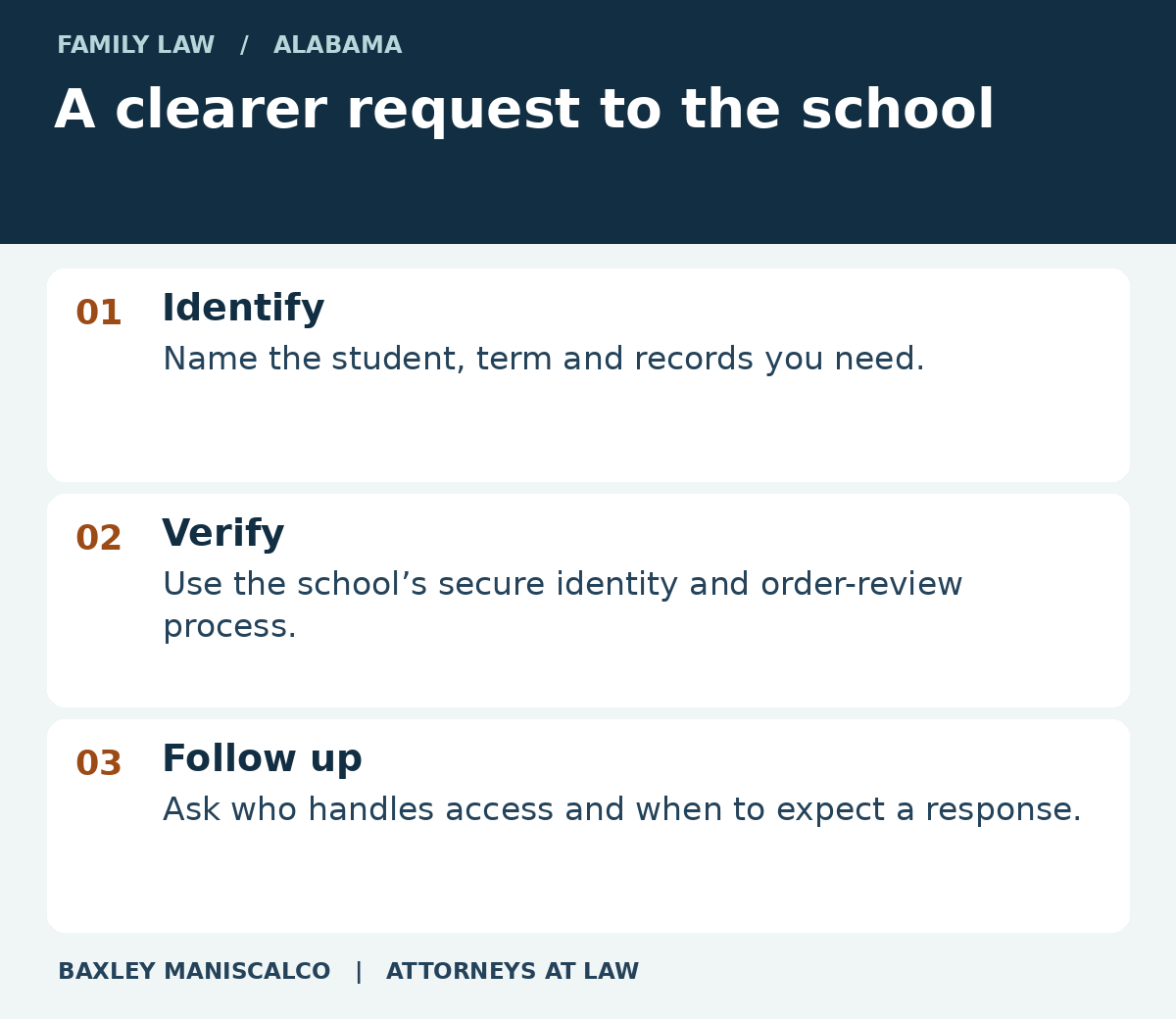
Try a short note like this: “I’m Jordan’s parent and would like to inspect the fall attendance record and most recent report card. What’s the secure process for verifying my identity and arranging access? I’d also like to know whether I can receive future report-card notices at my own email address.”
That wording gives the office two clear tasks. It doesn’t ask a staff member to interpret years of family history, and it doesn’t make access depend on getting the other parent’s password. Include the identifying details the school asks for through its approved channel. Don’t email a complete divorce file to a teacher’s group inbox.
If the school requests a custody order, ask where to send it securely and what it needs to see. Provide accurate, current information. Don’t omit a restriction or send only the favorable paragraph if that would give a misleading picture. If the order contains a protected address, ask about handling that information before forwarding it.
What if the school says only the primary parent can see grades?
Ask what the answer means in practice. “We can only send one automatic text per household” is a software limitation. “We won’t let you inspect the record” is a different response. Ask whether an appointment, a secure copy or a separate account is available. A records-access problem doesn’t always require a new court order.
For covered schools, FERPA generally requires access to inspect and review education records within a reasonable time, no more than 45 days after the request. The Education Department’s explanation of the review period describes a maximum, not a promise that a portal password or a second newsletter will arrive by that date.
Keep a dated copy of the request and reply. If the office is relying on a court order, ask which provision it believes controls. If it points to a district policy, ask who handles records requests at the district level. A calm written trail helps distinguish a misunderstanding from a refusal that needs closer review.
When safety restrictions or an older student change the answer
A protection order is a reason to slow down and get specific advice. Information on a record might reveal a location or schedule that an order protects. Don’t show up at the school, borrow a relative’s login or ask the child to photograph a protected document to get around a restriction.
Age and school type matter, too. Under FERPA’s federal framework, rights generally transfer to the student at 18 or upon attendance at a postsecondary institution at any age. A high school and a college may therefore handle a dual-enrolled student’s records differently. Don’t assume an old elementary-school procedure carries over to every transcript.
For a younger child, keep the immediate goal in view. If you need to help with missed assignments tonight, ask the teacher what work is due while the office sorts out record access. That can solve Tuesday’s homework problem without asking your child to take sides in an adult disagreement.
Frequently asked questions
Do I need my ex’s permission to ask for a report card?
Generally, a parent can contact the school directly about their own access, subject to the applicable order and law. Ask the school to verify your status rather than asking for your ex’s credentials.
Does the school have to give me my own portal login?
Access to education records doesn’t necessarily require a particular software feature. Ask how the school will let you inspect the records if a separate login isn’t available.
Can my new spouse request records for me?
Don’t assume your own access automatically extends to another adult. Ask the school what authorization it needs and check any limits in the custody order before sharing records.
If I can see attendance, can I pick up my child early?
No automatic pickup authority follows from record access. The school’s release procedures, the parenting schedule and any specific court restrictions still matter.
What if I already gave the school the old order?
Tell the designated office there’s a newer one and ask how to update the file securely. Identify the effective order rather than expecting school staff to decide between conflicting papers.
When should I involve a family law attorney?
It’s a good time to ask for help if an order is ambiguous, safety restrictions are involved or repeated written requests leave you unable to access important information. Bring the actual replies, not just a summary.
Leave your child out of the paperwork
Being able to say “I saw your teacher’s note. What would help?” is a more useful goal than winning an argument about a password. Sometimes it takes one email to the registrar. Sometimes the adults need help understanding what the order allows.
If you’re getting different answers, contact Baxley Maniscalco or call (256) 770-7232. Bring the school’s response and your order. We’ll start there.
Can't find what you're looking for? Search our site below.