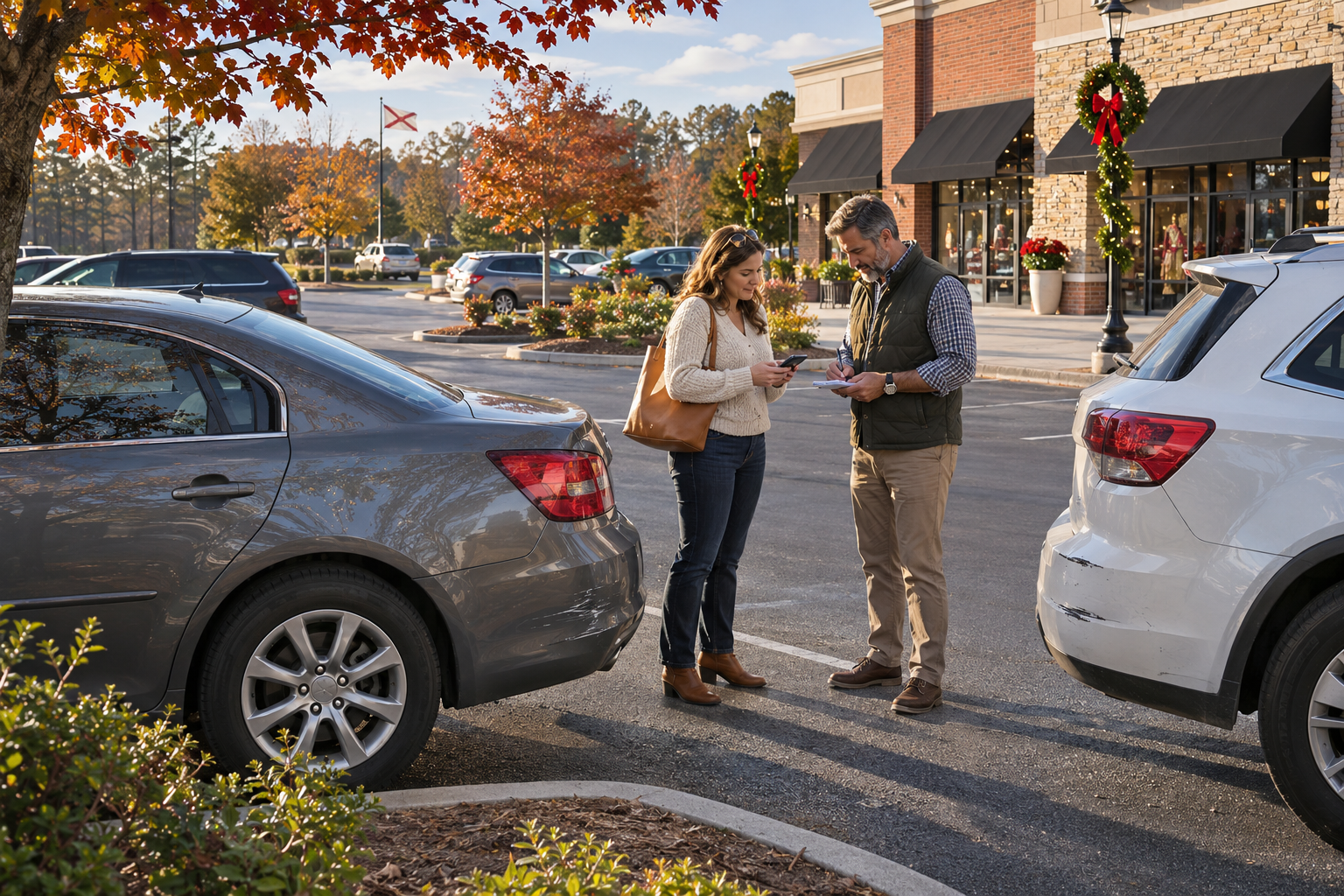
Two cars back out, brakes squeal, and holiday shoppers stop to look. Before anyone has compared the damage, someone announces, “Parking lots are always fifty-fifty.”
That isn’t an Alabama rule. Parking-lot accident fault depends on the evidence and applicable law, not an automatic split because the collision happened outside a store.
We help injured drivers evaluate these disputes through our Alabama auto accident practice. A low-speed crash can still raise serious questions about injuries, responsibility and insurance coverage.
Injured in a parking-lot collision? Contact us for a free consultation or call (256) 770-7232. We can help you understand the claim before you accept a quick explanation of fault.
Are Parking-Lot Accidents Always 50/50 in Alabama?
No. There is no automatic fifty-fifty allocation simply because both cars were moving or the collision occurred on private property.
A negligence claim asks whether someone failed to use reasonable care, whether that failure caused the collision and what harm resulted. Each driver’s actions need their own review.
Alabama also follows contributory negligence for ordinary negligence claims. If the injured person’s own negligence proximately contributed to the injury and the defense is established, recovery can be barred rather than merely reduced by a percentage.
That makes casual fault labels especially unhelpful. “We were both backing” describes movement. It doesn’t, by itself, establish what each person could see, whether either stopped or how the impact happened.
In Monroy v. Payne, a federal court applying Alabama law discussed contributory negligence and the disputed facts surrounding a backing collision. The lesson for a shopper isn’t a preset result; it’s the importance of a complete factual record.
Does Being on Private Property Change the Rules?
It can change which traffic statutes apply directly. It doesn’t create a law-free zone or excuse careless driving.
In Dale v. Kelly, the Alabama Supreme Court addressed a collision in a privately owned parking lot. The court distinguished highway traffic statutes from the ordinary negligence principles used to evaluate driving in the lot.
The current Alabama statutory provision on where traffic rules apply also contains exceptions, including provisions concerning accidents and accident reports. Don’t assume private property means there are no reporting duties.
Painted arrows, stop markings and the layout can still help explain what reasonable care required. Their significance depends on the location and circumstances, not just whether someone received a ticket.
What Matters When One or Both Cars Were Backing?
Start a few seconds before the impact. Where was each vehicle, what was moving, and what was blocking the view?
A car stopped after partially backing out presents a different factual picture from a driver continuing to reverse while looking away. A vehicle speeding through an aisle creates another issue entirely.
Useful details include:
- Movement: Which car was reversing, moving forward or fully stopped immediately before contact?
- Visibility: Did a large vehicle, display, landscaping or a crowd obstruct the sightline?
- Warnings: Were reverse lights, brake lights, a horn or another warning visible or audible?
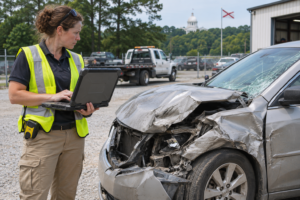
- Impact: Where did the vehicles touch, and does the damage fit the accounts being given?
- Timing: Did either driver have a reasonable opportunity to see the danger and respond?
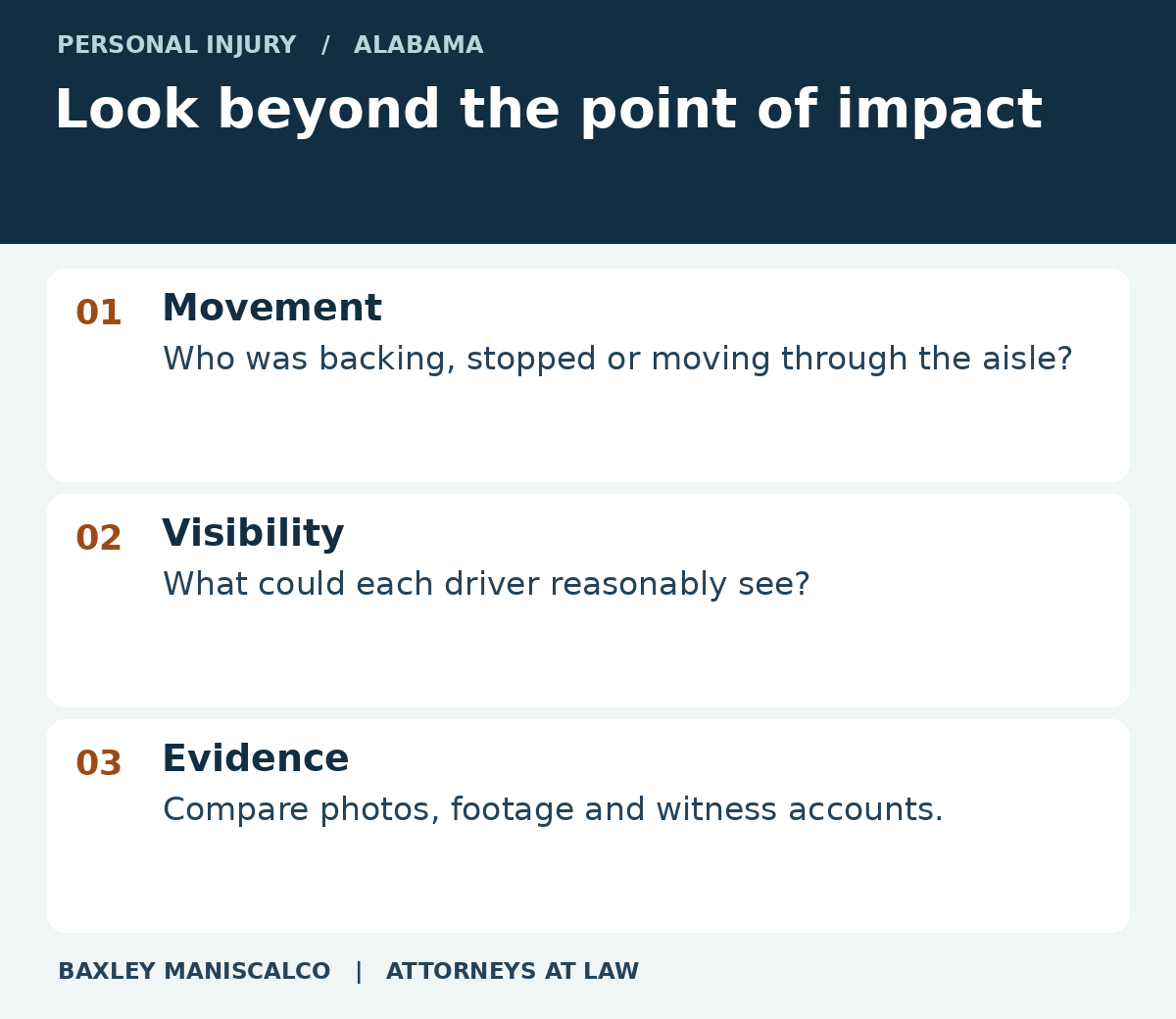
A dent alone rarely tells the entire sequence. Pair photographs with witness accounts, video and a clear description of what you actually saw.
What Should You Do Before Leaving the Lot?
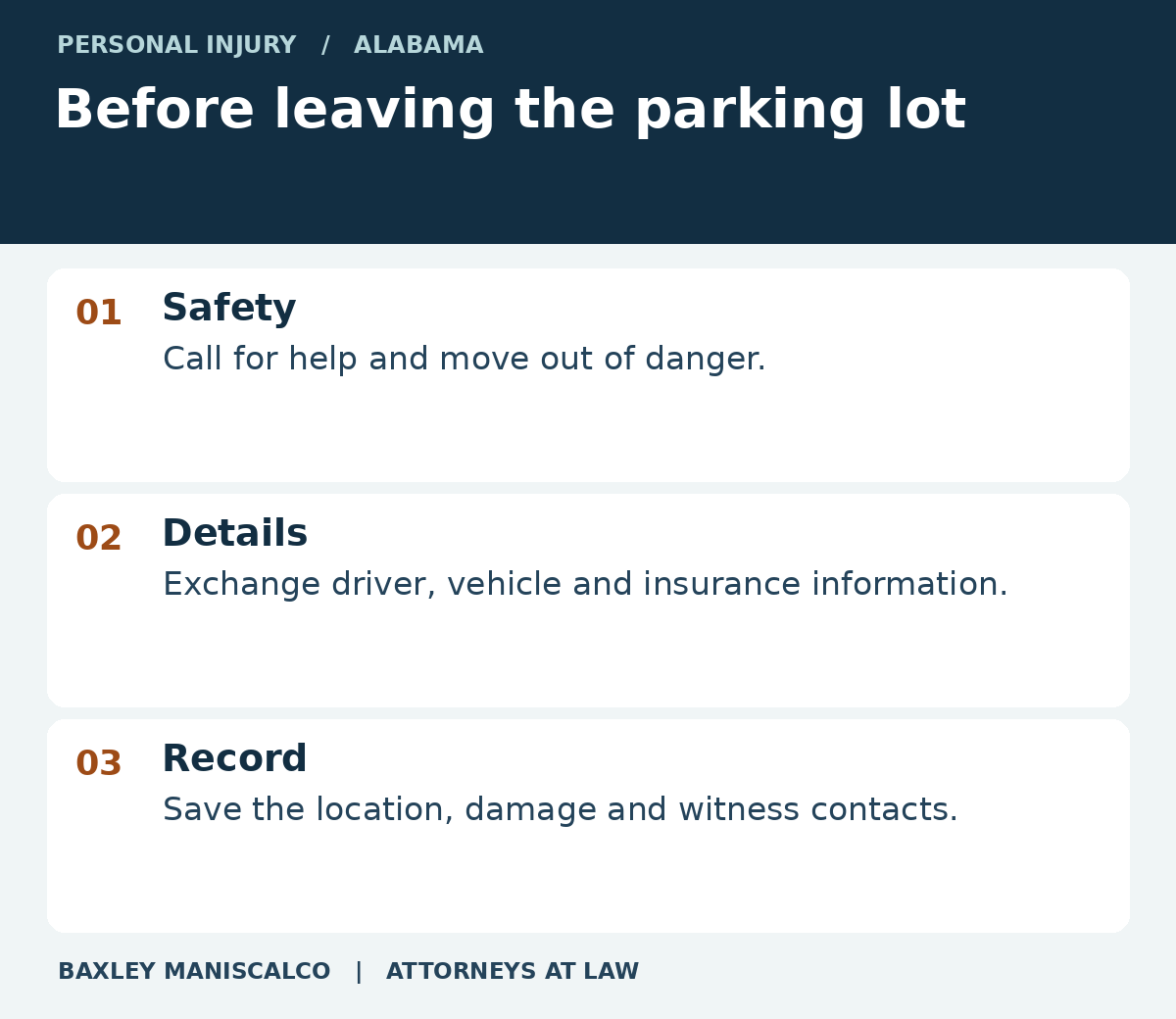
Check for injuries and call for emergency help when needed. Get out of moving traffic when it is safe, and follow instructions from responding authorities.
Don’t stand between vehicles or step into a busy aisle to get a better photograph. Evidence matters, but another collision would make the situation worse.
Collect what you safely can:
- Driver and vehicle details: Exchange names, contact information, license plates and insurance information.
- The exact location: Note the store address, entrance, parking row and direction of travel.
- Scene photographs: Capture the vehicles, damage, markings and obstructions from safe positions.
- Independent witnesses: Ask for contact details before everyone continues shopping.
- A contemporaneous account: Record the time and sequence without guessing at speed or distance.
If you report the crash and an officer doesn’t respond, ask what report or documentation process is available. Save the call details and any reference number.
Notify your insurer as required by the policy. Describe facts honestly, but don’t turn a polite apology or an uncertain first impression into a firm technical conclusion about fault.
What If There’s No Police Report or the Stories Conflict?
A police report can be useful, but its absence doesn’t automatically defeat a claim. Other evidence may establish what happened.
Nearby businesses may have cameras. Another driver may have a dashcam. A passenger might remember a horn, while a pedestrian saw which vehicle had already stopped.
Ask promptly about preserving relevant footage. Identify the date, approximate time and precise location; the camera showing the store entrance may not cover the parking row where the collision occurred.
We explain more about prompt evidence requests in our surveillance footage guide. A request isn’t a guarantee of access, so retain your own photographs and witness information too.
If an insurer assigns fault, ask for the reasoning and the evidence it relied on. A percentage in an adjuster’s letter isn’t automatically a court’s determination of your legal rights.
Separate Fault, Coverage and the Extent of the Injury
Those questions can overlap, but they aren’t interchangeable. Your own collision coverage may address vehicle damage subject to the policy and deductible, even while fault remains disputed.
An injury claim against another driver requires its own analysis. Get appropriate medical care and accurately describe the collision, symptoms and relevant medical history to your treating provider.
Don’t assume minimal visible damage proves that nobody was hurt. Conversely, don’t exaggerate an injury because the other driver’s account frustrates you. Reliable records are more useful than a dramatic description.
Before signing a release, check which claims it resolves. Our guide to property-damage and injury releases explains why a car-repair payment may require a closer look at the paperwork.
Frequently Asked Questions About Alabama Parking-Lot Crashes
Is the Backing Driver Always at Fault?
No automatic rule answers every backing collision. The driver’s lookout, movement and opportunity to avoid contact matter, as do the other driver’s actions. Being in the traffic aisle isn’t permission to drive carelessly. Evidence must establish the relevant conduct and causation.
What If Both Cars Were Reversing?
Both drivers’ conduct needs review. That doesn’t automatically make the result fifty-fifty. One car may have stopped, one driver may have had a clearer view, or other facts may change the analysis. Alabama contributory-negligence issues make those details particularly important.
Can I Bring a Claim Without a Police Report?
Potentially, yes. Photographs, witnesses, video, medical records and the parties’ accounts can help support a claim. You should still comply with applicable reporting requirements. A lack of a report can make documentation harder, but it isn’t an automatic legal bar.
Does No Ticket Mean Nobody Was Negligent?
No. A citation and a civil injury claim answer different questions. The absence of a ticket doesn’t prove that both drivers used reasonable care, and a citation doesn’t resolve every issue of causation, damages or insurance coverage.
Will My Own Insurance Pay for the Car?
That depends on the coverages and terms you purchased. Collision coverage may apply to vehicle damage, subject to a deductible and policy conditions. Ask your insurer to identify the relevant coverage and explain its decision in writing if the answer is unclear.
Can the Shopping Center Be Responsible Too?
Possibly, if a separate unsafe condition and a legally responsible party’s conduct contributed to the crash. Poor visibility alone doesn’t prove a premises claim. Ownership, control, notice, the specific hazard and causation would need independent investigation.
Get a Clearer Answer Than “That’s Just Parking Lots”
You deserve an explanation grounded in what happened. We can review the evidence, the insurer’s position and the effect of Alabama law on your injury claim.
Bring us the photographs and whatever paperwork you’ve received. Contact us for a free consultation or call (256) 770-7232, and we’ll help you sort through the next steps.
Can't find what you're looking for? Search our site below.