

The adjuster emails a form and says, “We just need the records from your accident.” The form itself says “any and all providers.” There’s no obvious start date. You were expecting a request for last month’s ER visit, not permission to ask the doctor you saw ten years ago.
Before signing a medical records release for an Alabama injury claim, compare what the adjuster says is needed with what the document actually authorizes. You can ask about narrower dates, named providers or supplying relevant records another way. The right response depends partly on who’s asking: the other driver’s insurer, your own carrier or a party using formal court procedures.
If a form feels broader than the conversation, let us look at it with you or call (256) 770-7232. Your personal injury consultation is free.
Why the insurer wants records in the first place
An emergency-room bill shows you were charged for a visit. It might not say what symptoms you reported, what the clinician observed or why follow-up was recommended. Those details matter when an insurer evaluates whether a crash caused an injury and whether the treatment relates to it. Asking for supporting evidence can be entirely reasonable.
Consider two claims involving a sore left knee. One person had never sought knee treatment before the crash. Another had surgery on that knee the previous year but was back at work without restrictions. The surgeon’s discharge note could be especially helpful to the second person: It may show what they could do before the collision and what changed afterward.
That’s the question to keep returning to: Which record helps answer which disputed issue? A pre-crash note can be useful without making every unrelated office visit relevant. Conversely, drawing the start date exactly at the crash may leave out the document that best explains your recovery. The goal is an accurate picture, not the thinnest possible file.
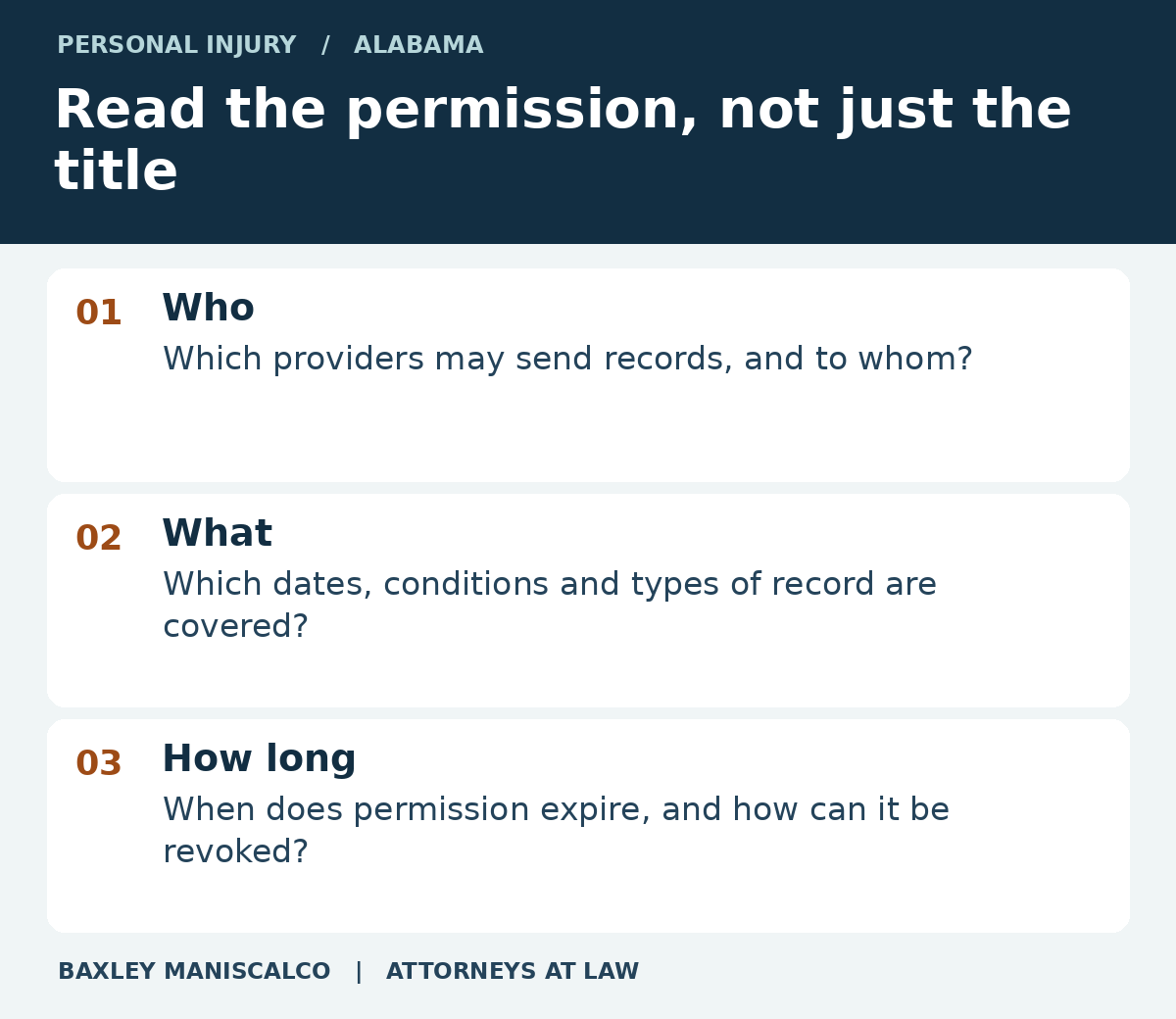
Read the form as a set of instructions to your providers
A signed authorization tells a healthcare provider what it may disclose under that authorization. It isn’t just a receipt acknowledging a conversation. Under the HIPAA authorization rule, core elements include a description of the information, who may disclose it, who may receive it, the purpose, an expiration date or event, and the individual’s signature and date. There are other requirements and exceptions; those elements alone aren’t a do-it-yourself validity test.
Read the actual permission from beginning to end. Does “hospital records” include imaging and billing, or did you intend only to provide the visit summary? Does the recipient line name a particular insurer or include other recipients? Check attached pages and any electronic terms presented before the signature screen. Save a copy of exactly what you were asked to sign.
Don’t confuse the records date range with the authorization’s expiration. A form might authorize requests for the next six months while allowing the recipient to obtain records dating back many years. Those are two different clocks. The U.S. Department of Health and Human Services explains that expiration may be tied to a date or an event.
A practical way to ask for a narrower request
Say the adjuster is evaluating eight weeks of physical therapy after a rear-end crash. The form would allow requests to any provider for your lifetime. You might respond: “I understand you need records supporting the shoulder treatment. Which providers, dates and records do you need, and what question are you evaluating? Would the initial evaluation, visit notes and discharge summary from this therapist address it?”
That response doesn’t hide the ball or promise the insurer will agree. It asks the adjuster to identify the gap. If the reply is that a prior shoulder injury affects the evaluation, ask which earlier records would help establish your baseline. If a revised authorization is offered, compare the new form with the old one rather than relying on the word “revised.”
- Name the provider or facility. A hospital visit can generate separate records from the facility, radiologist and follow-up practice. Check which one has the material being requested.
- Specify dates and record types. Ask whether a report, image, treatment note or itemized bill is needed. Sending the wrong item can create another round of requests.
- Confirm the delivery method. Ask for a secure channel, identify the recipient and keep a dated copy of what you sent. Don’t send a patient-portal password.
- Keep the entire exchange. Preserve the original request, any agreed limits and the final signed version. Don’t alter a form on your own and assume the other side accepted your edits.
Your insurer’s letter may need a different response
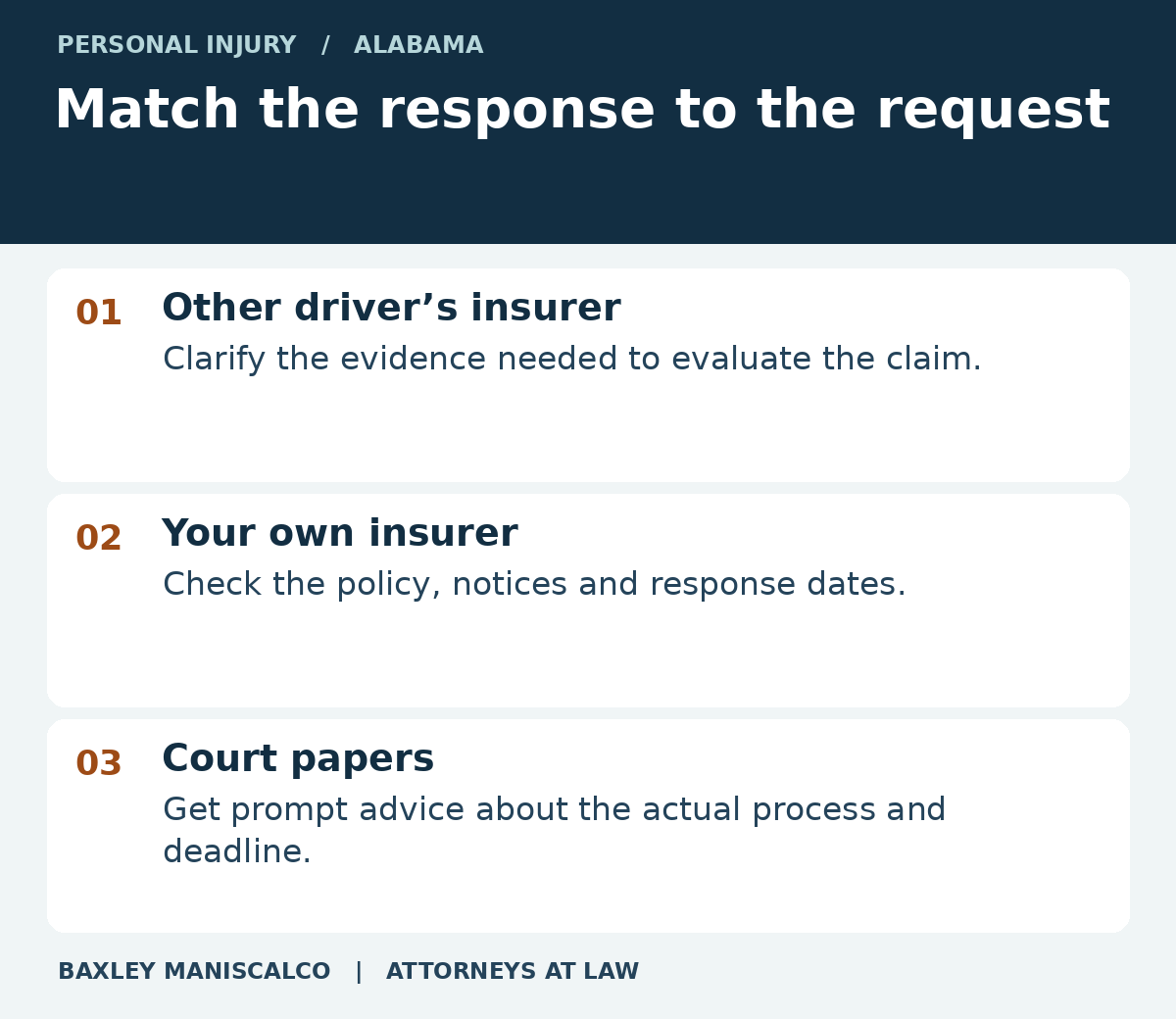
A request from the other driver’s liability carrier is different from a request for benefits under your own policy. Your own insurer may point to cooperation provisions, proof requirements or response dates. Don’t ignore the letter because a friend was told not to sign a different company’s form in a different claim.
Ask for the relevant policy language, the claim number and a clear description of what’s missing. If time is short, raise the issue promptly and get any extension confirmed in writing. Our guide to dealing with insurance adjusters in Alabama can help you prepare for that conversation.
A subpoena or court order belongs in a different pile altogether. HHS distinguishes court orders from subpoenas and explains the conditions under which a covered provider may disclose records. Send legal papers to your lawyer promptly. Declining a voluntary authorization doesn’t resolve formal discovery, and a privacy objection doesn’t give you permission to miss a deadline.
Already signed? Find out what actually happened
First, get the signed version, including the date, recipients and any instructions for revocation. Ask which providers received it, which requests are pending and what has already been disclosed. There’s a meaningful difference between a form in an adjuster’s inbox and records that were delivered last week.
HIPAA authorizations can generally be revoked in writing, subject to exceptions, including action already taken in reliance on the authorization. Revocation is prospective in that respect. It doesn’t pull back records already released. Ask for advice about the recipients to notify and how a change would affect an outstanding claim or policy obligation.
If the problem is an inaccurate medical entry, changing the authorization won’t correct the chart. Note the exact date and passage, then ask the provider about its amendment process. Preserve the original record. Never delete pages from a document and present the remainder as a complete record.
Frequently asked questions
How far back can the other driver’s insurer look?
There isn’t one lookback period that fits every injury claim. Review what the authorization permits, why earlier history is being sought and whether a different process, policy term or court order applies.
Can I request and send my own records?
Often, yes. Patients generally have rights to access records under HIPAA’s individual access rule, subject to exceptions. Confirm which materials the insurer needs and whether it will accept them that way.
Does signing a medical authorization settle my case?
An authorization to disclose records serves a different purpose from a settlement release. Read the entire packet: A single electronic envelope can contain both documents or other agreements.
What if I had the same symptoms before the crash?
Tell your lawyer and treating professionals accurately. Records documenting your prior condition and functioning can help distinguish what already existed from what changed. Don’t conceal relevant history.
Do I have to sign while I’m on the phone?
Ask for the complete form and the actual response deadline. If the request involves your own policy or legal papers, get prompt advice rather than assuming there’s no time limit.
What should I bring if I’m worried about privacy?
Bring the form, the adjuster’s explanation, the relevant policy correspondence and a list of providers. You can start the conversation without emailing your entire medical history.
Get clear on the request before you sign
It’s reasonable to want your claim evaluated and your unrelated medical history kept private. Start with the form in front of you and the specific question the insurer says it needs answered.
You don’t have to untangle the wording alone. Reach out to Baxley Maniscalco or call (256) 770-7232. We’ll help you understand what you’ve been asked to share and what options are worth discussing.
Can't find what you're looking for? Search our site below.