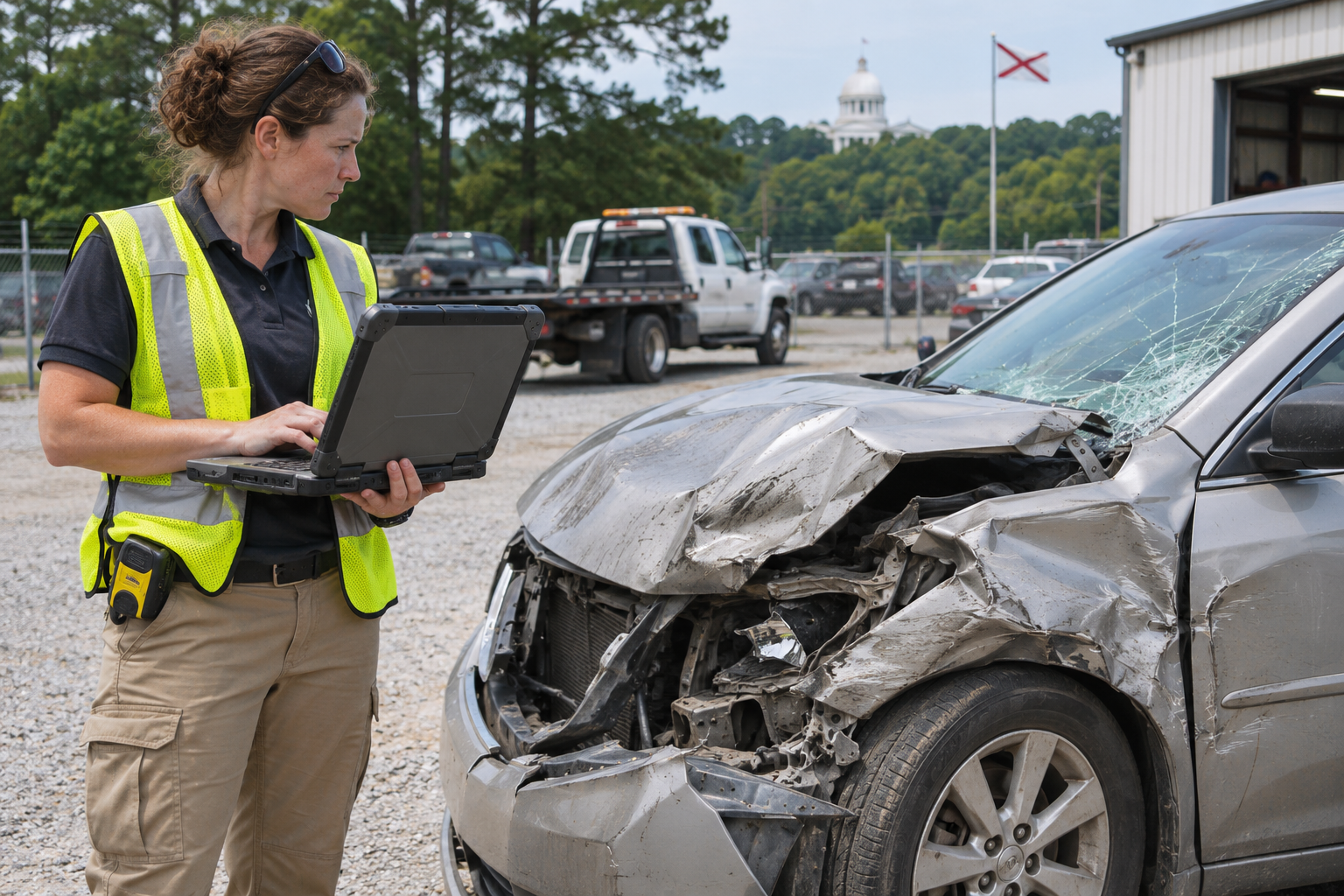
You call the tow yard to get your sunglasses out of the glove box. That’s when you learn your totaled car is leaving for a salvage auction. You’ve taken pictures of the damage. Is there anything else worth keeping?
Possibly. A vehicle’s event data recorder, often called a car black box, may hold a short record of what the vehicle was doing around impact. If injuries or fault are disputed, ask about preserving the car and its electronic evidence before a sale, dismantling or transfer. Don’t try to remove a module yourself.
Have a pickup date but no clear answer about inspection? Contact our Alabama car accident team or call (256) 770-7232 for a free consultation. Tell us when the move is supposed to happen.
What might a car’s black box actually know?
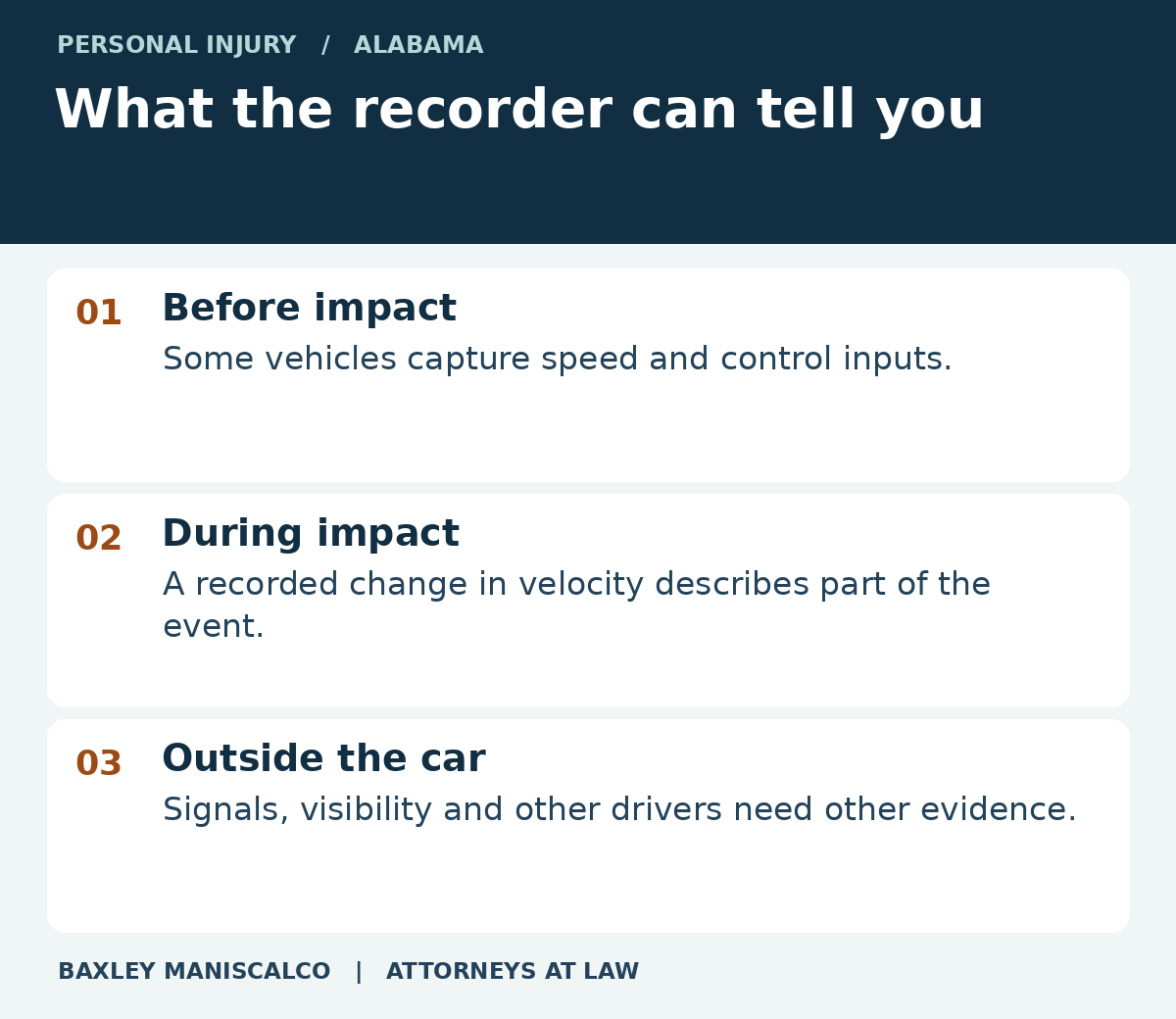
An event data recorder, or EDR, records certain vehicle measurements associated with a qualifying event. Depending on the vehicle and the event, the information can include indicated speed, accelerator position, whether the service brake was on, and a change in velocity during impact. Federal EDR regulations distinguish required data elements for covered vehicles equipped with EDRs from additional items recorded under specified conditions.
Think of a spreadsheet with several columns and a short series of time samples. That’s closer to what an investigator may receive than a movie of the collision. “Brake on” isn’t a picture of someone’s foot. A sample of vehicle speed isn’t a measurement of the other driver’s speed, and change in velocity during impact isn’t the speed the car was traveling before impact.
A recorder won’t tell you the traffic light was green, that a delivery van blocked your view or who was looking at a phone. A dashcam, a nearby business camera or a witness may answer those questions. If the car has a dashcam, mention it separately. Asking somebody to preserve “the black box” may not alert them to a removable memory card.
When is it worth asking for the data?
Suppose two drivers agree that a collision happened at an intersection but disagree about whether one vehicle was stopped. Data from the relevant vehicle might help assess that narrow question. It still takes vehicle identification, timing, physical evidence and a qualified interpretation to connect a recorded event to this particular crash.
Now suppose everyone agrees the car was parked and unoccupied when it was struck. If there’s good video and the dispute is solely about a replacement door, a specialist’s retrieval may add little. Before paying for an inspection, ask what question the examiner would try to answer and how the answer might affect the claim.
The strongest reason to act early isn’t that every crash needs an expert. It’s that an avoidable transfer can take the choice out of your hands. A lawyer may be able to assess the need quickly if you have the vehicle identification number, the lot’s contact details and the actual date of the next move.
The call to make before the car leaves
Start with the people who know where the vehicle is. The towing company, collision shop and insurer can play different roles. The adjuster handling your medical claim may never see the instructions issued by the person handling the total loss. Don’t assume one call puts everyone on notice.
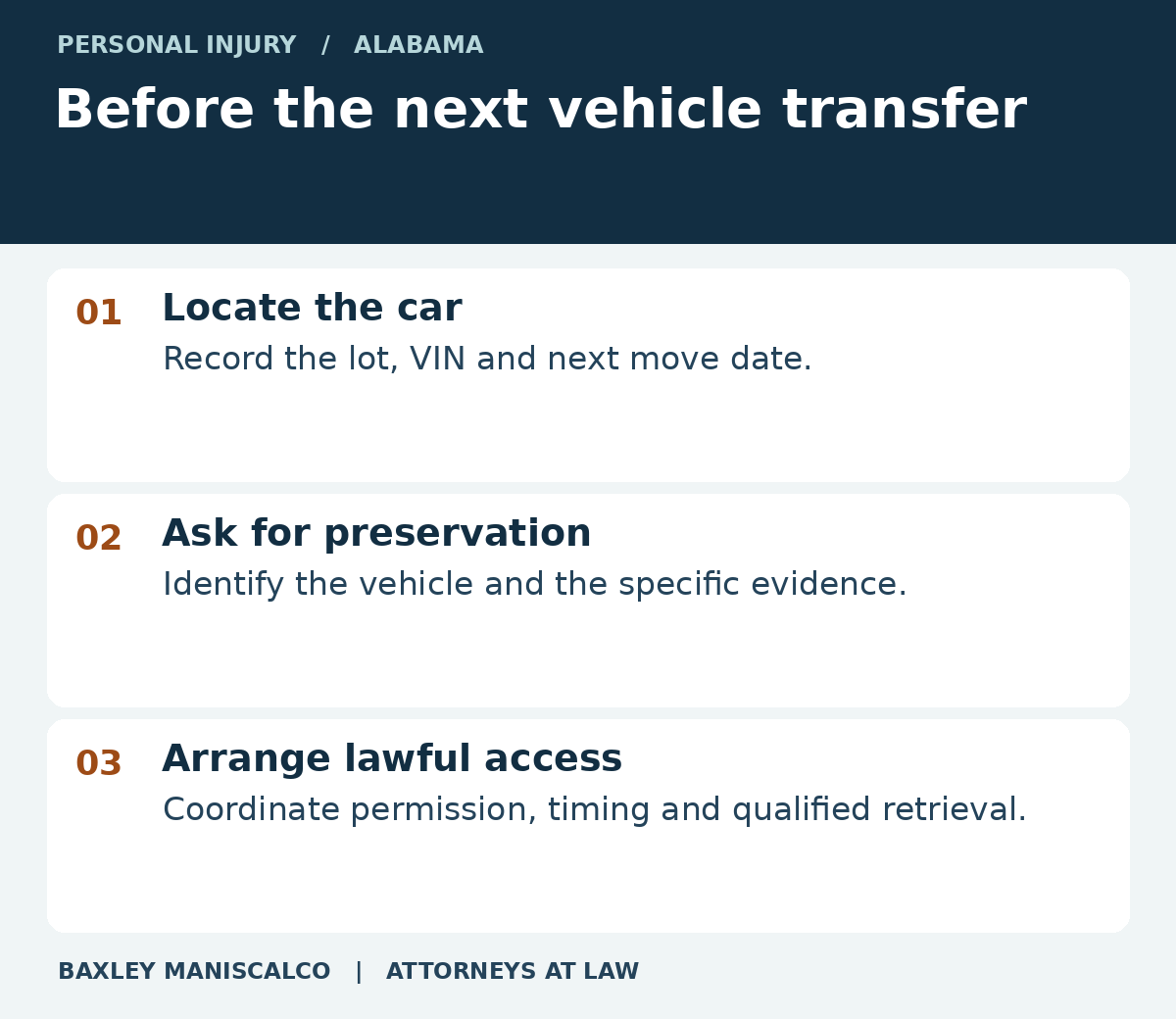
- Locate the exact vehicle. Write down the VIN, year, make, model, current lot address and lot or stock number. Ask whether the car has already moved once.
- Pin down the next event. Is it a transfer between storage locations, a title transfer, an auction or dismantling? Get the date, the destination if known and a contact person.
- Communicate the concern in writing. Identify the vehicle and explain that it may contain evidence relating to an injury claim. Ask what can be held, for how long and who has authority to confirm that arrangement.
- Ask about cost and access. Storage fees can continue while people exchange emails. Find out who is paying, whether inspection requires an appointment and what documentation the facility needs.
If the yard says “we’ll make a note,” ask what that means. Was the transporter actually told to wait? Has the auction date changed? Write down the name and time and request confirmation. A request is useful, but it isn’t automatically a binding hold, permission for an examiner to enter the yard or a promise that storage is free.
Who owns the data, and who can retrieve it?
Under the federal Driver Privacy Act of 2015, section 24302, EDR data belongs to the owner or, for a leased vehicle, the lessee. The law limits access by others and provides exceptions, including qualifying owner or lessee consent and access authorized by a court or other appropriate authority under specified conditions.
Possessing the keys, paying the tow bill and having authority to retrieve the data aren’t the same thing. A passenger who was badly hurt may have good reason to seek preservation without owning the vehicle. Similarly, you can’t authorize a technician to inspect the other driver’s car merely because you believe it caused the crash.
Let counsel coordinate with the proper parties, particularly if title is changing or the vehicle was borrowed or leased. Keep copies of any permission and the resulting report. Ask who performed the retrieval, which vehicle and module were examined, and whether the original data file is being retained along with the readable report.
If the answer comes back “no data”
Ask what that answer means. Was the vehicle equipped with a supported recorder? Was there a recorded event that could be tied to this impact? Was the equipment too damaged to read by the method attempted? Those explanations are different. The absence of a report doesn’t establish that nobody braked or that the crash was too minor to cause harm.
Return to the physical scene. Original photographs, witness contact information, tow records and time-stamped video can still help. Compare the vehicle damage with what the drivers said, and keep the medical timeline as its own part of the case. Our guide to crash evidence walks through other ways to document what happened.
Frequently asked questions
Is every modern car recording my entire drive?
Don’t assume that. An EDR captures event-related data, not a continuous video diary. Navigation, cameras, a phone and connected-car services are separate systems with different capabilities.
Can the recorder show the color of the light?
An EDR report generally won’t answer that. Identify nearby cameras and witnesses promptly. Their evidence may explain what was happening outside the vehicle when the recorder captured its measurements.
Do I have to refuse a total-loss payment?
Not automatically. Ask how the proposed payment, title paperwork, storage arrangement and inspection fit together. Get advice before assuming either that you must refuse payment or that signing won’t affect access.
Can I plug in a scanner at the tow yard?
A diagnostic trouble-code scan isn’t the same as a forensic crash-data retrieval. Get lawful access and a qualified examiner rather than experimenting on a damaged vehicle or disturbing potential evidence.
What if my car has already gone to auction?
Get the stock number, transfer date, auction contact and any title documents. Promptly ask counsel about tracing the vehicle and preserving remaining evidence. Moving the car doesn’t prove that the data is gone.
Is the download enough to win an injury case?
No. A measurement can support or undermine a specific account. It won’t decide every issue of duty, fault, causation or damages, and it won’t replace medical evidence.
Start with the next move date
If you only have time to make one note today, record where the car is and when it’s expected to leave. That’s the information someone needs to make a useful call on your behalf.
If the salvage process is moving faster than you expected, get in touch with Baxley Maniscalco or call (256) 770-7232. We can help you decide what’s worth preserving while the vehicle is still within reach.
Can't find what you're looking for? Search our site below.