

You’ve separated, but the holiday shopping account hasn’t. A few gifts, a travel booking and several buy-now-pay-later installments are about to turn into January bills.
Who pays? In an Alabama divorce, the answer requires two separate questions: who is responsible to the creditor, and how should responsibility be divided between the spouses? Moving into separate homes doesn’t automatically settle either one.
We help clients work through that distinction in our Alabama divorce practice. Before Black Friday adds another layer to the finances, it’s worth understanding what you’re actually sharing.
Concerned about holiday spending during a separation? Contact us or call (256) 770-7232. We can review the accounts and any existing orders with you.
Does Separating Automatically Separate Your Credit Card Debt?
No. Living apart doesn’t rewrite a credit agreement. If you’re a joint borrower, the issuer may still look to you for payment even when your spouse made the purchases.
The Consumer Financial Protection Bureau’s guidance on debt after divorce explains that a divorce decree allocating a debt doesn’t automatically remove a borrower’s obligation to the creditor.
Account status matters. A joint account holder and an authorized user aren’t the same thing. An authorized user is generally not personally responsible for the balance simply because they were permitted to use the card.
Don’t rely on whose name is printed on the plastic. Request the agreement or confirmation of each person’s legal role from the issuer, and retain the response.
How Do Alabama Courts Divide Debt Between Spouses?
Alabama divorce courts consider the financial circumstances and equitable division of the marital estate. Equitable doesn’t necessarily mean every account is divided into equal halves.
In A.M. v. M.G.M., the Court of Civil Appeals reviewed debt allocation as part of the overall property division. The decision illustrates that debts need to be considered alongside assets and the broader financial arrangement.
For new holiday charges, useful questions include when the debt arose, what it purchased, who benefited and whether the spending complied with existing orders. Those details help us evaluate the issue; they aren’t a promise of a particular allocation.
Buying the children’s coats, paying for ordinary household needs and funding an expensive solo vacation aren’t identical facts. A credit card statement that says only “department store” may hide those differences.
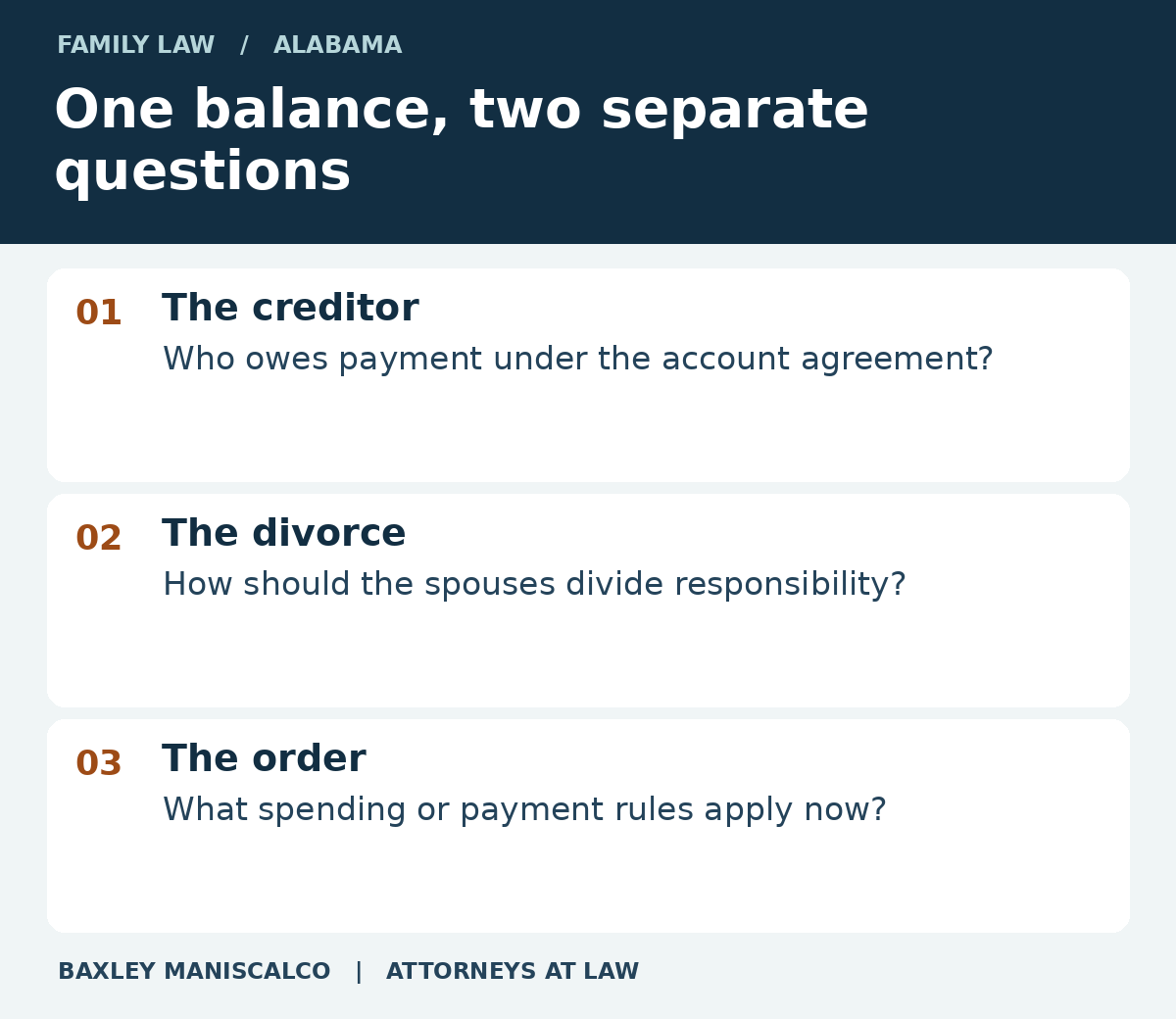
Check Temporary Orders Before Changing the Accounts
If a divorce case is pending, review every temporary order or standing order that applies. There may be requirements about bill payments, access to funds, asset transfers or unusual spending.
Don’t assume that filing for divorce automatically freezes every credit card. Don’t assume you can safely close an account, stop payments or remove access without checking the governing requirements, either.
Ask us to review the actual paperwork before making a major change. If new borrowing is a concern, we can discuss appropriate requests for temporary relief and practical steps consistent with the order.
An informal separation also differs from a court decree of legal separation. Our guide to legal separation in Alabama explains that distinction. Tell us whether you simply moved apart or already have a signed court order.
The goal is to prevent new confusion while maintaining required payments and access to necessities. A sudden financial cutoff can create problems that a clear interim arrangement might avoid.
Build a Holiday Spending Record Before the Balance Grows
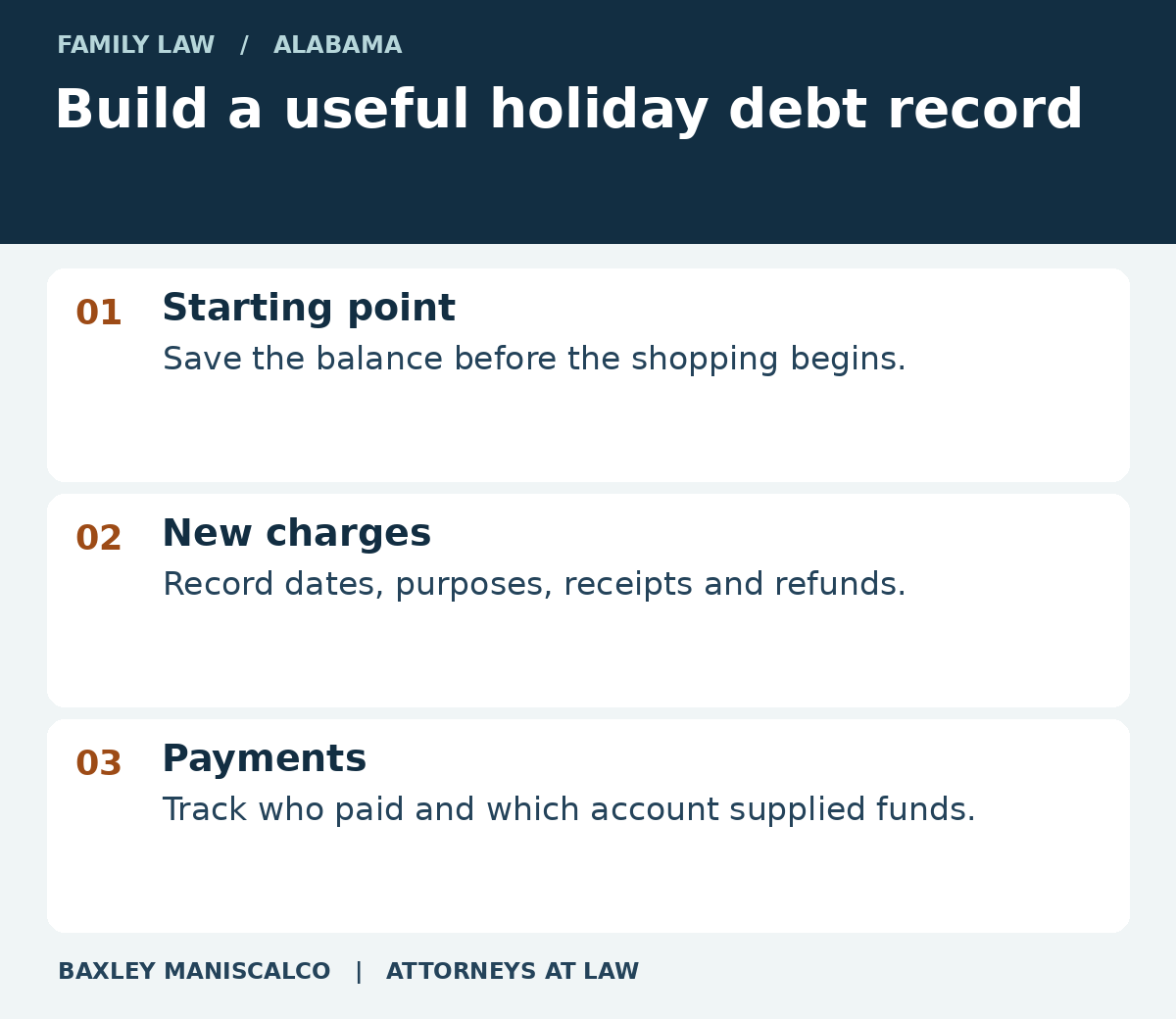
Start with a statement showing the balance before the new purchases. Then separate existing debt from later charges, fees, payments and refunds.
Keep a simple record for each account:
- Account responsibility: Identify the borrower, any joint borrower and any authorized users.
- The starting balance: Save a dated statement around the relevant separation or court-order date.
- New purchases: Keep the receipt, transaction date, amount and a brief description of the purpose.
- Payments and refunds: Record what was paid or returned and where the money went.
- The order: Note any provision addressing that account or category of spending.
Use information you’re authorized to access. Don’t guess passwords, enter a spouse’s private account without permission or alter records to make the timeline look better.
If an important statement isn’t available to you, tell us what’s missing. Formal requests during the divorce process may be appropriate.
A Holiday Purchase Can Look Different on the Statement
Imagine a hypothetical $900 department-store charge after separation. Part bought necessary winter clothing for the children. Part bought gifts for relatives. The rest bought an item later returned.
Looking only at the $900 total misses the purpose of the purchases and the refund. Keep the itemized receipt and the return confirmation, not just the account balance.
Now add a shared agreement: each parent said they’d contribute $100 toward a child’s present. That agreement may help explain the spending, but it doesn’t automatically bind the credit card issuer or replace a court order.
Write down the agreed budget before purchasing. Identify the item, each contribution and how a return would be handled. Avoid broad promises such as “I’ll cover Christmas” when you actually mean one present.
Buy-now-pay-later plans deserve the same attention. List the actual borrower, remaining installments and due dates. A purchase can create several future bills even if only the first installment appears in this month’s bank activity.
What If Your Spouse Is Running Up the Balance?
Bring the statements and your concern to us promptly. We need to distinguish ordinary living expenses, disputed purchases, possible misuse and charges that may violate an order.
Avoid responding with a spending spree of your own or stopping every payment in protest. Late fees and credit consequences can complicate the problem while doing little to resolve responsibility.
Ask the issuer what account-control options are available, and coordinate any action with the applicable court orders and legal advice. Report suspected unauthorized transactions accurately; a purchase you dislike isn’t automatically fraud.
The Office of the Comptroller of the Currency likewise distinguishes the divorce decree from obligations under a joint credit agreement. That’s why both the family-law issue and the account itself need attention.
Frequently Asked Questions About Holiday Debt During Separation
Am I Responsible for Every Purchase My Spouse Makes?
Not automatically. Your liability to a creditor depends on the agreement and applicable law, while allocation between spouses is a separate divorce issue. Account ownership, the transaction and any court orders all matter. Don’t decide from the cardholder’s name alone.
Does Spending After We Move Apart Automatically Become Separate Debt?
Don’t assume that the move-out date resolves every new charge. The purpose, account terms and governing orders still need review. Keep dated records so we can distinguish existing balances from later borrowing and evaluate the particular circumstances.
Does a Divorce Order Remove My Name From a Joint Card?
No. Assigning payment responsibility between spouses doesn’t itself release a borrower from the creditor’s contract. An issuer-approved release, payoff or another appropriate account change may be needed. Confirm the creditor’s position rather than relying only on the decree.
Can I Close the Card Before Black Friday?
Possibly, but first review your authority and any temporary or standing orders. Ask the issuer about available options and the effect on existing balances or recurring bills. Closing an account doesn’t erase its debt, and a court order may limit unilateral changes.
Is an Authorized User the Same as a Joint Borrower?
No. Those roles carry different responsibilities. An authorized user is generally not liable merely because they can use the card, while joint borrowers may both be responsible under the agreement. Ask for confirmation of your actual status if the account history is unclear.
Should I Include Buy-Now-Pay-Later Purchases in Divorce Records?
Yes. List outstanding installments and the agreement, even if the purchase doesn’t appear as a traditional credit card balance. Save receipts and refunds too. Accurate records help prevent a small initial payment from obscuring a larger remaining obligation.
Start the Season With a Clearer Financial Plan
You don’t have to settle the whole divorce before buying a present. But understanding the accounts, current orders and available budget can prevent avoidable disputes.
We can help you organize the questions and decide what needs attention now. Bring the statements and orders you have, even if the finances still feel tangled.
Let’s talk through the holiday spending before the January bills arrive. Contact us or call (256) 770-7232 to discuss your next step.
Can't find what you're looking for? Search our site below.