
Over 40 percent of children in Alabama grow up in single-parent households, a figure that outpaces the national average by a wide margin and speaks to the volume of custody arrangements, divorce settlements, and support orders processed through the state's courts each year.
In Calhoun County alone, the Circuit Court in Anniston handles a steady stream of domestic relations filings from residents living in Oxford, Jacksonville, Piedmont, Weaver, Hobson City, and the rural communities that fill the county's 606 square miles.
Each filing represents a family at a turning point, and the legal decisions made during that period carry consequences that last for years or even decades.
This page is designed as a practical resource for anyone exploring family law services in Calhoun County.
It walks through the main areas of practice, explains how Alabama statutes apply locally, and answers the questions that come up most often when people are weighing their options.
The goal is to give you a clear picture of the legal landscape so that when you do sit down with an attorney, you already have the background you need to have a productive conversation about your case.
The Legal Framework That Governs Family Matters in Calhoun County
Anyone seeking family law services in Calhoun County should understand that every case filed here operates within a framework set by the Alabama Legislature and refined by appellate court rulings over many decades.
Title 30 of the Alabama Code is the primary body of statute law covering marriage dissolution, custody, visitation, child support, and spousal maintenance.
Title 26 governs adoptions, termination of parental rights, and related child welfare proceedings. Together, these statutes create the rules that Calhoun County judges apply when making decisions about local families.
Alabama permits both no-fault and fault-based divorce. No-fault filings cite incompatibility or an irretrievable breakdown of the marriage, while fault-based filings may allege grounds such as adultery, habitual intoxication, cruelty, or abandonment.
The distinction matters because fault can influence how the court handles property division and alimony. Alabama also imposes a 30-day cooling-off period between the filing of a divorce complaint and the earliest date a judge can sign a final decree.
For custody, Alabama has long used the "best interests of the child" standard, but the passage of House Bill 229 has reshaped how that standard is applied.
Under HB 229, courts now begin with a rebuttable presumption that joint legal and physical custody serves children best, and judges who depart from that presumption must explain their reasoning in writing.
This shift has changed how attorneys build their cases and how parents prepare for hearings in Calhoun County and throughout the state.
Meet our Family Law Attorneys

Alyssa Enzor Baxley, experienced trial attorney and active community member.

Syndey Merrin focuses her practice on family law matters in Calhoun County.

Adam Maniscalco, experienced trial attorney and Deputy Attorney General.
Divorce in Calhoun County: Two Distinct Tracks
Divorce filings in Calhoun County follow one of two general tracks, and which one applies depends on whether the spouses can agree on the terms of their separation.
Understanding the difference early in the process helps set realistic expectations about cost, timeline, and the level of court involvement required.
When Both Sides Agree: the Uncontested Path
An uncontested divorce means the spouses have reached a full agreement on every issue before the case is submitted to the court. That includes the division of assets and debts, any alimony arrangement, and, when children are involved, a parenting plan that covers custody, visitation, and support.
Because there is nothing for the judge to decide, these cases move through the Calhoun County court system relatively quickly.
Once the 30-day waiting period expires, the judge reviews the settlement agreement, confirms it is fair, and signs the final decree. For many families, this is the least disruptive and most affordable way to end a marriage.
When Disputes Remain: The Contested Path
A contested divorce occurs when at least one significant issue remains unresolved. The disagreement might center on who keeps the family home, how retirement accounts should be split, whether alimony is warranted, or which parent should have primary custody.
Contested cases in Calhoun County can involve formal discovery, depositions, expert appraisals of property or businesses, and court-ordered mediation before they ever reach a trial setting. Common points of contention include:
- Real estate, retirement funds, and business assets, particularly when the couple disagrees about what qualifies as marital versus separate property or what a business or professional practice is worth.
- Spousal support obligations, where one party requests ongoing financial assistance and the other argues it is unnecessary or excessive given the circumstances.
- Parenting arrangements and custody designations, which tend to generate the most conflict and often require the court to appoint a guardian ad litem or order a custody evaluation.
- Monthly child support amounts, which are calculated under Alabama's Income Shares Model but can still be disputed when income is difficult to verify or when parents disagree about expenses.
Contested cases in Calhoun County typically take anywhere from six months to well over a year to reach a final resolution, and the more complex the finances or the more contentious the custody dispute, the longer the timeline tends to stretch.
Custody Disputes and How Calhoun County Courts Evaluate Parenting Arrangements
When it comes to family law services in Calhoun County, custody is almost always the issue that carries the most emotional weight. A custody order dictates where a child sleeps, who makes medical and educational decisions, and how holidays and school breaks are divided.
Alabama separates these decisions into two categories: legal custody, which covers decision-making authority, and physical custody, which determines the child's primary residence and day-to-day living arrangements.
A court can award either type jointly or solely, and the combinations vary widely depending on the facts of each case.
What Judges Look at When Deciding Custody
Calhoun County judges apply the same best-interest factors outlined in Alabama statute and case law, though each judge may weigh individual factors differently based on the evidence presented. The central considerations in most custody cases include:
- Who has been the primary caregiver, meaning the parent who has historically handled daily responsibilities like meals, bedtime routines, homework help, and medical appointments.
- Stability in the child's current environment, including whether a proposed custody arrangement would require the child to change schools, leave behind friends, or adjust to an unfamiliar neighborhood.
- Physical and mental fitness of each parent, evaluated in terms of whether either parent has conditions or behaviors that could impair their ability to provide consistent, responsible care.
- Evidence of abuse, neglect, or substance issues, any of which triggers a legal presumption against custody for the parent involved and can dramatically limit visitation rights.
- The child's expressed wishes, which carry more weight as the child matures but are never the sole determining factor regardless of age.
- Cooperative parenting ability, meaning each parent's demonstrated willingness to encourage and facilitate the child's relationship with the other parent rather than undermine it.
These factors do not operate in isolation. A parent with a strong caregiving history may still face an unfavorable ruling if there is credible evidence of substance abuse or domestic violence.
Conversely, a parent who has been less involved in day-to-day care may receive joint custody if they can demonstrate fitness, stability, and a genuine commitment to co-parenting.
What HB 229 Means for Calhoun County Parents
House Bill 229 changed the default starting point in Alabama custody proceedings. Rather than leaving custody entirely to judicial discretion, the law now presumes that joint legal and physical custody is in a child's best interest.
The statute defines "frequent and substantial contact" as equal or approximately equal parenting time.
Every custody filing now requires a detailed parenting plan, regardless of whether the parents are seeking joint or sole custody. And when a judge decides that joint custody is not appropriate, the order must include specific written findings explaining why.
For Calhoun County families, this means the parent opposing joint custody now bears the burden of presenting evidence that shared parenting would not serve the child well.
It also means that parenting plans are more detailed and more important than ever, since they now serve as the operational blueprint for how children move between households.
How Child Support Works in Calhoun County
Among the most common reasons people seek family law services in Calhoun County is child support.
Alabama determines child support using the Income Shares Model, a formula-based system that estimates what both parents would collectively spend on the child in an intact household and then allocates that cost proportionally based on each parent's gross income.
The model factors in health insurance premiums paid on behalf of the child, work-related daycare costs, and the parenting time split between households.
Calhoun County judges are required to follow these guidelines, though they retain limited discretion to deviate when the standard calculation would produce an unjust result.
Once a support order is entered, enforcement falls to a combination of the Alabama Department of Human Resources and the Calhoun County court system. The state has several tools at its disposal to collect unpaid support, and they escalate in severity depending on the extent of the delinquency:
- Automatic wage withholding, which diverts a portion of the paying parent's paycheck directly to the receiving parent before the money ever reaches a bank account.
- Interception of state and federal tax refunds, redirecting refund payments to cover outstanding child support arrears.
- Suspension of driving privileges and professional licenses, creating practical consequences that motivate compliance.
- Civil contempt proceedings, which can result in fines, mandatory payment plans, or even jail time for parents who willfully refuse to pay.
Attorneys at Baxley Maniscalco serve as deputy attorneys general enforcing child support in Calhoun and Cleburne counties, which gives the firm direct, hands-on familiarity with how the enforcement system operates from the inside.
That perspective benefits clients on both sides of a support dispute, whether they are trying to collect what they are owed or seeking a fair modification of an existing order.
Spousal Support and Alimony Decisions in Calhoun County
Alimony disputes represent another significant category of family law services in Calhoun County. Unlike child support, alimony in Alabama is not determined by a formula. Judges have wide latitude to decide whether spousal support is warranted, how much it should be, and how long it should last.
This makes alimony one of the least predictable elements of a Calhoun County divorce, and it is often one of the most heavily negotiated terms in a settlement agreement.
Alabama courts weigh several considerations when evaluating a request for alimony:
- Duration of the marriage, since longer marriages tend to produce stronger alimony claims, particularly when one spouse sacrificed career advancement to support the household.
- Disparity in earning power, focusing on each spouse's current income, education level, work experience, and realistic prospects for future employment.
- Marital standard of living, which establishes the financial benchmark that the court tries to preserve, at least partially, for the lower-earning spouse.
- Non-financial contributions, including years spent raising children, managing the household, or supporting the other spouse's career or education.
- Health and age of both spouses, particularly when a medical condition or advanced age limits one party's ability to re-enter the workforce.
The court may award periodic alimony paid monthly for a set duration, rehabilitative alimony intended to fund education or job training so the receiving spouse can become self-sufficient, or a single lump-sum payment that resolves the obligation in one transaction.
In some Calhoun County cases, the parties negotiate a combination of these types as part of a broader settlement package.
Building a Family through Adoption in Calhoun County
Adoption is a meaningful component of family law services in Calhoun County. The process permanently transfers parental rights and responsibilities from one set of parents to another, and Alabama law imposes detailed procedural requirements to protect everyone involved, especially the child.
For families in Calhoun County pursuing adoption, the type of adoption determines which court handles the petition and what steps must be completed before the adoption can be finalized.
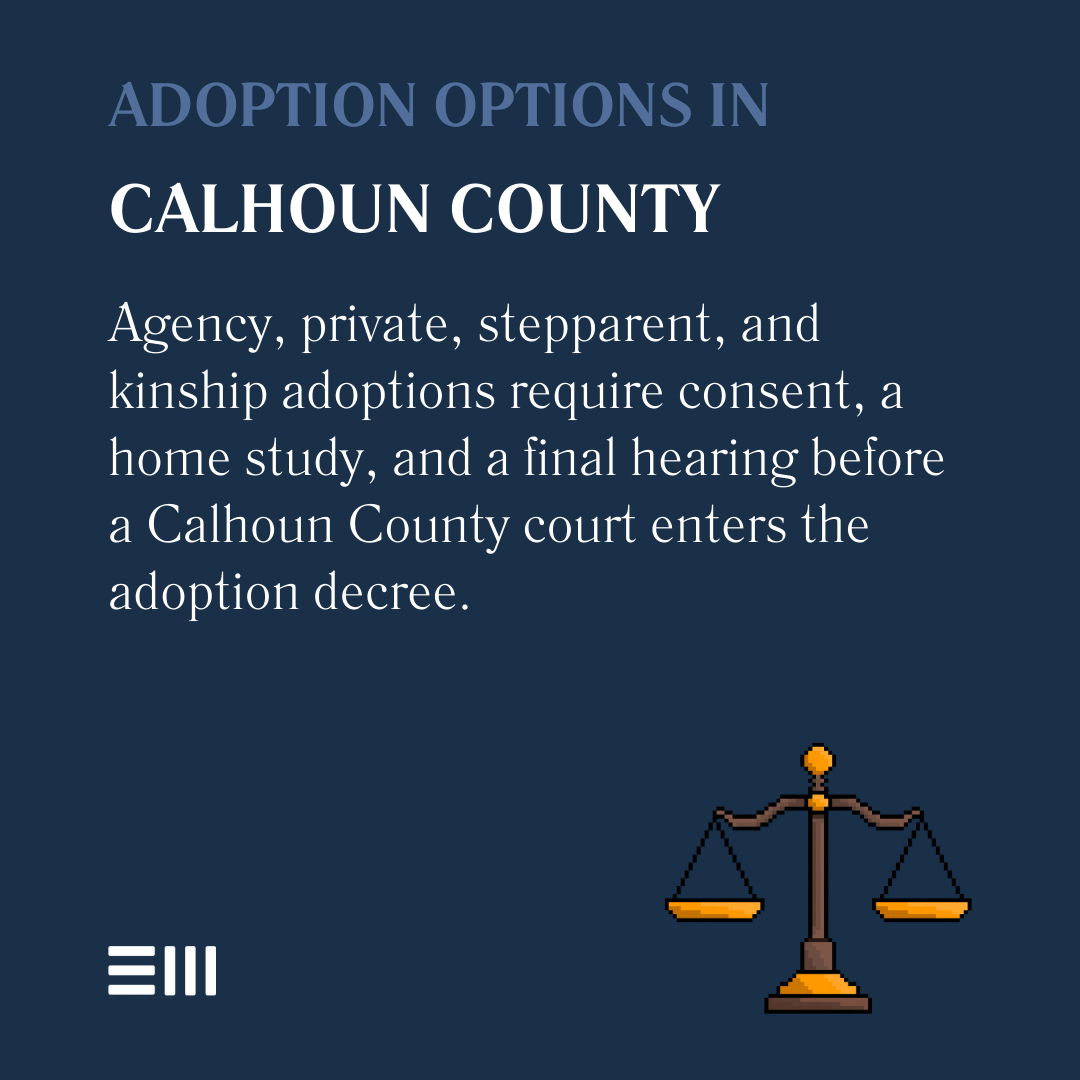
The most common adoption types handled through family law services in Calhoun County include:
- Agency-facilitated adoptions, where a licensed child-placing organization identifies a child, typically from the foster care system, and matches them with qualified prospective parents.
- Independent or private placements, in which birth parents select the adoptive family directly, often with an attorney coordinating the legal paperwork and consent process.
- Stepparent adoptions, one of the most frequently filed adoption types, where a spouse formally adopts their partner's child from a previous relationship to establish legal parent-child status.
- Kinship or relative adoptions, which formalize an existing caregiving arrangement by granting legal parental rights to a grandparent, aunt, uncle, or other family member.
Every adoption in Alabama requires a home study, the legal consent of biological parents or a court order terminating their rights, and a final hearing where the judge enters the adoption decree.
Depending on the adoption type, the petition may be filed with the Calhoun County Probate Court or the Circuit Court.
An attorney who regularly handles adoptions in Calhoun County can help navigate the specific filing requirements and ensure that no procedural misstep delays the finalization.
Domestic Violence Protections and Their Role in Family Law Cases
Domestic violence protections are an integral part of family law services in Calhoun County. Abuse is not a separate area of law in Alabama so much as it is a factor that cuts across nearly every type of family law dispute.
When abuse is present, it affects how courts handle custody, visitation, property division, and even the physical safety of parties during litigation.
Alabama's Protection from Abuse Act gives victims a mechanism to seek immediate legal protection, and Calhoun County courts take these petitions seriously.
A victim can file for an emergency protection order through the Calhoun County Circuit Court. If the court finds evidence of immediate danger, it can issue a temporary order the same day, before the accused party has an opportunity to respond.
A full evidentiary hearing follows within 10 days, at which both sides present testimony and the judge decides whether to issue a final protection order lasting up to 12 months. Renewal is available if the threat persists.
In custody disputes, a finding of domestic violence triggers a rebuttable presumption that awarding custody to the abusive parent would not serve the child's best interest. The abusive parent must then produce evidence sufficient to overcome that presumption, which is a high bar.
Alabama law further provides that a parent who relocated to escape abuse cannot be penalized for that decision in a custody proceeding.
These protections mean that domestic violence evidence can reshape the entire trajectory of a family law case in Calhoun County, making early documentation and legal counsel especially important for anyone in an abusive situation.
Resolving Family Disputes outside the Courtroom
Litigation is not the only path through a family law dispute, and for many Calhoun County families it is not the best one.
Mediation and other forms of alternative dispute resolution allow parties to negotiate terms in a structured setting with the help of a neutral facilitator, often reaching agreements that are more tailored and more durable than outcomes imposed by a judge.
In mediation, a trained mediator guides the conversation and helps both sides identify areas of common ground. The mediator does not issue rulings or take sides.
Calhoun County Circuit Court judges frequently order mediation in contested divorce and custody cases before scheduling a trial, and many cases settle during or shortly after the mediation process. The advantages of reaching a mediated agreement include:
- Significantly lower legal costs, because mediation compresses the negotiation timeline and eliminates the expense of trial preparation, witness coordination, and extended courtroom proceedings.
- A faster path to resolution, given that mediation sessions can be scheduled within weeks, while trial dates in Calhoun County may be months out on the court calendar.
- Customized outcomes, since parties in mediation can craft arrangements that address their family's specific needs in ways that a judge, bound by statutory guidelines, may not.
- Less damage to the co-parenting relationship, as the collaborative tone of mediation stands in contrast to the adversarial nature of a courtroom hearing, which tends to deepen conflict rather than resolve it.
That said, mediation is not a fit for every situation. Cases involving domestic violence, active substance abuse, or extreme power imbalances between the parties may require the structure and protections that only a courtroom proceeding can provide.
Alabama data suggests that mediation resolves family disputes roughly half the time, which means the other half of contested cases still require a judge to make the final call.
The Advantage of Working with Attorneys Rooted in Calhoun County
Alabama law is the same whether a case is filed in Calhoun County, Jefferson County, or Mobile County. But the practical reality of how cases move through the system varies meaningfully by jurisdiction.
Each county has its own bench of judges with individual tendencies, its own scheduling rhythms, its own pool of mediators and guardians ad litem, and its own unwritten courtroom expectations that can catch an unfamiliar attorney off guard.
When choosing among providers of family law services in Calhoun County, local experience matters. An attorney who has spent years practicing here knows the local landscape in a way that cannot be replicated by reading the rules alone.
They know which mediators are most effective for specific types of disputes. They know how the local judges have ruled on contested alimony questions or parenting time splits in the past.
They know the clerks, the court reporters, and the DHR case managers who will be involved in the process.
That kind of embedded familiarity translates directly into better preparation, sharper strategy, and fewer surprises for the client.
Calhoun County's legal community is tightly connected, and the relationships that attorneys build within that community over time serve their clients in ways that are difficult to quantify but easy to recognize.
When complications arise or when a case needs to move quickly, those relationships make a difference.
Frequently Asked Questions about Family Law Services in Calhoun County
Below are the questions that Calhoun County residents ask most frequently when they begin considering family law representation. While every case is different, these answers provide a useful starting framework for understanding the process.
How Long Does It Take to Finalize a Divorce in Calhoun County?
Alabama mandates a 30-day minimum between filing and finalization. An uncontested divorce with all paperwork in order can wrap up shortly after that window closes.
Contested cases are a different story entirely.
Depending on the number of unresolved issues, the need for discovery or expert evaluations, and the court's scheduling availability, a contested divorce in Calhoun County can take anywhere from six months to more than a year to conclude.
What Is the Difference between Legal Custody and Physical Custody?
Legal custody is about decision-making authority. The parent with legal custody has the right to make choices regarding the child's schooling, medical treatment, religious instruction, and participation in activities.
Physical custody determines the child's primary residence. Alabama courts can award sole or joint versions of either type independently, so it is possible for parents to share legal custody while one parent serves as the primary physical custodian.
Can a Child Support Order Be Changed after It Is Entered?
Yes, but only when a material change in circumstances justifies recalculation. Qualifying changes include a significant increase or decrease in either parent's income, a shift in the custody arrangement, new medical or educational expenses for the child, or the emancipation of one of the children covered by the order.
The parent requesting the modification files a petition with the Calhoun County Circuit Court and bears the burden of proving that the change is substantial enough to warrant a new calculation.
Do Alabama Courts Give Preference to Mothers in Custody Cases?
They do not. Alabama law is gender-neutral when it comes to custody. Judges evaluate both parents against the same best-interest factors, and fathers have the same legal standing as mothers throughout the process.
The passage of HB 229 reinforces this principle by establishing a starting presumption that both parents should share custody equally, regardless of gender. The parent who can best demonstrate fitness, stability, and a commitment to co-parenting has the strongest position in court.
What Happens if My Spouse Will Not Cooperate with the Divorce?
One spouse cannot block a divorce in Alabama. If the non-filing spouse has been properly served with the complaint and fails to respond within the required timeframe, the court can enter a default judgment granting the divorce on the filing spouse's terms.
If the non-filing spouse does respond but refuses to negotiate, the case simply proceeds as a contested matter through discovery, mediation, and ultimately trial if necessary.
How Does Alabama Divide Property in a Divorce?
Alabama uses equitable distribution, which means the court divides marital property fairly but not necessarily equally.
Judges look at the length of the marriage, each spouse's financial and non-financial contributions, each party's economic situation going forward, and whether either spouse engaged in conduct that dissipated marital assets.
Property acquired before the marriage, along with gifts and inheritances received by one spouse individually, is generally classified as separate property and excluded from division, unless it has been mixed with marital funds.
Do I Have to Live in Calhoun County to File for Divorce Here?
You must meet Alabama's residency requirement, which mandates that at least one spouse has lived in the state for a minimum of six months before filing.
The case is filed in the county where the defendant lives, where the couple last lived together, or where the plaintiff lives if the defendant resides outside Alabama.
If those criteria point to Calhoun County, the filing goes to the Circuit Court Clerk's office in Anniston.
Can Grandparents Petition for Visitation in Alabama?
Alabama does allow grandparents to petition for court-ordered visitation, but the bar is high. The grandparent must show that visitation is in the child's best interest and that the parent has unreasonably denied access.
Federal constitutional protections give parents broad authority over who spends time with their children, so courts scrutinize these petitions carefully.
In Calhoun County, a grandparent seeking visitation should be prepared to present specific, documented evidence about the existing grandparent-child bond and the harm caused by the denial of contact.
What Should I Expect to Pay for Family Law Representation?
Costs vary widely based on case complexity. A simple uncontested divorce where both parties have already agreed on terms will cost a fraction of what a contested custody battle involving expert witnesses, depositions, and a multi-day trial will require.
Most family law attorneys use either hourly billing or flat fees for defined services. The best way to get an accurate estimate is to schedule a consultation, bring relevant documents, and have a candid conversation with the attorney about the scope of your particular situation.
No list of frequently asked questions about family law services in Calhoun County can substitute for individualized legal advice. The answers above offer general guidance, but the specifics of your case may raise issues that require a deeper analysis by a qualified Calhoun County family law attorney.
Take the First Step with a Team That Fights for Calhoun County Families
Our experienced Calhoun County family law attorneys here at Baxley Maniscalco have spent years representing clients in the Calhoun County courts, building the relationships, the courtroom track record, and the local insight that translate into stronger outcomes for the families we serve.
We take a team-based approach to every case, which means you always have someone available to answer your call, address an urgent issue, or keep you informed about what comes next.
Our attorneys also serve as deputy attorneys general enforcing child support in Calhoun and Cleburne counties. That dual role gives us a perspective on the family law system that few firms can match.
Whether your case involves a contested divorce, a custody modification, a stepparent adoption, or an enforcement action, we bring aggressive advocacy backed by deep familiarity with the local process.
Contact us today to schedule a confidential consultation.
We meet with clients in person at our Oxford, Alabama office, by phone, or by video — whichever option fits your schedule best.