
Every year, thousands of Alabama families find themselves at a crossroads—facing divorce, custody battles, or disputes over child support.
With the state reporting approximately 3.2 divorces per 1,000 residents annually, Alabama consistently outpaces most of the country in marital dissolution rates, according to national research data.
DeKalb County, nestled in Alabama's northeastern corner with a population exceeding 71,000, encompasses communities from Fort Payne to Rainsville, Fyffe, and Valley Head—each home to families who may eventually require legal assistance to resolve domestic matters.
Our experienced family law attorneys here at Baxley Maniscalco deliver results-driven representation throughout DeKalb County. The county courthouse in Fort Payne, part of Alabama's 9th Judicial Circuit, handles hundreds of divorce and custody cases annually.
From the scenic communities near Little River Canyon to the growing towns along Interstate 59, families across this region turn to skilled advocates when domestic disputes demand legal resolution.
When your family's stability hangs in the balance, partnering with a DeKalb County family law attorney who knows local procedures and personalities makes all the difference in achieving favorable results.
Meet our Family Law Attorneys

Alyssa Enzor Baxley, experienced trial attorney and active community member.

Syndey Merrin focuses her practice on family law matters.

Adam Maniscalco, experienced trial attorney and Deputy Attorney General.
Our DeKalb County Family Law Services
Domestic relations matters span everything from ending marriages to establishing parental rights for children born outside wedlock. Our attorneys handle the complete range of family law issues that DeKalb County residents encounter.
- Contested and uncontested divorce. Whether you and your spouse have reached agreement or face significant disagreements, we manage all aspects of marital dissolution—from initial filing at the DeKalb County Circuit Court on Grand Avenue in Fort Payne through final decree. Explore our detailed guide on how to file for divorce in Alabama.
- Child custody disputes. Alabama presumes joint custody benefits children when both parents can cooperate. We advocate for parenting arrangements that protect your relationship with your children while addressing practical concerns like school schedules and transportation.
- Child support establishment and enforcement. State guidelines under Rule 32 dictate support calculations using both parents' incomes. We ensure accurate figures and pursue enforcement when obligors fall behind. For more details, see how child support works in Alabama.
- Alimony negotiations. Spousal maintenance depends on numerous variables including marriage duration and earning disparities. We present compelling cases for appropriate support—whether you seek alimony or contest an unreasonable request.
- Post-judgment modifications. Job changes, relocations, and evolving family needs sometimes require updating existing court orders. Alabama's McLendon standard sets strict requirements for custody changes that we help clients navigate successfully.
- Paternity and legitimation. Biological fathers seeking rights to their children must establish paternity through the DeKalb County District Court before pursuing custody or visitation.
- Protection from abuse orders. Domestic violence situations demand immediate legal intervention to safeguard vulnerable family members through protective orders and emergency custody arrangements.
Resolving any of these matters requires strategic thinking and thorough preparation. A DeKalb County family law attorney from our team will analyze your circumstances and develop an approach designed to protect your most important interests.
Alabama's Approach to Child Custody
Nothing generates more anxiety during divorce than uncertainty about your children's living arrangements. Alabama courts resolve custody questions by examining what serves each child's welfare—not by defaulting to either parent based on gender or tradition.
The law separates custody into two distinct components. Physical custody addresses where children reside and who manages their daily routines—meals, homework, bedtimes, and transportation.
Legal custody concerns decision-making authority over significant matters: which school they attend, what medical treatments they receive, whether they participate in religious activities, and similar choices shaping their development.
Courts configure these components independently, resulting in various possible arrangements tailored to each family's dynamics.
Alabama Code Title 30, Chapter 2-11 articulates a legislative preference for custody arrangements enabling children to maintain strong bonds with both parents. Judges must consider joint custody in every case, though they retain authority to award sole custody when circumstances warrant.
Factors influencing these determinations include the emotional connections between each parent and child, household stability, parenting history, work demands, and each parent's attitude toward fostering the child's relationship with the other parent.
Once children reach 14, they may express opinions about where they wish to live. Courts consider these preferences but remain free to reach different conclusions if a teenager's stated wishes conflict with their genuine wellbeing.
Read more about when children can influence custody decisions in Alabama.
Navigating Divorce Proceedings in DeKalb County
Ending a marriage launches a legal process with specific requirements that must be satisfied before any court will grant a divorce. Knowing what lies ahead helps you prepare mentally and practically for the journey.
Alabama mandates that the filing spouse establish state residency for at least six months before initiating proceedings.
Petitions go to the DeKalb County Circuit Court in Fort Payne, where the case receives a docket number and begins moving through the system.
The non-filing spouse receives formal notification through service of process—personal delivery, certified mail, or publication when the spouse cannot be located.
Couples may pursue divorce on fault or no-fault grounds. No-fault filings cite incompatibility or irretrievable breakdown without assigning blame to either party.
Fault-based petitions allege specific misconduct—infidelity, desertion, habitual substance abuse, imprisonment, or physical cruelty. While fault findings can impact alimony decisions, proving allegations requires evidence and typically prolongs litigation.
Dividing accumulated assets follows equitable distribution principles rather than automatic fifty-fifty splits.
Judges weigh what each spouse contributed financially and otherwise, how long the marriage lasted, each party's earning potential, and related factors before allocating property and debts.
Inheritances and premarital assets generally remain with their original owner unless commingled during the marriage. Some couples benefit from collaborative divorce approaches that minimize conflict while protecting both parties' interests.
Timeline varies dramatically between cases. Spouses who agree on everything may finalize matters within weeks. Contested proceedings requiring discovery, depositions, and trial preparation can consume a year or longer before resolution.
Spousal Support Determinations
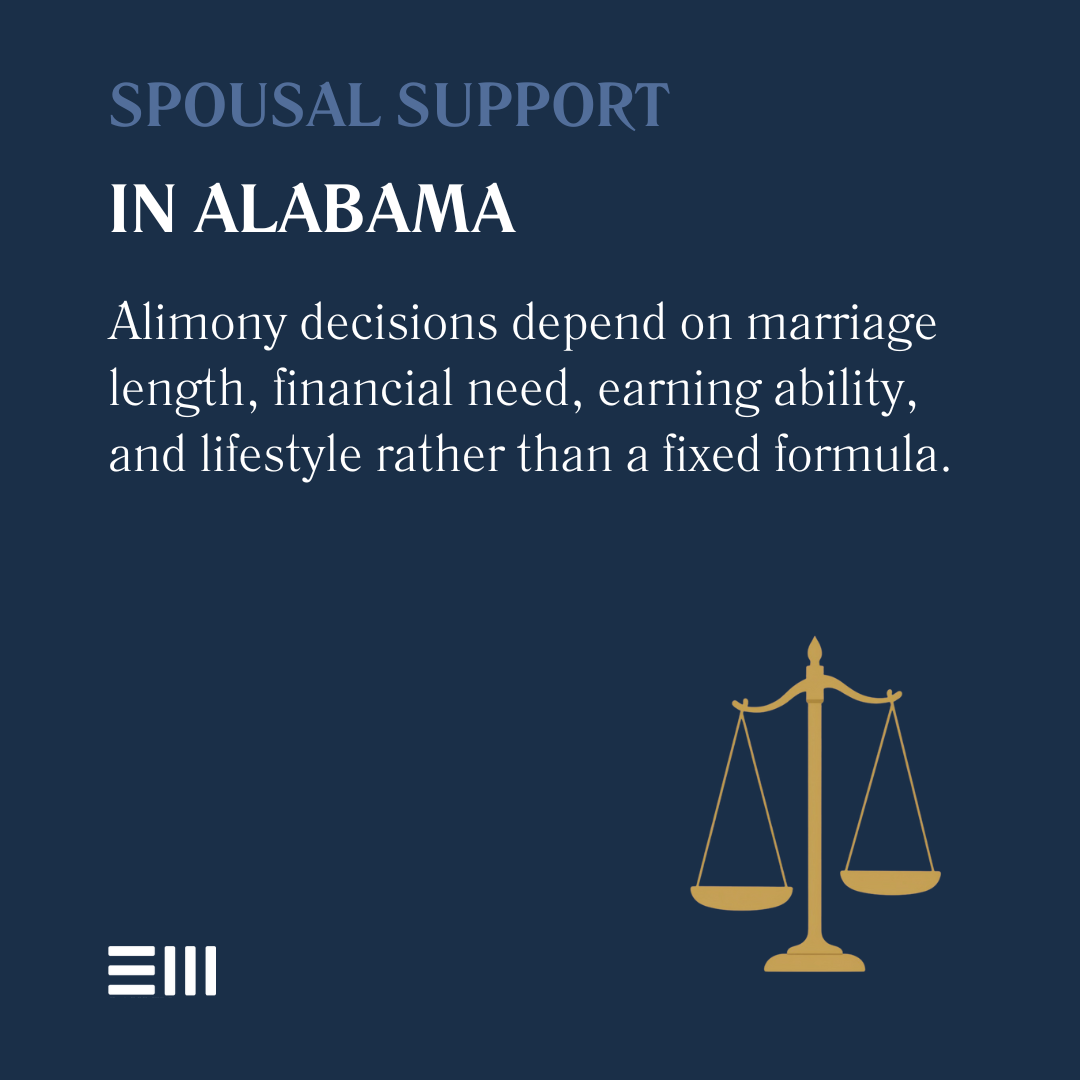
Alabama treats alimony as discretionary rather than automatic—judges award support only when circumstances justify requiring one spouse to contribute toward the other's post-divorce expenses.
No mathematical formula dictates amounts or duration, leaving substantial room for advocacy on both sides.
The state recognizes multiple alimony categories serving different purposes, as detailed in Alabama spousal support law:
- Pendente lite support. Courts may order temporary payments while divorce litigation proceeds, ensuring the financially disadvantaged spouse can meet basic needs until permanent orders issue.
- Rehabilitative support. Designed for spouses needing time to acquire marketable skills or complete education, rehabilitative alimony typically runs five years or less—enough time to transition toward self-sufficiency.
- Periodic support. Ongoing monthly payments continuing for extended periods address situations where one spouse sacrificed career advancement to support the household or raise children throughout a lengthy marriage.
- Lump-sum support. Sometimes called alimony in gross, this one-time payment or predetermined series of payments cannot be modified later and often serves property settlement purposes.
What persuades courts to award alimony? Marriage length matters considerably—unions under a decade rarely produce extended support obligations, while marriages exceeding twenty years create stronger expectations.
Judges also evaluate lifestyle during the marriage, each spouse's health and age, career sacrifices made by either party, and whether misconduct contributed to the breakdown.
For comprehensive guidance, review our resource on Alabama alimony laws and guidelines.
Modifying Existing Family Court Orders
Court orders issued during divorce or initial custody proceedings don't necessarily remain fixed forever. Changed circumstances sometimes justify revisiting custody schedules, support amounts, or other terms—though Alabama imposes meaningful requirements before allowing modifications.
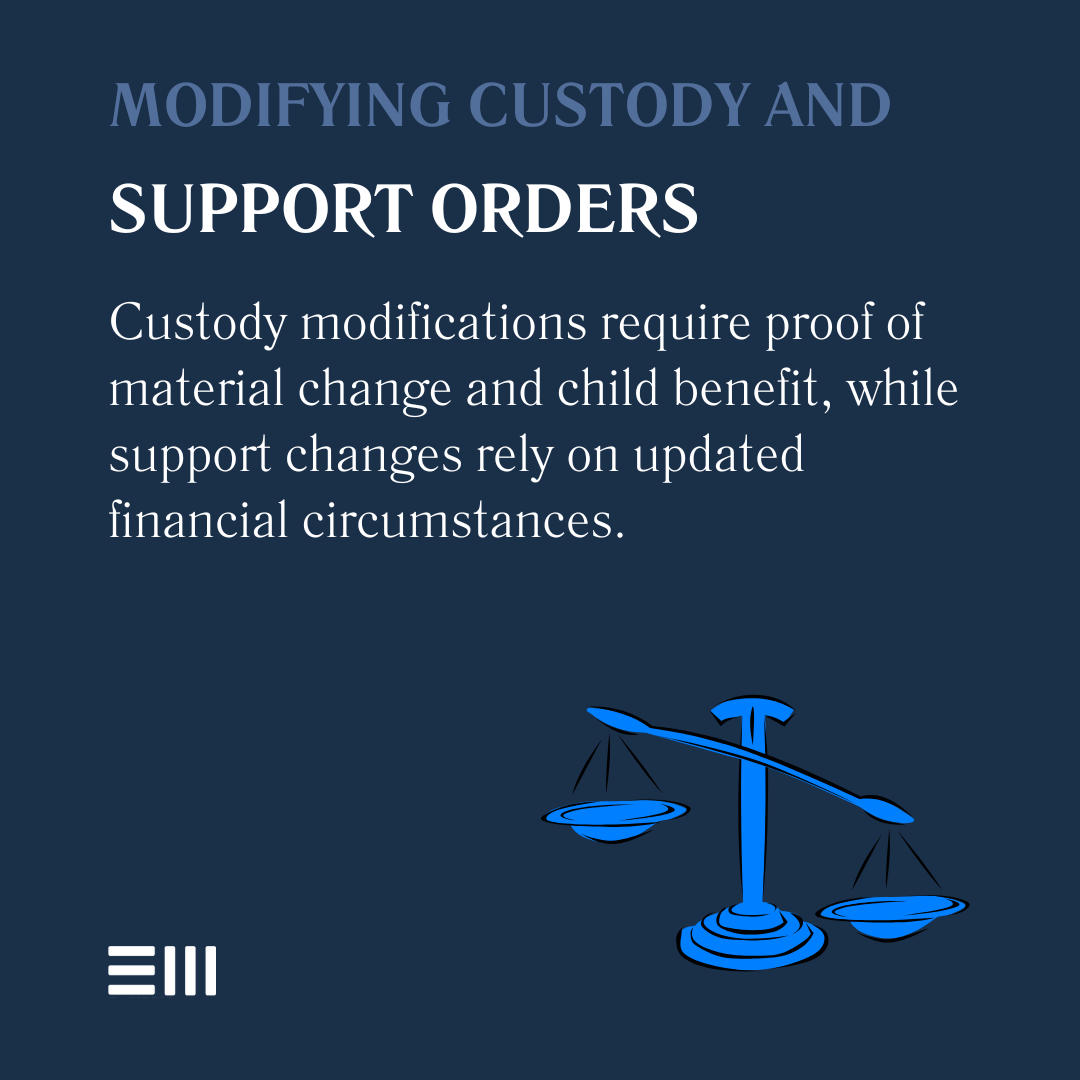
Custody changes face the stringent McLendon standard, named for a 1984 Alabama Supreme Court decision.
Parents requesting modified custody must satisfy three requirements: demonstrating material changes since the current order, proving the proposed arrangement would substantially benefit the child, and establishing that those benefits justify disrupting existing stability.
Courts apply this demanding test because research confirms children generally thrive with consistent routines.
What Qualifies as Sufficient Modification Grounds for Alabama Court Orders?
Situations warranting custody modification commonly include one parent's planned relocation affecting the parenting schedule, evidence of neglect or unsafe conditions, major shifts in either parent's work obligations or availability, documented substance abuse problems, and the developing needs of children as they mature.
The parent pursuing modification carries the burden of proving all required elements. Support modifications follow somewhat different rules.
Either party may request recalculation when material circumstances change—typically meaning significant income fluctuations, job loss, altered custody arrangements affecting parenting time, or changed expenses related to the child's health or education.
Courts apply current Rule 32 guidelines using updated financial information.
Learn about recent changes to Alabama child support laws that might affect your situation.
Questions DeKalb County Clients Frequently Ask
When families in Fort Payne, Rainsville, and surrounding communities consult with our firm, certain questions come up repeatedly. These responses offer general guidance, though individual circumstances always require personalized analysis.
Where Do I File Divorce Papers in DeKalb County?
Divorce petitions go to the DeKalb County Circuit Court located on Grand Avenue in Fort Payne. The Circuit Clerk's office processes filings and can provide information about required forms, though staff cannot offer legal advice.
Your DeKalb County family law attorney handles all filing procedures and ensures documents meet court requirements.
How Long Until My Divorce Becomes Final?
Timelines range widely. Uncontested divorces where spouses agree on all issues may conclude within 30 to 60 days.
Contested cases involving custody fights, complex property divisions, or disputed support can extend six months to two years depending on the issues' complexity and court availability.
What Determines Child Support Amounts?
Alabama's Rule 32 guidelines calculate support using both parents' gross incomes, the number of children, health insurance costs, and work-related childcare expenses.
The custody schedule also affects calculations since parents with substantially equal parenting time may have different obligations than those with traditional arrangements. Obligations typically continue until age 19.
Read about the Alabama child support age limit and exceptions.
Can My Spouse Prevent Me from Seeing Our Children?
Parents cannot unilaterally deny court-ordered visitation. If your former spouse interferes with your parenting time, you may file a contempt motion asking the court to enforce existing orders. Repeated violations can result in modified custody arrangements favoring the compliant parent.
Does Cheating Affect Divorce Outcomes?
Infidelity may influence alimony awards, potentially reducing or eliminating support for the unfaithful spouse or increasing awards to the wronged party.
Property division is less commonly affected. Pursuing fault-based allegations requires proof and extends proceedings, so many clients conclude no-fault approaches better serve their overall interests.
What Happens to Our House in a Divorce?
Marital residences typically constitute marital property subject to equitable division.
Options include selling the home and splitting proceeds, one spouse buying out the other's interest, or—less commonly—one spouse retaining the home offset by the other receiving different assets of comparable value.
Factors like children's school enrollment, each spouse's ability to maintain mortgage payments, and emotional attachment to the property influence these decisions. Retirement accounts, business interests, and investment portfolios require similarly careful analysis during property division.
Get Experienced Representation in DeKalb County
Confronting divorce, custody disputes, or support issues without qualified legal counsel leaves you exposed to outcomes you may regret for years.
The court system doesn't accommodate learning curves—mistakes in filings, missed deadlines, or poorly presented arguments can permanently impact your rights and your children's futures.
Our experienced family law attorneys here at Baxley Maniscalco have spent years advocating for DeKalb County families facing exactly these challenges.
We approach each case with the attention it deserves, recognizing that behind every legal filing sits a family working through one of life's most stressful transitions.
Whether you seek an aggressive advocate to fight for maximum parenting time or a steady hand to guide an amicable separation, our team tailors its approach to match your needs and objectives.
Call Baxley Maniscalco today to arrange a confidential consultation with a DeKalb County family law attorney. Let us put our courtroom experience and negotiation skills to work securing the best possible outcome for you and your family.