
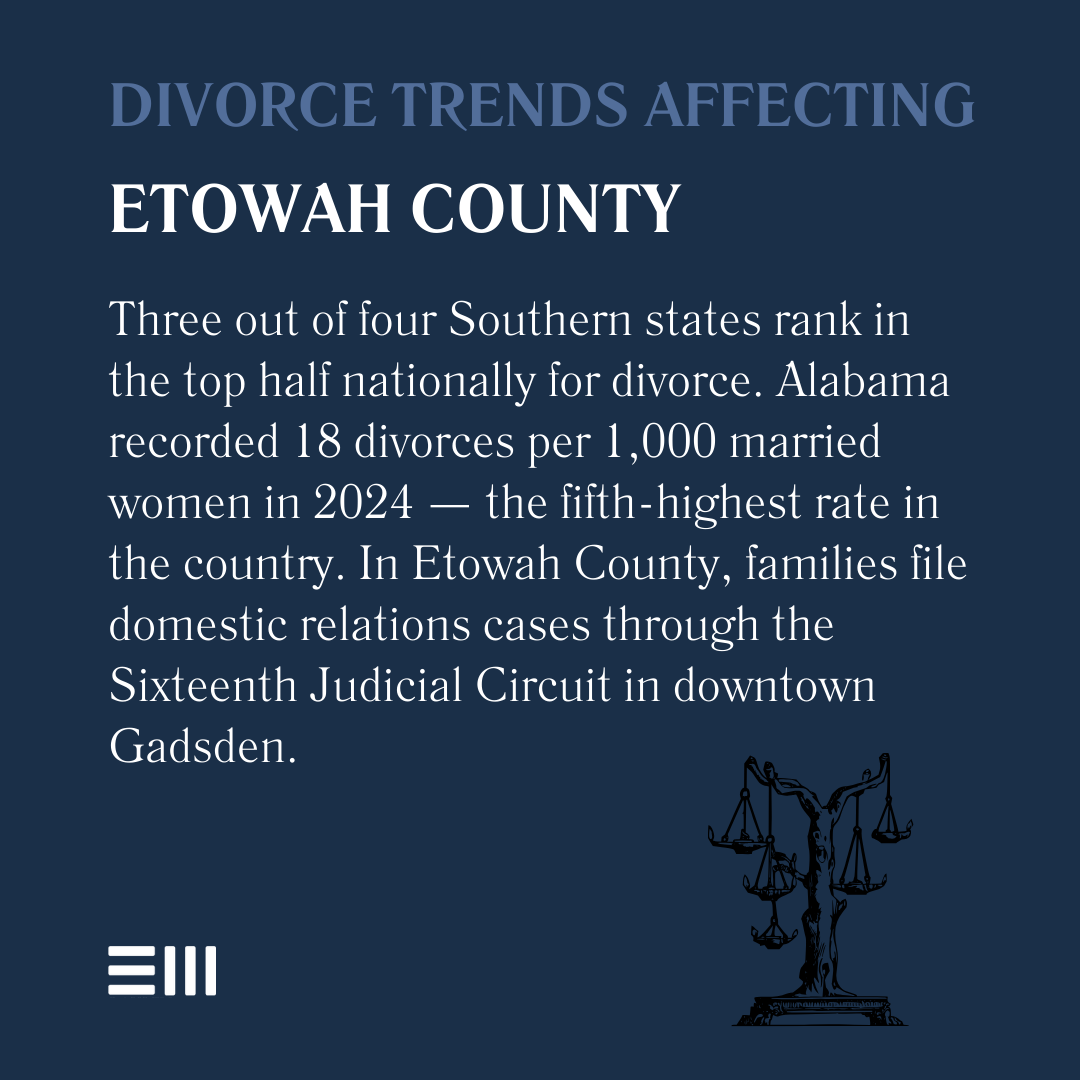
Three out of every four Southern states fall into the top half of national divorce rankings, according to 2024 data from the National Center for Family and Marriage Research at Bowling Green State University.
Alabama is no exception — the state recorded 18 divorces per 1,000 married women that year, enough to claim the fifth-highest rate in the country.
Those numbers land differently when you live in a county where the local economy has spent decades transitioning away from heavy industry and where financial strain on households is a daily reality rather than a headline.
Etowah County sits at the center of that reality. Home to more than 103,000 residents concentrated in the Gadsden Metropolitan Statistical Area, the county is the smallest in Alabama by land area yet one of the most densely populated.
Families across Gadsden, Rainbow City, Attalla, Glencoe, Hokes Bluff, Southside, and Sardis City file domestic relations cases through the Sixteenth Judicial Circuit courthouse on Forrest Avenue in downtown Gadsden.
The volume of filings, combined with the emotional and financial weight of each one, makes reliable legal counsel not just helpful but necessary.
This page provides a thorough overview of family law services in Etowah County.
It walks through the areas of practice that affect local families most directly, explains how Alabama statutes apply inside Etowah County courtrooms, and answers the questions that residents raise most often when they begin weighing their options.
Alabama's Statutory Framework and How It Applies in Etowah County
Every family law case filed in the Sixteenth Judicial Circuit draws from the same body of Alabama statute law that governs proceedings statewide. Title 30 of the Alabama Code addresses divorce, custody, visitation, child support, and spousal maintenance.
Title 26 covers adoption, termination of parental rights, and child welfare proceedings. Together, these two titles define the boundaries within which Etowah County judges decide the matters that reshape local families.
Alabama provides both no-fault and fault-based grounds for divorce. A no-fault filing typically alleges an irretrievable breakdown of the marriage or incompatibility, while a fault-based complaint may assert grounds such as adultery, abandonment, habitual intoxication, or cruelty.
The choice between no-fault and fault carries real strategic consequences — fault findings can influence how a court approaches alimony awards and the division of marital property.
Alabama also imposes a mandatory 30-day waiting period between the date a complaint is filed and the earliest date a final divorce decree may be entered.
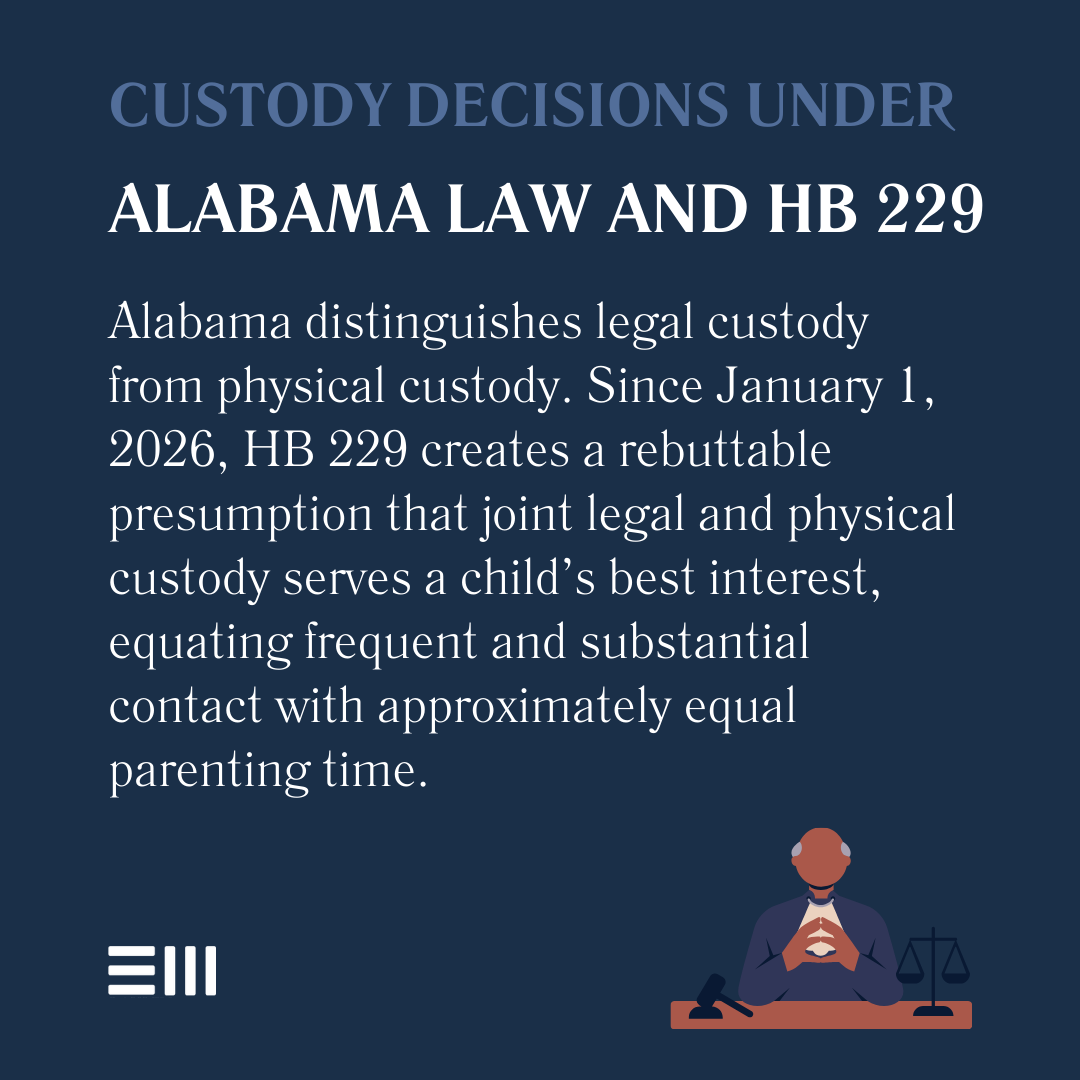
On the custody side, House Bill 229 went into effect on January 1, 2026, creating a rebuttable presumption that joint legal and physical custody serves a child's best interest.
This legislation has redefined how custody petitions are drafted, argued, and decided across all 67 Alabama counties, Etowah included. Understanding the statutory landscape before your first consultation puts you in a considerably stronger position to make sound decisions about your case.
Meet our Family Law Attorneys

Alyssa Enzor Baxley, experienced trial attorney and active community member.

Syndey Merrin focuses her practice on family law matters.

Adam Maniscalco, experienced trial attorney and Deputy Attorney General.
Navigating Divorce Through the Etowah County Circuit Court
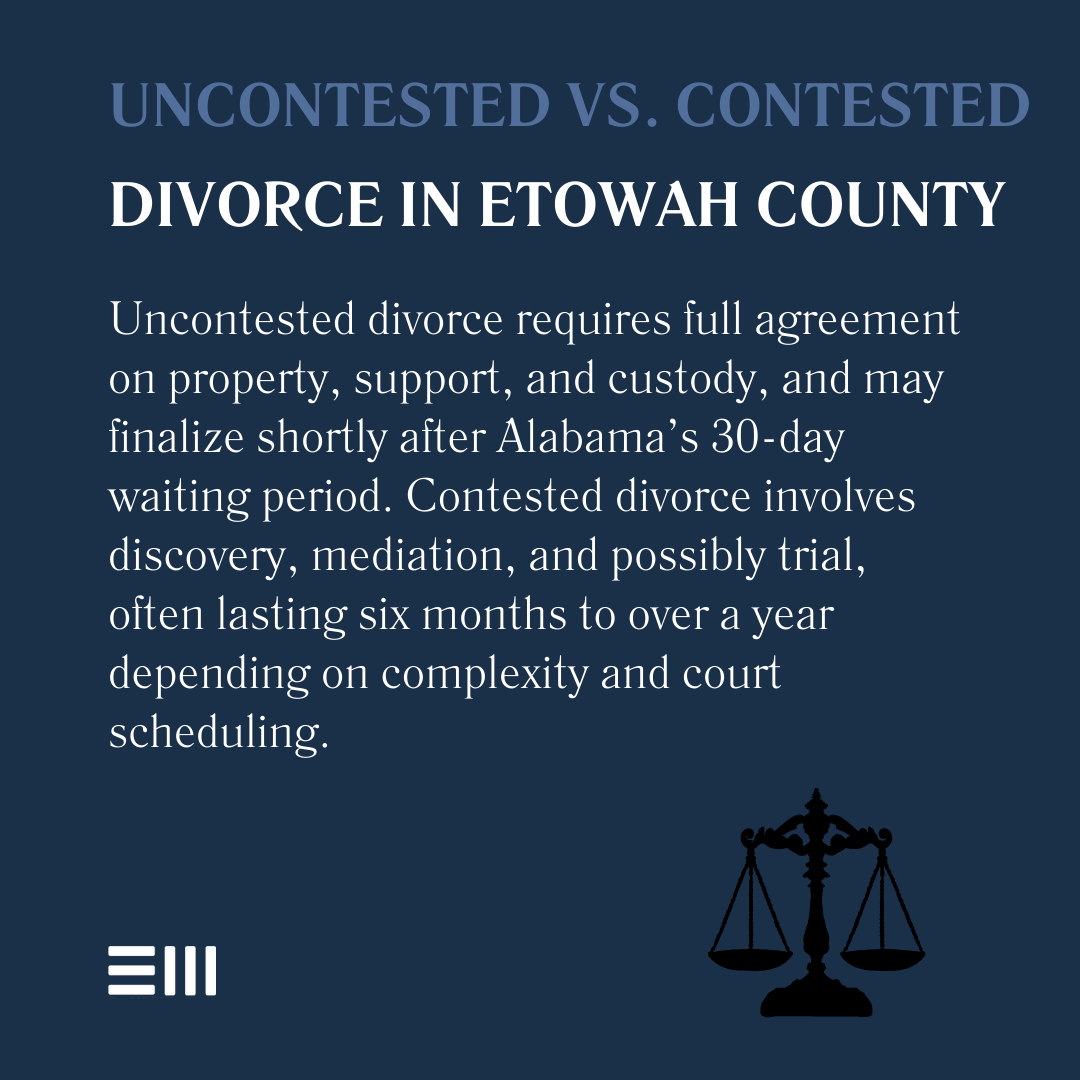
Divorce represents the single largest category of family law services in Etowah County. Every case proceeds down one of two tracks, and the dividing line between them is straightforward: either both spouses agree on all significant terms, or they do not.
Which track applies shapes the cost, the timeline, and the level of judicial involvement your case will demand.
When Both Spouses Agree: The Uncontested Path
An uncontested divorce is available when both parties reach consensus on every material issue — the division of assets and debts, whether alimony will be paid, and, if children are involved, the specifics of custody, visitation, and child support.
The couple submits a signed settlement agreement and, where applicable, a parenting plan to the Etowah County Circuit Clerk's office on Forrest Avenue.
Because no disputes remain for the judge to resolve, an uncontested case can be finalized soon after Alabama's mandatory 30-day waiting period runs.
These filings represent the fastest and least expensive way to obtain a final decree, and in a court system handling a metropolitan-area caseload, avoiding the contested docket can save months of waiting.
When Disagreements Remain: The Contested Path
A contested divorce arises when the spouses cannot reach agreement on one or more key issues. The sticking point may be the family residence, retirement account division, a business valuation, an alimony dispute, or — most commonly — custody and parenting time.
Contested cases in the Sixteenth Judicial Circuit generally involve formal discovery, witness depositions, asset appraisals, and frequently court-ordered mediation before a trial date is assigned. The issues that generate the most conflict include:
- Valuation and division of marital assets, especially when the couple disagrees about whether specific property is marital or separate, or when a business, professional practice, or real estate portfolio requires independent appraisal.
- Requests for ongoing spousal support, where one party argues a financial need and the other contends the request is disproportionate to the circumstances of both households.
- Contested custody and parenting arrangements, the area most likely to prompt the court to appoint a guardian ad litem or order a professional custody evaluation before ruling.
- Disputed child support figures, which become complicated when a parent's income fluctuates due to self-employment, seasonal work, overtime variability, or disagreements over includable expenses.
A contested divorce filed in Etowah County can take anywhere from six months to well over a year to reach a final judgment, depending on the complexity of the unresolved issues, the court's calendar, and each party's willingness to negotiate in good faith.
How Etowah County Courts Determine Custody
Among all family law services in Etowah County, custody disputes carry the highest emotional stakes. A custody order controls where a child sleeps, who makes decisions about medical treatment and schooling, and how holidays, birthdays, and summer breaks are divided between two homes.
Alabama law draws a clear distinction between legal custody — the right to make major decisions about a child's health, education, and welfare — and physical custody, which establishes the child's primary residence and daily living arrangements.
Either type may be awarded jointly or solely to one parent, and the possible combinations vary considerably from case to case.
Applying the Best-Interest Standard in Etowah County
Etowah County judges evaluate custody petitions under Alabama's best-interest-of-the-child standard, weighing a collection of factors drawn from state statute and appellate precedent. The considerations that tend to matter most in local courtrooms include:
- Day-to-day caregiving history, looking at which parent has consistently handled meals, transportation, homework supervision, bedtime routines, and medical appointments.
- Continuity and stability of the child's environment, including whether a proposed arrangement would uproot the child from a familiar school, neighborhood, or circle of friends.
- Physical and emotional capacity of each parent, assessed through testimony, documentation, and sometimes court-ordered evaluations when one party's fitness is genuinely in question.
- Evidence of abuse, neglect, or substance misuse, which triggers a statutory presumption against placing the child with the offending parent and may severely restrict that parent's contact.
- The child's stated preference, which carries progressively more weight as the child matures but never serves as the sole basis for a ruling at any age.
- Willingness to support the co-parenting relationship, measuring whether each parent encourages or undermines the child's bond with the other household.
An Etowah County judge weighs these factors collectively. A strong showing in one area can offset a weaker one elsewhere, and the parent who builds the most thorough and credible evidentiary record across the board typically secures the most favorable outcome.
What HB 229 Means for Etowah County Parents
House Bill 229 represents the most significant revision to Alabama custody law in nearly two decades.
Since January 1, 2026, every court in the state — including the Sixteenth Judicial Circuit in Etowah County — operates under a rebuttable presumption that joint legal and physical custody is in a child's best interest.
The statute equates "frequent and substantial contact" with approximately equal parenting time.
Every new custody petition now requires a detailed parenting plan, and any judge who departs from the joint custody presumption must state specific written findings on the record explaining the deviation.
The parent opposing shared custody bears the burden of demonstrating that it would not serve the child. For fathers and mothers alike, HB 229 has leveled the starting position and placed a premium on preparation, documentation, and credible evidence from the very first filing.
Child Support Calculations and Enforcement in Etowah County
Child support is among the most frequently sought family law services in Etowah County.
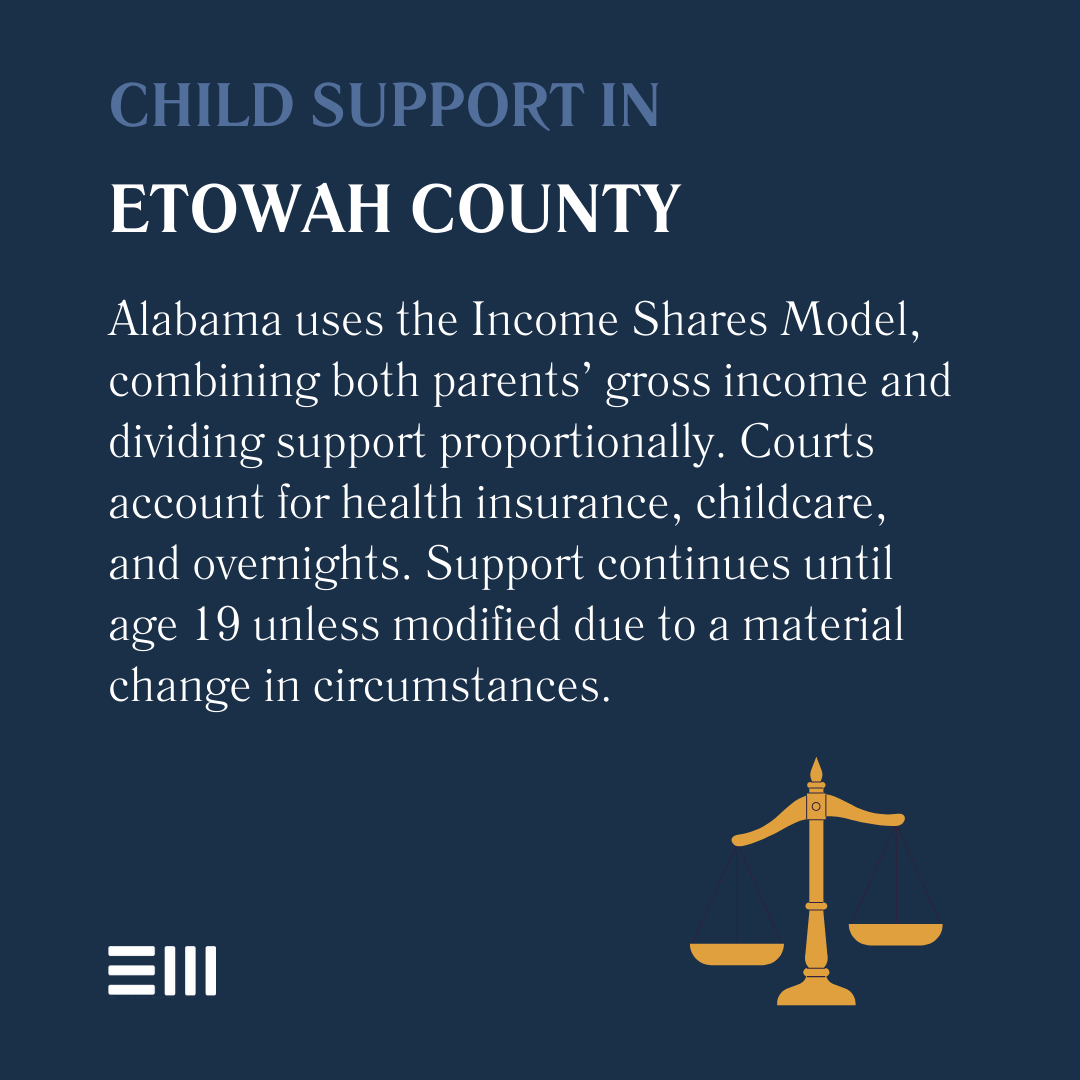
Alabama determines each parent's obligation using the Income Shares Model, a formula that combines both parents' gross incomes, references a statewide schedule estimating the cost of raising the child at that combined income level, and divides the total proportionally based on each parent's percentage of the combined earnings.
The calculation accounts for health insurance premiums paid on the child's behalf, work-related childcare costs, and the number of overnights each parent exercises.
Etowah County judges follow the statewide guidelines closely but retain limited discretion to deviate when rigid application would produce an unjust result.
Enforcement of support orders in Etowah County is managed through a combination of the Alabama Department of Human Resources and the local court system.
The standard support percentage depends on the parents' combined income and the number of children covered. When a parent falls behind, the enforcement tools available to compel compliance include:
- Automatic income withholding, which diverts a portion of the paying parent's paycheck directly to the receiving parent before the funds reach a personal account.
- Seizure of tax refunds, redirecting state and federal refund payments toward accumulated child support arrears.
- Suspension of licenses and professional credentials, creating practical consequences that pressure a delinquent parent to bring their account current.
- Civil contempt proceedings, the most serious mechanism, which can lead to court-imposed fines, structured repayment schedules, or incarceration for willful non-payment.
Support obligations in Alabama continue until the child reaches 19, the state's age of majority, unless the child is emancipated earlier or a qualifying disability extends the duty.
Either parent may petition for a modification when a material change in circumstances — such as a significant income shift or a change in custody — justifies a new calculation.
Alimony and Spousal Support in Etowah County Divorces
Unlike child support, alimony in Alabama is not driven by a fixed formula. Judges exercise broad discretion in determining whether to award spousal support, in what amount, and for what duration.
That discretion makes alimony one of the most unpredictable — and most heavily negotiated — components of any Etowah County divorce.
Alabama courts consider a range of factors when ruling on an alimony request:
- Duration of the marriage, as courts are more inclined to award significant support after long unions in which one spouse deferred career advancement or education for the benefit of the household.
- Disparity in earning capacity, measured by current income, educational background, job history, professional credentials, and each party's realistic employment outlook.
- Standard of living during the marriage, which serves as the benchmark for gauging how much support is necessary to prevent a drastic financial decline for the lower-earning spouse.
- Non-financial contributions, including years devoted to raising children, managing the home, or facilitating the other spouse's professional growth or educational pursuits.
- Age and health of each spouse, particularly when a chronic illness or advancing age restricts one party's realistic capacity to rejoin the workforce and become self-sufficient.
An Etowah County judge may order periodic alimony paid monthly over a defined term, rehabilitative alimony linked to education or vocational training, or a one-time lump-sum payment that resolves the issue permanently.
Hybrid arrangements combining more than one form are common in negotiated settlements. Knowing the circumstances under which alimony can be denied helps both sides enter negotiations with realistic expectations and avoid unnecessary litigation.
Adoption in Etowah County: Creating Permanent Family Bonds
Adoption is one of the most fulfilling areas of family law services in Etowah County. The legal process permanently transfers parental rights from one set of parents to another, establishing a parent-child relationship that carries identical rights and responsibilities to a biological one.
Alabama law imposes strict procedural safeguards at every stage to protect the welfare of the child being placed. The specific type of adoption dictates which court has jurisdiction and what steps must be completed before finalization. The adoption categories filed most often in Etowah County include:
- Agency placements, coordinated by a licensed child-placing organization that identifies children — often from the foster care system — and matches them with approved families who have completed the required screening.
- Independent or private adoptions, in which the birth parents select the adoptive family directly and an attorney manages the consent process, documentation, and court filings on both sides.
- Stepparent adoptions, among the most common filings, where a spouse legally adopts their partner's child from a previous relationship and formalizes a bond that already exists in practice.
- Relative or kinship adoptions, which grant legal parental status to a grandparent, aunt, uncle, or other family member who has been serving as the child's primary caregiver.
Every Alabama adoption requires a home study, either the biological parents' voluntary consent or a court order terminating their rights, and a finalization hearing before a judge.
Depending on the type of adoption, the petition may be filed in the Etowah County Probate Court or the Circuit Court. An attorney who handles adoptions locally can ensure the filing reaches the correct court and that no procedural misstep delays the outcome.
Domestic Violence and Its Impact on Etowah County Family Cases
Domestic violence intersects with virtually every other category of family law services in Etowah County. When abuse is present, it fundamentally alters the calculus for custody, visitation, property division, and the physical safety of the parties during and after the litigation.
Alabama's Protection from Abuse Act permits a victim in Etowah County to petition the Circuit Court for a protective order.
When a judge determines that an immediate threat exists, a temporary order can be issued the same day the petition is filed — before the accused party has an opportunity to respond.
A full evidentiary hearing follows within 10 days, and a final protection order can remain in effect for up to 12 months with the possibility of renewal.
In custody proceedings, a documented finding of domestic violence creates a rebuttable presumption that placing the child with the abusive parent does not serve the child's best interest.
The burden of overcoming that presumption falls squarely on the parent with the abuse finding. Alabama law also shields a parent who relocated to escape violence from being penalized in a custody determination for that move.
Etowah County's relatively dense population and proximity to multiple municipal police departments and the Etowah County Sheriff's Office mean that protective resources are more accessible here than in some of Alabama's rural jurisdictions.
Even so, swift documentation and prompt legal action remain essential for any resident who needs protection.
Mediation and Alternative Dispute Resolution in Etowah County
Going to trial is not the only path available to Etowah County families working through a divorce or custody disagreement.
Mediation provides a structured, confidential process in which a trained, neutral third party helps both sides negotiate toward a resolution without the formality — and expense — of a courtroom proceeding.
Judges in the Sixteenth Judicial Circuit regularly order mediation before scheduling contested matters for trial. Many cases settle during mediation or in the days immediately following a session. The practical benefits that draw families toward this approach include:
- Meaningful cost savings, because mediation compresses negotiation into a concentrated timeframe and eliminates the need for extensive trial preparation, expert witness fees, and multi-day hearings.
- Faster resolution, since mediation sessions can typically be scheduled within weeks while contested trial dates on the Etowah County docket may be months out.
- Tailored outcomes, because the parties retain full control over the terms of their agreement and can design arrangements more precisely fitted to their family's circumstances than a court-imposed order.
- Reduced damage to the co-parenting relationship, as the collaborative tone of mediation tends to preserve communication channels that an adversarial trial often disrupts.
Mediation is not appropriate in every case. Situations involving domestic violence, active substance abuse, or a significant power imbalance between the parties may require the procedural safeguards that only formal litigation provides.
For the cases where it is a good fit, however, mediation gives Etowah County families a quicker, less expensive, and less combative way forward.
Why Local Court Experience Matters in Etowah County
Alabama's family law statutes apply uniformly from Mobile to Huntsville, but how those statutes translate into practice differs meaningfully from one courthouse to the next.
Every jurisdiction operates on its own scheduling rhythms, with its own judges who bring individual perspectives to contested issues, and with its own network of mediators, guardians ad litem, and court staff who shape how cases move through the system.
For anyone pursuing family law services in Etowah County, working with an attorney who knows the Sixteenth Judicial Circuit from the inside offers a tangible advantage.
Counsel who regularly appears in the Gadsden courthouse understands how local judges approach contested custody questions, knows the scheduling realities of a docket serving a metropolitan-area population, and has developed working relationships with the clerks, case managers, and DHR representatives involved in the process.
Our experienced family law attorneys here at Baxley Maniscalco bring that level of embedded local knowledge to every case.
Whether the matter involves a straightforward uncontested filing or a complex multi-issue contested dispute, our familiarity with the Etowah County court system allows us to advise clients with the specificity that only comes from consistent local practice.
Frequently Asked Questions about Family Law Services in Etowah County
The questions below reflect what Etowah County residents ask most often when they first begin exploring their family law options. While general answers cannot substitute for a consultation about your specific circumstances, these responses offer a solid foundation.
How Quickly Can a Divorce Be Finalized in Etowah County?
Alabama mandates a minimum 30-day waiting period after the complaint is filed. An uncontested divorce in which all terms are settled and paperwork is complete can be finalized shortly after that window closes.
Contested cases follow a longer trajectory. Depending on the number of unresolved issues, the scope of discovery, and the Sixteenth Judicial Circuit's calendar, a contested divorce in Etowah County may take six months to more than a year before reaching a final judgment.
What Is the Difference Between Legal Custody and Physical Custody?
Legal custody grants a parent the authority to make major decisions about a child's medical care, education, religious upbringing, and extracurricular activities. Physical custody determines where the child lives on a day-to-day basis.
Alabama courts can structure these independently. For instance, parents may share joint legal custody while one parent holds primary physical custody and the other receives a structured visitation schedule.
Can an Existing Child Support Order Be Changed?
Yes. Either parent may file a petition for modification when a material change in circumstances has occurred since the current order was entered.
Qualifying changes include a substantial increase or decrease in either parent's income, a shift in the custody or visitation arrangement, or a significant new expense tied to the child's health or education.
The parent seeking the modification carries the burden of proving that the change is substantial enough to warrant a recalculation under Alabama's guidelines.
Does Alabama Law Favor Mothers over Fathers in Custody Cases?
It does not. Alabama's custody statutes are entirely gender-neutral, and fathers are evaluated under precisely the same best-interest factors as mothers.
HB 229 further reinforces this neutrality by establishing a presumption that both parents share custody equally from the outset. The parent who most convincingly demonstrates fitness, stability, and a cooperative approach to co-parenting holds the strongest position regardless of gender.
What Happens if My Spouse Refuses to Participate in the Divorce?
One spouse cannot prevent a divorce from proceeding in Alabama. If the respondent has been properly served with the complaint and fails to answer within the statutory deadline, the court may enter a default judgment and grant the divorce on the filing spouse's terms.
If the respondent files a response but refuses to negotiate, the case moves forward as a contested matter and ultimately proceeds to trial if no settlement can be reached.
How Does Alabama Divide Property in a Divorce?
Alabama follows equitable distribution principles. The court divides marital property in a manner it considers fair, which does not necessarily mean a 50/50 split.
Factors considered include the length of the marriage, each spouse's contributions — both financial and non-financial — the economic position each party will occupy after the divorce, and whether either spouse engaged in conduct that dissipated marital assets.
Property acquired before the marriage, along with individual gifts and inheritances, is generally classified as separate property and excluded from division unless it has been commingled with marital funds.
Do I Need to Live in Etowah County to File for Divorce Here?
Alabama requires at least one spouse to have been a resident of the state for a minimum of six months before filing. The complaint is then filed in the county where the defendant resides, where the couple last lived together, or where the plaintiff resides if the defendant has left the state.
When those residency rules point to Etowah County, the filing is submitted to the Circuit Clerk's office at the Etowah County Judicial Building at 801 Forrest Avenue in Gadsden.
Can Grandparents Petition for Visitation Rights in Alabama?
Alabama does permit grandparents to file a petition for court-ordered visitation, but the legal threshold is demanding. The grandparent must establish that visitation serves the child's best interest and that the custodial parent has unreasonably withheld contact.
Courts apply heightened scrutiny in these cases because federal constitutional principles afford parents broad discretion over their children's associations.
In Etowah County, a grandparent who can present evidence of an established, meaningful relationship with the child and concrete harm resulting from the denial of access will have the strongest case.
How Much Does It Cost to Hire a Family Law Attorney?
Cost depends entirely on the nature and complexity of your case. An uncontested divorce where all terms are already agreed upon will cost significantly less than a contested custody battle requiring expert witnesses, depositions, and a multi-day trial.
Our experienced family law attorneys here at Baxley Maniscalco offer consultations where we can discuss the specifics of your situation, explain the likely scope of legal work, and provide a clear picture of expected costs before you make any commitment.
Reaching out to our team through our contact page is the most direct way to get answers tailored to your case.
Your Family Deserves Experienced Representation in Etowah County — Let Us Help
The decisions made during a divorce, custody dispute, support proceeding, or adoption carry consequences that last for years.
They affect where children live, how household finances are restructured, and what each family member's daily life looks like moving forward. Handling these matters without experienced counsel risks outcomes that are difficult and expensive to undo.
Our experienced family law attorneys here at Baxley Maniscalco have the local knowledge, the courtroom presence, and the personal commitment to guide Etowah County families through every stage of the process.
We are available in person at our office, by phone, or through video conference — whichever option works best for your schedule.
Contact us today to schedule a confidential consultation. Let us review your situation, explain your options under current Alabama law, and help you take the first step toward protecting what matters most.