
St. Clair County's population has surged nearly 18 percent since 2010, a growth rate that ranks among the highest in Alabama and one fueled almost entirely by families migrating into the Birmingham metro's eastern corridor.
Researchers at the University of Alabama's Center for Business and Economic Research identified St. Clair as one of only six Alabama counties where net in-migration exceeded 1,400 people in a single year.
New neighborhoods are going up along the shores of Logan Martin Lake and in the Springville-Moody growth belt, and with that population growth comes a proportional rise in the demand for family law representation — divorce filings, custody disputes, support calculations, and adoption petitions all increase in step with community size.
That demand meets a county with a courthouse system unlike any other in Alabama. St. Clair is the only county in the state with two full-service county seats — one in Ashville, on the northern side of Backbone Mountain, and another in Pell City, on the southern side.
The Thirtieth Judicial Circuit operates courtrooms in both locations, and which courthouse handles your case can depend on where you live within the county.
Families in Pell City, Riverside, and Odenville typically file through the Pell City Division, while residents of Ashville, Springville, Steele, and Margaret file through the Ashville Division.
This page provides a detailed overview of family law services in St. Clair County.
It explains the substantive practice areas that matter most to local families, walks through how Alabama statute law applies in each of the county's two divisions, and answers the questions residents ask most often when they begin evaluating their legal options.
Alabama Statute Law and Its Application in St. Clair County's Courts
Every family law proceeding filed in the Thirtieth Judicial Circuit rests on the same body of Alabama statute law that governs courts statewide. Title 30 of the Alabama Code addresses marriage dissolution, child custody, visitation, child support, and spousal maintenance.
Title 26 covers adoption, termination of parental rights, and related child welfare proceedings. These two titles establish the legal framework within which judges in both the Ashville and Pell City divisions decide cases that reshape St. Clair County families.
Alabama permits both no-fault and fault-based grounds for divorce.
A no-fault petition generally alleges incompatibility or an irretrievable breakdown of the marriage, while a fault-based complaint may cite adultery, abandonment, habitual substance abuse, or physical cruelty as the basis for dissolution.
The distinction carries strategic weight — a successful fault finding can influence how the court handles alimony and the division of marital property.
Alabama law also requires a mandatory 30-day waiting period between the filing of a divorce complaint and the earliest possible entry of a final decree.
On the custody front, House Bill 229 took effect January 1, 2026, establishing a rebuttable presumption that joint legal and physical custody serves a child's best interest.
The law has fundamentally reshaped how custody petitions are structured, litigated, and decided in all 67 Alabama counties, including both divisions of St. Clair County.
Gaining a working understanding of the statutory framework before your first consultation allows you to ask sharper questions and make better-informed decisions about your case from the outset.
Meet our Family Law Attorneys

Alyssa Enzor Baxley, experienced trial attorney and active community member.

Syndey Merrin focuses her practice on family law matters.

Adam Maniscalco, experienced trial attorney and Deputy Attorney General.
Divorce in St. Clair County: Two Courthouses, Two Paths
Divorce filings account for the largest volume of family law services in St. Clair County, and each case follows one of two procedural tracks. Whether the case qualifies as uncontested or contested dictates the cost, the timeline, and how much courtroom involvement your matter will require.
The Uncontested Route
When both spouses reach full agreement on the division of property and debt, whether alimony will be paid, and — where children are involved — the specifics of custody, visitation, and child support, the case qualifies as uncontested.
The couple files a signed settlement agreement and, where applicable, a parenting plan with the appropriate division of the St. Clair County Circuit Clerk's office — Ashville or Pell City depending on residency.
With no open disputes for a judge to resolve, the case can reach a final decree shortly after Alabama's mandatory 30-day waiting period expires.
An uncontested filing is the fastest and most cost-effective path to a finalized divorce, and in a rapidly growing county where docket congestion is a genuine concern, keeping your case off the contested calendar can save considerable time.
The Contested Route
A contested divorce arises when the parties cannot agree on one or more material issues.
The disagreement may involve the marital residence, the division of retirement assets, a business valuation, an alimony claim, or — in the cases that produce the most sustained conflict — custody and parenting time.
Contested matters filed in the Thirtieth Judicial Circuit generally involve formal discovery, witness depositions, asset valuations, and in many instances court-ordered mediation before a trial date is placed on the calendar. The issues that generate the sharpest disputes include:
- Classification and division of marital property, particularly when the spouses disagree about whether certain holdings are marital or separate in nature, or when a business interest, professional practice, or investment portfolio demands independent appraisal.
- Competing alimony positions, where the requesting spouse argues genuine financial need and the other contends that the amount or duration sought is out of proportion to the marriage and the parties' actual circumstances.
- Custody and parenting time arrangements, the area most likely to escalate to the point where the court appoints a guardian ad litem or orders a professional custody evaluation before issuing a ruling.
- Child support calculation disagreements, which arise most frequently when a parent's earnings are variable due to self-employment, commission-based compensation, seasonal employment, or disputes about which expenses should factor into the formula.
A contested divorce in St. Clair County may take six months to well beyond a year to conclude, depending on the number and complexity of the unresolved issues, the availability of court dates across both divisions, and each party's willingness to negotiate toward resolution.
How Custody Is Decided in St. Clair County
Custody cases carry the highest emotional weight of any family law services in St. Clair County.
A custody order determines where a child lives each night, who authorizes medical treatment and educational decisions, and how weekends, holidays, and school breaks are allocated between two households.
Alabama law separates custody into two distinct components. Legal custody confers the authority to make significant decisions about a child's health care, education, religious training, and extracurricular involvement.
Physical custody establishes where the child resides on a daily basis. A court may award either form jointly or exclusively to one parent, and the range of possible arrangements is broad.
The Best-Interest Analysis in St. Clair County Courtrooms
Judges in both the Ashville and Pell City divisions evaluate custody petitions under Alabama's best-interest-of-the-child standard, applying a series of factors rooted in state statute and appellate precedent. The considerations that typically carry the most influence include:
- Historical pattern of daily caregiving, examining which parent has consistently managed meals, school transportation, homework supervision, bath and bedtime routines, and coordination of medical care.
- Stability and continuity of the child's living environment, assessing whether a proposed custody arrangement would force the child to leave a familiar school district, neighborhood, or established circle of friends and activities.
- Each parent's emotional and physical fitness, evaluated through witness testimony, relevant records, and occasionally court-ordered psychological or parenting evaluations when capacity to parent is contested.
- Any record of abuse, neglect, or substance misuse, which activates a statutory presumption against placing the child with the offending parent and may restrict that parent's visitation to supervised settings.
- The child's own expressed preference, given increasing consideration as the child matures but never treated as determinative at any age.
- Each parent's attitude toward co-parenting, measuring whether a parent actively supports or works to undermine the child's relationship with the other household.
A St. Clair County judge examines these factors as an integrated whole.
Demonstrated strength in one area can compensate for relative weakness in another, and the parent who assembles the most complete, credible evidentiary presentation across the full spectrum of factors positions themselves most favorably.
The Practical Impact of HB 229 in St. Clair County
House Bill 229 represents the most far-reaching change to Alabama custody law in nearly a generation.
Since January 1, 2026, every Alabama court — including both divisions of the Thirtieth Judicial Circuit — operates under a rebuttable presumption that joint legal and physical custody is in the child's best interest.
The statute defines "frequent and substantial contact" as approximately equal parenting time.
New custody petitions now require a detailed parenting plan from the outset, and a judge who departs from the joint custody presumption must enter specific written findings explaining why.
The parent contesting shared custody bears the full burden of demonstrating that the arrangement would not serve the child.
For fathers and mothers alike, HB 229 has reset the baseline and placed heightened importance on thorough preparation, solid documentation, and persuasive evidence starting from the very first filing.
Child Support: Calculations, Payments, and Enforcement in St. Clair County
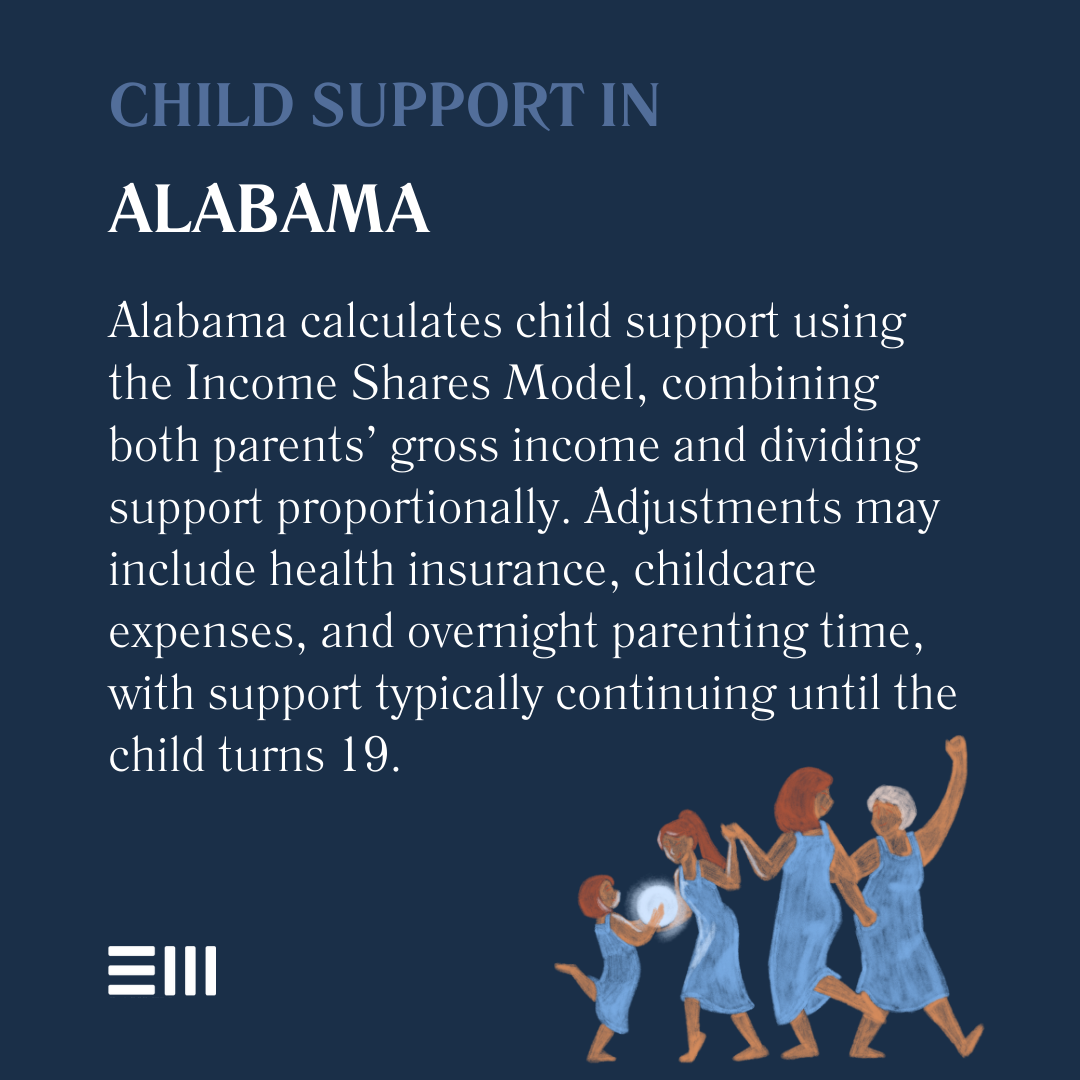
Child support ranks among the most commonly requested family law services in St. Clair County. Alabama uses the Income Shares Model to determine each parent's financial obligation.
The formula aggregates both parents' gross incomes, references a statewide schedule that estimates the cost of raising the child at that combined income level, and divides the total proportionally based on each parent's share of the combined earnings.
The calculation incorporates adjustments for health insurance premiums paid on the child's behalf, work-related daycare expenses, and the number of overnights each parent exercises.
Judges in both St. Clair County divisions follow the statewide guidelines closely but retain limited discretion to deviate when strict application would yield a result that does not serve the child's needs.
When a parent falls behind on support obligations, the enforcement mechanisms available through the Alabama Department of Human Resources and the local court system include:
- Automatic income withholding, which routes a designated portion of the obligor's earnings directly to the custodial parent before the funds reach a personal account.
- Interception of state and federal tax refunds, redirecting refund payments toward accumulated child support arrears.
- License and credential suspension, revoking driver's licenses or professional certifications to create tangible consequences that motivate payment.
- Civil contempt proceedings, the most severe enforcement avenue, which can result in court-ordered payment plans, monetary sanctions, or incarceration for willful refusal to pay.
Child support in Alabama continues until the child reaches 19, which is the state's age of majority, unless the child is emancipated earlier or a qualifying disability extends the obligation beyond that age.
Either parent may petition for a modification when a material change in circumstances — such as a significant income shift, a change in custody, or a new child-related expense — warrants a recalculation under the guidelines.
Spousal Support and Alimony in St. Clair County Divorces
Unlike child support, alimony in Alabama is not calculated through a standardized formula. Trial judges retain broad discretion over whether to award spousal support, what amount to set, and how long payments should continue.
That judicial discretion makes alimony one of the most uncertain — and therefore most heavily negotiated — elements of any St. Clair County divorce.
Alabama courts evaluate a range of considerations when ruling on a spousal support request:
- Length of the marriage, since courts view long-duration marriages — particularly those in which one spouse subordinated career development for the family — as stronger candidates for significant alimony awards.
- Gap in earning potential between the spouses, measured by current income, education, professional certifications, work history, and each party's realistic employment prospects after the divorce.
- Marital standard of living, which the court uses as a reference point to gauge how much support is needed to prevent a steep financial decline for the lower-earning spouse.
- Non-monetary contributions, encompassing years spent raising children, maintaining the household, or supporting the other spouse's career advancement or educational pursuits.
- Health and age of each spouse, especially when illness, disability, or advanced age limits one party's practical ability to re-enter the workforce and achieve financial independence.
A St. Clair County judge may order periodic alimony paid monthly for a fixed term, rehabilitative alimony tied to education or vocational retraining, or a one-time lump-sum payment that resolves the issue entirely.
Blended arrangements that combine multiple forms are frequently negotiated in settlement discussions. Understanding when alimony can be denied gives both sides a clearer picture of what to expect and can prevent costly litigation over claims that are unlikely to succeed.
Building Families Through Adoption in St. Clair County
Adoption represents one of the most personally meaningful areas of family law services in St. Clair County.
The process permanently transfers all parental rights and responsibilities from one set of parents to another, creating a legally recognized bond identical in every respect to a biological parent-child relationship.
Alabama's adoption statutes impose strict procedural requirements at each stage to protect the child being placed. The specific adoption category determines which court has jurisdiction and which procedural steps must be completed. The types filed most often in St. Clair County include:
- Agency placements, facilitated by a licensed child-placing organization that identifies children — frequently from the foster care system — screens prospective families, and oversees the matching process.
- Independent or private adoptions, where birth parents select the adoptive family directly and an attorney handles consent procedures, legal documentation, and all required court filings.
- Stepparent adoptions, one of the most frequently filed types in the county, in which a spouse formally adopts their partner's child from an earlier relationship and gives legal standing to a bond that already exists in the household.
- Relative or kinship placements, which confer full parental rights on a grandparent, aunt, uncle, or other family member who has been serving as the child's primary caregiver.
Every Alabama adoption requires a completed home study, either voluntary parental consent or a court order terminating the biological parents' rights, and a finalization hearing.
Depending on the type, the petition may be filed with the St. Clair County Probate Court or the Circuit Court in either the Ashville or Pell City division. An attorney who handles adoptions locally ensures the filing reaches the correct court and that procedural requirements are met without delay.
How Domestic Violence Shapes Family Law Cases in St. Clair County
Domestic violence reaches across virtually every category of family law services in St. Clair County. Where abuse is present, it fundamentally changes the analysis for custody, visitation, property division, and the physical safety of the parties throughout and after the legal proceedings.
Under Alabama's Protection from Abuse Act, a victim in St. Clair County may petition the Circuit Court for a protective order.
When a judge finds that an immediate threat of harm exists, a temporary order can be granted the same day — before the accused party receives notice or an opportunity to respond.
A full evidentiary hearing follows within 10 days, and a final order of protection may remain in force for up to 12 months with the possibility of extension.
In custody proceedings, a documented finding of domestic violence triggers a rebuttable presumption that placing the child with the abusive parent is not in the child's best interest.
The burden of overcoming that presumption falls entirely on the parent with the abuse finding. Alabama law further protects a parent who relocated to escape violence from being penalized for that move in any subsequent custody determination.
Given St. Clair County's geographic size — 654 square miles divided by Backbone Mountain — knowing which courthouse division to approach and which law enforcement agencies serve your area can make the difference between receiving same-day protection and losing critical time.
Prompt documentation and immediate legal action remain essential for any resident facing a domestic violence emergency.
Mediation as an Alternative to Trial in St. Clair County
Trial is not the only available resolution for St. Clair County families working through contested divorce or custody matters.
Mediation offers a structured, private process in which a neutral third-party mediator helps both sides negotiate toward a voluntary agreement outside the courtroom.
Thirtieth Judicial Circuit judges in both the Ashville and Pell City divisions routinely order mediation before placing contested cases on the trial calendar.
A meaningful percentage of cases reach resolution either during a mediation session or in the days immediately afterward. The benefits that draw families toward mediation include:
- Substantially reduced costs, because mediation condenses negotiation into focused sessions and eliminates the expense of full-scale trial preparation, expert testimony, and multi-day courtroom proceedings.
- Accelerated timelines, since mediation can typically be scheduled weeks ahead while contested trial slots across St. Clair County's two divisions may be months away.
- Greater flexibility in outcomes, because the parties retain control over the terms of their agreement and can design solutions more precisely tailored to their family's circumstances than a judge-imposed order.
- Preservation of the co-parenting dynamic, as the collaborative nature of mediation tends to protect lines of communication that adversarial litigation frequently damages.
Mediation is not appropriate in every situation. Cases involving active domestic violence, untreated substance abuse, or a severe power imbalance between the parties may require the structural protections that only formal courtroom proceedings can provide.
For those cases where mediation is a good fit, it gives St. Clair County families a faster, less expensive, and less antagonistic path to resolution.
Why Attorneys with Local Knowledge Matter in St. Clair County
Alabama family law may be uniform across the state, but how that law operates in practice differs substantially from county to county — and in St. Clair County, even from one courthouse division to the next.
The dual-seat structure means that scheduling patterns, available court dates, and the procedural preferences of individual judges can vary depending on whether your case is heard in Ashville or Pell City.
For anyone pursuing family law services in St. Clair County, working with an attorney who understands the Thirtieth Judicial Circuit's dual-division system offers a concrete edge.
Counsel who regularly practices in both courthouses knows which division handles your case based on geographic residence, understands the scheduling realities and procedural expectations in each location, and has developed working relationships with clerks, mediators, guardians ad litem, and DHR representatives on both sides of the mountain.
Our experienced family law attorneys here at Baxley Maniscalco bring that dual-courthouse familiarity to every case.
Whether the matter involves a straightforward uncontested filing in Pell City or a complex contested custody dispute in Ashville, our team's consistent local practice allows us to advise with the specificity that only hands-on experience in both divisions can provide.
Frequently Asked Questions about Family Law Services in St. Clair County, Alabama
The following questions come up most often when St. Clair County residents begin exploring their family law options. While general answers cannot replace a consultation tailored to your individual circumstances, these responses provide a reliable starting point.
How Long Does a Divorce Take in St. Clair County?
Alabama law imposes a mandatory 30-day waiting period after the complaint is filed. An uncontested divorce where all terms are settled and documentation is complete can be finalized shortly after that window closes.
Contested cases operate on a longer timeline. Depending on the scope of unresolved issues, the extent of discovery, and docket availability in whichever St. Clair County division is handling the case, a contested divorce may take six months to more than a year before a final judgment is entered.
Which St. Clair County Courthouse Handles My Case?
St. Clair County is divided into two judicial districts, each served by its own courthouse. Generally, residents on the southern side of Backbone Mountain — including Pell City, Riverside, and Odenville — file through the Pell City Division at 1815 Cogswell Avenue.
Residents on the northern side — including Ashville, Springville, Steele, and Margaret — file through the Ashville Division at 100 6th Avenue North.
An attorney familiar with the Thirtieth Judicial Circuit can confirm which division applies to your situation based on your residential address.
What Is the Difference between Legal and Physical Custody?
Legal custody gives a parent the right to make major decisions about a child's medical treatment, education, religious upbringing, and participation in activities. Physical custody determines where the child lives on a daily basis.
Alabama courts may combine these in different ways. For example, parents may share joint legal custody while one holds primary physical custody and the other receives a structured parenting time schedule.
Can a Child Support Order Be Modified after It Is Entered?
Yes. Either parent may petition for a modification when a material change in circumstances has occurred since the last order.
Qualifying changes include a significant increase or decrease in income, a change in the custody or visitation arrangement, or a substantial new expense related to the child's health or education.
The parent requesting the change must demonstrate that the shift is meaningful enough to justify a recalculation under Alabama's guidelines.
Does Alabama Custody Law Give One Parent an Advantage Based on Gender?
No. Alabama's custody statutes are entirely gender-neutral. Fathers and mothers are assessed under the same set of best-interest factors, and neither receives any presumptive advantage.
HB 229 reinforces this principle by presuming that both parents will share custody equally unless evidence demonstrates otherwise. The parent who presents the strongest showing of fitness, stability, and willingness to co-parent holds the most favorable position regardless of gender.
What If My Spouse Will Not Agree to the Divorce?
One spouse cannot prevent a divorce from moving forward in Alabama. If the respondent is properly served with the complaint and fails to respond within the statutory time limit, the court may enter a default judgment granting the divorce on the filing party's terms.
If the respondent does respond but refuses to negotiate, the case proceeds as a contested matter and will ultimately go to trial if no settlement is reached.
How Does Alabama Divide Marital Property?
Alabama follows equitable distribution principles, meaning the court divides marital property in a manner it considers fair — which does not always mean an equal split.
Factors include the length of the marriage, each spouse's financial and non-financial contributions, the economic position each party will face after the divorce, and any dissipation or waste of marital assets by either spouse.
Assets acquired before the marriage, together with personal gifts and inheritances, are generally treated as separate property and excluded from division unless they have been commingled with marital funds.
Do I Need to Be a St. Clair County Resident to File for Divorce Here?
Alabama requires at least one spouse to have been a resident of the state for a minimum of six months before filing. The complaint is filed in the county where the defendant lives, where the couple last resided together, or where the plaintiff resides if the defendant has left the state.
When those criteria point to St. Clair County, the filing is submitted to the Circuit Clerk's office in either the Ashville Division or the Pell City Division, depending on your geographic location within the county.
Can Grandparents Seek Visitation Rights through a St. Clair County Court?
Alabama law does allow grandparents to petition for court-ordered visitation, but the legal standard is rigorous. The grandparent must demonstrate that visitation is in the child's best interest and that the custodial parent has unreasonably denied access.
Because federal constitutional principles give parents broad discretion over whom their children associate with, courts apply significant scrutiny to these petitions.
A grandparent who can document a longstanding, meaningful relationship with the child and show concrete harm from the denial of contact will present the strongest possible case.
Ready to Protect Your Family in St. Clair County? We Are Here to Help
Family law decisions made in a courtroom — whether in Ashville or Pell City — carry consequences that extend for years.
They determine where children live, how financial resources are divided, and what each family member's future looks like. Navigating these decisions without experienced counsel risks results that are difficult and costly to undo.
Our experienced family law attorneys here at Baxley Maniscalco understand the Thirtieth Judicial Circuit's dual-division system, the scheduling dynamics of both courthouses, and the practical realities of practicing in one of Alabama's fastest-growing counties.
We are available for consultations in person, by phone, or through video conference — whichever format suits your schedule.
Contact us today to schedule a confidential consultation. Let us review your situation, walk you through your options under current Alabama law, and help you take the first step toward securing the outcome your family deserves.