
Alabama ranks fifth in the nation for its refined divorce rate, with approximately 18 out of every 1,000 married women ending a marriage in 2024 alone.
Behind that number are real families splitting households, negotiating parenting schedules, and working through financial questions they never expected to face.
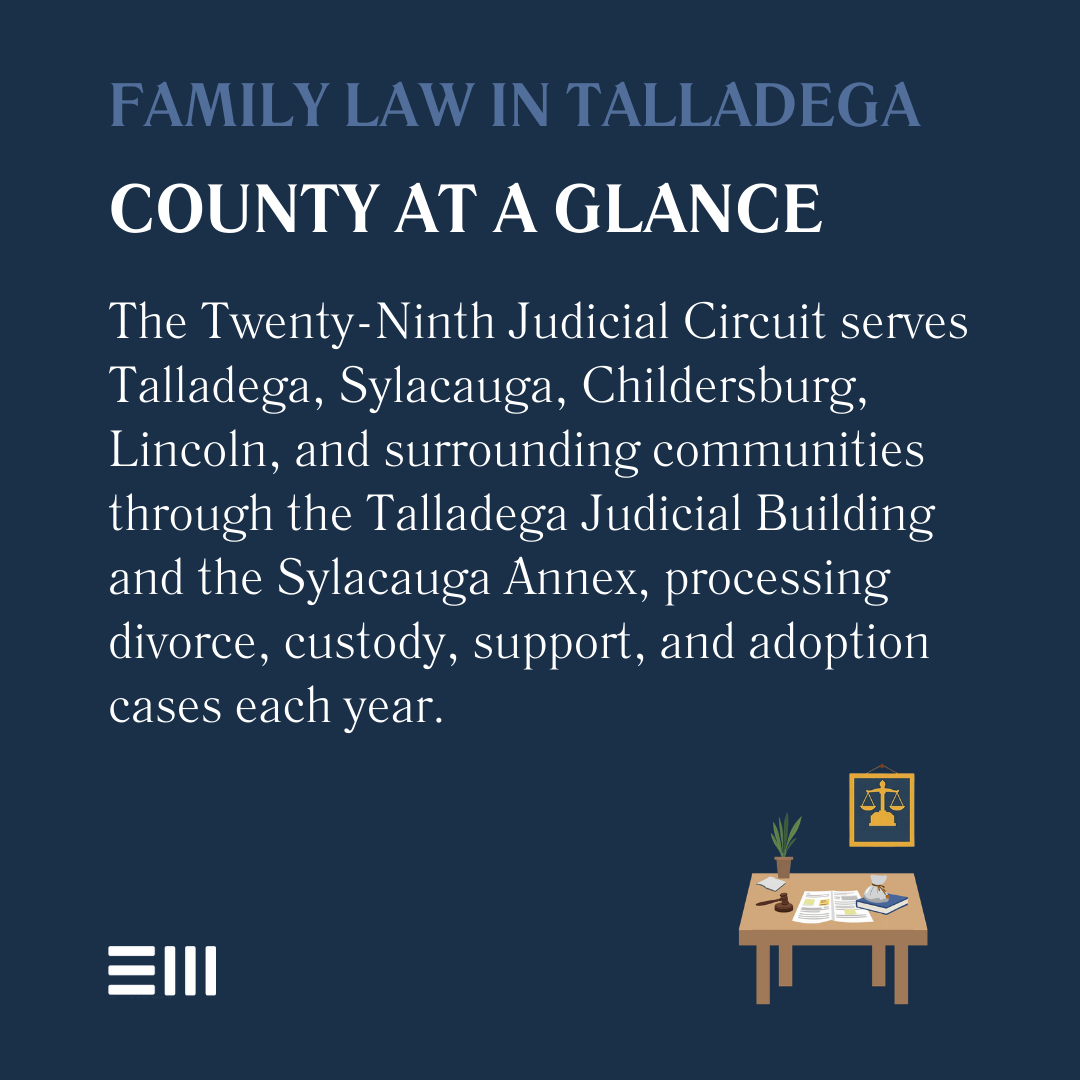
Talladega County sits at the center of that reality. With roughly 81,000 residents spread across the city of Talladega, Sylacauga, Childersburg, Lincoln, and a patchwork of smaller communities, the Twenty-Ninth Judicial Circuit processes a substantial volume of domestic relations cases every year.
The county operates two fully functional courthouses — the Judicial Building on Courthouse Square in Talladega, recognized as the state's oldest courthouse in continuous use, and the Sylacauga Annex in the county's southern division — giving residents access to court services across a wide geographic area.
This page covers the major areas of family law services in Talladega County, from divorce and custody to child support, alimony, adoption, and protective orders.
Every section is written to help you understand Alabama law as it applies to your local jurisdiction so that you can walk into a consultation prepared and informed.
Alabama Statutes and How They Apply in Talladega County
Understanding family law services in Talladega County starts with knowing the state-level rules that control every case filed here.
Alabama's domestic relations statutes are concentrated in two main sections of the Alabama Code. Title 30 addresses marriage, divorce, custody, visitation, child support, and spousal maintenance. Title 26 covers adoption proceedings, termination of parental rights, and child welfare matters.
Alabama recognizes both no-fault and fault-based grounds for divorce. A no-fault filing typically alleges incompatibility or an irretrievable breakdown of the marriage, while fault-based filings may cite adultery, habitual substance abuse, cruelty, or abandonment.
Fault allegations can influence how a Talladega County judge approaches property division and alimony, which makes the choice between the two tracks a strategic decision that should be discussed with an attorney early in the process.
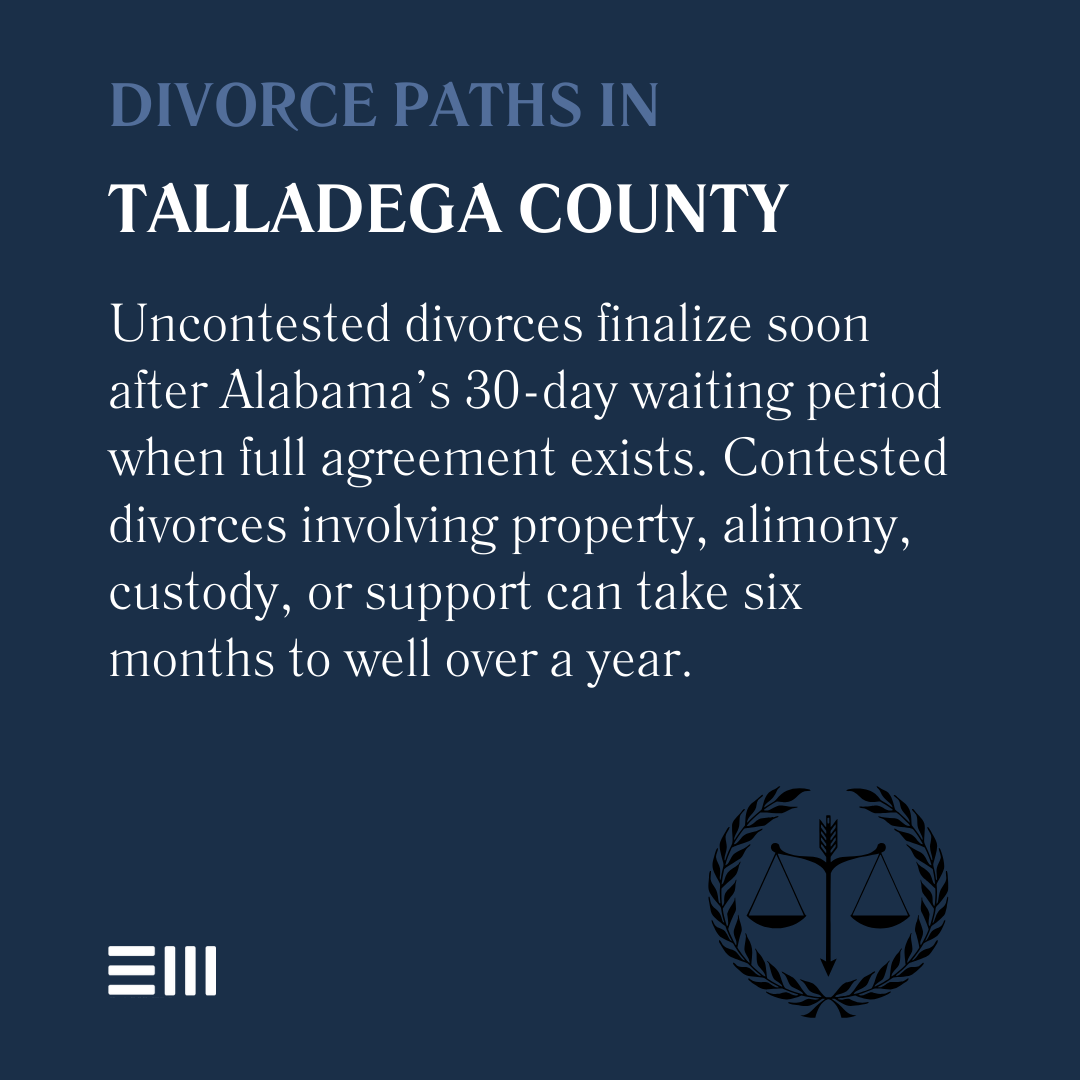
Every divorce filed in Alabama is subject to a mandatory 30-day waiting period between the date of filing and the earliest date a judge can sign a final decree.
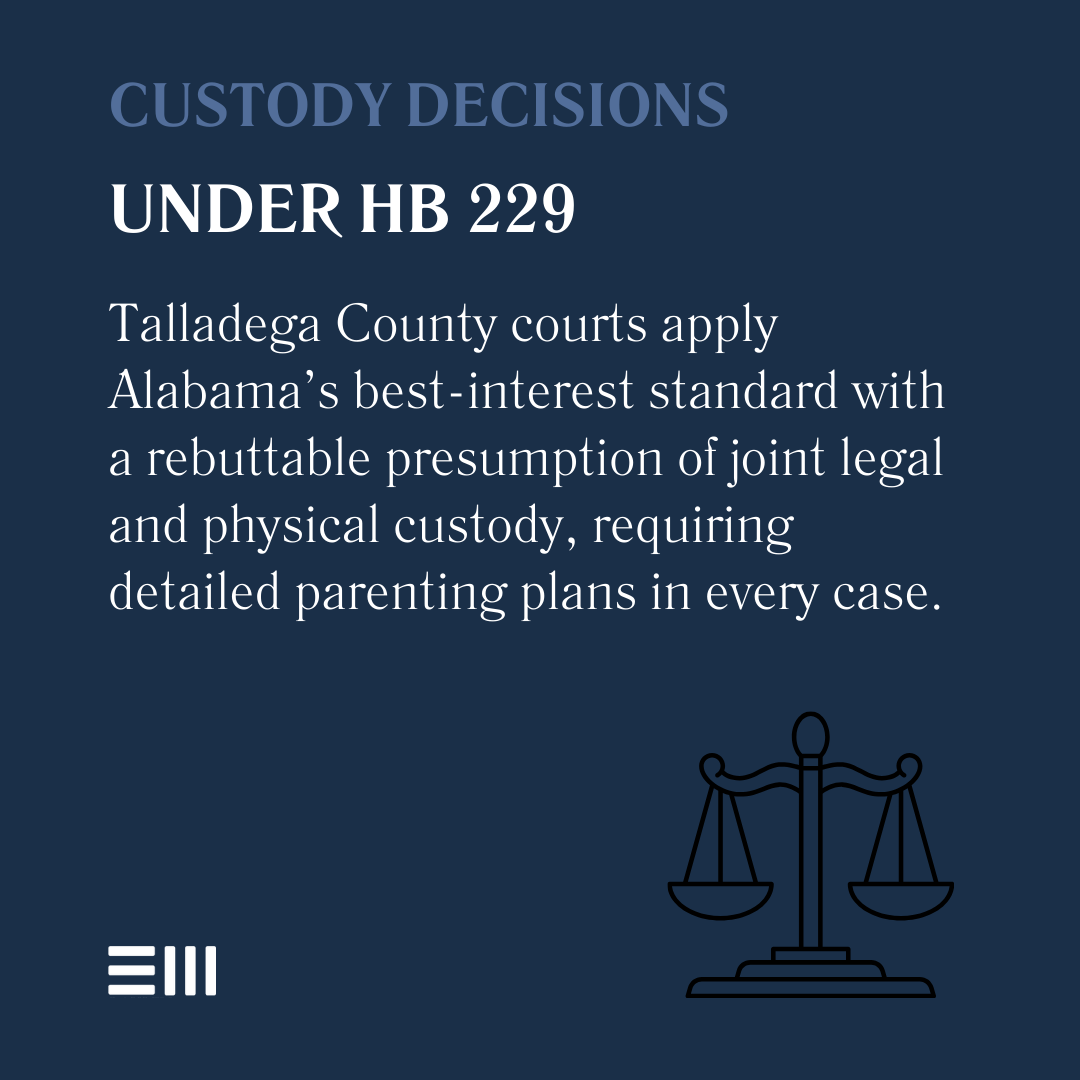
On the custody side, House Bill 229 introduced a rebuttable presumption favoring joint legal and physical custody as of January 1, 2026, fundamentally altering how judges in Talladega County and throughout Alabama evaluate parenting arrangements.
These statutes set the boundaries within which every local case unfolds.
Meet our Family Law Attorneys

Alyssa Enzor Baxley, experienced trial attorney and active community member.

Syndey Merrin focuses her practice on family law matters.

Adam Maniscalco, experienced trial attorney and Deputy Attorney General.
Navigating Divorce in Talladega County
Divorce is the most frequently filed action among family law services in Talladega County, and the process branches in two directions depending on whether the spouses can resolve their differences outside of court.
Knowing which path applies to your situation shapes everything from legal fees to the number of months you will spend in the system.
Reaching Agreement: The Uncontested Route
An uncontested divorce means both spouses agree on every material term before submitting their case to the court.
That agreement must address property and debt division, any spousal support arrangement, and, if minor children are involved, a comprehensive parenting plan covering custody, visitation, and child support.
Because there is no dispute for the judge to resolve, uncontested cases in Talladega County move through the system efficiently.
Once the 30-day cooling-off period passes, the judge reviews the settlement, confirms its terms are reasonable, and enters the final decree. For couples who have worked through their differences before filing, this is typically the fastest and least expensive way to finalize a divorce.
When Agreement Breaks Down: The Contested Route
A contested divorce arises when the spouses cannot agree on at least one significant issue.
The sticking point might involve who retains the marital home, how to value and split a business or retirement account, whether alimony should be part of the final order, or which parent should serve as the primary custodian.
Contested proceedings in Talladega County can include discovery requests, depositions, forensic accounting, property appraisals, and court-ordered mediation. The issues that most commonly drive litigation include:
- Division of real property, retirement assets, and business interests, especially when the couple disputes how to classify or value what they own.
- Alimony disputes, where one spouse argues for ongoing financial support and the other contends it is unwarranted given each party's earning capacity.
- Custody and parenting time, which frequently generate the deepest disagreements and may require the appointment of a guardian ad litem or a professional custody evaluation.
- Child support calculations, particularly when one parent's income is irregular, self-employment makes earnings difficult to verify, or the parties disagree over which expenses should factor into the formula.
Contested divorces in Talladega County regularly take six months to well over a year to resolve, with the most complex cases stretching longer depending on the court's docket and the scope of the contested issues.
Divorce filings in Calhoun County follow one of two general tracks, and which one applies depends on whether the spouses can agree on the terms of their separation.
Understanding the difference early in the process helps set realistic expectations about cost, timeline, and the level of court involvement required.
How Talladega County Courts Handle Custody Determinations
Few areas of family law services in Talladega County carry more emotional weight than custody. A custody order controls where a child lives, who makes decisions about schooling and medical care, and how time is divided between households during holidays and summer breaks.
Alabama law draws a clear distinction between legal custody and physical custody. Legal custody refers to the authority to make major life decisions on a child's behalf.
Physical custody determines the child's primary residence and daily living arrangement. Courts can award either form jointly or to one parent exclusively, and the specific combination depends on the circumstances of each family.
Factors That Shape a Custody Ruling
Talladega County judges rely on Alabama's best-interest standard to decide custody, but the weight given to each factor depends on the evidence the parties present. The considerations that typically matter most include:
- History of day-to-day caregiving, looking at which parent has been primarily responsible for routines like meals, school drop-off, bedtime, and doctor visits.
- Environmental stability for the child, including whether a proposed arrangement would uproot the child from their school, neighborhood, or established social connections.
- Mental and physical well-being of each parent, assessed through testimony, records, and sometimes professional evaluations to determine whether either parent has limitations that affect their caregiving ability.
- Documented abuse, neglect, or substance dependency, which creates a legal presumption against custody for the offending parent and can sharply restrict visitation rights.
- The child's stated preference, which courts give increasing weight to as the child matures, though it is never the sole basis for a ruling at any age.
- Willingness to support co-parenting, measuring whether each parent has shown a genuine commitment to preserving the child's relationship with the other parent or has instead attempted to interfere.
No single factor is decisive. A Talladega County judge considers the full picture, and the party that builds the strongest overall evidentiary record across these categories tends to secure the most favorable outcome.
How HB 229 Reshapes Custody in Talladega County
House Bill 229 represents the most significant change to Alabama custody law in nearly two decades. Effective January 1, 2026, the statute creates a rebuttable presumption that joint legal and physical custody serves a child's best interest.
The law defines "frequent and substantial contact" as equal or approximately equal time spent with each parent.
Under HB 229, every custody filing in Talladega County must now include a detailed parenting plan, regardless of whether the parents are seeking joint or sole custody.
If a judge determines that joint custody is not appropriate in a particular case, the order must include written findings explaining the departure. The parent who opposes shared custody now carries the burden of demonstrating why it would not work.
This shift means fathers and mothers enter custody proceedings on genuinely equal footing, and it puts a premium on thorough preparation and credible evidence from the very start of the case.
Child Support Obligations in Talladega County
Child support is one of the most practical reasons residents seek family law services in Talladega County.
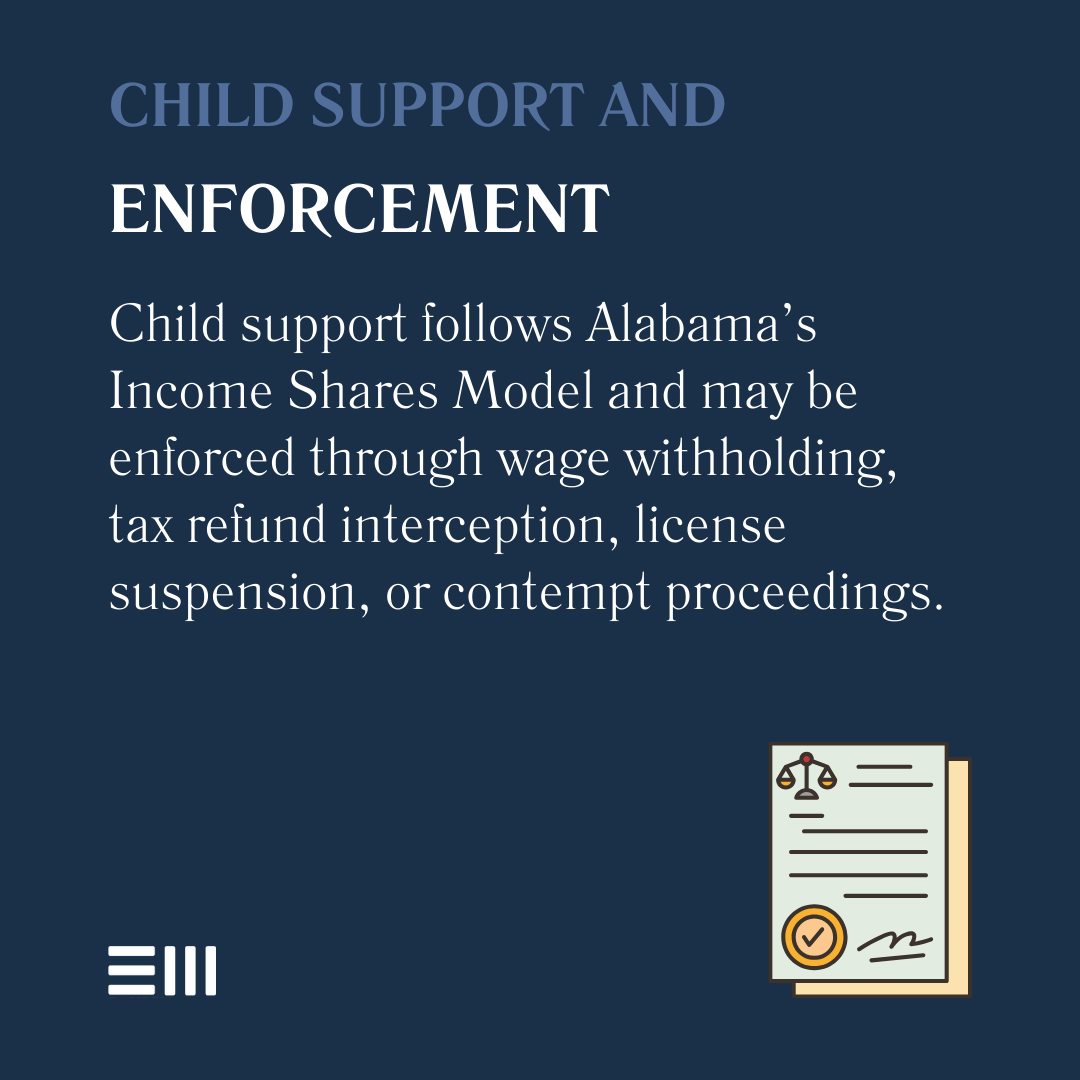
Alabama calculates support using the Income Shares Model, which estimates what both parents would collectively spend on their child if the household were still intact, then divides that obligation based on each parent's proportional share of their combined gross income.
The calculation also accounts for health insurance premiums carried on the child's behalf, work-related childcare costs, and the amount of parenting time each parent exercises.
Talladega County judges follow the state guidelines closely, though they can deviate in unusual circumstances where strict application of the formula would produce an unreasonable result.
Once a child support order is in place, enforcement is handled through the Alabama Department of Human Resources and the Talladega County court system. The state's enforcement mechanisms escalate with the severity of non-compliance:
- Wage withholding orders, which intercept a portion of the paying parent's earnings before they are deposited, ensuring consistent and documented payments.
- Tax refund interception, allowing the state to redirect federal and state refund payments toward unpaid child support arrears.
- License suspensions, covering driver's licenses and professional credentials, which create immediate practical pressure to bring payments current.
- Contempt of court proceedings, the most aggressive enforcement tool, which can lead to fines, structured repayment orders, or incarceration for parents who willfully refuse to meet their obligation.
Child support in Alabama continues until the child reaches 19, the state's age of majority, unless the child is emancipated earlier or has a qualifying disability that extends the obligation.
Either parent can petition for a modification when a material change in circumstances -- such as a significant income shift or a change in custody -- warrants a new calculation.
Alimony and Spousal Support in Talladega County Divorces
Alimony is one of the more unpredictable elements of family law services in Talladega County because Alabama does not use a formula to set it.
Instead, judges exercise broad discretion after weighing the facts of each case, which makes alimony one of the most heavily negotiated terms in any settlement.
Alabama courts consider several factors when deciding whether to award spousal support and, if so, in what amount and for how long:
- Length of the marriage, with longer unions generally producing stronger claims for ongoing support, particularly when one spouse deferred career goals to maintain the household.
- Income and earning capacity of each spouse, including current wages, education, professional skills, work history, and realistic potential for future employment.
- Standard of living during the marriage, which the court uses as a benchmark when assessing how much support is needed to prevent a dramatic economic drop for the lower-earning spouse.
- Homemaking and child-rearing contributions, recognizing years spent outside the workforce raising children or supporting a spouse's career advancement as economically valuable sacrifices.
- Age and health of both parties, particularly when physical limitations or chronic conditions reduce one spouse's ability to become self-supporting after the divorce.
A Talladega County judge may award periodic alimony paid on a monthly schedule, rehabilitative alimony designed to fund education or vocational training so the receiving spouse can achieve financial independence, or a one-time lump-sum payment that resolves the obligation entirely.
In many cases, the final agreement blends more than one type as part of a broader negotiated settlement.
Understanding whether alimony can be denied and under what circumstances is an important part of building realistic expectations before entering negotiations.
Adoption Proceedings in Talladega County
Adoption permanently establishes a legal parent-child relationship and extinguishes the rights of the biological parents. It is a deeply meaningful area of family law services in Talladega County, and Alabama imposes detailed procedural safeguards at every stage to protect the child's welfare.
The type of adoption determines the court that handles the petition and the steps that must be completed before finalization. The adoption categories most commonly pursued in Talladega County include:
- Agency-facilitated adoptions, where a licensed child-placing organization, often working with the foster care system, matches a child with vetted prospective parents and oversees the placement process through finalization.
- Private or independent adoptions, in which the birth parents select the adoptive family on their own, typically with an attorney managing the legal requirements, consent documents, and court filings.
- Stepparent adoptions, among the most frequently filed types, where a spouse formally adopts their partner's child from a prior relationship to create a legally recognized parent-child bond.
- Relative or kinship adoptions, which formalize an existing care arrangement by granting legal parental rights to a grandparent, aunt, uncle, or other family member who has been serving as the child's primary caretaker.
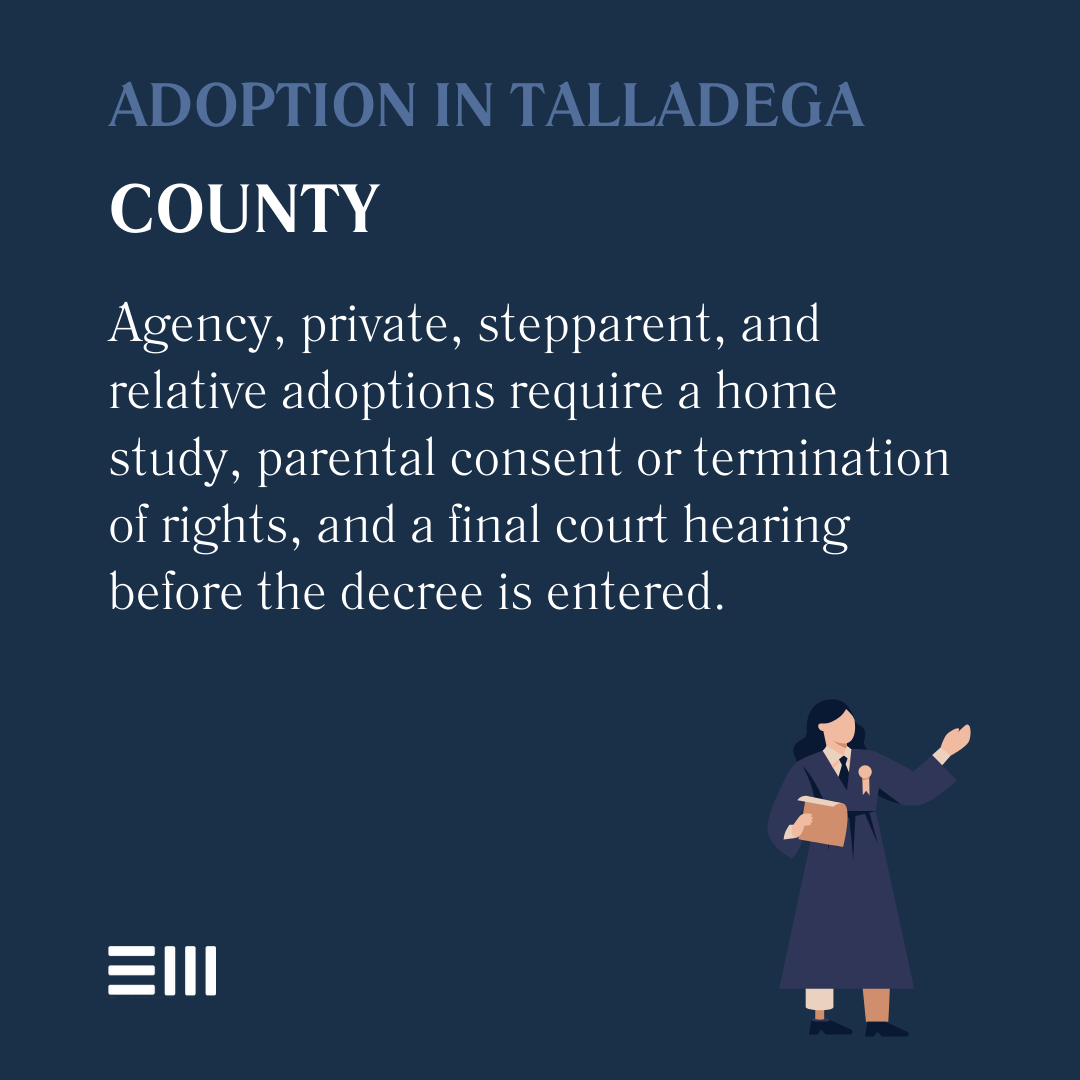
Every adoption filed in Alabama requires a home study, either the voluntary legal consent of the biological parents or a court order terminating their parental rights, and a final hearing where the judge enters the adoption decree.
Depending on the type, the petition may go to the Talladega County Probate Court or the Circuit Court. An experienced adoption attorney can steer the filing to the correct court and prevent procedural missteps that delay finalization.
Domestic Violence and Its Impact on Family Law Cases
Domestic violence is not a separate practice area so much as a thread that runs through many other categories of family law services in Talladega County.
When abuse is alleged or documented, it fundamentally changes how the court handles custody, visitation, property distribution, and the physical safety of the parties involved.
Alabama's Protection from Abuse Act gives victims a direct mechanism to seek emergency relief.
A victim in Talladega County can petition the Circuit Court for a protection order, and if the judge finds evidence of immediate danger, a temporary order can be issued the same day, before the respondent has an opportunity to be heard.
A full evidentiary hearing is then scheduled within 10 days, after which the judge decides whether to enter a final order that can remain in effect for up to 12 months and may be renewed if the threat continues.
In custody disputes, a finding of domestic violence triggers a rebuttable presumption that placing the child with the abusive parent would not serve the child's best interest. The abusive parent carries the burden of rebutting that presumption, which is a steep evidentiary hill.
Alabama law also ensures that a parent who relocated to escape domestic violence cannot be penalized for that decision during custody proceedings.
Because domestic violence evidence can redirect the entire trajectory of a family law case, early documentation and prompt legal action are critical for anyone in Talladega County who is dealing with an abusive situation.
Alternatives to Courtroom Litigation
Not every family dispute requires a trial. Mediation and other forms of alternative dispute resolution offer Talladega County families a chance to reach agreements on their own terms, in a less adversarial setting, with the guidance of a trained neutral facilitator.
In mediation, a neutral third party guides the discussion and helps both sides identify areas of overlap.
The mediator does not take sides or issue rulings. Talladega County Circuit Court judges regularly order mediation in contested divorce and custody cases before setting a trial date, and a significant number of cases settle during or soon after the process. The benefits of a mediated resolution include:
- Reduced legal expenses, because mediation condenses the timeline and eliminates the costs associated with trial preparation, expert witness coordination, and extended courtroom appearances.
- Faster outcomes, since mediation sessions can often be scheduled weeks ahead of a trial date that may be months out on the Talladega County court calendar.
- Tailored agreements, allowing parents and spouses to craft solutions that reflect their family's specific priorities in ways a judge, bound by statutory guidelines, may not be positioned to replicate.
- Preservation of co-parenting communication, because the collaborative structure of mediation tends to keep relationships more intact than the adversarial nature of a courtroom hearing.
Mediation is not appropriate in every case. Situations involving active domestic violence, severe substance abuse, or significant power imbalances between the parties typically require the procedural protections of a formal courtroom proceeding.
For cases where mediation is appropriate, however, the resolution rate is strong enough that most Talladega County judges encourage or require the attempt before trial.
Why Local Experience Matters in Talladega County
Alabama family law applies uniformly across all 67 counties, but the practical experience of navigating a case varies from one courthouse to the next.
Each county has its own bench of judges with individual preferences, its own scheduling patterns, its own roster of mediators and guardians ad litem, and its own unwritten expectations for how cases should be presented.
When evaluating providers of family law services in Talladega County, the attorney's familiarity with the local system matters.
An attorney who practices regularly in the Twenty-Ninth Circuit knows how the Talladega and Sylacauga divisions operate, understands the tendencies of the judges who hear domestic relations cases here, and has working relationships with the clerks, court reporters, and DHR case managers who play a role in every filing.
That kind of rooted, day-in-and-day-out experience translates into more accurate case assessments, sharper preparation, and fewer procedural surprises for the people who depend on their attorney to guide them through one of the most consequential periods of their lives.
Frequently Asked Questions About Family Law Services in Talladega County
Talladega County residents considering family law representation tend to raise the same set of questions early in the process. The answers below offer a solid starting framework, though every case involves facts that may change the analysis.
How Long Does a Divorce Take to Finalize in Talladega County?
Alabama requires a minimum 30-day waiting period between filing and finalization. An uncontested divorce with complete paperwork can close shortly after that window expires.
Contested cases take considerably longer. Depending on the disputed issues, the need for discovery, and the court's scheduling availability, a contested divorce in Talladega County may take anywhere from six months to over a year.
What Is the Difference between Legal Custody and Physical Custody?
Legal custody grants the right to make major decisions about the child's education, healthcare, religious upbringing, and extracurricular activities. Physical custody determines where the child lives on a day-to-day basis.
Alabama courts can award sole or joint versions of either type independently, meaning one parent can have primary physical custody while both parents share legal custody.
Can a Child Support Order Be Modified after It Is Entered?
Yes, but only if a material change in circumstances has occurred since the last order. Common qualifying changes include a significant increase or decrease in either parent's income, a shift in the custody arrangement, or new expenses related to the child's health or education.
The parent seeking the change files a petition with the Talladega County Circuit Court and carries the burden of proving the modification is warranted.
Does Alabama Favor Mothers over Fathers in Custody Cases?
No. Alabama's custody statutes are gender-neutral. Both parents are evaluated using the same best-interest factors, and fathers have identical legal standing to mothers at every stage of the proceedings.
HB 229 reinforces this by presuming that both parents should share custody equally from the outset. The parent best positioned to demonstrate fitness, stability, and a willingness to cooperate with the other parent holds the advantage.
What Happens if My Spouse Refuses to Participate in the Divorce?
One spouse cannot prevent a divorce in Alabama. If the non-filing spouse has been properly served and does not respond within the required timeframe, the court can enter a default judgment on the filing spouse's terms.
If the non-filing spouse responds but refuses to negotiate, the case proceeds as a contested matter through discovery, mediation, and trial if necessary.
How Does Alabama Divide Marital Property?
Alabama follows equitable distribution principles. The court divides marital property in a manner it considers fair, which does not necessarily mean a 50-50 split. Judges weigh the marriage's duration, each spouse's contributions (financial and otherwise), and each party's economic outlook after the divorce.
Property owned before the marriage, along with gifts and inheritances received by one spouse individually, is typically classified as separate property and excluded from division unless it has been commingled with marital funds.
Do I Need to Live in Talladega County to File for Divorce Here?
At least one spouse must have been a resident of Alabama for a minimum of six months before filing. The case is then filed in the county where the defendant resides, where the couple last lived together, or where the plaintiff resides if the defendant is out of state.
If those criteria point to Talladega County, the filing is submitted to the Circuit Clerk's office in Talladega or the Sylacauga division.
Can Grandparents Request Visitation Rights in Alabama?
Alabama permits grandparents to petition for visitation, but the standard is demanding. The grandparent must demonstrate that visitation serves the child's best interest and that the parent has unreasonably denied contact.
Because federal constitutional protections give parents broad authority over who spends time with their children, Talladega County judges evaluate these petitions with a high level of scrutiny.
Concrete evidence of a strong existing bond and documented harm from the denial of access strengthens the case considerably.
What Should I Budget for Family Law Representation?
Costs depend heavily on case complexity. A straightforward uncontested divorce costs a fraction of what a contested custody battle with expert witnesses and multiple hearing dates will require.
Most family law attorneys bill hourly or charge flat fees for specific services. The most reliable way to get an estimate is to schedule a consultation, bring your financial documents and any relevant court orders, and have an honest conversation about the scope of your case.
These frequently asked questions about family law services in Talladega County offer general guidance. The facts of your individual case may raise additional issues that require a detailed analysis with a qualified attorney.
Protect What Matters. Schedule Your Talladega County Consultation Today
Our experienced family law attorneys here at Baxley Maniscalco have built their practice on the kind of hands-on courtroom work and local knowledge that Talladega County families depend on when the stakes are highest.
We take a team-based approach to every case. That means you always have someone available to take your call, respond to an urgent development, or walk you through the next step in your case.
Our attorneys also serve as deputy attorneys general enforcing child support in Calhoun and Cleburne counties, giving us a working understanding of the enforcement system that few private firms can offer.
Whether you are facing a contested divorce, pursuing a custody modification under HB 229, finalizing a stepparent adoption, or seeking protection from domestic violence, we bring aggressive advocacy paired with genuine familiarity with how cases move through the Talladega County courts.
Contact us today to schedule a confidential consultation. We meet with clients in person at our Oxford, Alabama office, by phone, or by video—whichever option works best for your schedule.