
More than 40% of Alabama children reside in single-parent households, a figure that exceeds the national rate of 35%, according to data from the National Center for Family & Marriage Research.
Behind each of these statistics is a family working through the legal and emotional complexities of divorce, custody arrangements, or support disputes.
In Tallapoosa County—home to over 41,000 residents across Alexander City, Dadeville, and the scenic Lake Martin region—these family transitions require skilled legal guidance to protect parents' rights and children's well-being.
Our experienced family law attorneys here at Baxley Maniscalco bring deep knowledge of Alabama domestic relations law to every case we handle in Tallapoosa County. The county operates courthouses in both Dadeville and Alexander City, and we regularly appear before the judges in this jurisdiction.
We understand that family law disputes involve far more than legal technicalities—they touch on your most fundamental relationships and your vision for your future.
When you need a Tallapoosa County family law attorney who will fight for your interests while helping you navigate an emotionally difficult process, our team is prepared to stand with you.
Meet our Family Law Attorneys

Alyssa Enzor Baxley, experienced trial attorney and active community member.

Syndey Merrin focuses her practice on family law matters.

Adam Maniscalco, experienced trial attorney and Deputy Attorney General.
Legal Services for Tallapoosa County Families
Domestic relations cases touch on nearly every aspect of family life, from finances and living arrangements to parenting time and decision-making authority. Our firm assists Tallapoosa County residents with the full spectrum of family law concerns.
- Divorce representation. We guide clients through contested and uncontested dissolutions, handling property division, debt allocation, and related financial matters. Cases are filed through the Tallapoosa County Circuit Court, with facilities available at 125 North Broadnax Street in Dadeville and 1 Court Square in Alexander City.
- Custody and visitation. Alabama courts prioritize joint custody arrangements whenever feasible, examining each parent's ability to provide a stable, nurturing environment. We advocate for parenting plans that serve your child's developmental needs.
- Child support matters. State guidelines under Rule 32 govern support calculations based on parental income and custody time. We help clients understand their obligations or entitlements under these formulas. Learn more about how child support is calculated in Alabama.
- Alimony and spousal maintenance. Courts may order temporary, rehabilitative, or long-term support depending on marriage length, earning disparities, and other statutory factors.
- Order modifications. Changed circumstances—job loss, relocation, health issues—may warrant adjustments to existing custody or support orders. Alabama's McLendon standard sets the bar for custody changes.
- Paternity actions. Establishing legal fatherhood through the Tallapoosa County District Court creates the foundation for custody rights and support obligations for unmarried parents.
- Domestic violence protection. When safety is at risk, we help clients obtain protective orders that establish boundaries and temporary custody provisions.
No two families face identical circumstances, which is why personalized legal counsel matters. A Tallapoosa County family law attorney from our firm will evaluate your situation and develop a strategy tailored to your objectives.
Custody Determinations in Alabama Courts
Disputes over children generate more conflict than any other aspect of family law proceedings. Parents who managed to cooperate during marriage often find themselves at odds when negotiating custody terms, each convinced they know what their child truly needs.
Alabama judges resolve these disputes by applying the "best interests of the child" test—a flexible standard that considers the totality of circumstances affecting the child's welfare rather than defaulting to rigid formulas.
State law draws an important distinction between physical and legal custody. Physical custody addresses where the child lives and who provides daily care.
Legal custody concerns authority over significant life decisions—schooling, medical treatment, religious upbringing, and participation in activities. Courts can award either form of custody solely to one parent or jointly to both, creating various possible combinations based on family dynamics.
Under Alabama Code Title 30, Chapter 2-11, legislators have declared a preference for arrangements that preserve meaningful relationships between children and both parents.
This policy favoring joint custody does not mandate equal time-sharing, but it does mean judges will carefully consider whether shared arrangements can work before awarding sole custody to either parent.
What factors influence custody outcomes? According to Alabama family law provisions, courts look at the emotional bonds between parent and child, each parent's home environment, work schedules and availability, physical and mental health, and track record of involvement in the child's life.
Judges also weigh each parent's demonstrated willingness to encourage the child's relationship with the other parent.
Teenagers aged 14 and above may voice their own preferences, though the court retains discretion over how much weight to assign those wishes.
For more information, read our blog on at what age a child can decide custody in Alabama.
Ending a Marriage in Tallapoosa County
Dissolving a marriage involves untangling shared lives, finances, and often parenting responsibilities. Alabama law establishes specific procedures and requirements that govern how divorces proceed through the court system.
Before filing, one spouse must demonstrate Alabama residency for at least six consecutive months. Petitions go to the Tallapoosa County Circuit Court, which sits within Alabama's 5th Judicial Circuit alongside Chambers, Macon, and Randolph counties.
Once filed, the non-filing spouse must receive proper legal notice before the case can advance.
Grounds for divorce fall into two categories. No-fault grounds—incompatibility or irretrievable breakdown—allow couples to end their marriage without proving wrongdoing.
Fault-based grounds require evidence of specific misconduct: adultery, abandonment, imprisonment, violence, or substance addiction.
Pursuing fault grounds may influence alimony awards but typically extends litigation timelines and intensifies conflict.
For a detailed walkthrough, see our guide on how to file for divorce in Alabama.
Alabama divides marital assets according to equitable distribution principles. Rather than automatically splitting everything down the middle, judges assess what constitutes a fair allocation based on each spouse's contributions, the marriage's duration, future earning prospects, and other relevant considerations.
Assets acquired before the wedding or received as individual gifts or inheritances generally remain with their original owner, though tracing separate property through years of marriage can prove challenging.
When spouses reach consensus on all outstanding issues, an uncontested divorce may conclude within weeks of filing.
Contested cases requiring judicial intervention on property, custody, or support disputes can extend for many months or even longer when complex assets or contentious custody battles are involved.
Many couples find that mediation or collaborative divorce processes help them reach resolution more efficiently than traditional litigation, though these approaches require both parties to engage in good faith.
Spousal Support Under Alabama Law
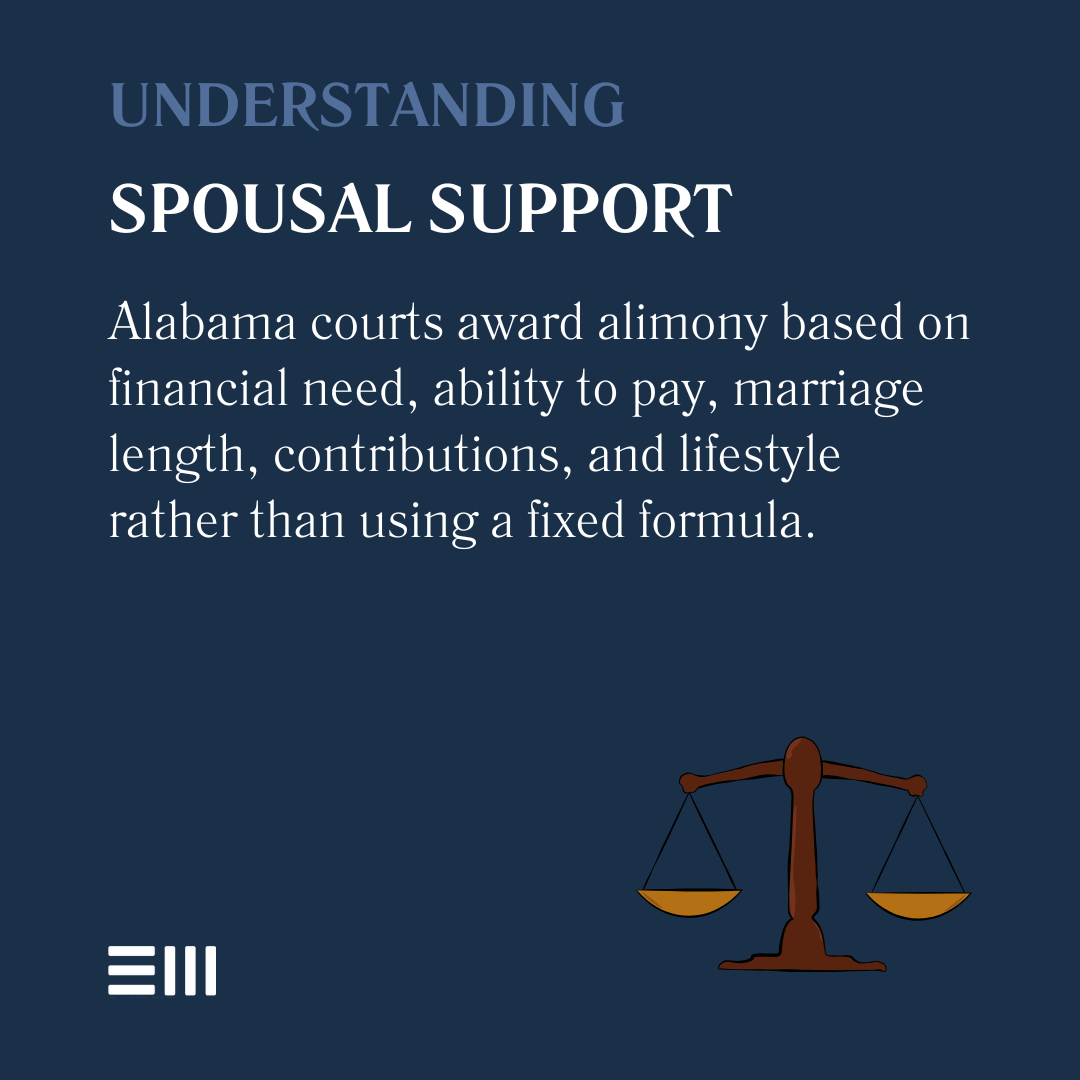
Alimony remains one of the least predictable aspects of Alabama divorce, as no statutory formula dictates awards. Judges exercise broad discretion in determining whether support is warranted and structuring any award to fit the circumstances.
Alabama recognizes distinct categories of spousal maintenance, as outlined in Alabama alimony statutes:
- Pendente lite support. Temporary payments during the divorce litigation period help the financially disadvantaged spouse maintain stability until final orders issue.
- Rehabilitative support. Time-limited payments, generally capped at five years, assist a spouse in obtaining education or training to achieve self-sufficiency after years away from the workforce.
- Periodic support. Ongoing monthly payments may extend for years or even decades in long marriages where one spouse sacrificed career advancement to support the household.
- Lump-sum support. A single payment or defined series of payments—sometimes called alimony in gross—provides a clean break and cannot be modified once ordered.
Factors shaping alimony decisions include how long the marriage lasted, the lifestyle the couple maintained, each spouse's health and employability, sacrifices one spouse made to support the other's career or education, and any marital misconduct.
Marriages under ten years rarely result in extended support, while unions exceeding twenty years create stronger presumptions favoring ongoing maintenance.
For a comprehensive overview, explore our guide to understanding Alabama alimony laws. Your Tallapoosa County family law attorney can assess how these variables apply to your marriage and advocate for an appropriate outcome.
Changing Existing Court Orders
Family circumstances evolve after divorce decrees and custody orders become final. A parent may receive a job offer requiring relocation.
Income levels may rise or fall significantly. Children's needs change as they grow. Alabama provides legal avenues for modifying orders when current arrangements no longer fit reality.
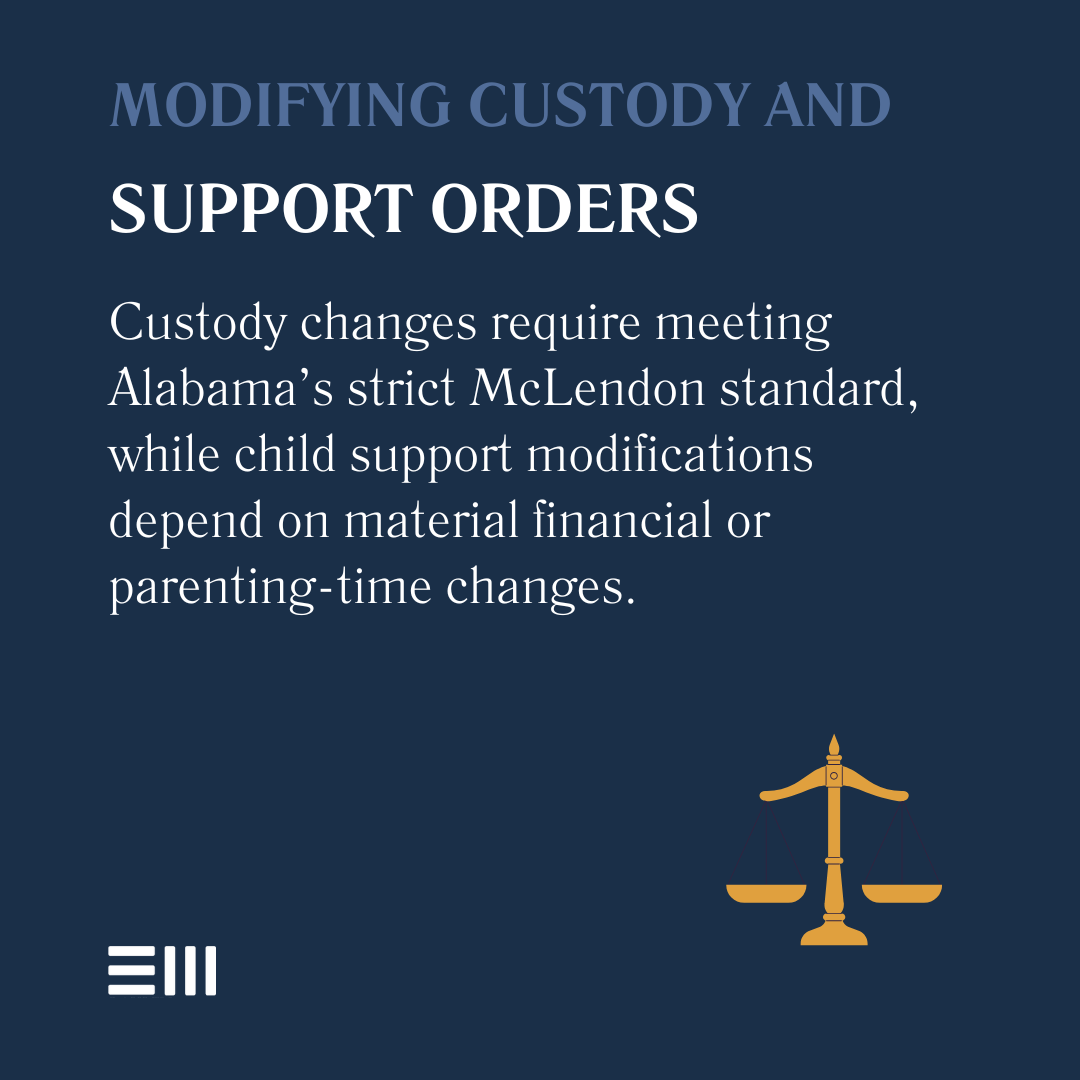
Custody modifications face the strictest scrutiny under Alabama's McLendon standard, established by the state Supreme Court in 1984.
Courts demand proof of three elements: a substantial change in circumstances since the current order, clear benefit to the child from modifying custody, and evidence that those benefits justify the inherent disruption of altering established arrangements.
This demanding test reflects judicial recognition that stability generally serves children's interests.
What qualifies as grounds for revisiting custody?
Situations that frequently support modification petitions include one parent's proposed move to a distant location, documented substance abuse or domestic violence concerns, repeated violations of the existing parenting plan, major shifts in a parent's availability due to work or health changes, and emerging special needs that one parent is better positioned to address.
Child support modifications operate under different rules.
Either parent may seek adjustment upon demonstrating that material circumstances have changed since the existing order—typically involving significant income fluctuations, altered custody schedules, or changes in the child's healthcare or educational expenses.
Courts recalculate obligations using current income figures and the same Rule 32 guidelines applied initially.
Unlike custody modifications, support changes focus primarily on financial factors rather than on weighing disruption to the child's living arrangements.
Stay informed about new Alabama child support laws that may affect your case.
Answers to Common Client Questions
Prospective clients throughout Tallapoosa County raise similar concerns during initial consultations.
Below, we address several questions that arise frequently in discussions with residents from Alexander City, Dadeville, and neighboring communities.
Where Do I File for Divorce in Tallapoosa County?
Tallapoosa County operates two courthouse locations. The primary Circuit Court sits in Dadeville at 125 North Broadnax Street, while an annex in Alexander City at 1 Court Square also processes family court matters.
Your attorney can advise which venue is appropriate and handle filing logistics on your behalf.
How Does Alabama Calculate Child Support Amounts?
Rule 32 guidelines establish support amounts based on combined parental income, number of children, healthcare costs, childcare expenses, and the custody schedule.
Worksheets produce a presumptive support figure, though courts may deviate from guidelines when circumstances warrant. Support obligations generally run until the child turns 19.
Read more about the Alabama child support age limit and when obligations may extend or terminate early.
What Must I Prove to Modify Custody?
Alabama's McLendon standard requires demonstrating three things: circumstances have materially changed since the last order, the proposed change would significantly benefit the child, and those benefits outweigh disruption caused by altering the status quo.
Meeting this burden requires compelling evidence and strategic presentation.
Will Adultery Affect My Divorce Outcome?
Marital infidelity may influence alimony determinations and occasionally property division. However, pursuing fault-based allegations extends litigation, increases expenses, and escalates conflict.
Many clients find that no-fault proceedings better serve their overall interests despite feelings of betrayal. Your attorney can help you weigh these considerations.
How Are Retirement Accounts Divided?
Retirement assets accumulated during marriage typically constitute marital property subject to equitable division.
Dividing pensions and 401(k) accounts often requires specialized court orders called Qualified Domestic Relations Orders (QDROs). Proper handling prevents tax penalties and ensures both spouses receive their entitled share.
Can I Relocate with My Children after Divorce?
Alabama imposes notice requirements on custodial parents planning to move with minor children.
Non-relocating parents may object and seek court intervention to prevent the move or modify custody. Relocation disputes involve complex legal analysis and frequently require litigation to resolve.
Work with an Advocate Who Understands Tallapoosa Courts
The decisions made during divorce and custody proceedings shape your family's trajectory for years ahead.
Attempting to handle these weighty matters without experienced counsel puts you at a significant disadvantage, particularly when the other party has legal representation.
Our experienced family law attorneys here at Baxley Maniscalco have built our practice on providing Tallapoosa County residents with skilled, attentive advocacy through every phase of their cases.
We recognize that each client's priorities differ. Some seek to maximize parenting time; others focus on financial security or simply want the process concluded as quickly as possible.
Whatever your goals, our role is to help you understand the legal landscape, develop realistic expectations, and pursue the most favorable resolution available under the circumstances.
Reach out to Baxley Maniscalco now to arrange a consultation with a Tallapoosa County family law attorney. Let us put our knowledge of Alabama domestic relations law to work protecting what matters most to you.