

Your divorce order says you can claim your child on this year’s taxes. You send it to your tax preparer, expecting that sentence to settle the question.
Then you’re asked for a signature from your former spouse, a record of overnight stays, or a form you’ve never seen. The order matters, but the filing requirements matter, too.
A tax provision can create obligations between parents without satisfying every federal requirement for a return. That gap can turn an agreed parenting arrangement into a dispute over a refund.
We help parents address these practical details in their Alabama divorce agreements and resolve questions involving child support obligations.
The starting point is identifying which tax benefit is at issue, what the order requires, and whether the necessary paperwork exists.
Need help with a tax provision in your divorce order? Contact us to discuss your family-law matter or call (256) 770-7232.
“Claiming the Child” Isn’t One Single Tax Benefit
Parents often use that phrase to mean the child tax credit, head-of-household filing status, or an earned income tax credit. Those benefits have different eligibility rules.
Under the IRS’s rules for divorced and separated parents, a qualifying release can allow certain child-related benefits to go to the noncustodial parent.
It doesn’t transfer every benefit associated with the child. A parent can be entitled to one benefit while the other parent remains eligible for a different one.
That distinction should be clear before anyone agrees to alternate “all deductions” or promises a specific refund. Income, the child’s age, and other eligibility requirements still matter.
The IRS Looks at the Child’s Actual Living Arrangement
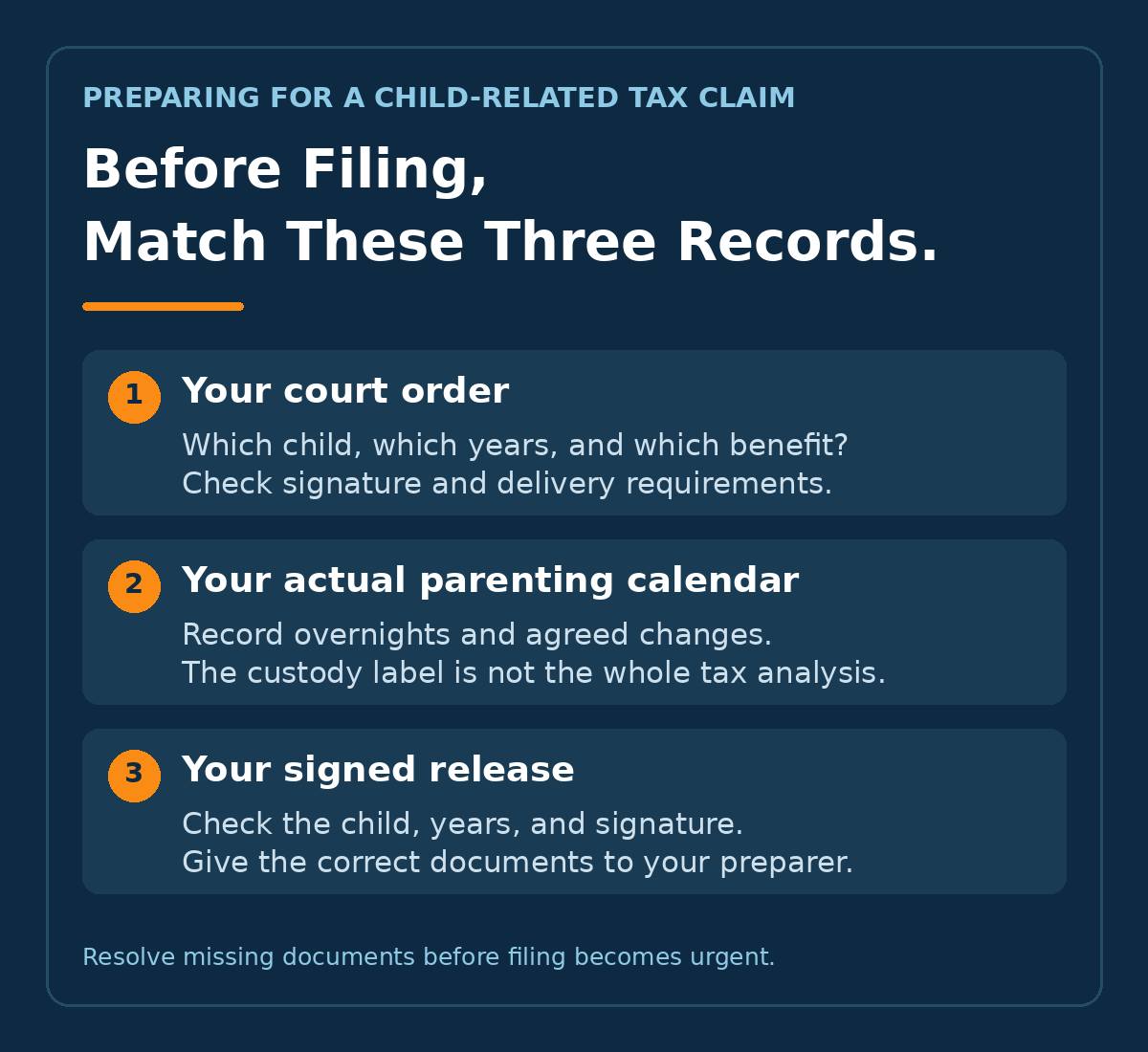
For this federal tax rule, the custodial parent is generally the parent with whom the child spent more nights during the year. A state custody label doesn’t replace that inquiry.
The IRS explains in its earned income tax credit guidance that equal nights generally make the parent with the higher adjusted gross income the custodial parent.
Special rules can affect how nights are counted. Don’t guess about temporary absences, unusual work schedules, or a midyear change in where the child lived.
Keep an actual calendar, including agreed schedule changes. A parenting plan shows the intended arrangement; it may not prove which arrangement occurred.
Tax analysis also shouldn’t drive unauthorized changes to parenting time. Follow the custody order and address disputes through the appropriate legal process.
When Form 8332 Becomes Important
IRS Form 8332 documents a custodial parent’s release of a claim for the specified child and year or years. It also provides a way to revoke an earlier release.
The special rule has eligibility conditions beyond a signature. These include requirements concerning the parents’ separation, the child’s custody, and support provided by the parents.
Your tax professional should confirm that the rule applies before relying on the form. Signing it doesn’t independently establish eligibility for a credit.
For a decree or agreement effective after 2008, IRS Publication 501 says the noncustodial parent can’t substitute decree pages for the required release.
The parent generally needs Form 8332 or a qualifying statement with the required information and must attach it to the return. Giving the decree to a preparer isn’t the same step.
A valid release must be unconditional for federal tax purposes. A statement saying the release applies only if support is paid doesn’t satisfy that requirement.
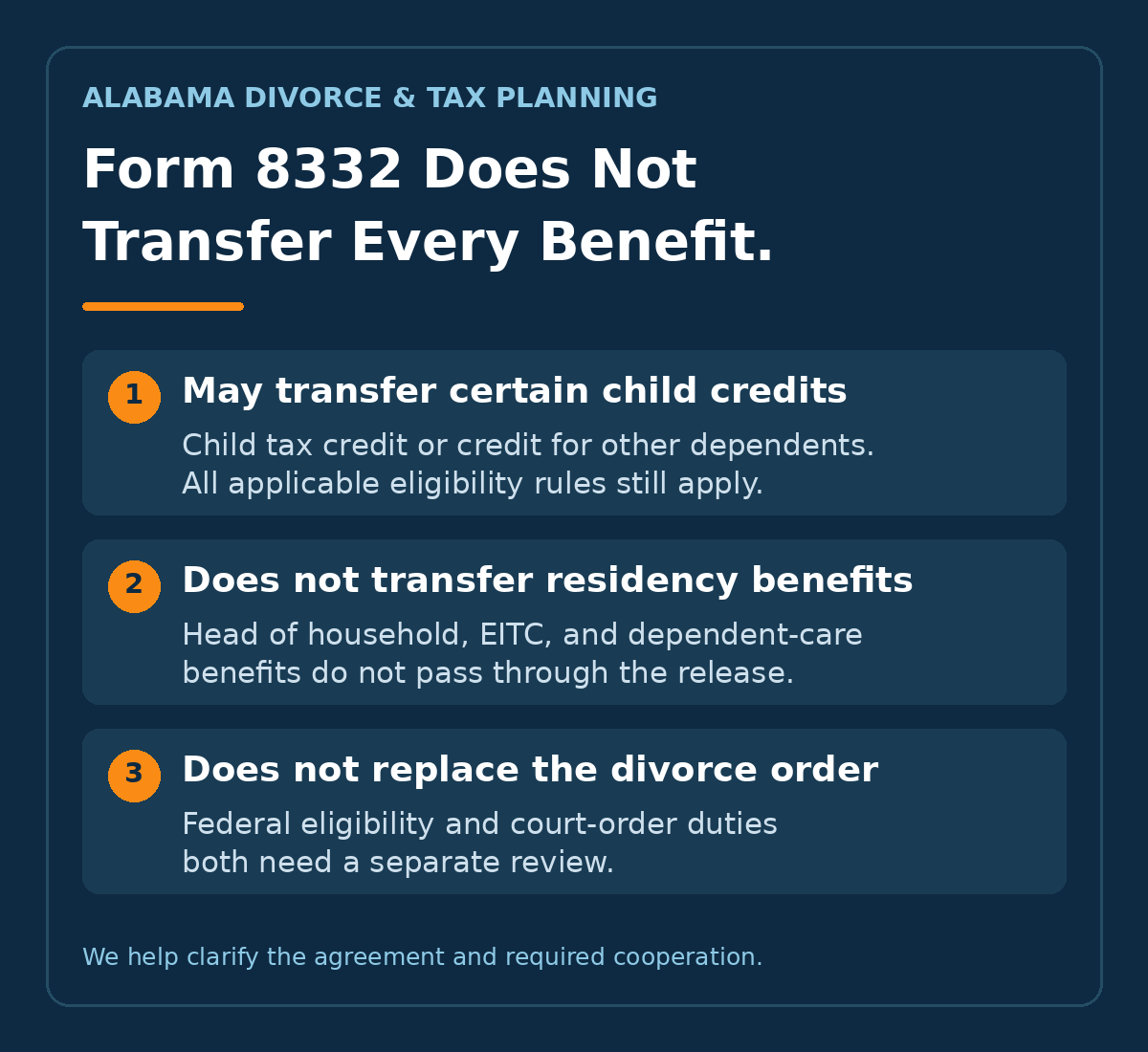
What the Release Transfers, and What It Doesn’t
The IRS’s dependent-claim FAQ separates benefits available through the release from benefits that remain subject to residency and other rules.
- Potentially available through a qualifying release: Claiming the child as a dependent for the child tax credit or credit for other dependents, subject to the applicable requirements.
- Not transferred by the release: Head-of-household filing status, the earned income tax credit, the child and dependent care credit, or the exclusion for dependent care benefits.
- Still requiring individual review: Income limits, the child’s age, identification requirements, qualifying expenses, and other conditions for each benefit.
Suppose a child spends more nights with one parent, but the divorce agreement allocates the child-related credit to the other parent for that year.
If the special rule applies and the release is properly completed, that allocation may be implemented. It doesn’t automatically give the receiving parent head-of-household status or the earned income tax credit.
This example is why we recommend identifying each benefit precisely instead of relying on the phrase “claim the child.”
Your Alabama Order Still Needs to Be Followed
Federal filing requirements don’t make the divorce order irrelevant. A parent’s obligation to provide a release and the IRS’s requirements for accepting a claim are separate questions.
In Flanagan v. Flanagan, the Alabama Court of Civil Appeals recognized trial-court discretion over allocating the dependency exemption, subject to the child-support guidelines’ requirements.
That older decision addresses the family court’s allocation authority. It isn’t a substitute for current IRS forms or today’s rules governing particular credits.
If your order requires a signature and the other parent refuses, keep the written request and response. We can review whether clarification or enforcement is appropriate.
Don’t sign for the other parent, alter an old form, or assume that an unsigned decree will satisfy the IRS. Don’t withhold child support as a way to force cooperation.
Where an agreement links the allocation to timely support, the drafting needs particular care. We can address the parents’ obligations while your tax professional confirms the federal release requirements.
A Better Agreement Names the Paperwork and the Deadline
An alternating-year provision can leave practical questions unanswered. We work to resolve those questions while negotiating the agreement, before a filing deadline creates pressure.
Useful details include:
- The child and the years: Identify each child and specify the allocated tax years, especially when siblings follow different arrangements.
- The required cooperation: Identify the release or other documents to be provided and a clear delivery deadline.
- The scope of the allocation: Distinguish the intended child-related credit from benefits that can’t be transferred through Form 8332.
- Changed circumstances: Address how parents will communicate about custody changes, eligibility concerns, and information needed by their tax professionals.
- A dispute process: Explain how missed deadlines or conflicting interpretations will be addressed without turning the child into the messenger.
Keep copies of signed documents and proof of delivery. Send sensitive tax records through an appropriate secure channel rather than a public message thread.
A Multi-Year Release Deserves a Careful Review
Don’t sign for “all future years” simply because that option is available. Compare the requested years with the order and discuss the consequences before signing.
The Form 8332 instructions describe advance-notice requirements for revocation. A revocation generally can’t take effect before the tax year after notice is provided or reasonably attempted.
For example, notice first provided in 2026 generally can’t make the revocation effective for 2026; 2027 is the earliest possible year under that timing rule.
Meeting federal revocation requirements doesn’t answer whether revoking the release would violate your divorce order. Have both issues reviewed before taking action.
If the Other Parent Already Claimed the Child
A rejected electronic return doesn’t establish who was legally entitled to the benefit. Filing first isn’t a rule that awards the claim to the faster parent.
Start by checking the child’s identifying information, the actual living arrangement, any signed releases, and the divorce order with your tax professional.
The IRS’s current duplicate-dependent filing guidance allows eligible returns to be e-filed with the primary taxpayer’s valid IP PIN, even after another return claimed the dependent.
That process applies beginning with 2024 tax returns. An IP PIN helps with filing authentication; it doesn’t decide the underlying entitlement dispute.
If that option isn’t available, a paper return may be necessary. Follow the IRS instructions for a duplicate-dependent rejection and respond to any later request for records.
We can separately review whether a parent’s conduct violated the family-court order. A tax professional can handle the return and advise on any IRS correspondence.
Frequently Asked Questions
Does paying more child support give me the right to claim the child?
Not by itself. Paying support doesn’t replace the federal residency rules, a required release, or the other tests for a particular tax benefit.
Bring both the support order and any tax-allocation provision to your attorney and tax preparer so they can evaluate the complete arrangement.
Can we each claim the child for half of the year?
You can’t divide a dependent claim into two half-year claims. However, the special rules can allow different qualifying benefits to be claimed by different parents.
The answer depends on the specific benefit and each parent’s eligibility, rather than a simple percentage of parenting time.
Does joint physical custody mean we automatically alternate tax years?
No. Joint custody doesn’t create an automatic alternating-year federal tax rule. Review actual overnights, any applicable tie-breaker rule, the order, and the required paperwork.
Do I have to provide the release every year?
A release can cover specified future years, so a new signature isn’t necessarily required annually. The noncustodial parent must still attach the required release for each year it is used.
Keep an accessible copy and check that the year you’re claiming is actually covered.
Can I revoke a release because my ex missed a payment?
Don’t assume a missed payment makes a signed release disappear. Federal revocation timing and the terms of your court order both need review.
We can discuss enforcement of the support obligation without treating an inaccurate tax filing as a remedy.
Should the tax preparer or the divorce attorney handle the disagreement?
Often, both have a role. Your tax professional evaluates return eligibility and filing requirements; we interpret the family-court order and address compliance or enforcement.
Sharing the same records with both helps prevent advice based on an incomplete picture.
Let’s Make the Tax Provision Work in Practice
An agreement should do more than name a parent and a year. It should give both parents a workable way to exchange the required documents and address disagreements.
We can review your existing order or help draft clearer terms in a new agreement. Bring the decree, parenting calendar, prior releases, and any relevant correspondence.
Contact us to discuss your Alabama family-law matter or call (256) 770-7232.
Can't find what you're looking for? Search our site below.